Most Affordable Master's in Special Education Programs
Compare 830+ accredited most affordable Special Education programs at 540+ schools, with graduate earnings, cost, debt, and completion data from IPEDS and the U.S. College Scorecard.
Special education keeps appearing on state teacher shortage lists, pulling more working teachers toward low-cost master's degrees. Advertised per-credit rates rarely match the final bill once term fees and unpaid student teaching are counted.
For the schools in this ranking, average annual net price after grants runs from $2,984 at CUNY Hunter College to $9,403 at The University of Texas at El Paso. Those are averages, not quotes.
Price is only half the test. A degree that lacks your state's initial certification can cost more than a pricier program that delivers it. UTEP's M.Ed., for instance, does not include a teaching credential, so candidates without a license must pair it with a separate certification route.
Key Points
- These rankings prioritize net price after grants over sticker tuition.
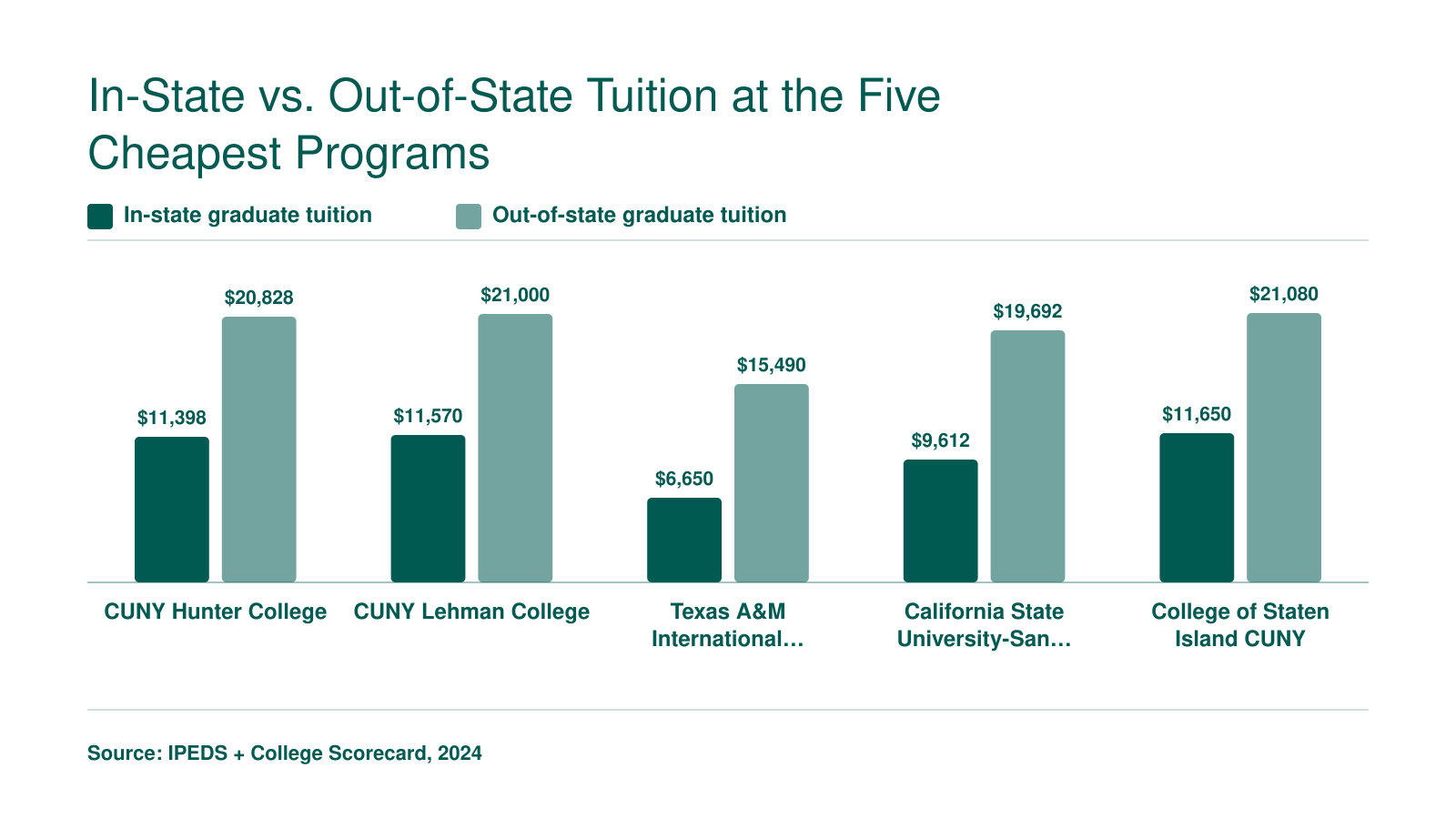
- Out-of-state rates at the cheapest programs here run $8,840 to $10,080 higher.
- Special education master's graduates at Cal State Dominguez Hills earn $95,089 median.
Top 10 Most Affordable Special Education Master's Programs
These 10 special education master's programs pair manageable net price with distinct tracks, from initial licensure to advanced endorsement and specialization. Residency matters: several public universities charge a much higher out-of-state rate, so online candidates should compare the nonresident figure carefully. Use the program-level notes below to check delivery format, credential outcomes, and admission requirements before building a short list.
Texas A & M International University
#1Laredo, TX · ~$7,000/yr (est.)
Best for: Online learners prioritizing short seven-week courses
Texas A&M International University runs a fully online Master of Science in Special Education with a Curriculum and Instruction specialization. The 33-credit program can be finished in as few as 12 months through seven-week courses, and students may qualify for TEACH Grants. The format is convenient, but online students outside Texas should note that the nonresident graduate rate is far higher than the in-state rate.
- 33 total credit hours, 12-month completion pace
- Fully online with seven-week course terms
- Specialization in Curriculum and Instruction
- Requires bachelor's degree and 2.75 GPA in final 60 hours
- Covers evidence-based practice and behavior management
- Prepares for classroom teaching plus curriculum design and leadership roles
- TEACH Grants available for eligible students
- Financial aid available
CUNY Hunter College
#2New York, NY · ~$11,000/yr (est.)
Best for: Aspiring NYC special educators seeking certification
CUNY Hunter College's MSEd in Special Education (All Grades) is a hybrid program aimed at aspiring PreK-12 special education teachers. Classes run in the afternoon and evening, blending in-person and online work around supervised student teaching in New York City public schools. The program leads to New York State certification in Students with Disabilities All Grades, and Hunter also offers urban residency and teaching-fellow routes that can reduce the cost for eligible candidates. Nonresident tuition is roughly double the in-state rate, so out-of-state applicants should plan accordingly.
- Prepares for New York State Students with Disabilities All Grades certification
- Hybrid in-person and online classes held in the afternoon and evening
- Includes supervised student teaching in New York City public schools
- Requires a 3.0 GPA and two recommendation letters
- Fieldwork integrated into select courses
- Prerequisite courses required
- Statement of purpose required
- Small class sizes and a supportive cohort model
California State University-San Bernardino
#3San Bernardino, CA · ~$10,000/yr (est.)
Best for: Credential holders seeking research-based specialization
California State University, San Bernardino offers a campus-based MS in Special Education with three concentrations: Early Childhood Special Education, Mild to Moderate Support Needs, and Moderate to Severe Support Needs. The curriculum emphasizes research methodologies and evidence-based practices for educators who are enrolled in an Education Specialist credential program or already hold a credential. Out-of-state graduate tuition is significantly higher than in-state tuition, a factor for anyone relocating for this program.
- Three concentrations: early childhood, mild to moderate support needs, and moderate to severe support needs
- Emphasizes advanced research methodologies and research-based practices
- Campus-based access to special education faculty
- Designed for concurrent Education Specialist credential enrollment or prior credential holders
- Addresses contemporary topics and issues in special education
CUNY Lehman College
#4Bronx, NY · ~$12,000/yr (est.)
CUNY Lehman College offers several campus-based MSEd paths in special education, including childhood and early childhood dual certification and a Students with Disabilities 7-12 Generalist track. Coursework is built around the Lehman Urban Transformative Education framework and Council for Exceptional Children standards, with student teaching embedded in urban settings. Some tracks add bilingual, severe disabilities, or gifted and talented extensions. Out-of-state tuition is roughly double the in-state rate, so non-New York residents should compare carefully.
- 48 total credit hours and 16 total courses
- Designed for applicants without New York State certification
- Prepares for New York State certification exams
- Aligned with Council for Exceptional Children standards
- Based on the Lehman Urban Transformative Education framework
- Includes student teaching in urban settings
- Offers Bilingual Extension, Severe Disabilities Annotation, and Gifted and Talented Extension
- Capstone required
- 48 total credit hours with $470 per credit
- Fall entry only
- Dual certification in Early Childhood and Special Education
- Requires a 3.0 GPA and two recommendation letters
- Extensions available in Bilingual, Severe Disabilities, and Gifted
- Eligible for internship certificate after 50% coursework
- Videotaped lesson performance evaluation required
- Culminating Master's Project required
- 36 total credit hours
- Prepares for edTPA and New York State certification
- No education background needed
- Covers literacy, math, and content areas
- Bilingual extension and severe disabilities annotation available
- Admission interview required
- Videotaped lesson evaluation required
California State University-Northridge
#5Northridge, CA · ~$9,000/yr (est.)
California State University, Northridge offers a Master of Arts in Special Education that builds on the Preliminary Education Specialist and Induction credential programs. Students choose among Deaf/Hard-of-Hearing, Early Childhood Special Education, and Mild/Moderate and Extensive Support Needs options. The program is geared toward leadership, advocacy, and scholarship roles in schools and the broader special education profession. Nonresident tuition is considerably higher than the in-state rate.
- Three options: Deaf/Hard-of-Hearing, Early Childhood Special Education, and Mild/Moderate and Extensive Support Needs
- Builds on Preliminary Education Specialist and Induction credential competencies
- Campus-based Department of Special Education
- Prepares for leadership, advocacy, and scholarship roles
- Also offers an online Master of Arts in Educational Therapy
The University of Texas at El Paso
#6El Paso, TX · $5,000 – $10,000/yr (est.)
The University of Texas at El Paso offers a 30-credit Master of Education in Special Education through a hybrid format with a fully online option. Students complete an 18-hour online core and then add a 12-hour specialization in Bilingual Special Education or Social-Emotional Learning. The degree does not include a teaching credential, but coursework can be paired with the Alternative Certification Program. Out-of-state tuition is much higher, so online students outside Texas should check the nonresident rate.
- 30 total credit hours, 18-hour core plus 12-hour specialization
- Fully online option available
- Specializations: Bilingual Special Education (online) and Social-Emotional Learning
- Capstone in special education required
- Admission requires 3.0 GPA, CV, statement of intent, and two references
- Virtual interview with faculty required
- Program does not include a teaching credential
- May pair with the Alternative Certification Program
California State University-Bakersfield
#7Bakersfield, CA · $5,000 – $10,000/yr (est.)
California State University, Bakersfield offers a campus-based master's degree in Special Education that can be paired with a preliminary credential. The credential portion requires 37 semester units, and several credential courses can apply toward the master's degree. Candidates choose either the Mild Moderate Support Needs or Extensive Support Needs preliminary credential, with traditional and intern tracks available. The out-of-state tuition rate is significantly higher than the in-state rate.
- 37 semester units required for the special education credential
- Credential courses can apply toward the master's degree
- Choose Mild Moderate Support Needs or Extensive Support Needs preliminary credential
- Traditional and intern tracks available
- Two-part application process for university and Special Education Program
- Prerequisites: EDSP 4800, EDSP 4260, and EDEL 4100
Florida Atlantic University
#8Boca Raton, FL · $7,000 – $18,000/yr (est.)
Florida Atlantic University's fully online M.Ed. in Special Education covers leadership, assessment, instructional design, and collaboration. Students choose among four concentrations: Applied Behavior Analysis, Autism Spectrum Disorders, Early Childhood Special Education, and Special Education Intervention Specialist. The program mixes synchronous and asynchronous classes with fast-track options, and total program tuition is listed under $14,000. The nonresident tuition rate is much higher than the in-state rate, though the fully online format keeps location flexible.
- Four concentrations: ABA, ASD, Early Childhood Special Education, and Special Education Intervention Specialist
- Fully online with synchronous and asynchronous options
- Fast-track and traditional course formats
- Complete in 16-24 months
- 3.0 GPA minimum
- No thesis or capstone required
- Total program tuition under $14,000
- Can lead to BCBA certification, Florida ASD endorsement, or ESE K-12 credentials
- ABA sequence verified by Association for Behavior Analysis International
- Prepares for Board Certified Behavior Analyst (BCBA) exam
- Research assistantships available for graduate students
- Council for Exceptional Children advanced preparation standards
- Prepares for Florida Autism Spectrum Disorders endorsement
- Fully online concentration with no thesis or capstone
- Fast-track courses available
- Scholarships and financial aid available
Florida International University
#9Miami, FL · ~$11,000/yr (est.)
Florida International University's Master of Science in Special Education is a 36-credit campus program with concentration options in autism and early childhood special education. An autism endorsement specialization runs through FIU Online for students who need an online credential add-on. Clinical placements and student teaching are arranged through the Office of Clinical Experiences, and Project SPECIAL connects special education teachers with future school psychologists. Out-of-state tuition is significantly higher than in-state tuition.
- 36 credit hours minimum
- Concentrations in autism and early childhood special education
- Autism endorsement specialization available through FIU Online
- Requires 3.0 GPA and three recommendation letters
- Teaching experience required for applicants without an education degree
- TOEFL, IELTS, or Duolingo scores required
- Clinical placements arranged through the Office of Clinical Experiences
- Project SPECIAL funded by the U.S. Department of Education
California State University-Dominguez Hills
#10Carson, CA · $9,000 – $19,000/yr (est.)
California State University, Dominguez Hills offers a Master of Arts in Special Education for educators who already hold a valid initial or advanced special education teaching credential. Admission requires a 3.00 GPA in the last 60 units or a combined GRE score of 1000, with a low GPA petition available. The campus program accepts applications for fall and spring, and out-of-state tuition is significantly higher than the in-state rate.
- Requires a valid initial or advanced Special Education teaching credential
- 3.0 GPA in last 60 units or combined GRE score of 1000
- Low GPA petition for exception available
- Two letters of recommendation and CV or resume required
- $70 non-refundable university application fee
- Fall and spring application deadlines
- Processing takes 4-6 weeks after completion
Cost & outcomes by school
Federal data for the highest-earning Special Education programs, independent of the ranking above. Earnings are this field's master's graduates four years after completing, where the Scorecard reports them.
| School | Earnings | Tuition / yr | Debt | Grads/yr | Format |
|---|---|---|---|---|---|
| California State University-Dominguez Hills CA | $95,089 | $8,978 | — | 12 | Campus |
| CUNY City College NY | $94,601 | $11,402 | $23,914 | 127 | Hybrid |
| Notre Dame de Namur University CA | $94,588 | $15,300 | — | 16 | Online |
| CUNY Brooklyn College NY | $90,918 | $11,524 | $24,807 | 256 | Campus |
| University of San Francisco CA | $89,791 | $29,960 | — | 9 | Campus |
| CUNY Hunter College NY | $88,978 | $11,398 | $30,530 | 316 | Hybrid |
| Manhattan University NY | $87,967 | $25,485 | $25,131 | 19 | Campus |
| Point Loma Nazarene University CA | $86,603 | $11,880 | $42,073 | 10 | Online |
| College of Staten Island CUNY NY | $86,157 | $11,650 | $18,524 | 38 | Campus |
| National University CA | $85,908 | $16,416 | $53,471 | 352 | Online |
| California State University-Northridge CA | $85,826 | $8,982 | — | 43 | Campus |
| CUNY Queens College NY | $85,359 | $11,612 | $21,433 | 54 | Hybrid |
Sources: U.S. Department of Education. Tuition and graduates: IPEDS. Earnings and debt: College Scorecard, this field's master's graduates; a dash means no figure is reported.
Cost, debt & payoff
Median earnings of this field's master's graduates (4 yrs after completing) vs. their median federal loan debt · U.S. College Scorecard
Across these programs the median graduate earns about $62,368 and finishes with roughly $28,728 in debt — a ratio that clears a common rule of thumb (keep debt below first-year salary). Tuition and debt vary widely school to school, so check the per-school figures in the table above before you shortlist.
Why Trust This Ranking: Net Price, Not Sticker Price
A per-credit rate and the special education master's degree cost are two different numbers. Most competing lists rank on the sticker figure: credits times a published rate. We rank on what students pay after grants and scholarships come off the top, drawn from federal College Scorecard and IPEDS records, and we weigh degree-aware graduate tuition rather than the marketing rate alone. The difference can run thousands of dollars a year.
What the Numbers Capture
Affordability sits at the center, but it is read alongside financial aid signals, including the share of students receiving Pell grants, so a low price backed by real aid counts for more than a low price alone. Graduation and retention stay in the mix as quality checks: a cheap degree you never finish is not a bargain.
Where the Data Stops
Be clear about the limits. Net price is reported institution-wide and averaged across the sector, not isolated to the special education program. Graduation rates describe the whole school, not this specific degree. Treat both as directional, not precise.
These figures also cannot tell you which licensure track an online master's in special education leads to, how heavy its practicum load runs, or the exact fees and part-time rates you will face. Those questions decide fit, and later sections tackle each one directly so you can match a low price to the program that actually serves your career.
How Much Does a Special Education Master's Really Cost? Fees, Books, and Part-Time Rates
The price tag starts with credits, but it does not end there
An affordable master's in special education is often advertised by its per-credit tuition rate, but the total bill also includes fees charged every term, online course fees, technology or lab fees, licensing exams, background checks, books, and the unpaid time spent in student teaching or practicum. At public universities, the same online course can carry one rate for in-state students and a higher rate for out-of-state students, although several schools now charge the same e-tuition to all online learners. At the University of Idaho Online M.Ed. in Special Education, for example, online tuition matches the in-state rate of $11,796 for the 30-credit program and adds a $35 per-credit web course fee.
Does the advertised per-credit rate hold for part-time students?
At many programs, yes. Per-credit pricing usually applies whether a student takes one course or four, because the tuition charge is calculated on enrollment, not on a flat full-time package. Quinnipiac's $775 per-credit rate is the same for part-time and full-time students, with a part-time spring or fall estimate of $4,885.1 William Paterson charges a flat $649.90 per credit, or $1,949.70 per course, regardless of residency.2 However, flat-rate pricing, when it exists, only saves money for students who can carry a full course load each term; part-time students should check whether programs add per-term registration or technology fees that repeat every semester.
Hidden fees and exam costs to plan for
Online programs often add mandatory fees that are not included in the headline tuition. The University of Georgia Online M.Ed. in Special Education charges online students $431 in fees per semester. Quinnipiac adds a $30 online registration fee per term and technology or lab fees that vary by enrollment status, from $110 per summer session to $430 per semester for full-time students.1 Texas State's $15,060 total tuition excludes BookSmart fees that are automatically added each semester and must be opted out by the term start.3 Praxis or edTPA exam fees, background checks, and fingerprinting are usually paid separately to testing or state agencies and are rarely listed on a program's tuition page, so prospective students should verify current costs directly with the state licensing board and program.
A simple cost formula
A realistic estimate is: (credits × per-credit rate) + (per-term fees × number of terms) + exam and certification fees + books and materials. For a 30-credit program at $465 per credit, like the University of Southern Indiana Online M.S.Ed. in Special Education, tuition alone would be $13,950 before any per-term fees, exams, or books. Building in those extras, rather than comparing only the posted per-credit number, shows which program is actually cheapest across the full degree.
In-State vs. Out-of-State Tuition at the Five Cheapest Programs
Annual published graduate tuition and fees show a clear residency gap, with out-of-state rates running $8,840 to $10,080 higher per year. None of these schools lists the same in-state and out-of-state graduate tuition, so online students should confirm whether their program charges a flat distance rate. These are annual published tuition and fee figures, not total program cost.
Initial License, Added Endorsement, or Advanced Degree? Know Your Track Before Enrolling
Will a cheap online special education master's actually get me licensed? Often it won't, and that mismatch is the most common reason an affordable degree fails the person who enrolled in it. The degree name tells you little. What matters is who the program admits and what credential it produces.
The Three Track Types
- Initial licensure: Built for career changers with a bachelor's degree and no teaching license. These include supervised fieldwork. University of Hartford's initial certification route, for example, requires 36 credits, a full-day 14-week student teaching placement, and Connecticut licensure tests.1 Vermont State University's initial licensure option calls for a full semester of full-time student teaching and is aimed at new career entrants.2
- Endorsement or add-on: Built for teachers who already hold a license. Hartford's cross endorsement program (32 credits) requires a Connecticut teaching certificate.1 The University of Kansas teacher track leads to a High-Incidence Disabilities Endorsement and requires a Kansas teaching license.3
- Non-licensure advanced degree: Built for paraprofessionals, family members, administrators, and others. Kansas says none of its online special education programs leads to initial licensure.3 Eastern Oregon University requires an Oregon license and is not an initial-licensure route.4 Xavier University's online master's does not provide licensure, and its initial licensure pathway is a face-to-face program.5
If you hold no teaching license, only the first type fits, and many of the cheapest online masters in special education options are in the other two categories.
State Authorization and Portability
An online program may be approved for licensure only in its home state. Cumberland University's disclosures, for instance, list Tennessee only for the 2024-2025 year. The NASDTEC Interstate Agreement can help a licensed teacher apply for a comparable license in another participating state, but it is a cooperation framework, not automatic reciprocity. The receiving state may still require its own exams, coursework, or background checks.
Verify Before You Pay a Deposit
- Find the program's professional licensure disclosure page. Universities must say whether the program meets educational requirements for the state where you physically live.6 Note that this usually covers coursework, not exams or credential issuance.
- Look for plain wording. "Eligible to apply" is not the same as licensure.
- Check your own state education department's requirements, and ask for written confirmation of what it will accept, especially for student teaching and testing.
- Ask whether any fieldwork must happen in the program's home state.
Online vs. Campus Formats for Working Teachers
A program's format is the schedule it asks you to keep: when you log in, whether you meet classmates live, and how often you show up in person. A program listed as online may still require campus visits or a fixed calendar, so confirm the details before enrolling.
Asynchronous Online
West Virginia University's Online M.A. in Special Education and Drexel University deliver coursework asynchronously, so you complete lessons on your own time. West Virginia runs 8-week terms, and Drexel University's Online MS in Special Education states there are no campus requirements. Both still involve field work. Drexel builds a field component into most courses and coordinates placements near your home. This format suits teachers with unpredictable evenings.
Synchronous or Hybrid Online
Western Governors University's M.A. in Special Education and the University of Cincinnati are listed as synchronous or hybrid,5 and the University of Oklahoma offers a hybrid and online mix.6 Live-session frequency is not established for most of these programs, so ask admissions how many meetings you would be expected to attend. WGU adds supervised student teaching of 12 to 20 weeks, which is the real schedule constraint there. This format suits people who want structure and contact with peers.
Campus-Based
Campus formats offer face-to-face classes and built-in cohort support, but they demand fixed commuting hours. They fit full-time students or those living near the school.
Pace and Placements
Part-time options vary. Maryland's online M.Ed. is one course per term.1 Wilson College allows 6 to 14 credits a semester.2 Placements also differ: University of Mount Saint Vincent expects students to find their own field placement,3 while Drexel helps arrange one. Colorado Springs requires 20 field hours even for fully online students.4
Related Articles
Practicum and Student Teaching: The Time Cost Nobody Advertises
A cheap tuition rate can hide an expensive semester, because full-time student teaching often means giving up a paycheck. How much field work you face depends on your track, and no single hour requirement applies nationwide.
What Programs Typically Require
Initial-licensure tracks lean on a full-semester placement. Liberty's MAT asks for at least 90 practicum hours plus at least one full semester of student teaching. Arkansas State's 36-credit MAT includes a 6-credit, full-semester internship.1 Ohio University's route for candidates without a license requires 4 or more practicum credits and a 12-credit, full-time internship for one semester.2
special education endorsement tracks are lighter. Michigan State uses a 6-credit practicum,3 and City University of Seattle requires one practicum with 100 in-classroom hours on its Washington pathway.4
Can You Use Your Own Classroom?
Sometimes. Emporia State allows practicums at your own school, though its programs do not lead to initial licensure. Seattle decides case by case.4 Ohio University lets teachers with two years of full-time experience in a matching special-education setting complete 6 practicum credits instead of the internship.2 Full-time student teaching for initial licensure generally means stepping out of your classroom, and often out of your salary.
What It Does to Your Budget
Add a semester of unpaid work to the tuition bill and the true cost of an affordable program can rise sharply. It can also stretch your timeline if the placement only starts in certain terms.
Before you commit, ask admissions:
- Placement: Does the program arrange your school and mentor teacher, or must you find your own?
- Location: Can hours happen in your current classroom?
- Schedule: Is any portion full-time, and when is it offered?
What Special Education Master's Graduates Earn
The strongest published earnings signal among the programs ranked here belongs to California State University-Dominguez Hills. Four years after finishing, its Master of Arts in Special Education graduates had median earnings of $95,089. This is a program-level figure, not an institution-wide average.
Special Education programs by state
Frequently Asked Questions About Affordable Special Education Master's Programs
Tuition headlines rarely capture fees, transfer rules, and licensure details. These answers cover the practical questions prospective special education students ask most, from part-time pricing to transfer credit and out-of-state licensure.
Can I earn a special education master's without an existing teaching license?
Do advertised per-credit rates apply to part-time students?
Will an online special education master's from another state qualify me for licensure at home?
Can I transfer graduate credits or get credit for prior coursework to lower the total cost?
Compare Special Education programs on the data that matters
Explore more Education & Teaching specializations or browse every graduate field.
All Education & Teaching programs