Best Master's in Special Education Programs in Minnesota
Compare 14 accredited Special Education programs in Minnesota at 13 schools, with graduate earnings, cost, debt, and completion data from IPEDS and the U.S. College Scorecard.
Minnesota issues special education licenses by disability area, so the specialty you choose (early childhood, autism spectrum, emotional behavioral disorders) sets your classroom before you finish coursework.
Price varies far more than outcomes. Average net price across the most affordable master's in special education programs runs from about $15,261 at Bemidji State to $29,155 at St. Thomas, public and private, campus and online alike, while median earnings four years out cluster within a few thousand dollars of each other.
That gap is the real decision: the license determines the job, cost determines the payoff.
Key Points
- Martin Luther College lists the lowest program tuition among the schools ranked here.
- Minnesota State Mankato and Martin Luther College both offer fully online special education master's options.
- Minnesota teaching licenses require a PELSB-approved program and passing MTLE exams unless exempt.
2027 Rankings: Top Special Education Master's Programs in Minnesota
Minnesota's strongest special education master's options pair solid graduate outcomes with tuition that doesn't outrun a teacher's salary. The order below follows that balance of results and value, and the list mixes campus, hybrid, and online programs. Graduation rates cited are institution-wide figures, not program figures.
University of Minnesota-Twin Cities
#1Minneapolis, MN · ~$22,000/yr (est.)
The University of Minnesota-Twin Cities graduates about 85% of its students, the highest institution-wide rate on this list. Its MEd in Special Education combines online coursework with in-person field experiences and offers licensure in Academic and Behavioral Strategist, Deaf and Hard of Hearing, Early Childhood Special Education, and Emotional and Behavioral Disorders. The degree minimum is 30 credits, but licensure routes can run well beyond that, and the university has paused ECSE admissions while it evaluates partnerships. Its transfer policy sets no special education cap, only the 30-credit minimum or the program's higher minimum.
- Four licensure areas: ABS, ECSE, DHH, and EBD
- 30-credit degree minimum; licensure routes can require more
- Online coursework paired with in-person fieldwork
- Evening classes and flexible pacing for working professionals
- ECSE route currently paused for admissions
- Scholarships, TEACH Grants, and district partnership grants listed
University of St Thomas
#2Saint Paul, MN · ~$21,000/yr (est.)
Best for: District employees earning licensure while working
The University of St. Thomas in Saint Paul graduates about 76% of its students. Its MA in Special Education earns the master's and a Minnesota special education license together, with five concentrations that can all be completed online. Classes meet in Minneapolis, St. Paul, and metro sites, and students start year-round. District ties are a draw: a Work and Learn option lets district employees train while working, and Regional Low Incidence tuition support may be available.
- Five concentrations: ABS, ASD, Developmental Disabilities, ECSE, EBD
- Earn the MA and special education license together
- Fully online option available
- Rolling starts throughout the year
- Pathway for teachers holding a Tier III license
- Mentored clinical practice and student teaching
- Partnerships with Minneapolis and St. Paul public schools
Bethel University
#3Saint Paul, MN · ~$10,000/yr (est.)
Best for: Online learners focused on autism and behavior
Bethel University in Saint Paul graduates about 71% of its students. Its M.A. in Special Education is approved by PELSB and fulfills Minnesota licensure requirements, with concentrations in ABS, autism, developmental disabilities, and EBD. Teachers who are not yet Tier 3 or Tier 4 licensed add the Standards of Effective Practice concentration. Candidates also complete the edTPA, and Bethel cannot confirm licensure eligibility outside Minnesota. An earlier graduate catalog excluded methods and reading courses from transfer, so confirm the current policy.
- Concentrations: ABS, ASD, Developmental Disabilities, EBD, Standards of Effective Practice
- 41 credits per concentration at $581 per credit
- Standards of Effective Practice adds 16 credits for non-Tier 3 or 4 teachers
- Fully online option available
- Student teaching courses must be taken at Bethel
- Basic sequence skips student teaching and licensure
- Licensure outside Minnesota not confirmed
Martin Luther College
#4New Ulm, MN · ~$6,000/yr (est.)
Martin Luther College in New Ulm graduates about 72% of its students and has the lowest graduate tuition among the private schools here. Its fully online MS in Education with a Special Education emphasis suits classroom teachers who want to serve diverse learners without changing licensure. A separate version prepares candidates for Minnesota Learning Disabilities licensure. The setting is faith-based and designed for WELS teachers.
- 100% online, non-licensure track for current classroom teachers
- Finish in as little as two years, or stretch to seven
- Up to 21 elective credits in instruction, leadership, or theology
- Focus on learning, behavioral, and communication needs
- Prepares for Minnesota Learning Disabilities licensure
- 12-week internship included
- Fast-track option for undergraduates
- Designed for WELS teachers
Winona State University
#5Winona, MN · ~$11,000/yr (est.)
Winona State University graduates about 57% of its students and charges in-state graduate tuition near the low end of Minnesota's public options. Its Special Education Department prepares teachers for K-12 students with mild to severe disabilities, with master's, non-degree licensure, and post-baccalaureate licensure pathways. On transfer, students may bring in up to 10 graduate credits from regionally accredited institutions, or up to 16 from other Minnesota State campuses or the University of Minnesota. Credits must be recent (within 7 years), and a lower cap for special education was not confirmed.
- Three pathways: master's, graduate non-degree licensure, post-baccalaureate licensure
- Requires a Minnesota teaching license for admission
- 3.0 GPA over last 60 credits, or approved reading, writing, and math subtests
- Three references required
- Comprehensive exam and professional paper for the master's
- Classroom and clinical work for mild to severe disabilities
Minnesota State University-Mankato
#6Mankato, MN · $10,000 – $20,000/yr (est.)
Minnesota State University-Mankato graduates about 54% of its students and offers a fully online MS in Special Education. The 34-credit degree can stand alone or be paired with initial licensure in ASD, DCD, EBD, LD, or ECSE. For transfer, up to 9 semester credits from other accredited graduate institutions are allowed with coordinator approval, or up to half of the minimum credits from another Minnesota State university. Projects, theses, internships, and practica do not transfer.
- 34 total credits including a 1-credit capstone project
- Fully online option available
- Licensure areas: ASD, DCD, EBD, LD, and ECSE
- Restricted electives of 11 to 27 credits, with advisor approval
- Credits may double count toward graduate certificates in Special Education
Minnesota State University Moorhead
#7Moorhead, MN · ~$12,000/yr (est.)
Minnesota State University Moorhead graduates about 57% of its students. Its Master of Science in Special Education includes licensure and requires a Minnesota teaching license for admission. Applicants submit a GradCAS application, an essay, two recommendations, and transcripts. The Spring 2027 application window closes November 30, 2026.
- Includes licensure; Minnesota teaching license required to apply
- 3.0 minimum GPA on the last 30 semester credits (3.25 listed as an alternate)
- 1,000 to 1,200 word essay and two recommendations
- Applications through GradCAS, $50 fee
- Spring, summer, and fall starts
- Spring 2027 deadline is November 30, 2026
Bemidji State University
#8Bemidji, MN · ~$10,000/yr (est.)
Bemidji State University graduates about 48% of its students, the lowest institution-wide rate on this list, but it has some of the lowest graduate tuition in the state. Its 30-credit Master of Special Education covers autism spectrum disorders, emotional behavior disorders, specific learning disabilities, and cross-categorical special education. A Minnesota teacher license may require extra coursework, practicum hours, and student teaching.
- 30 credits with a 3.0 GPA requirement
- Focus areas: ASD, EBD, specific learning disabilities, cross-categorical
- 12 credits of 6000-level content courses and 12 credits of advisor-chosen electives
- Zero-credit comprehensive exam required to graduate
- Licensure may add coursework, practicum hours, and student teaching
Cost & outcomes by school
Federal data for the highest-earning Special Education programs, independent of the ranking above. Earnings are this field's master's graduates four years after completing, where the Scorecard reports them.
| School | Earnings | Tuition / yr | Debt | Grads/yr | Format |
|---|---|---|---|---|---|
| Bethel University MN | $67,614 | $10,260 | — | 45 | Online |
| University of St Thomas MN | $66,391 | $21,151 | — | 108 | Hybrid |
| Bemidji State University MN | $65,503 | $10,099 | $29,500 | 40 | Campus |
| University of Minnesota-Twin Cities MN | $62,786 | $22,017 | $38,750 | 11 | Campus |
| Minnesota State University Moorhead MN | $62,753 | $11,902 | $19,684 | 27 | Campus |
| Minnesota State University-Mankato MN | $62,401 | $10,449 | $21,516 | 40 | Online |
| Capella University MN | $61,268 | $15,092 | $35,078 | 31 | Online |
| Walden University MN | — | $10,885 | — | — | Online |
| Metropolitan State University MN | — | $11,323 | — | — | Campus |
| Hamline University MN | — | $13,113 | — | — | Online or campus |
| The College of Saint Scholastica MN | — | $15,084 | — | — | Online |
| Martin Luther College MN | — | $6,300 | — | — | Online |
Sources: U.S. Department of Education. Tuition and graduates: IPEDS. Earnings and debt: College Scorecard, this field's master's graduates; a dash means no figure is reported.
Cost, debt & payoff
Median earnings of this field's master's graduates (4 yrs after completing) vs. their median federal loan debt · U.S. College Scorecard
Across these programs the median graduate earns about $62,786 and finishes with roughly $29,500 in debt — a ratio that clears a common rule of thumb (keep debt below first-year salary). Tuition and debt vary widely school to school, so check the per-school figures in the table above before you shortlist.
Most Affordable Rankings
These schools are ordered by average net price, the amount students pay after grant aid, using IPEDS and College Scorecard data from 2024. Program tuition is shown alongside it. Martin Luther College has the lowest listed program tuition here but the highest net price, so the two measures do not always point the same way. Check both before you compare schools.
| Rank | School | City | Average net price | Listed program tuition | Format |
|---|---|---|---|---|---|
| 1 | Bemidji State University | Bemidji | $15,261 | $10,099 | Campus |
| 2 | University of Minnesota-Twin Cities | Minneapolis | $16,778 | $22,017 (in-state) | Campus |
| 3 | Winona State University | Winona | $17,503 | $10,886 (in-state) | Campus |
| 4 | Minnesota State University Moorhead | Moorhead | $17,997 | $11,902 | Campus |
| 5 | Martin Luther College | New Ulm | $18,463 | $6,300 | Online |
What Drives Our Minnesota Special Education Master's Rankings
These rankings are built on independent public data about Master's Programs in Minnesota, not on reputation or admissions marketing. We weigh graduate tuition, net price after aid, federal College Scorecard earnings and debt figures, and completion counts. The point is to surface the best master's in special education programs where the financial and career tradeoffs are most favorable.
Earnings snapshots carry a time window: four years after completion for program-level figures, or ten years after entry for institution-wide figures. For licensure, Minnesota candidates take MTLE special education content tests. PELSB publishes statewide first-attempt pass rates in its biennial report, and its Data Center now reports preparation, completion, licensure, and Minnesota school employment by provider. Check a school's own accountability page for any additional program-level effectiveness data.
Online and Hybrid Special Education Master's Options in Minnesota
Which Minnesota special education master's programs can you actually complete online, and where will you complete field hours? The schools below mix campus, hybrid, and fully online formats. Martin Luther College and Minnesota State Mankato list fully online options, and St. Cloud State University's special education graduate program lists online synchronous and asynchronous delivery. Bethel University and University of St. Thomas offer hybrid paths with online coursework, and St. Thomas notes a fully online option. The University of Minnesota-Twin Cities is campus based but uses online courses with in-person fieldwork; Winona State, Minnesota State Moorhead, and Bemidji State also list campus formats.
Synchronous and asynchronous class details are not consistently published across these program pages, so confirm live meeting times before enrolling. No regular campus residency requirement is listed for the online and hybrid options here.
For practicum and student teaching, check whether your own district can serve as the placement site. St. Thomas mentions mentored clinical practice and student teaching, and Minnesota-Twin Cities highlights district partnership grants, but placement approval still depends on the program and district.
Out-of-state students should verify licensure authorization early. Bethel University's program page notes licensure outside Minnesota is not confirmed, so anyone planning to teach elsewhere should contact the relevant state licensing board before starting.
Related Articles
Which Minnesota Special Education Master's Programs Skip the GRE
Test-optional admission has become the norm for Master's in Special Education Programs With No GRE Required in Minnesota, but the real screening happens through GPA, licensure, and prerequisites. A few No-GRE master's programs have removed the GRE entirely, while others simply publish no policy.
- University of Minnesota-Twin Cities: GRE no longer required.1 The MA deadline is December 1 for September entry.1 The early childhood MEd requires a 2.8 GPA, lists no teaching license prerequisite, and uses March 1 priority and June 1 final fall deadlines.3
- Bethel University: No published GRE policy. Minimum GPA is 3.0; license-track applicants must submit a current state or internationally recognized teaching license.
- Winona State University: GRE not required for graduate programs.2 Minimum GPA is 2.75, with 2.6 possible on probation; apply at least three weeks before classes begin.2
- Minnesota State University-Mankato: No published GRE policy. Minimum GPA is 3.2; U.S. deadlines are July 1 for fall, November 1 for spring, and April 1 for summer.
- University of St Thomas, Martin Luther College, Minnesota State University Moorhead, and Bemidji State University: No published policy.
Minnesota PELSB Special Education Licensure
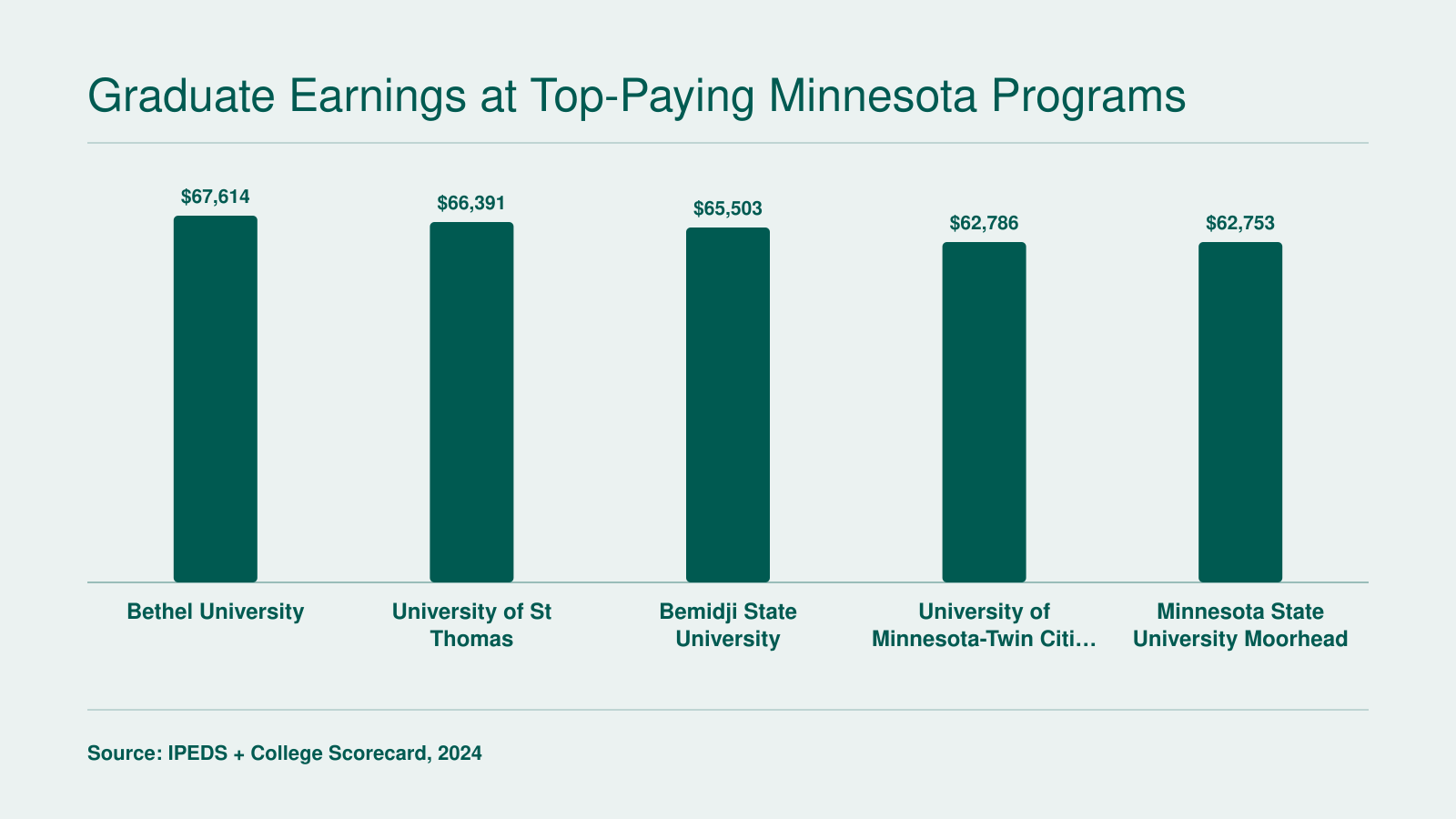
Graduate Earnings at Top-Paying Minnesota Programs
These are median earnings of graduates four years after completing each school's special education master's program. Earnings gaps between these schools are modest, while net price at the private schools runs well above the public ones, so cost matters as much as pay when you compare value.
Quick Answers on Minnesota Special Education Master's Degrees
These short answers cover the questions prospective students ask most often about special education master's programs in Minnesota. Details vary by school and pathway, so confirm specifics with each admissions office.
Which Minnesota special education master's program ranks highest overall?
Do you need a teaching license before enrolling in a special education master's in Minnesota?
Can you earn a special education master's fully online in Minnesota?
What does a special education master's typically cost in Minnesota?
Which programs lead to initial special education licensure in Minnesota?
How many semesters does a special education master's take in Minnesota?
Can you find a master's in special education with ABA coursework in Minnesota?
Can out-of-state teachers use a Minnesota program and still get licensed back home?
Compare Special Education programs on the data that matters
Explore more Education & Teaching specializations or browse every graduate field.
All Education & Teaching programs