Master's Programs in South Dakota
Every master's program reported by a school in South Dakota: 160+ programs at 16 graduate schools, with the online options, costs and outcomes behind each one.
South Dakota's Board of Regents lists resident graduate tuition from $351.15 to $373.65 per credit hour for Fall 2026, low by national standards. Yet the sticker rate is only part of the bill. Fees, formats, and funding rules vary by school and by program, and the university websites rarely line them up for you.
The fields and schools are already listed on this page, so the analysis here covers what those lists leave out: cost, formats, admissions, funding, licensure, and outcomes.
In a state with thin earnings data, the programs that pay off are usually the ones with the lowest total cost and a clear wage gain, not the best-known name.
Key Points
- Resident graduate tuition is $351.15 per credit hour for Fall 2026.
- Online courses largely carry one rate, regardless of residency.
- South Dakota's LPC requires 48 credits and 2,000 supervised hours.
Popular degrees in South Dakota
Master's programs in South Dakota by field
Business & Management
- Management11 programs
- Marketing7 programs
- Healthcare Administration7 programs
- Accounting6 programs
- General Business4 programs
- Finance4 programs
- Public Administration3 programs
- Healthcare Management3 programs
Education & Teaching
- STEM Education or Science Education or Mathematics Education5 programs
- Special Education4 programs
- Curriculum & Instruction3 programs
- Educational Leadership3 programs
- Educational Technology or Instructional Design3 programs
- Secondary Education3 programs
- Reading & Literacy2 programs
- Higher Education or Adult Education2 programs
Counseling
- Clinical Mental Health Counseling4 programs
- School Counseling3 programs
- Marriage and Family Therapy or Marriage and Family Counseling2 programs
- Addiction Counseling1 program
Healthcare
- Exercise Science2 programs
- Public Health2 programs
- Health Administration2 programs
- Nutrition1 program
- Health Informatics1 program
- Speech Pathology1 program
Psychology
- Applied Behavior Analysis3 programs
- Clinical Psychology2 programs
- Counseling Psychology2 programs
- General Psychology1 program
Communications & Media
- Communication Disorders3 programs
- Communication2 programs
- Speech Pathology1 program
- Public Relations1 program
Nursing
- Public Health2 programs
- Family Nurse Practitioner (FNP)1 program
- Psychiatric Mental Health Nurse Practitioner1 program
- Nursing Education or Nurse Educator1 program
- Nurse Administrator1 program
- Health/Nursing Informatics1 program
Science & Engineering
- Sustainability or Environmental Management3 programs
- Geography2 programs
Social Work & Social Sciences
- Social Work Advanced Standing2 programs
- Social Work2 programs
- Human Services1 program
Religion & Theology
- Divinity2 programs
- Theology1 program
- Christian Ministry1 program
- Christian Leadership1 program
Arts & Design
- Creative Writing3 programs
- Fine Arts1 program
Computers & IT
- Data Analytics1 program
- Information Security & Assurance1 program
What a Master's Degree Really Costs in South Dakota
Who Sets the Price
The South Dakota Board of Regents sets graduate tuition for the six public universities, so rates sit close together. For Fall 2026, the Board's rate page lists resident graduate tuition of $351.15 per credit hour at Black Hills State, Dakota State and Northern State, $358.40 at South Dakota State and the University of South Dakota, and $373.65 at South Dakota School of Mines and Technology.1 Mandatory fees and program fees then push the real totals apart. Note that the Board's FY26 fee schedule and its later rate page do not fully agree2, so confirm figures with the bursar before you budget.
A Worked Estimate
The formula is simple: per-credit rate times required credits (typically 30 to 36), plus mandatory fees, plus any program-specific fees.
Take a University of South Dakota resident on campus. Tuition of $358.40 plus the $57.55 general activity fee2 comes to $415.95 per credit. Over 30 credits that is about $12,479. Over 36 credits it is about $14,974. Treat these as estimates, since fees can change by term.
Costs That Get Missed
Program and discipline fees can add thousands. USD lists per-credit discipline fees such as $77.80 for Computer Science and $110.60 for Communication Sciences and Disorders.2 At $110.60, a 30-credit degree adds roughly $3,300. USD also lists a $399.90 delivery fee for its Sioux Falls MBA and a $1,000 fee for the Executive MBA.2 Nursing (MSN programs), business (MBA programs), and engineering programs are the ones to check first. I could not confirm a comparable 2026 program-fee example for South Dakota State, so ask its bursar directly.
Also budget for books, lab or clinical supplies, and travel to practicum or internship sites, none of which appear on a tuition bill.
Resident, Nonresident and Online
Nonresident rates are higher than resident rates, and the Board's schedule lists them by institution. Online and distance rates are separate. USD's online graduate rate is $495.70 per credit with a $0.00 activity fee.1 Over 30 credits that is about $14,871, more than the on-campus resident estimate above.
The lowest sticker rate is therefore not always the lowest total. Compare the all-in figure: tuition, mandatory fees, discipline or delivery fees, and what you would spend on commuting or relocating. For current numbers, use the South Dakota Board of Regents tuition pages and each university's bursar page, and check which academic year the figures cover.
Graduate Tuition Side by Side: Public and Private South Dakota Schools
All figures are published per-credit graduate tuition for the 2026-2027 academic year, drawn from the South Dakota Board of Regents rate schedule and each university's own tuition pages, including USD, SDSU, South Dakota Mines, and Augustana. Estimated totals multiply the resident campus rate by 30 to 36 credits and cover tuition only, so mandatory fees, books, and living costs come on top. Rates for Augustana University, the University of Sioux Falls, and Mount Marty University are marked Not published here because we have no verified per-credit figure; private rates generally run well above public resident rates, so get a current quote before comparing. A private program can still make sense when it offers a smaller cohort, a schedule built for working adults, or a specific program the public schools do not offer.
| Institution | Type | Resident Campus Rate (per credit) | Nonresident Campus Rate (per credit) | Online Rate (per credit) | Est. Total Tuition (30-36 credits) |
|---|---|---|---|---|---|
| University of South Dakota (USD) | Public | $358.40 | $689.15 | $495.70 | About $10,750 to $12,900 (estimate, resident rate) |
| South Dakota State University (SDSU) | Public | $358.40 | $689.15 | Not published | About $10,750 to $12,900 (estimate, resident rate) |
| Northern State University (NSU) | Public | $351.15 | $495.70 | Not published | About $10,530 to $12,640 (estimate, resident rate) |
| Dakota State University (DSU) | Public | $351.15 | $495.70 | Not published | About $10,530 to $12,640 (estimate, resident rate) |
| Black Hills State University (BHSU) | Public | $351.15 | $495.70 | Not published | About $10,530 to $12,640 (estimate, resident rate) |
| South Dakota Mines (SD Mines) | Public | $374 | $750 | $519 | About $25,000 (estimate, Master of Engineering, 30 credits) |
| Augustana University | Private | Not published | Not published | Not published | Not published |
| University of Sioux Falls | Private | Not published | Not published | Not published | Not published |
| Mount Marty University | Private | Not published | Not published | Not published | Not published |
Online, Hybrid, and On-Campus: Which Format Fits Working Adults
For working adults, the format question is a tradeoff between flexibility and structure. The more a program asks you to be somewhere at a set time, the harder it is to keep a full-time job, yet some fields can't be learned entirely from a laptop.
Three Delivery Models
South Dakota's public universities deliver graduate study in three ways. Fully online programs run entirely at a distance. Hybrid programs, as SDSU describes them, require some in-person attendance at a designated location, with the rest delivered online through live or self-paced sessions. On-campus programs follow a traditional schedule.
Fully online examples include:
- Dakota State University: The 30-credit M.S.Ed. in Education and Technology uses asynchronous courses, so you log in on your own schedule.
- University of South Dakota: The 36-credit Master of Science in Administration is offered 100% online, one of more than 50 online programs USD lists.
- South Dakota State University: The online MPH in Epidemiology, M.A. in Educational Leadership, and Master of Arts in Teaching are fully online.1
SDSU runs other programs as hybrids, including the M.A. in Teacher Leadership, the M.S. in Big Data Analytics, and the MPH in Health Promotion and Behavioral Science.1 For programs at Northern State and Black Hills State, confirm the current format directly with the school.
What Works Around a Job
Asynchronous coursework is the most forgiving format for anyone with shifting hours. Evening live sessions and shorter accelerated terms can also fit, so ask each program how its classes are actually scheduled. Daytime cohorts and research-heavy thesis tracks that depend on lab time or close faculty supervision are hard to balance with full-time employment. They suit students who can step back from work.
"Online" Does Not Always Mean Remote
SDSU notes that a fully online program does not necessarily make clinical, practicum, or internship requirements remote.1 USD says supervised field experiences may carry their own location rules. In education, clinical mental health counseling, and health fields, plan to arrange in-person placements and budget time for them.
Check Authorization If You Live Elsewhere
South Dakota participates in NC-SARA through WICHE, with the Board of Regents acting for the state.2 USD can enroll online students from 49 states, DC, Puerto Rico, and the Virgin Islands, plus California. SARA membership is not a program-by-program guarantee, though.2 DSU warns that availability varies by state and country, so confirm your state is eligible before you apply.
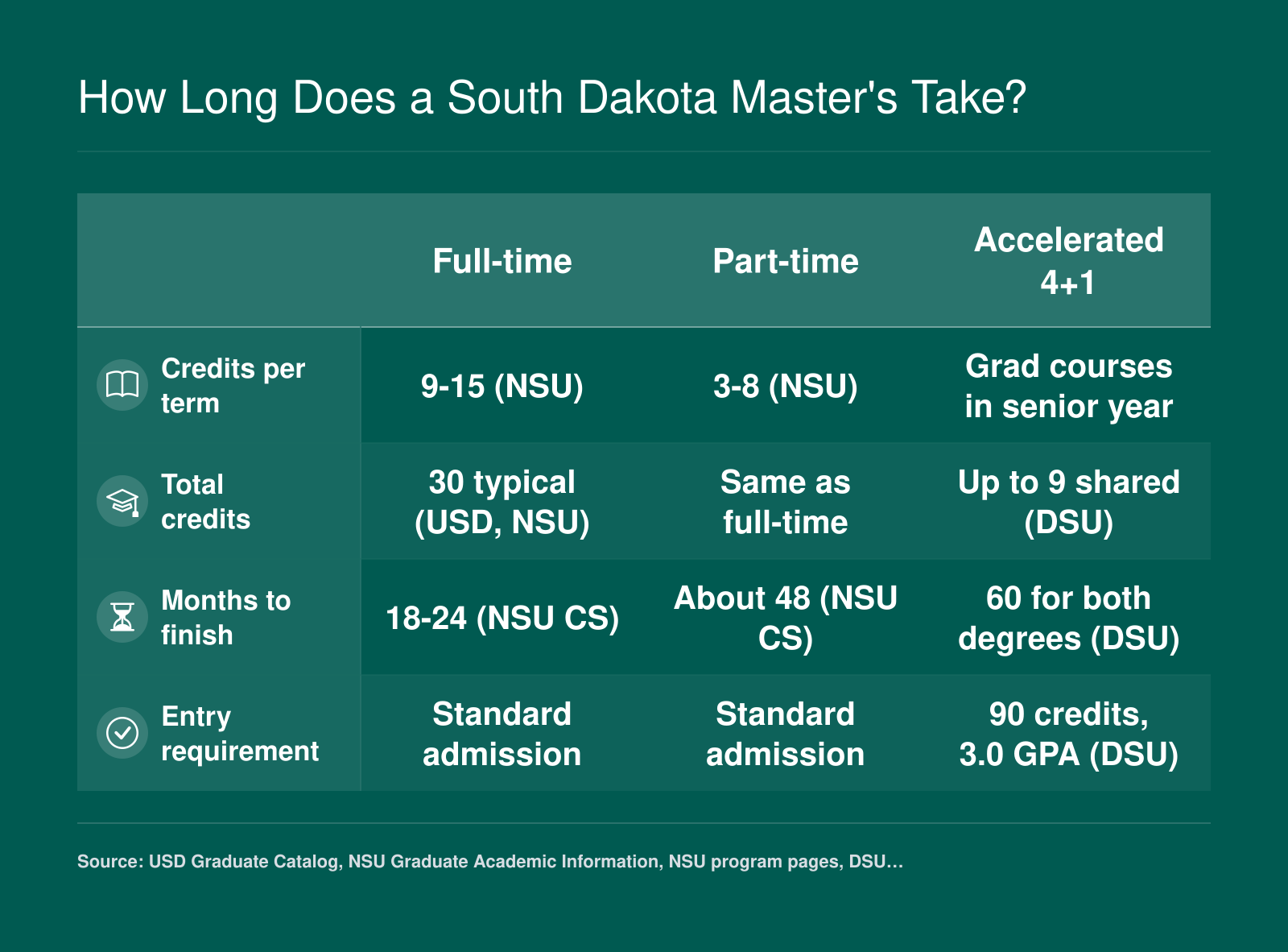
How Long Does a South Dakota Master's Take?
Most South Dakota master's degrees start from a 30-credit baseline, and your enrollment pace decides whether that takes about two years or closer to four. Thesis and non-thesis tracks can change the total: Northern State's Computer Science M.S. is 30 credits with a thesis and 33 with a project. Social Work at USD ranges from 36 to 60 credits depending on your bachelor's degree.
Admission Requirements and Deadlines at a Glance
University-wide minimums set the floor, but the program you apply to sets the real bar. A school-level GPA or test policy can be tightened, loosened, or replaced by a department, so the graduate school page is only a starting point.
Institution by institution
- University of South Dakota: The published standard is a 2.7 undergraduate GPA and/or a 3.0 graduate GPA. Provisional admission may be granted to applicants who fall short but show potential for graduate work. Deadlines are set by each program and listed in the Graduate Catalog, with applications due at 11:59 p.m. Eastern time on the deadline date.
- South Dakota State University: International applicants need a U.S.-equivalent 3.00 GPA to be considered. Applicants must also meet any additional program requirements. No university-wide fall or spring deadline is stated, so check the program.
- Dakota State University: GRE and GMAT scores are not required, placing it among No-GRE master's programs. A non-refundable application fee applies (the amount was not stated in the sources reviewed). Deadlines and entry semesters vary by program, and the catalog does not say whether conditional admission exists.
- South Dakota Mines: Successful applicants typically hold a GPA above 3.0, according to the application instructions. A GRE score at or above the 50th percentile is recommended, though the test is waived for Mines students and graduates. Thesis MS and PhD research applicants face an August 1 deadline for spring entry.
We did not verify current requirements at Northern State or Black Hills State, so confirm those directly with each graduate office. Treat everything above as a snapshot and recheck before applying, since policies change.
Read "rolling" deadlines with caution
Rolling admission usually means applications are reviewed as they arrive, not that you can apply whenever you like. Assistantships, tuition waivers, and scholarships often have earlier priority dates, and the best-funded positions can be gone before the admission window closes. If funding matters to your budget, ask the program for its funding priority date and aim to submit complete materials by then.
If your GPA is below the stated minimum, contact the program before assuming you are out. Provisional pathways exist at some schools, and a department may weigh work experience or recent coursework.
Paying for It: Assistantships, Scholarships, and Resident Tuition Rules
Do online or out-of-state students get resident tuition for a South Dakota master's degree? For distance courses, largely yes, because the Board of Regents does not distinguish between residents and nonresidents.1 The rest of the funding picture is more nuanced.
How Graduate Assistantships Work
The University of South Dakota awards more than 400 graduate assistantships a year, mostly teaching and research roles assigned by departments. For FY27, the minimum stipend is $4,285 per semester and $1,070 for a full four-week summer session. Hours are set as a percentage of a 40-hour week, depending on the appointment. Applicants must be admitted, in good standing, hold a 3.00 GPA, and register for 9 credits in fall and spring. A background check is required.
The tuition benefit matters as much as the stipend. Under Board policy, resident assistants receive a 53 percent tuition remission on the resident graduate rate for on-campus courses, and nonresident assistants receive 63 percent, with fees still charged in full. For comparison, the Board's FY26 graduate rate runs about $342.90 to $355.85 per credit.2 Stipend and remission details for South Dakota State University were not available in the sources reviewed, so ask the department directly.
Scholarships and Employer Help
USD promotes scholarships and other funding, but no complete graduate-specific list or award amounts are published. The state's better-known awards are poor fits: the Opportunity Scholarship is geared toward undergraduates, and the Freedom Scholarship covers bachelor's study only. Departmental awards are usually your best lead. Employer tuition assistance is also worth a conversation with human resources, especially if you work at a hospital or school district.
Residency and the Online Trade-Off
The Board's distance-education rule applies the same rate to all students, wherever they live.1 That does not guarantee identical pricing across programs, and delivery fees may apply. The published rules I reviewed do not lay out a full residency test for on-campus graduate students, so confirm in-state classification with the registrar before you enroll.
The real trade-off is that assistantships and their remission are tied mainly to on-campus enrollment. Distance courses can receive a reduction equal to the resident on-campus rate, but not every credit hour qualifies. An online student gains flexibility and loses most of the funding that makes an on-campus degree cheap.
Licensure, Accreditation, and How to Compare Programs by Field
Two Layers of Accreditation
Every South Dakota university needs institutional accreditation, and for the state's universities that comes from the Higher Learning Commission. It tells you the school is legitimate and that credits and federal aid are sound. It does not tell you whether a degree qualifies you for a license.
That is the job of programmatic accreditation, granted by a field-specific body. In licensure fields, this second layer often decides whether you can work at all.
Accreditors by Field
- Counseling: CACREP. The University of South Dakota's counseling programs have held CACREP accreditation since 1993. The state's LPC pathway requires a 48-hour counseling master's, the National Counselor Examination, and supervised practice1, and state rules recognize CACREP-approved or qualifying organized graduate study2.
- Speech-language pathology: ASHA's Council on Academic Accreditation. USD's M.A. received a Continued Accreditation decision in 2026.3
- Social work: CSWE. South Dakota certification requires a master's or doctorate from a CSWE-accredited school plus the state licensing exam4. USD's M.S.W. leads to that exam; before you commit, compare CSWE-accredited MSW programs and confirm its current status in the CSWE directory yourself.
- Business: AACSB. South Dakota State University is AACSB accredited5, though business master's degrees generally do not lead to a state license.
- Nursing and education: Look for CCNE or ACEN for nursing, and CAEP or state approval for education. We could not verify the status of specific South Dakota programs here, so check with the accreditor, the Board of Nursing, and the Department of Education.
A Simple Comparison Framework
When two programs in the same field look alike, compare them on four points:
- Accreditation status: Is the specific degree accredited, not just the university?
- Licensure pass rates: Use them where the program publishes them, and be wary of programs that will not.
- Practicum support: Ask whether the school arranges placements or leaves you to find your own sites and supervisors.
- Total cost: Add tuition, fees, and any unpaid clinical hours that limit your work income when you calculate the total cost of a master's degree.
A Warning for Online Students
Licensure is granted by the state where you practice, not the state where you study. An online master's program may be accredited yet still fall short of another state's rules on supervised hours, coursework, or exams. Before you enroll, email the licensing board in the state where you plan to work and ask whether the program satisfies its requirements. Get the answer in writing.
Counselor Licensure in South Dakota
Career Outcomes and Return on Investment
Federal earnings data now lets you test a master's degree against its price, but South Dakota's coverage is patchy. Where College Scorecard publishes figures, they are worth reading carefully.
What the Published Numbers Show
The clearest case is SDSU's master's in nursing. Graduates from the 2025-26 cohort reported median earnings of $103,339 one year after completion, against median debt of $46,000. That debt equals roughly 45% of a single year's earnings, a manageable ratio.
Counseling, including Marriage & Family Therapy, looks tighter. One 2026 presentation of SDSU's clinical counseling and applied psychology master's shows median earnings of $57,278 and median debt of $54,699, so debt is about 96% of annual earnings. Another source lists earnings of $51,269 for the same field. The sources do not say whether the gap reflects a different year, cohort, or field definition, so treat the range of about $51,000 to $57,000 as approximate. SDSU's educational administration master's shows median earnings of $63,921, with no debt figure published.
USD reports earnings by field but without debt pairs. Nursing graduates show $73,025 four years out, business administration and management $64,890, and teacher education $46,034. These may mix credential levels, so they are not strictly master's-only. USD's institution-wide median debt of $23,592 (2024-25, federal loans only) covers all students and should not stand in for any one master's field.
Why So Many Programs Show Nothing
Many South Dakota programs enroll small cohorts. Scorecard withholds a figure when too few graduates would make it identifiable, and Dakota Wesleyan's educational administration master's, with just six graduates, shows no earnings or debt at all. Absence of data says nothing about quality.
You can work around it:
- Ask the program directly: Request recent graduate placement rates, typical starting salaries, and average borrowing.
- Check a broader field: A parent category, such as M.Ed. programs, may have enough graduates to report.
- Compare across schools: If one school suppresses data, a similar program elsewhere in the state may not.
- Run your own ratio: Divide the program's published total cost by a realistic salary for your target job.
School Earnings Are Not Occupational Wages
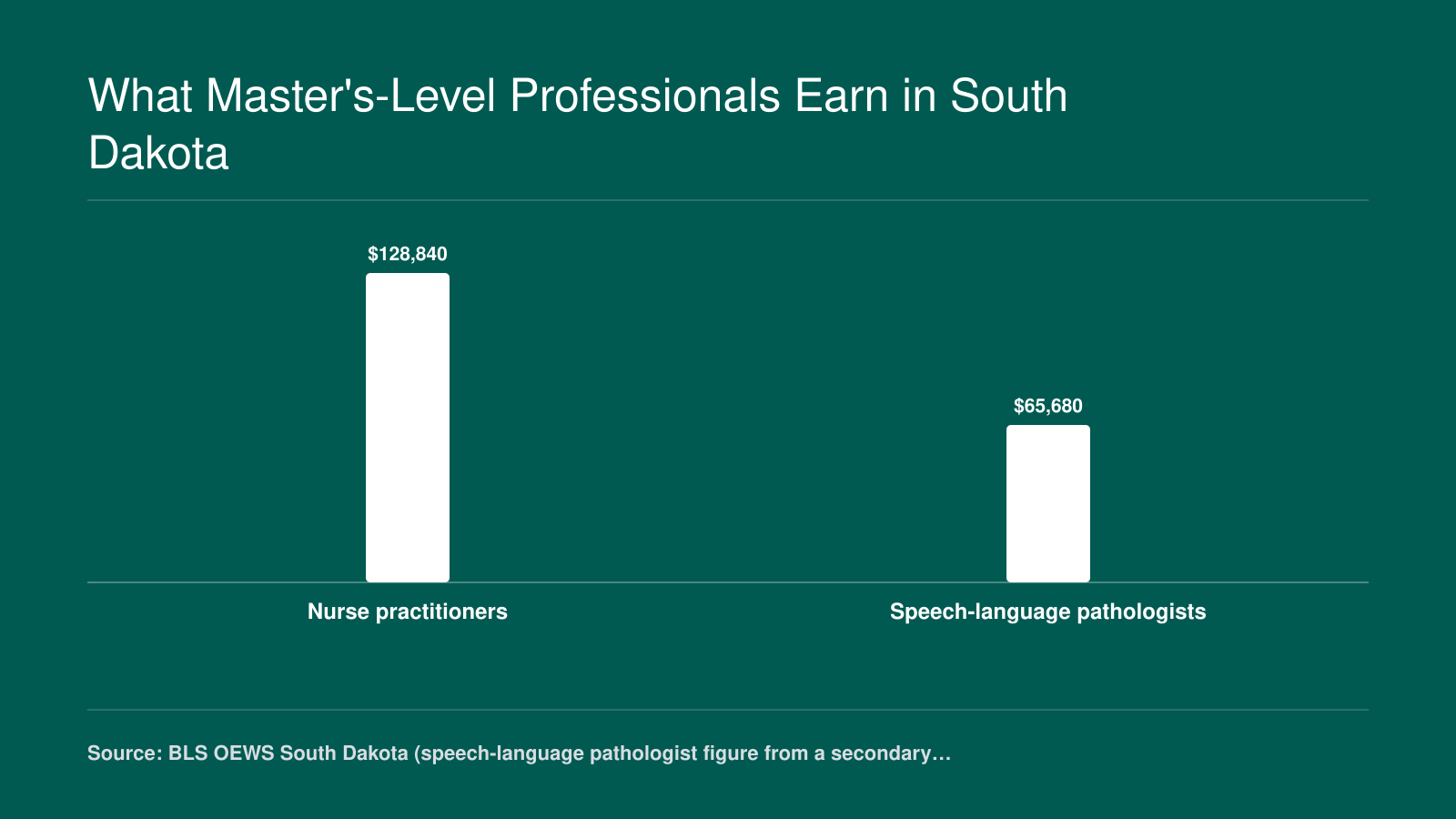
Scorecard figures describe people who completed a specific program and had federal aid records, measured one to four years out. They skew toward recent graduates and exclude some students, so they are not what an experienced professional earns in the job. The next visual covers occupational wages across the state, which is the better yardstick for long-run earning power. Use the two together: school data for the early payoff on your debt, wage data for where a career can realistically go.
What Master's-Level Professionals Earn in South Dakota
These bars show statewide median annual wages for two occupations that typically require a master's degree, from the Bureau of Labor Statistics occupational wage survey for South Dakota. They are occupational wages for all workers in the field, not earnings of graduates from any specific program on this page. Statewide medians for other master's-level occupations, such as education administrators, counselors, physician assistants, and occupational therapists, could not be confirmed for this chart, so check the state labor department's wage tables before relying on a figure.
Graduate schools in South Dakota with the most master's programs
| School | City | Type | Master's programs | Online | Grad tuition / yr |
|---|---|---|---|---|---|
| University of South Dakota | Vermillion | Public | 50 | 26 | $7,118 |
| South Dakota State University | Brookings | Public | 15 | 8 | $9,384 |
| Dakota State University | Madison | Public | 12 | 11 | $6,731 |
| National American University-Rapid City | Rapid City | Private for-profit | 12 | 12 | $16,425 |
| University of Sioux Falls | Sioux Falls | Private nonprofit | 12 | 12 | $7,470 |
| California Intercontinental University | Sioux Falls | Private for-profit | 12 | 12 | $10,674 |
| Northern State University | Aberdeen | Public | 11 | 11 | $6,736 |
| Kairos University | Sioux Falls | Private nonprofit | 9 | 8 | $3,600 |
| Black Hills State University | Spearfish | Public | 7 | 7 | $8,916 |
| Augustana University | Sioux Falls | Private nonprofit | 6 | 4 | $40,830 |
| Dakota Wesleyan University | Mitchell | Private nonprofit | 5 | 5 | $15,300 |
| Sinte Gleska University | Mission | Public | 4 | 2 | $2,108 |
| Mount Marty University | Yankton | Private nonprofit | 3 | 3 | $16,499 |
| Oglala Lakota College | Kyle | Public | 1 | 1 | $2,518 |
| South Dakota School of Mines and Technology | Rapid City | Public | 1 | 1 | $8,500 |
Program counts are the verified master's listings in our directory; tuition is the school-wide average for a full-time graduate student (IPEDS).
South Dakota Master's Programs: Common Questions
These answers cover the questions prospective students ask most often about South Dakota graduate study. Policies vary by program and change from year to year, so confirm details with the program before you apply.
Which South Dakota master's programs are fully online?
What is the total cost of a master's degree in South Dakota?
Which South Dakota schools accept applicants with lower GPAs or without standardized tests?
Which South Dakota master's programs are professionally accredited?
Can out-of-state students pay in-state rates for an online master's in South Dakota?
Compare programs nationwide
Many South Dakota residents study online. Every ranked list above has an online lens, or browse every field.
Online master's programs Browse all fields