Master's Programs in Colorado
Every master's program reported by a school in Colorado: 520+ programs at 23 graduate schools, with the online options, costs and outcomes behind each one.

A Colorado resident and an out-of-state student at the same public university can pay very different rates for an identical degree, while private schools such as the University of Denver bill one per-credit rate regardless of residency. The diploma reads the same either way. The bill does not.
Cost, delivery formats, deadlines, funding, licensure, and outcomes follow, with a tuition table, a deadline table, and an ROI framework near the end.
Sticker price rarely settles the question. A cheaper program with weak graduate earnings can cost more over time than a pricier one that pays back quickly.
Key Points
- At CU Denver, 2026-27 housing and food ($18,740) far exceed the $4,464 resident tuition estimate.
- Colorado Mesa and Western Colorado often undercut the Boulder and Denver flagships on price.
- Deadlines are set by department, so check each program page for 2026 dates.
Popular degrees in Colorado
Master's programs in Colorado by field
Business & Management
- Accounting22 programs
- Healthcare Administration15 programs
- Finance14 programs
- Management13 programs
- Project Management12 programs
- General Business11 programs
- Organizational Leadership10 programs
- Marketing10 programs
Education & Teaching
- STEM Education or Science Education or Mathematics Education14 programs
- Teaching11 programs
- Music Education10 programs
- Special Education9 programs
- Curriculum & Instruction8 programs
- Educational Leadership6 programs
- Library Science or Library and Information Science or Library Media5 programs
- Secondary Education5 programs
Social Work & Social Sciences
- Social Work13 programs
- Sociology13 programs
- Social Work Advanced Standing8 programs
- Political Science, Government3 programs
Communications & Media
- Communication7 programs
- Communication Management7 programs
- Speech Pathology5 programs
- Media Communication4 programs
- Strategic Communication3 programs
- Organizational Communication3 programs
- Communication Disorders3 programs
- Journalism2 programs
Nursing
- Family Nurse Practitioner (FNP)6 programs
- Nursing Education or Nurse Educator5 programs
- RN to MSN5 programs
- Psychiatric Mental Health Nurse Practitioner4 programs
- Adult Gerontology Acute Care Nurse Practitioner2 programs
- Nurse Administrator2 programs
- Adult Gerontology Primary Care Nurse Practitioner1 program
- MSN/MBA1 program
Healthcare
- Health Administration7 programs
- Health Informatics6 programs
- Public Health4 programs
- Speech Pathology4 programs
- Exercise Science3 programs
- Health Education3 programs
- Nutrition2 programs
Science & Engineering
- Sustainability or Environmental Management13 programs
- Geography8 programs
- Environmental Science7 programs
Psychology
- Clinical Psychology5 programs
- Counseling Psychology5 programs
- Educational Psychology or School Psychology4 programs
- General Psychology3 programs
- Addiction Psychology3 programs
- Forensic Psychology2 programs
- Sports Psychology2 programs
- Industrial Organizational Psychology1 program
Counseling
- Clinical Mental Health Counseling7 programs
- School Counseling6 programs
- Marriage and Family Therapy or Marriage and Family Counseling5 programs
- Addiction Counseling4 programs
Arts & Design
- Creative Writing13 programs
- Fine Arts3 programs
Computers & IT
- Cybersecurity10 programs
- Machine Learning4 programs
- Information Security & Assurance2 programs
Criminal Justice & Law
- Public Policy6 programs
- Master of Laws3 programs
- Homeland Security2 programs
- Legal Studies1 program
- Business Law1 program
Religion & Theology
- Divinity3 programs
- Theology3 programs
- Christian Leadership2 programs
- Christian Ministry1 program
What You'll Pay: Colorado Master's Tuition at CU Boulder, CSU, CU Denver, DU and Regional Schools
Master's tuition in Colorado is the per-credit charge, plus mandatory fees, that a school bills for graduate coursework, and it depends heavily on who you are and what you study. At public universities, residency is the first dividing line. Colorado residents pay a lower rate than nonresidents on campus, and the gap can be substantial. The University of Denver, as a private institution, sets one rate for every student regardless of home state, so there is no residency discount to earn and no nonresident penalty to avoid.
Residency and Differential Tuition
CU Boulder, CU Denver, CU Anschutz, CSU, UCCS, UNC, Colorado Mesa and Western Colorado all publish graduate rates by residency, credit load and college or program. We could not confirm a complete 2026-27 master's rate and mandatory-fee schedule for these schools from the official pages available to us, so we are not quoting on-campus figures here. What the schools do state is that rates vary by program and are updated annually.
That variation matters. Many programs charge differential tuition, meaning a higher per-credit rate than the university's baseline. MBA programs, engineering, and health-related degrees, including MHA programs, are the usual examples, and CSU's catalog confirms differential tuition applies to specific graduate programs. A cheap-looking campus average can understate what your own program bills.
Online Rates at CSU and CU Denver
CSU Online states that residency is not a factor in tuition for online, distance or off-campus courses, so out-of-state students pay the same online rate as Coloradans.1 There is no single CSU Online master's rate. Published per-credit prices differ by program:
- Addiction Counseling: $448 per credit.1
- Dietetics (MAPD): $627 per credit.1
- Computer Engineering: $747 per credit, across 30 required credits.2
- Aerospace Engineering: $992 per credit.1
On those figures, a 30-credit Computer Engineering degree comes to roughly $22,400 in tuition alone.2 Mandatory fees are billed on top, and CSU notes online tuition is added to other university charges, so treat that as a floor rather than a total.
CU Denver also offers master's degrees online. We could not verify its current per-credit online rates, so check whether a given program uses a flat online price or bills residents and nonresidents differently before assuming either.
Reading the Numbers
Compare programs on total credits times per-credit rate, then add fees. A lower rate on a 45-credit degree can cost more than a higher rate on a 30-credit one. Confirm every rate on each school's bursar page, since figures reset each academic year.
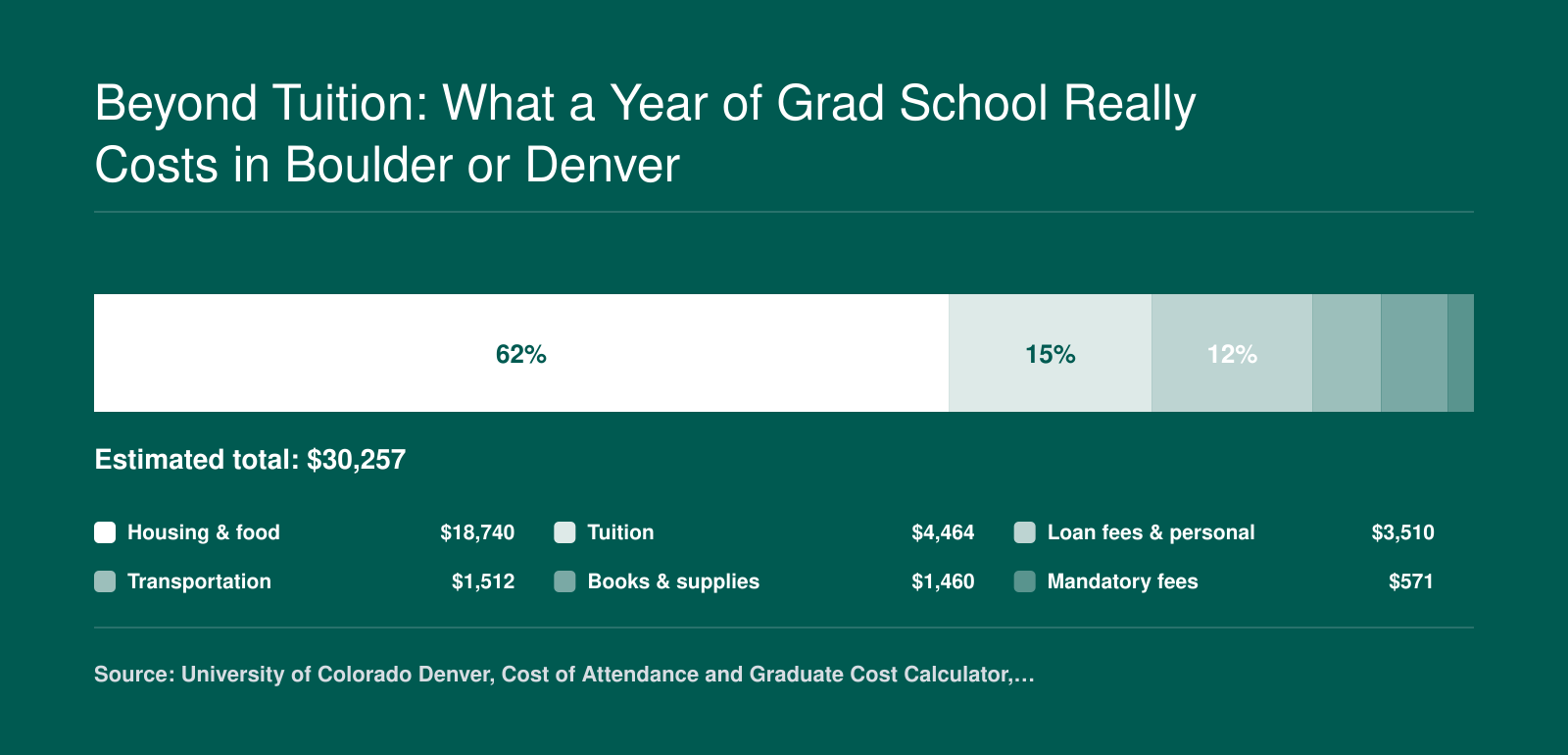
Beyond Tuition: What a Year of Grad School Really Costs in Boulder or Denver
CU Denver's 2026-27 cost-of-attendance estimate for a resident master's student shows how much of the budget goes to living in the city. Housing and food total $18,740, more than four times the $4,464 tuition line in this estimate. Tuition varies by school and program, and the figures assume full-time, on-campus living. The university's broader cost page lists a higher graduate total of $32,755 for on-campus, full-time students. Treat both as planning estimates, not a bill.
The Regional Option: UCCS, UNC, Colorado Mesa and Western Colorado
Colorado’s regional public universities can undercut the Boulder and Denver flagships on sticker price, especially for online and low-residency master’s students. The clearest savings appear at Colorado Mesa and Western Colorado, while UCCS and UNC sit in the middle with program-specific pricing that rewards careful comparison.
The price spread is real, but not one-size-fits-all
UCCS Spring and Summer 2026 graduate schedules list $963 per credit,12 but college-level rates vary. The online Special Education MA is priced at $737 per credit,3 and the online Engineering Management ME at $900 per credit.4 UCCS also participates in the Western Regional Graduate Program (WRGP), so eligible residents from participating WICHE states pay tuition capped at 150% of in-state rates for selected programs.5 UNC’s Fall 2026 nonresident graduate schedule lists $1,393 per credit for one cluster,6 but main-campus and extended campus rates are separate and vary by program. Colorado Mesa’s 2026-2027 estimates, assuming six credits per semester, work out to about $597 per credit, or $7,164 for two semesters,7 with fees listed separately. Western Colorado posts some of the most accessible online-oriented pricing: the MA in Education is $353.60 per credit plus a $73.40 per-credit fee, with a published total of $13,287 for 31 credits, while the Master of Behavioral Science is $730 per credit for 39 credits, with a published total of $31,382.60.
Delivery strengths for working professionals
UCCS leans into evening and online options for Colorado Springs professionals. UNC has a strong reputation for online and hybrid education programs, though its published rate tables do not label every online master’s. Western Colorado markets its MA in Education as online or low-residency, and the institution is known for low-residency formats that reduce time on campus. Colorado Mesa’s lower per-credit estimate is a common comparison point for price-conscious students.
The tradeoff: breadth and assistantship funding
Lower sticker prices usually mean fewer large research assistantships and a narrower program menu than CU Boulder or DU. If you need a highly specialized master’s, travel funding, or a deep bench of graduate research roles, a regional campus may not have the same capacity. But for students whose priority is a credential in education, behavioral science, engineering management, or another regional strength, these campuses can deliver significant savings.
Online, Hybrid, or On-Campus: How Colorado Delivers Master's Degrees
Yes, fully online master's degrees exist in Colorado. Colorado State University Online, CU Denver, University of Denver University College, and the University of Northern Colorado are the main providers, and CU Boulder runs several online degrees through Coursera. Program inventories change, so confirm the delivery format on each program's own page before you apply.
Credits and Time to Finish
The published examples cluster around 30 credits or a little more. CU Boulder's general master's requirement is a minimum of 30 credits, and its online MS programs in computer science and data science both use that figure. The fully online Master of Public Policy and Administration at CSU Online requires 39 credits.
Timelines vary more than credit counts:
- CU Boulder engineering: typically 1.5 to 2 years full-time or 2 to 3 years part-time.
- CU Boulder Coursera degrees: a 2-year track means 2 to 3 courses per 8-week session, with courses lasting 4 to 6 weeks. Slower schedules are allowed, but coursework must finish within 8 years of degree conferral.
- CSU Online MPPA: about 2 years (24 months) at the fast end, and up to 5 years depending on your pace. CSU does not publish separate full-time and part-time timelines.
For CU Denver, DU University College, UNC, and CU Anschutz, we could not verify credit counts or completion times for individual programs. Check each program's published requirements, and note any time limit on finishing.
Hybrid and Executive Formats
CU Boulder's engineering master's programs can be delivered online or hybrid, which suits working engineers who cannot relocate. DU and CU Anschutz also serve working professionals with evening, weekend, or blended schedules in some programs. These formats vary by program, so ask the department how often you would have to be on campus.
Licensure Tracks Still Need You in Person
Online coursework does not remove field requirements. Counseling, teaching, and similar licensure-track programs, such as Marriage & Family Therapy, typically require supervised practicum or internship placements at approved sites, often in Colorado. If you plan to study online from another state, confirm that the program can arrange a placement near you and that it meets your licensing board's rules. That check matters more than the delivery label.
Application Deadlines and GRE Policies at Major Colorado Graduate Schools
There is no single statewide deadline for Colorado master's programs: dates are set at the department level, and the program page you are applying to is always the authoritative source. The figures below are representative starting points, not fixed rules, so verify every one before you plan around it.
Typical Fall Deadlines
Deadlines at the big research universities swing widely by program, so treat these as orientation rather than gospel.
- CU Boulder: Dates vary by school and program. The School of Education, for example, has listed roughly early March for domestic applicants and mid-February for international ones, while Chemical and Biological Engineering has posted a December 1 target. No university-wide master's deadline exists.
- Colorado State University: The CSU Graduate School Application Deadlines page lists an April 1 general fall deadline, with an earlier mid-February cutoff tied to financial support. Individual programs often set their own dates, and the Impact MBA and Master of Finance have shown a May 1 deadline.
- CU Denver: Deadlines vary by program across every college. Check the specific department page rather than assuming a shared date.
For the University of Denver, UCCS, and the University of Northern Colorado, publicly confirmed Fall 2026 master's deadlines were not available at the time of writing, so confirm current dates directly with each program.
GRE and GMAT Policies
Testing requirements have loosened unevenly, so do not assume a blanket waiver, even among No-GRE master's programs.
- CU Boulder's Chemical and Biological Engineering program has stated the GRE is not required.
- CSU advises applicants to contact the department about GRE or GMAT expectations.1 The Impact MBA has listed the test as required for all applicants while also offering a post-application waiver petition, so the practical requirement depends on your profile.2
- CU Denver's Business School requires the GMAT but allows the GRE to substitute, with waivers decided case by case and varying by program, per the CU Denver Graduate Admissions Requirements. Its College of Engineering, Design and Computing does not require the GRE for most master's tracks.
Timing and Funding
If assistantships or departmental aid matter to you, the earlier priority deadline is the one that counts. Funding consideration at schools like CSU often hinges on applying by a December through February window, well ahead of the final admission date. Many online programs, by contrast, use rolling admission and review applications as they arrive, which trades a hard deadline for less predictable aid.
Funding Your Master's: Assistantships, WRGP and Employer Tuition Benefits
The single biggest variable in what a Colorado master's actually costs isn't tuition on the website: it's whether you land funding that lowers it. Assistantships, a regional tuition break, employer benefits, and federal loans each change the math differently, and access to them depends heavily on your field and your department.
Assistantships at CU Boulder and CSU
A graduate assistantship pairs part-time work (teaching or research) with support that can include tuition remission plus a stipend. These are most common in STEM and research-heavy departments, and in some sociology master's programs with assistantships, but they are rarer in professional master's tracks, where self-funding is the norm.
At CU Boulder, tuition remission for 2026-2027 is tied to your appointment: you need at least a 15% appointment and 12 weeks of work in a semester to keep it. Remission is semester-specific and non-transferable, and health-insurance contributions kick in only for appointments above 20% enrolled in the student plan.
At CSU, there is no single university-wide remission figure. Monthly stipends run roughly $990 to $1,980 depending on appointment level for 2026-2027 and are taxable; any remission appears separately on the appointment form as a qualified tuition reduction.1 Quarter-time assistants can receive 50% of base tuition for resident credits when the college's allotment is used.2 College of Business assistantships are their own case: up to 50% of first-year base tuition plus full mandatory fees and a stipend, but they exclude summers and online courses and are non-renewable.3
WRGP and Other Routes
For students from western states, WICHE's Western Regional Graduate Program caps tuition at 150% of in-state rates at participating Colorado programs.4 Participation is program-specific, not automatic, so confirm your target program is enrolled before counting on it.
Many Colorado employers offer tuition assistance; terms, caps, and eligibility vary by employer, so check with your HR department directly. When those sources fall short, federal Grad PLUS and Unsubsidized loans fill the gap, though they add to debt you'll repay.
One Tactic Before You Apply
Email the department, not just admissions, and ask how many funded assistantships they expect to offer incoming students and how allocation works. Program pages describe what is possible; a department coordinator can tell you how likely funding actually is for your cohort.
Teaching License in Colorado
Accreditation and Licensure: What to Verify Before You Apply
Accreditation is the single verification that protects your tuition investment and keeps your degree usable for licensure and further study. Check two layers before you apply: the institution itself, and the specific program if it leads to a license.
Confirm Institutional Accreditation
Colorado's public and most private universities are accredited by the Higher Learning Commission (HLC), the regional body recognized by the U.S. Department of Education. Rather than trust a school's marketing, look it up yourself. The HLC member directory lists every accredited institution and its current status, and the Department of Education's database (DAPIP) does the same. HLC reviews run on a cycle, and recent actions illustrate the ongoing nature of the process: Fort Lewis College was reaffirmed in HLC's March 2026 accreditation actions, CSU-Global in HLC's August 2026 accreditation actions, and Trinidad State College in HLC's June 2026 accreditation actions. A school's absence from any single month's action list does not mean it lacks accreditation; status is confirmed through the directory, not a news item.
Match the Program Accreditor to Your Field
For licensure-track degrees, institutional accreditation alone is not enough. Programmatic accreditors signal that a curriculum meets professional standards:
- ABET: engineering and computing programs
- CACREP: clinical mental health and counseling programs
- CAEP: teacher preparation and education programs
- CSWE: CSWE-accredited MSW programs
- AACSB: business and MBA programs
Missing the right accreditor can quietly block you from sitting for an exam or applying for a credential later.
Understand Colorado Licensure Through DORA
Colorado licenses professional counselors and engineers through the Division of Professions and Occupations (DORA).1 For counseling, note a procedural detail that trips people up: you must register as a candidate before you begin accumulating supervised experience hours, because hours earned beforehand do not count.1 DORA no longer accepts its own education-equivalency packets; the Center for Credentialing & Education now conducts those reviews for LPC, marriage and family therapy, psychology, and addiction counseling applicants.1 Specific 2026 requirements, including how much weight CACREP or ABET accreditation carries, should be confirmed directly with DORA before you commit.1
Out-of-State Online Students: Check Twice
If you are enrolling in an online Colorado program from another state, verify two things on the school's website: its state authorization to operate where you live, and its professional licensure disclosures. A program accredited for Colorado licensure may not satisfy your home state's board, so read the disclosure for your exact state before you pay a deposit.
Colorado Master's Earnings Snapshot
One College Scorecard record shows what to look for, but verify the field and credential level before relying on it.
Career Outcomes by Field: Where Colorado Master's Degrees Pay Off
The gap between what different master's fields pay has widened as Colorado's economy leans harder on technology and health care, and that shift matters more than any single program's prestige when you weigh cost against return.
The Higher-Earning Fields
Computer science and engineering master's graduates tend to land among the strongest earners statewide, and Colorado's labor market reinforces that. The Denver and Boulder tech corridor, along with a dense aerospace and defense sector along the Front Range, creates steady demand for graduates with advanced technical training. Nursing graduates with a master's, particularly those targeting adult-gerontology primary care nurse practitioner (AG-PCNP) MSN programs or leadership roles, also see competitive salaries driven by the state's large hospital systems and chronic clinician shortages. In these fields, the degree often functions as a multiplier: it opens higher-paying roles that a bachelor's alone would not.
When the Degree Is Required, Not Optional
Not every field rewards the master's with a big earnings jump. In teaching, clinical mental health counseling, and social work, including online MSW programs, the degree is frequently a licensure requirement rather than a salary lever. You may need it to practice at all, but public-sector and nonprofit pay scales cap what the credential returns. That doesn't make these programs a poor choice, but it changes the math: here you're buying access to a profession, not a premium over peers. Treat the tuition as the price of entry and judge affordability accordingly, leaning toward lower-cost public programs where you can.
Reading Outcomes Data With Care
Federal earnings figures for individual programs come with real limits, and it helps to know them before you draw conclusions:
- Aid recipients only: Reported earnings reflect graduates who took federal student aid, not every graduate, which can skew the picture at programs where many students pay out of pocket or use employer funding.
- Small programs omitted: Programs below a minimum graduate count are suppressed to protect privacy, so some fields at smaller Colorado schools show no figures at all.
- Timing matters: Earnings measured one to four years after completion may understate long-run pay in fields where salaries climb steeply with experience.
Use these numbers as one input among several. Pair them with your own field's licensing path, the local employers hiring in your discipline, and the net price you'd actually pay rather than treating any single figure as the verdict.
How to Compare Colorado Programs by Return on Investment
Return on investment, in plain terms, is what you spend to earn the degree weighed against what the degree earns you back. It's a simple subtraction most students never do before signing up, and it separates a smart purchase from an expensive credential.
The Basic Math
Start with total program cost: tuition plus mandatory fees, plus living expenses for the time you're enrolled, minus any aid, assistantships, or employer tuition benefits you'll actually receive. Then compare that figure against the expected earnings bump from the outcomes section of this guide. If a degree costs you $30,000 out of pocket and lifts your pay by $15,000 a year, it pays for itself in roughly two years. A degree that costs $90,000 for the same $15,000 bump takes six.
A Worked Example
Consider a resident pursuing an online master's at Colorado State University against a comparable degree at the University of Denver. Using the tuition figures above, the resident CSU Online path runs a fraction of DU's private sticker price, and because it's online, that student can keep working full-time. The DU graduate may finish faster or carry a stronger regional brand, but the earnings advantage has to clear a much larger cost gap to justify the premium. Run your own numbers with the tables above; the gap is often wider than the salary difference closes.
Questions to Ask Admissions
Time to degree and whether you can stay employed are part of the calculation, not afterthoughts. A longer program delays your earnings bump and raises your living costs. Before you commit, ask each admissions office directly:
- What share of graduates are employed in-field within a year, and where?
- What percentage of students receive assistantships, tuition waivers, or scholarships?
- What is the typical time to completion for part-time students?
If an office can't answer the funding and placement questions clearly, treat that as a data point of its own.
Graduate schools in Colorado with the most master's programs
| School | City | Type | Master's programs | Online | Grad tuition / yr |
|---|---|---|---|---|---|
| University of Denver | Denver | Private nonprofit | 68 | 29 | $42,173 |
| Colorado State University-Fort Collins | Fort Collins | Public | 62 | 23 | $14,125 |
| University of Colorado Denver/Anschutz Medical Campus | Denver | Public | 57 | 34 | $9,298 |
| University of Colorado Boulder | Boulder | Public | 50 | 8 | $16,634 |
| University of Northern Colorado | Greeley | Public | 41 | 32 | $15,376 |
| University of Colorado Colorado Springs | Colorado Springs | Public | 39 | 20 | $15,704 |
| Regis University | Denver | Private nonprofit | 36 | 34 | $24,300 |
| Colorado State University Pueblo | Pueblo | Public | 31 | 20 | $10,064 |
| Metropolitan State University of Denver | Denver | Public | 25 | 14 | $11,017 |
| Colorado Technical University-Colorado Springs | Colorado Springs | Private for-profit | 22 | 22 | $14,632 |
| Adams State University | Alamosa | Public | 20 | 19 | $5,898 |
| Colorado Christian University | Lakewood | Private nonprofit | 16 | 15 | $15,394 |
| Colorado Mesa University | Grand Junction | Public | 16 | 8 | $10,900 |
| Western Colorado University | Gunnison | Public | 8 | 7 | $15,550 |
| Naropa University | Boulder | Private nonprofit | 7 | 3 | $22,412 |
Program counts are the verified master's listings in our directory; tuition is the school-wide average for a full-time graduate student (IPEDS).
Common Questions About Master's Programs in Colorado
How long does it take to complete a master's degree in Colorado?
Which Colorado universities waive the GRE for master's programs?
Can out-of-state students qualify for in-state graduate tuition in Colorado (residency rules and WRGP)?
Do Colorado master's programs lead to engineering licensure?
Compare programs nationwide
Many Colorado residents study online. Every ranked list above has an online lens, or browse every field.
Online master's programs Browse all fields