Best Master's in Marriage and Family Therapy Programs in Colorado
Compare 5 accredited Marriage and Family Therapy programs in Colorado, with graduate earnings, cost, debt, and completion data from IPEDS and the U.S. College Scorecard.

Accreditation, not reputation, is the first filter in Colorado: COAMFTE accredits marriage and family therapy programs at Colorado State, Regis, and CU Denver, while the University of Northern Colorado's marriage, couples, and family counseling M.A. is CACREP-accredited. Both routes can lead to LMFT licensure, but the paperwork differs.
Cost spreads just as widely, from in-state public tuition to Regis's $896 per credit hour across 60 credits. Format, GRE policy, and clinical placement rules vary too, and 2,000 post-master's supervised hours wait at the end regardless.
Key Points
- COAMFTE accredits Colorado State, Regis, and CU Denver MFT programs.
- No ranked Colorado MFT program requires the GRE for admission.
- Rankings favor programs where graduate earnings outpace debt and net price.
Colorado's Standout Master's Programs in Marriage and Family Therapy
Colorado's standouts here pair structured clinical training with a realistic look at cost and completion. The programs below were weighed on what students pay, how many finish, and what completers earn a decade later, then checked against each program's required client-contact hours and placement setup.
Colorado State University-Fort Collins
#1Fort Collins, CO · ~$14,000/yr (est.)
Best for: Full-time students wanting structured two-year path
Colorado State University in Fort Collins offers a full-time, campus-based M.S. in Human Development and Family Studies with a Marriage and Family Therapy specialization. The COAMFTE-accredited program requires 400 client-contact hours, including 100 relational hours, and places students in three in-house clinical rotations at the Centers for Counseling, Assessment, and Mentoring. This structure gives students supervised experience in couple and family work without relying on outside placements. The school's graduation rate is 67%.
- COAMFTE-accredited master's program
- 400 client-contact hours, including 100 relational
- Three in-house clinical rotations under live supervision
- Campus-based delivery format
- Focus on evidence-based clinical practice
- Centers for Counseling, Assessment and Mentoring
University of Colorado Denver/Anschutz Medical Campus
#2Denver, CO · $5,000 – $10,000/yr (est.)
Best for: Working Denver students needing evening classes
University of Colorado Denver's Master of Arts in Couple and Family Therapy is a 54-credit campus program with an explicit social-justice and systemic relational focus. Students complete 300 direct-contact clinical hours, including at least 100 relational hours, across at least 12 months of practicum and internship. Most classes meet in three-hour evening or late-afternoon blocks Monday through Thursday, which suits working students. The school's graduation rate is 46%.
- 54-credit program
- COAMFTE accredited
- 300 direct-contact clinical hours
- Evening and late-afternoon classes Monday-Thursday
- Social justice and systemic relational approach
- Prepares for National MFT Exam
University of Northern Colorado
#3Greeley, CO · ~$15,000/yr (est.)
Best for: Greeley-area students wanting systems theory
University of Northern Colorado in Greeley offers a Marriage, Couples, and Family Counseling/Therapy M.A. that combines core courses with practicum and internship components. The CACREP-accredited program requires a 3.0 GPA for admission and considers GRE scores when an applicant's GPA is below that threshold. The curriculum emphasizes systems theory and relationship dynamics. The school's graduation rate is 51%.
- 66-75 credit master's program
- CACREP accredited
- 3.0 GPA admission requirement
- GRE required when GPA is below 3.0
- Focus on systems theory and relationships
- Includes practicum and internship components
Regis University
#4Denver, CO · ~$24,000/yr (est.)
Regis University's M.A. in Marriage and Family Therapy is a 60-credit hybrid program with evening and weekend classes. Students complete 300 direct client-contact hours, including at least 100 relational hours, starting with a 14-week in-house practicum at the Regis Center for Counseling, Family and Play Therapy before moving to approved community internship sites. The program is COAMFTE accredited, but it is no longer accepting new applications for the master's degree, so prospective students should verify current admissions status before planning around it. The school's graduation rate is 61%.
- 60-credit hybrid program
- COAMFTE accredited
- Practicum at Regis Center for Counseling, Family and Play Therapy
- Internships at approved community sites
- Evening and weekend class schedule
- $896 per credit hour for 2025-2026
- 300 direct client-contact hours
Cost & outcomes by school
Federal data for the highest-earning Marriage and Family Therapy programs, independent of the ranking above. Earnings are this field's master's graduates four years after completing, where the Scorecard reports them.
| School | Earnings | Tuition / yr | Debt | Grads/yr | Format |
|---|---|---|---|---|---|
| Colorado Christian University CO | — | $15,394 | — | 241 | Campus |
| University of Colorado Denver/Anschutz Medical Campus CO | — | $9,298 | — | 92 | Campus |
| Colorado State University-Fort Collins CO | — | $14,125 | — | 21 | Campus |
| University of Northern Colorado CO | — | $15,376 | — | 7 | Campus |
| Regis University CO | — | $24,300 | — | 39 | Hybrid |
Sources: U.S. Department of Education. Tuition and graduates: IPEDS. Earnings and debt: College Scorecard, this field's master's graduates; a dash means no figure is reported.
COAMFTE or CACREP? Verify a Program's Accreditation Before You Apply
One accreditor exists for Marriage & Family Therapy specifically; the other covers counselor education broadly. COAMFTE accredits MFT programs built on a systemic, relational framework. CACREP accredits counseling programs across specialties, including clinical mental health counseling and a marriage, couple, and family counseling track. A CACREP track can cover plenty of couples and family content without being a specialized MFT degree.
In Colorado, COAMFTE's directory lists accredited master's programs in Colorado at Colorado State University, the University of Colorado Denver, and Regis University. CU Denver's Master of Arts in Couple and Family Therapy and Regis's Master of Arts in Marriage and Family Therapy (accredited since December 2012) both carry that status.
Why it matters: Colorado's regulators accept degrees from COAMFTE-accredited programs, and CACREP degrees housed in counseling education departments, for LMFT eligibility. COAMFTE status tends to make that review cleaner and travels more predictably if you later license elsewhere.
One verification step: pull up the COAMFTE online directory yourself and find the exact degree title. A program page describing itself as accredited is not the same as a directory listing.
Online and Hybrid Master's in MFT Options for Colorado Students
Online master's in marriage and family therapy programs, including the Best Online Master's in Marriage and Family Therapy Programs, never mean fully remote: coursework can be delivered at a distance, but the clinical training that makes you licensable has to happen in person, with real clients, at an approved site near you.
Among the Colorado programs ranked here, Colorado State's Fort Collins master's and the University of Northern Colorado's Greeley degree are campus-based, as is CU Denver's couple and family therapy master's, which meets in person at its Thornton and Northwest Denver locations. Regis University runs the most hybrid-friendly structure of the group, though coursework is still primarily in person at Thornton, and applicants are generally expected to interview on campus.
For working students, the schedules matter more than the label. CU Denver holds most classes Monday through Thursday in 3:30 and 6:30 p.m. blocks. Regis offers seven-week courses meeting weekly from 5:30 to 10 p.m., 14-week courses from 6 to 9 p.m., and four-day monthly Friday/Saturday intensives. Plan on securing a Colorado placement regardless of format.
Related Articles
Which Colorado MFT Master's Programs Waive or Skip the GRE
Do Colorado MFT master's programs require the GRE? Based on the admissions pages, none of the schools here lists it as a requirement; in effect, they are master's in marriage and family therapy programs with no GRE required, though only one states a clear waiver.
- Colorado State University (M.S., Human Development and Family Studies, MFT specialization): Optional/Waived. Applicants need a 3.00 cumulative GPA and a related bachelor's degree. Those from other fields must finish a human development course, a family studies course, and a statistics course with a B or higher in each. The fall deadline is January 5.
- University of Colorado Denver (M.A., Couple and Family Therapy): No Published Policy.1 The minimum GPA is 2.75. Deadlines are September 1 for spring and January 15 for fall.
- Regis University (M.A., Marriage and Family Therapy): No Published Policy. Applications are due three weeks before interview day, and the program is no longer accepting applications.
Most programs now weigh interviews and relevant experience over test scores, a pattern common in no-GRE master's programs, so a strong clinical or human services background matters more than a GRE result. If a page is silent, email the admissions office before you spend money on the exam.
Master's in MFT Tuition and Hidden Costs in Colorado
These published tuition figures are program-level costs, and the net price shown is an institution-wide average after grant or scholarship aid, not an individual MFT quote. The table does not include several real costs that vary by student: credit-based program totals, residency travel, liability insurance, background checks, and clinical or supervision fees. Regis lists a $350 admission deposit and estimates about $2,940 for books and materials across its 60-credit degree.
| School | In-State Tuition | Out-of-State Tuition | Net Price After Aid |
|---|---|---|---|
| University of Colorado Denver/Anschutz Medical Campus | $9,298 | $27,154 | $11,900 |
| University of Northern Colorado | $15,376 | $26,446 | $17,760 |
| Regis University | $24,300 | $24,300 | $18,397 |
| Colorado State University-Fort Collins | $14,125 | $30,813 | $21,279 |
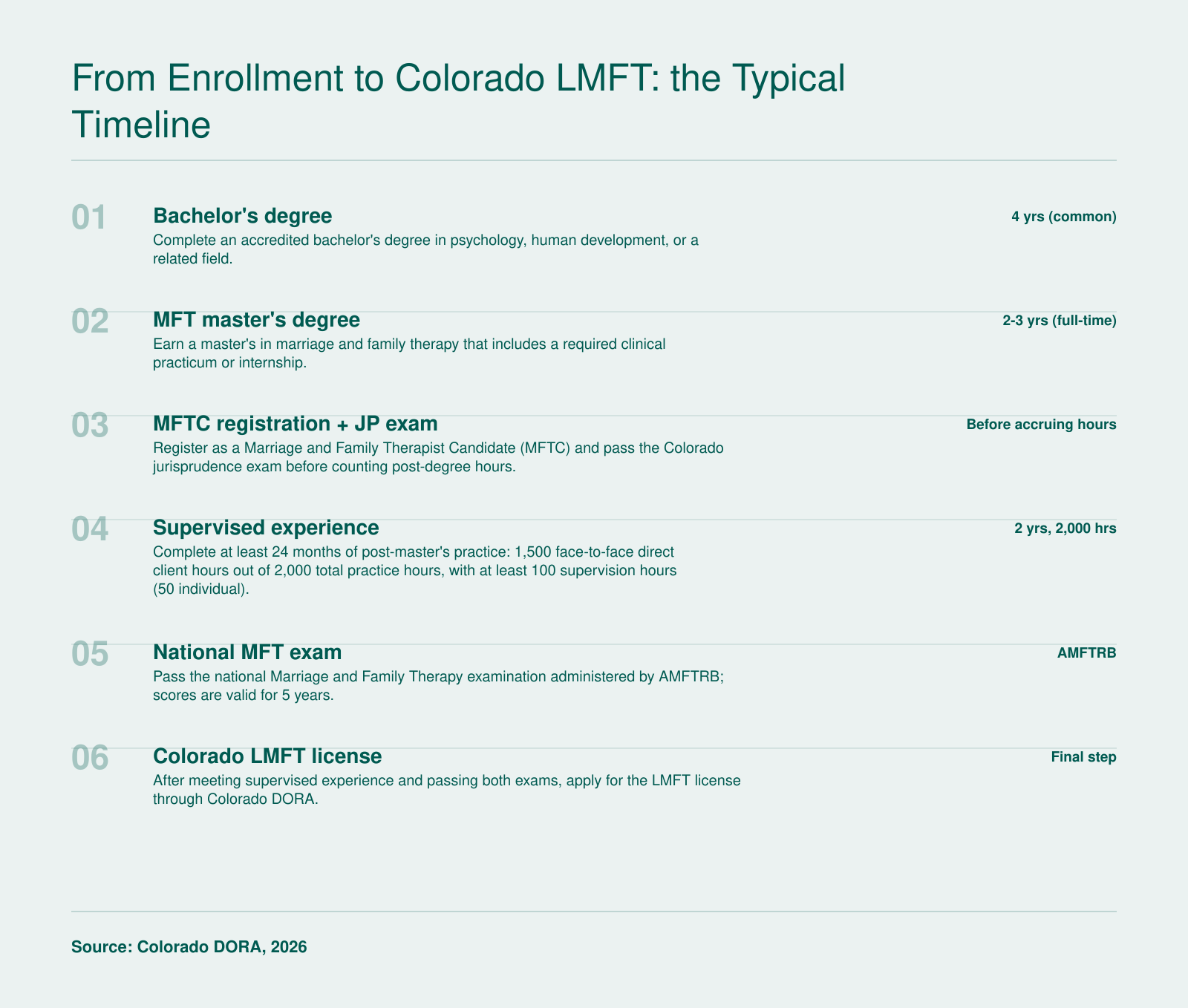
From Enrollment to Colorado LMFT: the Typical Timeline
From enrollment to Colorado LMFT, the typical path runs about six to seven years: a four-year bachelor's, a two- to three-year master's, then two years of post-master's supervised practice. The post-degree phase requires at least 2,000 practice hours, including 1,500 direct client hours, plus at least 100 supervision hours.
Master's Degree vs. a Post-Graduate MFT Certificate
Who should choose a post-graduate MFT certificate over enrolling in a full university master's program? The certificate is built for people who already hold a master's in counseling, mental health, or a related field and need a focused MFT pathway rather than another degree. It runs about 24 months and 46 quarter credits, including 500 clinical hours and 250 therapy sessions, and its COAMFTE post-degree accreditation supports Colorado MFTC and LMFT eligibility. Estimated total cost is $19,245, with a scholarship rate near $14,040, though supervision and practicum fees add to that, a price point to weigh against the Most Affordable Master's in Marriage and Family Therapy Programs. Outside Colorado, state boards set their own rules, so the certificate may carry less licensure portability than a degree-based MFT. Rule of thumb: choose the certificate if you already have a qualifying master's and plan to practice in Colorado; choose a full university master's, including Accelerated Master's in Marriage and Family Therapy Programs, if you need the degree itself or multi-state flexibility.
Colorado Licensing at a Glance
Why Earnings, Debt, and Net Price Drove These Placements
A strong MFT program is one where graduates can realistically cover their loans and still build a career, so this list rewards programs where completers' earnings outpace what they borrow and pay. We looked first at program-level median earnings at set points after completion, usually one year and five years out when a program reports them. Next we weighed each student's likely debt load, using median debt and net price after aid, and checked the graduation rate to see whether students actually finish. Institution-wide earnings and debt numbers are helpful school context, but they are not program outcomes, so they carry less weight. The schools that place well here show a clear pattern: reasonable net price, manageable debt, and graduates who earn enough to move forward.
Compare Marriage and Family Therapy programs on the data that matters
Explore more Counseling specializations or browse every graduate field.
All Counseling programs