Clinical Mental Health Counseling Master's Programs With No GRE Required
Compare 670+ accredited no-gre Clinical Mental Health Counseling programs at 580+ schools, with graduate earnings, cost, debt, and completion data from IPEDS and the U.S. College Scorecard.

Many clinical mental health counseling programs have dropped the GRE, and CACREP accreditation does not require it. But "no GRE" often depends on a minimum undergraduate GPA, with extra requirements for applicants who fall below it.
A waived test also says nothing about licensure. Accreditation and format decide whether a graduate meets a state's LPC or LMHC education requirements, and the cheapest or fastest option can still fall short. That gap is where applicants lose the most time and money.
Key Points
- CACREP accreditation does not require the GRE, so waivers rarely limit your licensure options.
- Without a test score, interviews and personal statements carry more weight in admission decisions.
- Real cost is the per-credit rate across 60 credits plus fees, not the sticker price.
10 Top No-GRE Clinical Mental Health Counseling Master's Programs for 2027
This list starts with programs that waive the GRE as a formal admissions barrier, then orders schools by how reliably they keep and graduate students, with cost and postgraduate earnings as supporting context. Because no-GRE policies can vary by concentration and application cycle, treat each program as test-optional rather than blanket-waived and confirm the current policy before applying.
Marquette University
#1Milwaukee, WI · ~$25,000/yr (est.)
Best for: Working professionals adding a counseling specialization
Marquette's Master of Science in Clinical Mental Health Counseling combines CACREP-accredited online and campus options with three focused concentrations in addiction, child and adolescent, and clinical rehabilitation counseling. The 60-credit program can be completed in 21 months, with a February 1 priority deadline and clinical placements in community settings. Strong job placement and scholarship pathways make it a practical choice for working professionals.
- CACREP accredited
- 60 credit hours in 21 months
- Three concentration options
- No GRE required
- Rolling admissions with February 1 priority
- Online and campus options
- Clinical placements in community settings
- 91% job placement rate
- Concentration in addiction counseling
- Test optional with rolling admissions
- Prepares for substance use and recovery settings
- 3.0 GPA minimum
- Scholarships and financial aid available
- Child and adolescent counseling concentration
- Only CMHC-CAS program in Wisconsin
- HRSA grant for child and adolescent specialization
- Faculty interview required for admission
- Trauma-informed, social justice curriculum
- Clinical rehabilitation counseling concentration
- Focus on disability and psychosocial aspects
- No prerequisite courses required
- Guided practical clinical placement
- Prepares for hospitals and community mental health
University of Oklahoma – Hudson College of Public Health
#2Norman, OK · ~$9,000/yr (est.)
Best for: Oklahoma residents seeking flexible hybrid LPC path
Oklahoma's Hudson College of Public Health offers a hybrid Master of Clinical Mental Health Counseling that can be completed through 16-week, weekend, or online coursework on the Norman or Tulsa campuses. The 60-credit, CACREP-aligned curriculum includes a 100-hour practicum and is approved by the state board for LPC licensure. No GRE is required.
- CACREP accredited
- No GRE required
- 60 total credit hours
- 100 clinical hours
- Multiple campus options: Norman and Tulsa
- 16-week, weekend, or online coursework
- Leads to LPC licensure in Oklahoma
- Emphasizes social justice and multicultural competencies
University of Utah
#3Salt Lake City, UT · $9,000 – $28,000/yr (est.)
Best for: Utah career changers pursuing social justice
Utah's M.Ed. in Clinical Mental Health Counseling is a competitive, three-year campus program with an 800-hour internship and an internship-fair placement model. The MPCAC-accredited curriculum emphasizes socially just practice, and admission is test-optional for the 2026 cycle.
- No GRE required
- MPCAC accredited through 2028
- 60 credit hours
- 800 clinical hours
- Approximately 10% acceptance rate
- Prepares for LCMHC licensure
- Research-based, socially just practices
- Apply by 2026-12-01
Marist University
#4Poughkeepsie, NY · ~$17,000/yr (est.)
Marist's campus-based M.A. in Clinical Mental Health Counseling offers a two-year accelerated or three-year schedule with 700 supervised clinical hours. The NYSED-approved program plans to apply for CACREP accreditation and offers graduate assistantships up to $4,500.
- No GRE required; test optional
- 60 total credit hours
- Full-time and part-time options
- 700 clinical hours
- Two-year accelerated full-time track or three-year schedule
- Approved by NYSED for LMHC licensure
- CACREP accreditation application planned
- Graduate assistantship up to $4,500 yearly
The University of Alabama
#5Tuscaloosa, AL · ~$12,000/yr (est.)
Alabama's CACREP-accredited MA includes four concentration areas and starts fall, spring, or summer. The 60-credit curriculum requires a 100-hour practicum and 600-hour internship with weekly supervision, and admission does not require the GRE.
- CACREP accredited
- No GRE required
- 60 total credit hours
- Starts fall/spring/summer
- 600-hour internship and 100-hour practicum
- Weekly group and individual supervision
- Four concentration options
- 3.0 GPA, two letters of recommendation
Adelphi University
#6Garden City, NY · ~$33,000/yr (est.)
Adelphi's master's in mental health counseling with a substance abuse concentration prepares students for CASAC-T eligibility through evening classes and placements at New York hospitals and agencies. The two-year, test-optional program is housed in the nationally ranked Derner School of Psychology.
- Substance Abuse Counseling concentration
- 2-Year program
- Test optional
- CASAC-T certificate eligible
- Evening classes
- Practicum and internship in NYC hospitals
- 3.1 GPA, prerequisite psychology courses
- Close ties with NYC hospitals
Sacred Heart University
#7Fairfield, CT · ~$34,000/yr (est.)
Sacred Heart's online MA in Clinical Mental Health Counseling blends CACREP-accredited coursework with two Connecticut residencies. Full-time students can finish in two years, and military benefits plus federal aid are accepted.
- CACREP accredited
- No entrance exam required
- $54,000 total program tuition, $900 per credit
- 60 credit hours
- Two immersive Connecticut residencies
- Full-time and part-time options
- 2.8 GPA, two references
Rollins College
#8Winter Park, FL · ~$23,000/yr (est.)
Rollins offers a 61-credit MA in Clinical Mental Health Counseling with optional concentration tracks in family and relationship therapy or applied neuroscience. The cohort-based campus program includes 100 hours of advocacy fieldwork and a Master Therapist Series capstone, with no application fee and no GRE.
- Family and relationship therapy concentration
- 61-credit curriculum
- Cohort-based delivery
- Three-year or four-year track
- 100 hours advocacy fieldwork
- Master Therapist Series capstone
- Prepares for LMHC and LMFT licensure
- No application fee
- Applied neuroscience concentration
- 61 total credit hours
- Cohort-based structure
- No entrance exam required
- Prepares for LMHC licensure
- Master Therapist Series capstone
- 100 hours advocacy fieldwork
Philadelphia College of Osteopathic Medicine
#9Philadelphia, PA · ~$32,000/yr (est.)
PCOM's MS in Mental Health Counseling is a two-year, CBT-oriented program with evening and weekend classes and part-time options. Rolling admissions, no application fee, and no GRE or MAT requirement lower barriers, though prerequisite psychology coursework is expected.
- No GRE or MAT required
- 2-Year, 60 credit hours
- Evening and weekend courses
- Rolling admissions, no application fee
- Cognitively behavioral tradition
- Prerequisites: intro psychology, statistics, abnormal psychology
- Writing sample required
- Three letters of recommendation
Agnes Scott College
#10Decatur, GA · ~$20,000/yr (est.)
Agnes Scott's in-person, cohort-based MA in Clinical Mental Health Counseling can be completed in five semesters with daytime or evening cohorts. The CACREP-accredited, 60-credit program emphasizes intersectional social justice and prepares graduates for Georgia LPC licensure.
- CACREP accredited
- No GRE required
- 60 credit hours
- Cohort-based daytime or evening
- Five consecutive semesters
- Intersectional social justice focus
- Prepares for LPC licensure in Georgia
- In-person delivery
Cost & outcomes by school
Federal data for the highest-earning Clinical Mental Health Counseling programs, independent of the ranking above. Earnings are this field's master's graduates four years after completing, where the Scorecard reports them.
| School | Earnings | Tuition / yr | Debt | Grads/yr | Format |
|---|---|---|---|---|---|
| Bay Path University MA | $79,114 | $15,162 | $56,228 | 25 | Online |
| Indiana State University IN | $73,874 | $8,596 | $36,342 | 28 | Campus |
| CUNY Brooklyn College NY | $73,843 | $11,524 | $36,646 | 28 | Campus |
| University of Phoenix-Arizona AZ | $71,586 | $15,208 | $52,671 | 164 | Hybrid |
| Florida State University FL | $61,024 | $10,553 | $41,000 | 388 | Campus |
| Capella University MN | $59,050 | $15,092 | $45,797 | 1,261 | Hybrid |
| Northeastern State University OK | — | $5,771 | — | — | Campus |
| Texas A&M University-Texarkana TX | — | $6,036 | — | — | Hybrid |
| Northwestern College IA | — | $6,790 | — | — | Online |
| University of Nevada-Reno NV | — | $7,032 | — | — | Campus |
Sources: U.S. Department of Education. Tuition and graduates: IPEDS. Earnings and debt: College Scorecard, this field's master's graduates; a dash means no figure is reported.
Cost, debt & payoff
Median earnings of this field's master's graduates (4 yrs after completing) vs. their median federal loan debt · U.S. College Scorecard
Across these programs the median graduate earns about $59,927 and finishes with roughly $56,013 in debt — a ratio that clears a common rule of thumb (keep debt below first-year salary). Tuition and debt vary widely school to school, so check the per-school figures in the table above before you shortlist.
Why Counseling Programs Are Dropping the GRE and Where Conditions Still Apply
The GRE has lost its grip on clinical mental health counseling admissions because it says little about who will make a good clinician. Programs also cite access and equity concerns, and many pandemic-era waivers simply stayed. CACREP accreditation does not require the test, so each school, including those with online master's in clinical mental health counseling, sets its own rules.
Expect three patterns:
- Fully GRE-free: NC State, UNC Greensboro, Lamar, and St. Mary-of-the-Woods list no exam.
- Waived above a GPA line: Gwynedd Mercy waives at 3.0 or with a prior graduate degree; Nicholls sets 3.5 for waiver requests.
- GRE as an alternate path: Below 3.0, Gwynedd Mercy asks for scores, and Scranton and Xavier may ask for test results.
Lower-GPA routes exist. East Texas A&M and UW-Extension offer conditional or provisional admission, with East Texas A&M requiring a 3.00 in set early courses.
What replaces the test: a personal statement, references, a resume, and often a group or individual interview screening for counseling dispositions.
Confirm the waiver on each program's own admissions page. Policies vary by applicant and by year.
Check CACREP Status and Your State's LPC Rules Before You Apply
The central tradeoff is geographic flexibility versus licensure certainty. A program may fit your budget and schedule, especially among the most affordable clinical mental health counseling programs, but if it doesn't meet the state board's education standards, you could spend years making up coursework later.
Where CACREP Is the Default
CACREP accreditation signals a 60-credit master's with at least 100 practicum hours and 600 internship hours, though some states require more. Florida, Kentucky, North Carolina, and Ohio require graduation from a CACREP-accredited program for LPC or LMHC licensure; Florida's rule took effect July 1, 2025. Other states, including Alabama and Colorado, don't strictly require CACREP but treat it as the clearest path because their rules align with the same coursework and clinical-hour pattern.
The Exam and Compact Factor
You'll also need to pass the NCE or NCMHCE; Colorado adds a state jurisprudence exam. The Counseling Compact is intended to smooth license portability, but its member-state status still varies, so graduates of non-CACREP programs can face extra coursework when they move.
Check Before You Enroll
Compare the program's exact credit hours and clinical hours against the licensure board's rules in the state where you plan to practice. A program that meets one state's requirements may not meet another's, even if both accept CACREP-equivalent standards.
Related Articles
What a No-GRE Counseling Master's Really Costs: Tuition, Net Price, and Debt
A no-GRE clinical mental health counseling master's is a 60-credit graduate degree, and its real price is the per-credit rate multiplied across all 60 credits, plus mandatory fees, not the sticker number schools advertise. Where you live matters: public programs charge Texas or Florida residents far less than out-of-state students, and that gap can double your bill.
The Annual Range
Annual graduate tuition at the lowest-cost no-GRE schools spans widely. Lamar University in Texas lists roughly $8,600 for residents versus about $16,000 out-of-state. Florida International University runs near $6,500 in-state and around $24,400 out-of-state. The resident discount is the single biggest lever on cost.
Total Program Estimates
Multiplying per-credit rates across 60 credits gives a clearer picture:
- Texas A&M Corpus Christi: about $201 per credit for 2025-2026, roughly $12,032 total. Fees are not stated.
- Lamar University: $360 per credit for 2026, a stated total tuition of $21,604. Mandatory fees are not broken out.
- Utah Valley University: about $27,236 total; per-credit and fees are not published.
- Walden University: $535 per credit, roughly $48,150 total.
Program-level median debt and graduate earnings are unavailable for these counseling tracks, so we will not guess. Any net-price figure you see is an institution-wide average after aid and only approximates what a graduate student actually pays.
Fully Online, Hybrid, or Campus: How No-GRE Formats Differ
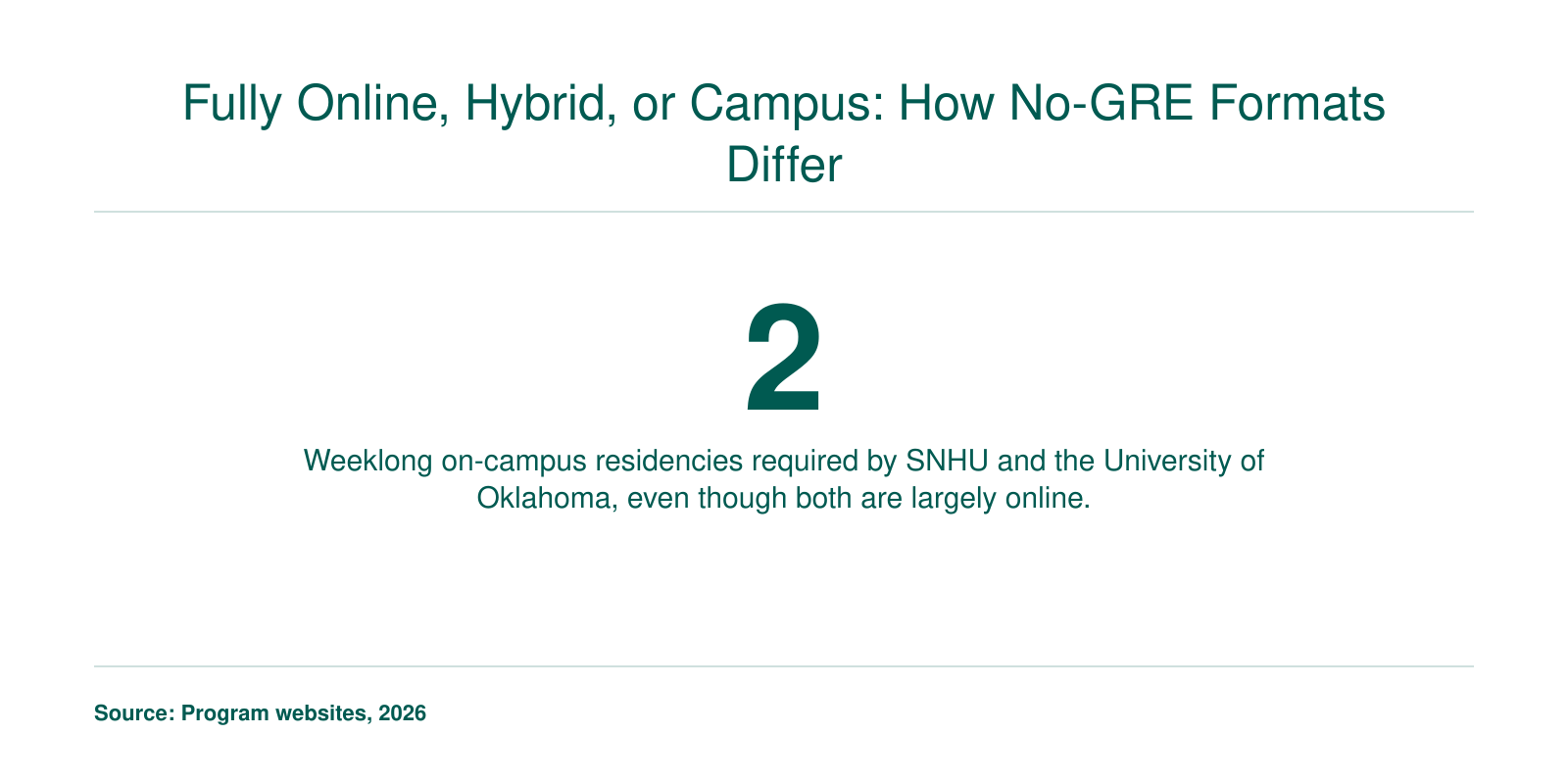
Fully online programs such as University of Western States lean on local placement and few campus visits. Online programs with residencies add short in-person stints: Huntington requires a 3-day intensive, George Fox a 2-day residency, and Sacred Heart a 1-week on-ground session. Hybrid formats like Seattle University's add weekly live group supervision. No format removes in-person clinical hours at an approved local site. Some online programs also cannot admit residents of certain states, so confirm your state before applying.
Clinical Mental Health Counseling programs by state
No-GRE Counseling Degree Questions, Answered
These answers cover the questions applicants ask most often about GRE waivers, formats, licensure, and timing. Policies change by school, so confirm details on each program's admissions page.
Do all applicants skip the GRE, or only those above a GPA cutoff?
Which no-GRE counseling programs can be finished without visiting campus?
Does an M.Ed., M.S., or M.A. in counseling make a difference for LPC licensure?
Are clinical hour requirements any lighter at programs that waive the GRE?
When do no-GRE counseling master's programs typically set application deadlines?
Will my license transfer if I move to another state after graduating?
Compare Clinical Mental Health Counseling programs on the data that matters
Explore more Counseling specializations or browse every graduate field.
All Counseling programs