Best Clinical Mental Health Counseling Master's Programs in Maryland
Compare 7 accredited Clinical Mental Health Counseling programs in Maryland, with graduate earnings, cost, debt, and completion data from IPEDS and the U.S. College Scorecard.

Every clinical mental health counseling master's in Maryland runs 60 credit hours, the threshold the state's LCPC pathway expects. The practical question is which program gets you there without surplus debt or extra semesters.
Maryland's pool of accredited programs is small, so each choice carries real weight, and campus and hybrid options sit side by side rather than on separate tracks. Cost, admissions requirements, and supervised clinical hours separate these programs far more than reputation does.
Key Points
- CACREP's standard calls for 100 practicum hours plus 600 internship hours.
- University of Maryland Eastern Shore is the one hybrid option here.
- Bowie State, Hood College, and Johns Hopkins hold CACREP accreditation for counseling.
Best Clinical Mental Health Counseling Master's Programs in Maryland, Ranked
Six Maryland programs make this list, spanning private, public, and HBCU campuses from Baltimore to the Eastern Shore. Each card flags CACREP status as our data shows it, because Maryland's LCPC pathway expects a 60-credit master's from a Board-approved accredited institution. Where accreditation is not confirmed, check the CACREP directory and the Maryland Board of Professional Counselors and Therapists before you apply.
Johns Hopkins University
#1Baltimore, MD · ~$65,000/yr (est.)
Best for: International students seeking STEM-designated study
Johns Hopkins offers its 60-credit Master of Science in Counseling with a Clinical Mental Health Counseling concentration in person, full-time or part-time, over three to five years. It is listed as CACREP accredited, and the program includes a practicum and internship in clinical mental health settings. Federal data shows median earnings of about $54,700 one year after graduation and about $66,800 four years out. Admission is selective, and the next fall application deadline is January 21, 2027.
- CACREP accredited per our program data
- 60 credit hours, completed in three to five years
- Full-time and part-time options, fall start
- Application deadline January 21, 2027
- Practicum and internship in a clinical mental health setting
- Prepares for NCE and NCMHCE exams
- STEM-designated with a 24-month OPT extension
- Financial aid and scholarships available
Hood College
#2Frederick, MD · ~$9,000/yr (est.)
Best for: Working professionals needing evening classes
Hood College in Frederick runs a 60-credit M.S. in Clinical Mental Health Counseling with classes in late afternoons, evenings, and weekends. Students train at the on-campus NeighborHood Counseling Training Center, and a partnership with Frederick Health widens practicum options. Our program data lists it as CACREP accredited. Federal data shows median earnings of about $56,100 one year after graduation.
- CACREP accredited per our program data
- 60 credits, typically 2.5 to 3 years
- About 700 supervised clinical hours
- Fall and spring starts, full-time or part-time
- 3.0 GPA minimum and two recommendation letters
- Optional certificates in thanatology or trauma, crisis, grief, and loss
- Early eligibility for NBCC NCC certification
- Prepares for LCPC licensure in Maryland
Bowie State University
#3Bowie, MD · ~$11,000/yr (est.)
Best for: Aspiring counselors focused on culturally responsive practice
Bowie State's 60-credit Master of Arts in Mental Health Counseling centers on culturally responsive practice and social justice. Students complete 1,000 hours of supervised field experience across three placements. It is described as Maryland's first HBCU with CACREP accreditation. Federal data shows median earnings of about $58,600 one year after graduation and about $79,100 four years out.
- CACREP accredited per our program data
- 60 credit hours
- 1,000 hours of supervised field experience
- Full-time and part-time options
- 3.0 GPA minimum and three recommendation letters
- Interview required for admission
- Prerequisite courses required
- Six-level course sequence with a personal advisor
Coppin State University
#4Baltimore, MD · $5,000 – $10,000/yr (est.)
Coppin State in Baltimore pairs clinical mental health counseling with a rehabilitation focus for work with people with disabilities. The 60-credit curriculum includes 700 supervised clinical hours. The program says it aligns with CACREP standards, but we could not confirm CACREP accreditation, so verify status before relying on it for LCPC planning.
- 60 credit hours
- 700 supervised clinical hours
- Curriculum aligned with CACREP standards; accreditation not confirmed
- Focus on counseling individuals with disabilities
- Culturally competent counseling emphasis
- On-campus format
Washington Adventist University
#5Takoma Park, MD · $10,000 – $15,000/yr (est.)
Washington Adventist University in Takoma Park offers a Master of Arts built on its SoulWellness model, which integrates spiritual, emotional, and physical health. A resource center provides internship handouts, LGPC application information, and NCE registration guidance. Our data does not confirm CACREP accreditation, so check the CACREP directory and the Maryland licensing board before applying. Published detail on credits and clinical hours is limited.
- CACREP accreditation not confirmed in our data
- SoulWellness model integrating faith and learning
- Clinical internship placement and handouts provided
- LGPC application information on the program site
- NCE registration guidance for students
University of Maryland Eastern Shore
#6Princess Anne, MD · ~$8,000/yr (est.)
The University of Maryland Eastern Shore in Princess Anne offers a Clinical Mental Health Counseling specialization within its Counselor Education M.Ed., with most courses on one evening per week. The 60-credit program includes a 100-hour practicum and 600-hour internship. We could not confirm CACREP accreditation in our data, so verify it directly. Scholarships and graduate assistantships are available.
- CACREP accreditation not confirmed in our data
- 60 credit hours, hybrid delivery
- 100-hour practicum and 600-hour internship
- Most courses meet one evening per week
- Fall, spring, and summer starts
- 3.0 GPA minimum, three letters, and an interview
- Capstone required
- Prepares for LGPC and LCPC licensure
Cost & outcomes by school
Federal data for the highest-earning Clinical Mental Health Counseling programs, independent of the ranking above. Earnings are this field's master's graduates four years after completing, where the Scorecard reports them.
| School | Earnings | Tuition / yr | Debt | Grads/yr | Format |
|---|---|---|---|---|---|
| Bowie State University MD | $79,149 | $10,854 | — | 14 | Campus |
| Johns Hopkins University MD | $66,778 | $64,730 | $59,000 | 49 | Campus |
| University of Maryland Eastern Shore MD | — | $8,010 | — | — | Hybrid |
| Washington Adventist University MD | — | $11,525 | — | — | Campus |
| Hood College MD | — | $9,470 | $46,161 | 28 | Campus |
| Coppin State University MD | — | $8,514 | $61,500 | 3 | Campus |
| Loyola University Maryland MD | — | $20,070 | — | — | Campus |
Sources: U.S. Department of Education. Tuition and graduates: IPEDS. Earnings and debt: College Scorecard, this field's master's graduates; a dash means no figure is reported.
What Earned a Program Its Place on This List
A Clinical Mental Health Counseling master's earns its keep through what graduates take home and what they owe, not through the name on the diploma. The Master's Programs in Maryland below are weighed on earnings after completion, typical borrowing, and what students actually pay once grant aid is subtracted.
Two caveats shape how those numbers should be read. Net price and graduation rates are institution-wide averages covering every student at the school, so they describe the university rather than its counseling program specifically. Earnings and debt measured at the program level come from federal College Scorecard reporting, which publishes figures only where a program enrolls enough graduates to clear privacy thresholds. Several counseling programs here have no published figure at all, and where that is the case, the gap is noted rather than filled with an estimate.
Online and Hybrid Counseling Master's Options in Maryland
Hybrid counseling study blends scheduled class sessions with supervised clinical work in a real setting, and in Maryland that mix is narrower than many applicants expect. The University of Maryland Eastern Shore is the one school here listed as hybrid, with most courses held one evening per week. Johns Hopkins, Hood, Bowie State, Coppin State, and Washington Adventist are listed as campus-based. Hood does offer late afternoon, evening, and weekend classes, which helps working adults without online delivery.
Practicum and internship placement
UMES requires a 100-hour practicum and a 600-hour internship. Bowie State's practicum, which begins in MHCO 836, runs 200 hours with at least 40% direct client contact.1 Hood's 700 clinical hours can draw on its on-campus NeighborHood Counseling Training Center. The published material does not make clear whether each school arranges sites or students must find their own, or whether any residency is required, so ask admissions directly.
Out-of-state online programs
If you are weighing an online master's in clinical mental health counseling based elsewhere, it must still satisfy Maryland's education requirements for LGPC and LCPC licensure. Confirm that with the Maryland licensing board before you enroll.
Which Maryland Counseling Master's Programs Skip the GRE
The GRE can feel like one more cost and hurdle before a counseling degree, and several programs here fall into the clinical mental health counseling master's with no GRE required category. Based on current admissions pages, Hood College publishes no GRE requirement or waiver for its M.S. in Counseling; it leans on transcripts, a personal statement, a résumé, two recommendation letters, and an interview for every applicant. UMGC's Master of Science in Clinical Professional Counseling likewise publishes no GRE policy, and applicants may be invited to a virtual group interview rather than facing one as a blanket requirement.
Washington Adventist University only pulls the GRE in: applicants at a 2.75 GPA or above need no scores, while those from 2.60 to 2.74 must submit GRE Psychology subject scores of at least 150. Frostburg State's Counseling Psychology program sets a 3.0 cutoff; below that, you submit a general GRE of 300 or an MAT of 410, with selected applicants invited to interview.1 Where a page stays silent, we say so rather than guess.
Related Articles
The Most Affordable Paths to a Maryland CMHC Master's
These are the lowest-cost options here by approximate net price. Net price is an institution-wide average after grant aid, not a quote for this master's, so your own cost will differ. Credit load drives the real price: Hood College, for comparison, publishes $850 per credit, about $51,000 over 60 credits before a $145 semester comprehensive fee.
| School | Approx. net price | Program tuition, in-state | Program tuition, out-of-state | Credits required |
|---|---|---|---|---|
| Coppin State University | $9,977 | $8,514 | $14,310 | 60 |
| University of Maryland Eastern Shore | $13,338 | $8,010 | $13,428 | 60 |
| Washington Adventist University | $18,526 | $11,525 | $11,525 | N/A |
Before you compare tuition, confirm the program is CACREP accredited. Accreditation is the simplest way to show your degree meets the coursework standards behind Maryland licensure.
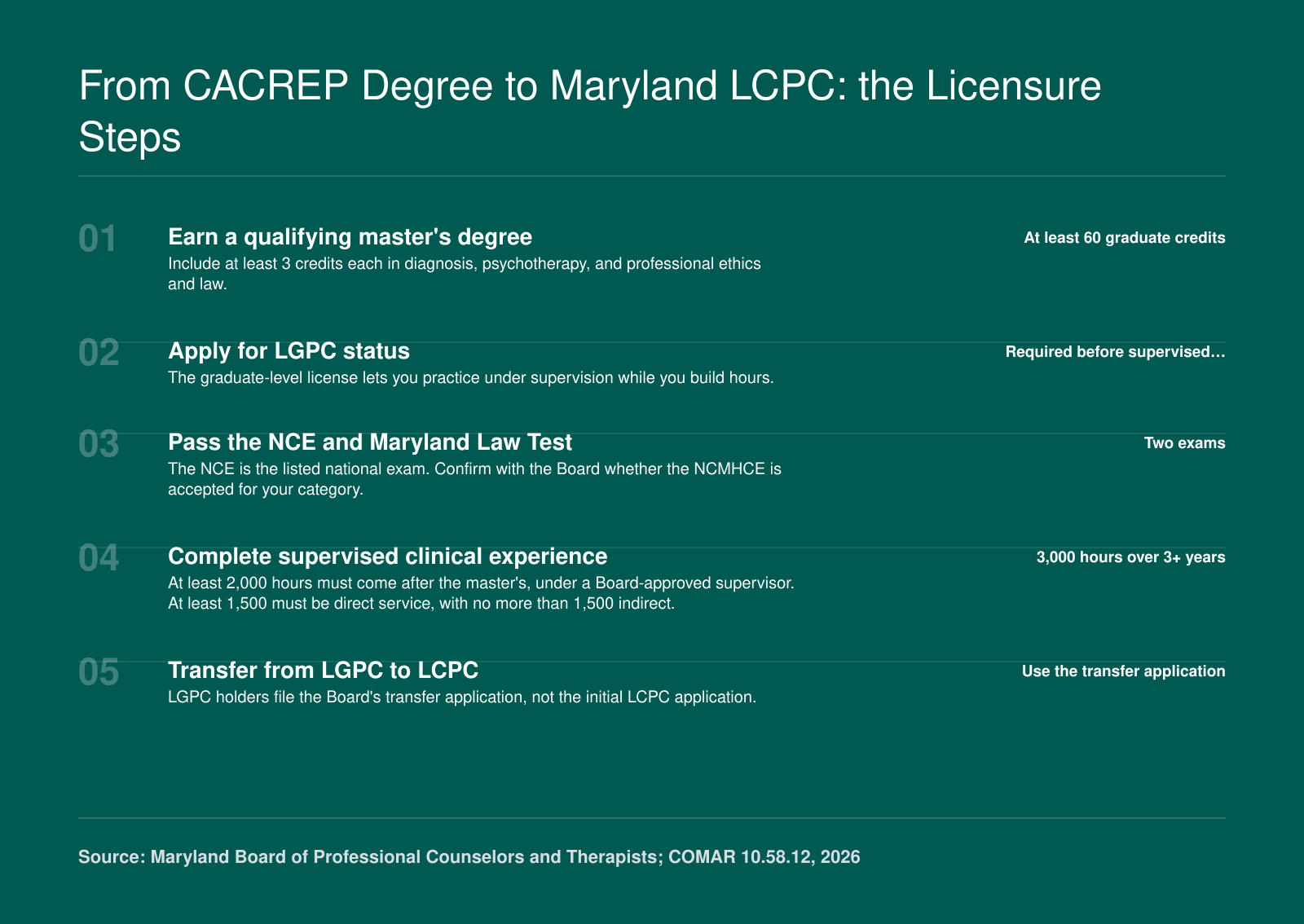
From CACREP Degree to Maryland LCPC: the Licensure Steps
The Maryland Board of Professional Counselors and Therapists licenses counselors in the state. The path runs from a qualifying degree through the LGPC credential to full LCPC status.
Clinical Hours and How Long the Master's Takes
Short timelines are appealing, but the clinical hours in a master's are what prepare you for supervised client work. CACREP's standard is 100 practicum hours plus 600 internship hours, and Johns Hopkins aligns at 700 total. Bowie State asks for more: a 200-hour practicum followed by two 400-hour internships, for a total of 1,000 hours.1 Those in-program hours are not the same as the post-degree supervised experience Maryland requires before LCPC licensure; that comes after graduation under an approved supervisor. Most 60-credit counseling programs fall in the two-to-three-year range full time, while accelerated clinical mental health counseling master's programs can shorten the timeline. Johns Hopkins offers full- and part-time sequences with a five-year maximum, while Bowie State's predominantly part-time design moves through six fixed levels2, letting working students stretch the timeline without losing the sequence. Compare program totals and clinical mental health counseling degree cost, not just credit counts, when weighing speed against clinical readiness.
Top Graduate Earnings Among Ranked Programs
Highest program-level earnings
Before You Apply: Quick Answers
These answers cover the questions applicants ask most before submitting materials. Admissions details change, so confirm each point with the program and the Maryland licensing board.
How selective is the Johns Hopkins clinical mental health counseling master's?
When are application deadlines and start dates for Maryland CMHC programs?
Can a Maryland LCPC transfer to another state?
Compare Clinical Mental Health Counseling programs on the data that matters
Explore more Counseling specializations or browse every graduate field.
All Counseling programs