Master's Programs in Missouri
Every master's program reported by a school in Missouri: 940+ programs at 50+ graduate schools, with the online options, costs and outcomes behind each one.

The first cost decision in Missouri is public or private. University of Missouri System campuses bill by the credit hour, and at $400 to $700 per credit a 30-credit degree runs roughly $12,000 to $21,000 before fees. Private schools such as Saint Louis University and Washington University price well above that range, and a higher sticker price does not automatically bring higher pay.
Online master's programs complicate the comparison. Several Missouri schools charge one flat rate regardless of residency, which lets out-of-state students skip the nonresident premium, though some charge online credits above their campus rates.
Key Points
- Expect $400 to $700 per credit over 30 to 36 credits.
- Missouri counseling licensure requires 3,000 supervised hours over at least 24 months.
- Federal graduate borrowing tightened July 1, 2026, so assistantships matter more.
Popular degrees in Missouri
Master's programs in Missouri by field
Business & Management
- Management30 programs
- Healthcare Administration27 programs
- Accounting27 programs
- General Business25 programs
- Analytics24 programs
- Organizational Leadership20 programs
- Finance20 programs
- Public Administration19 programs
Education & Teaching
- Teaching31 programs
- Curriculum & Instruction21 programs
- Educational Leadership16 programs
- Special Education15 programs
- Secondary Education15 programs
- Reading & Literacy14 programs
- Elementary Education13 programs
- STEM Education or Science Education or Mathematics Education11 programs
Nursing
- Nursing Education or Nurse Educator17 programs
- Family Nurse Practitioner (FNP)14 programs
- Psychiatric Mental Health Nurse Practitioner9 programs
- Nurse Administrator5 programs
- Pediatric Nurse Practitioner4 programs
- Adult Gerontology Acute Care Nurse Practitioner4 programs
- Nurse Executive Leader3 programs
- Adult Gerontology Primary Care Nurse Practitioner2 programs
Healthcare
- Health Administration16 programs
- Speech Pathology12 programs
- Nutrition8 programs
- Public Health8 programs
- Health Informatics8 programs
- Health Education6 programs
- Exercise Science5 programs
- Clinical Research Management1 program
Communications & Media
- Communication19 programs
- Speech Pathology15 programs
- Communication Disorders12 programs
- Strategic Communication5 programs
- Journalism1 program
- Media Communication1 program
- Technical Communication1 program
- Social Media1 program
Religion & Theology
- Theology13 programs
- Divinity12 programs
- Christian Ministry9 programs
- Christian Leadership5 programs
- Youth and Family Ministry1 program
- Urban Ministry1 program
Counseling
- School Counseling17 programs
- Clinical Mental Health Counseling13 programs
- Christian Counseling5 programs
- Marriage and Family Therapy or Marriage and Family Counseling2 programs
- Addiction Counseling1 program
Psychology
- Applied Behavior Analysis10 programs
- Counseling Psychology9 programs
- General Psychology5 programs
- Industrial Organizational Psychology5 programs
- Educational Psychology or School Psychology2 programs
- Child Psychology1 program
- School Psychology1 program
- Clinical Psychology1 program
Social Work & Social Sciences
- Social Work14 programs
- Social Work Advanced Standing9 programs
- Sociology5 programs
- Political Science, Government3 programs
- Human Services1 program
Computers & IT
- Data Analytics13 programs
- Cybersecurity8 programs
- Information Security & Assurance5 programs
- Machine Learning2 programs
Science & Engineering
- Environmental Science10 programs
- Sustainability or Environmental Management7 programs
- Geography6 programs
Arts & Design
- Creative Writing13 programs
- Fine Arts3 programs
Criminal Justice & Law
- Public Policy4 programs
- Master of Laws4 programs
- Legal Studies3 programs
- Business Law2 programs
- Homeland Security1 program
What You'll Pay for a Missouri Master's Degree
Missouri graduate tuition is billed by the credit hour, so a degree that sounds affordable at $400 to $700 per credit becomes clearer when you multiply it across 30 to 36 credits and add fees and program-specific charges.
Public in-state vs. out-of-state prices
Resident status is the biggest single variable. At the University of Missouri-Columbia, the 2026-27 proposal sets a resident graduate base rate of $575.80 per credit, while nonresidents pay $851.70 on top of that, or $1,427.50 combined before program supplements.1 Most graduate programs also add a resident program supplement of $16.50 to $24.80 per credit.1 At UMSL, 2026-27 rates run $697 per credit for Missouri residents and $1,658 for nonresidents in many arts and sciences and MSW programs. UMSL's College of Education is higher at $751 resident and $1,712 nonresident. Missouri State published a 2025-26 graduate rate of $394 per credit for residents and $786 for nonresidents, among the lower-priced publics in the state.2
A 30-credit program therefore lands in a wide range. At UMSL's standard rate, that is roughly $20,900 for residents and $49,700 for nonresidents before fees; at Mizzou's proposed base, roughly $17,300 and $42,800 before program supplements. Private universities such as Saint Louis University typically publish one rate for all students, so residency does not matter, but program-specific pricing may still vary.
Fees and differential tuition
Tuition is not the whole bill. Mizzou reported about $557 per semester in required fees for a typical full-time graduate student in 2025-26, and that figure can change by campus and program.4 Missouri State's required fees vary by college and course, and selected courses carry a per-credit enrollment fee for all students.3 UMSL's 2025-26 summary showed $0 in required fees for its reported typical full-time graduate student, though individual programs and courses may still add charges.4
Professional and clinical programs often cost more. UMSL's education rate is a clear example, and MBA programs, nursing, and other professional tracks frequently layer differential tuition or course fees above the standard graduate rate. Always build those charges into the total before comparing schools.
Graduate Tuition per Credit Hour at Mizzou, UMKC, UMSL, SLU and Other Missouri Schools
Where a student takes the course now matters almost as much as which campus offers it, because some Missouri schools charge online credits well above their campus rates. The figures below come from published tuition schedules. Schools update on different cycles, so the academic year is noted for each.
Published Per-Credit Rates
- Missouri State University (public): $414 per credit hour for residents (2026-2027)1 and $786 for nonresidents (2025-2026)2.
- Truman State University (public): $527 for residents (FY2026)3.
- Missouri S&T (public): $584 for residents on campus (FY2026)3. Online rates differ: $1,200 for most online graduate programs, or $950 for online Psychological Sciences, Mechanical Engineering, Aerospace Engineering, Business and Information Sciences, and Economics (2026-2027)4.
- UMSL (public): $677 for residents (FY2026)3.
- Webster University (private): $800 for everyone (2026-2027)5. Webster does not split resident and nonresident rates, and its online rate is the same.
What a 30-Credit Degree Adds Up To
At Missouri State's resident rate, 30 credits come to about $12,420 in tuition. At the other end, Missouri S&T's standard online rate of $1,200 puts the same credit load near $36,000, a gap of roughly $23,500. Webster lands in between at about $24,000. S&T's discounted $950 online programs would run about $28,500.
These totals cover tuition only. Mandatory fees, books, and any program-specific charges come on top, and a nonresident at Missouri State would pay closer to $23,580 for 30 credits.
Rates Not Shown Here
Published rates for Mizzou, UMKC, Saint Louis University, the University of Central Missouri, and Southeast Missouri State are not included in the figures above. Check each school's current bursar schedule before you build a budget, and compare rates from the same academic year. Many programs also charge flat or cohort-based prices that do not follow the standard per-credit schedule.
Online, Hybrid, and On-Campus Formats and How Long Each Takes
Missouri's graduate schools now offer three practical delivery lanes: fully online programs for students who cannot relocate, hybrid programs that pair online coursework with campus or clinical sessions, and evening or weekend on-campus formats built around full-time jobs in St. Louis and Kansas City. The right option usually comes down to credit load and time to degree rather than headline prestige.
Where Fully Online Options Are Concentrated
Mizzou Online is the most visible distance-learning hub in the state. Its education and technology in schools master's programs are fully online, carry 30 credit hours, and use 8- or 16-week sessions. The learning technologies and design master's is also fully online at 30 credits and typically takes about two years. The Higher Education M.Ed. adds a 33-credit, 8-week-course structure: a part-time student taking one course per 8-week session finishes in about two years, while a full-time student can complete in one year. Mizzou's Computer Science MS lets students choose fully online or hybrid delivery. Not every online-sounding degree is fully remote. The online journalism master's is blended, requires one campus visit, totals 33 credits, and usually takes two to three years part time.1 UMSL, UMKC, Missouri State, and the University of Central Missouri also maintain online and blended graduate options in fields such as education, business, nursing, and public health, though each program sets its own delivery terms.
Hybrid and Evening Formats for Working Professionals
Hybrid and evening or weekend formats are common in the St. Louis and Kansas City metro areas, especially in education, business, nursing, and public health. These tracks often pair evening synchronous classes or monthly campus sessions with asynchronous online work to accommodate full-time employment. Saint Louis University and nearby public universities offer graduate courses outside standard daytime hours, but students should verify with the specific department whether a program is live online, asynchronous, hybrid, or on campus.
Credit Loads and Realistic Timelines
Most Missouri master's degrees run about 30 to 36 credit hours, while counseling, social work, and nurse practitioner tracks commonly require 48 to 60 or more. A 30-credit degree can often be finished in one to two years full time; part-time students should plan for two to three years or longer depending on session length and course load. Accelerated 8-week terms compress that timeline, and some online programs offer 12-month completion routes. The University of Missouri sets an eight-year maximum for master's completion, though individual programs frequently require faster progress; other Missouri campuses apply their own maximums. Several Missouri schools also offer accelerated bachelor's-to-master's pathways that let undergraduates begin graduate credits early, but credit-sharing rules vary by department, so students should confirm eligibility before enrolling.
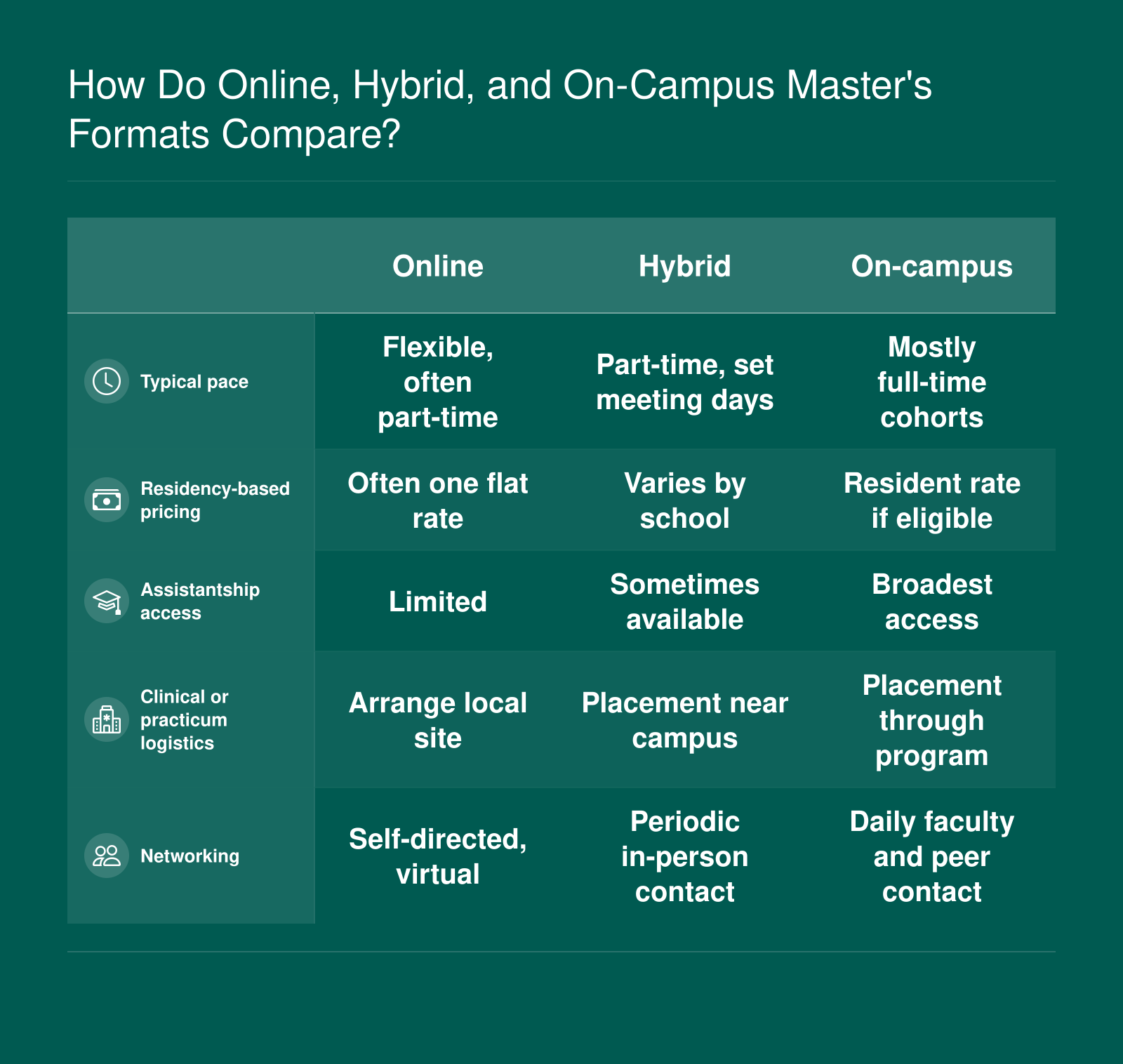
How Do Online, Hybrid, and On-Campus Master's Formats Compare?
The three formats differ less in the degree you earn than in how you pay, how you schedule, and who you meet along the way. Use this side-by-side to match a format to your budget and your life.
Missouri Graduate Admissions: GPA, GRE Waivers, and Deadlines
Most Missouri master's programs set a minimum undergraduate GPA of 2.75 to 3.0 on top of an accredited bachelor's degree, but that baseline is just the floor. University of Missouri-St. Louis, for example, lists 3.0 for regular graduate admission in its "How to Apply" guidance, while its Graduate Study Bulletin describes normal admission at a 2.75 GPA in the undergraduate and major field. Applicants below those thresholds can sometimes submit supporting evidence or recommendation letters, depending on the program. UMKC applies a similar 3.0 standard, though in its case that figure is the GPA required at degree conferral rather than a single university-wide admission cutoff.1 Individual departments routinely set stricter numbers than the campus baseline.
GRE and GMAT: Mostly Optional, Sometimes Required
The testing picture has shifted toward flexibility, with more master's programs with no GRE required, but it is not uniform. UMSL's Graduate School does not require the GRE, and its business programs (including the MBA and several MS degrees) have dropped the GMAT, admitting applicants at a 3.0 cumulative GPA; those below 3.0 can still earn restricted consideration with two recommendation letters. Mizzou's Master's Program Office treats the GMAT or GRE as preferred but not required2, and its Statistics master's lists the GRE as optional with a typical successful GPA at or above 3.03.
Doctoral and research-heavy tracks are stricter. Mizzou's PhD in Business Administration requires an official GRE or GMAT from every applicant, and its Marketing track expects a GMAT of 650 or more (or GRE equivalent) alongside a 3.3 GPA.4 The lesson: check the specific program page rather than assume a campus-wide waiver.
Deadlines and Funding Priority
Deadlines in Missouri are set program by program, not statewide. Mizzou's Master's Program Office uses a May 1 priority date and a July 1 final deadline for domestic fall applicants.2 Its Statistics program sets separate dates for funding: October 15 for spring and January 15 for fall full financial-aid consideration, with the applied master's track moving the fall date to March 15.3 The Business PhD closes full consideration on February 1.4 Across campuses, funding and international applicants almost always face earlier cutoffs, so apply well ahead of any stated final date.
Acceptance Rates
Missouri does not publish an official graduate acceptance rate for Mizzou, UMKC, UMSL, or Saint Louis University. Third-party estimates put Mizzou's overall graduate admit rate around 78 to 82 percent, but selectivity swings widely by program. Treat any single figure cautiously and look for department-level admission data instead.
Paying for It: Assistantships, Scholarships, and Employer Benefits
Federal graduate borrowing got tighter on July 1, 2026, which makes assistantships and employer money more important than they were a year ago.2
Graduate Assistantships
At the University of Missouri, eligible graduate assistants receive tuition remission, an insurance subsidy, and a stipend. For 2026-27, the university's minimum stipend for a master's or specialist assistantship is $18,540 on a 9-month appointment ($9,270 per semester) and $24,720 on a 12-month appointment. Nine-month awards are generally paid over 10 months, August 1 through May 31. Departments can pay more than these minimums.
Benefits vary by department and funding source. In Mizzou's Statistics and Data Science program, teaching assistants get a full tuition waiver and health insurance, and students appointed at quarter-time or above qualify for waivers. Regular TAs generally work half-time.4 Do not assume Mizzou's terms carry over to UMKC, Missouri S&T, or UMSL. Confirm them with each campus.
Apply through the department, not just the admissions office, and watch for funding deadlines that often fall earlier than the general application deadline.
Employer Tuition Assistance
Large Missouri employers and health systems often offer tuition benefits, so ask HR before you enroll. Federal tax law limits how much employer educational assistance you can receive tax-free each year, and anything above that is generally taxable income. Check the current limit and any service-commitment or repayment terms before relying on the benefit.
Federal Loans After July 1, 2026
- Annual cap: Most graduate students can borrow up to $20,500 a year in Direct Unsubsidized loans.1
- Aggregate cap: New graduate borrowers face a $100,000 limit, not counting undergraduate loans.1
- Grad PLUS: It is eliminated for new borrowers, so you can no longer borrow up to the full cost of attendance.2
- Professional programs: The limits are $50,000 a year and $200,000 in total. Ask your school's aid office whether your program qualifies as professional.3
- Lifetime cap: A $257,500 limit applies across undergraduate, graduate, and professional borrowing.2
Some continuing students may be able to borrow under the old rules for a limited period. Eligibility depends on conditions you should verify with the aid office.2
State-Specific Aid
No current Missouri-specific graduate scholarship or loan forgiveness program for nurses or teachers could be verified, so none is listed. Ask your program and the school's financial aid office what is available, and confirm amounts and service obligations in writing.
Licensure and Clinical Placement for Missouri Professional Degrees
What does a Missouri master's degree actually have to contain for the state to license you? The answer varies by profession, and in several fields the degree is only the first of three or four gates.
Counseling
Missouri's Licensed Professional Counselor path starts with a master's in counseling or a related field from a regionally accredited institution, carrying at least 48 semester hours.1 Many programs run longer than that, and a 60-hour curriculum is common nationally, so compare the credit total against both the state floor and your own portability plans if you may move. After the degree, you work under a provisional license while completing 3,000 supervised hours over no less than 24 months, including at least 1,200 hours of direct client contact and a minimum of 15 working hours per week.1 Supervision means at least one hour per week, face to face and documented, provided by a licensed professional counselor, psychologist, or psychiatrist.1 A licensed clinical social worker cannot supervise you toward the LPC.1 You also sit for the examination the Missouri Committee for Professional Counselors designates, so confirm the current exam directly with the board before you register.1
Teaching
Missouri certification runs through the Department of Elementary and Secondary Education, not through a degree level. A standard certificate requires a bachelor's degree earned through a DESE-approved educator preparation program, a recommendation from the program's designated official, a Praxis or MoCA content assessment, and a background check.2 Minimum GPA expectations apply: roughly 2.5 in content-area coursework and 3.0 in professional education coursework.2 Career changers often meet those requirements through a master's-level initial certification program, such as a Master of Arts in Teaching (MAT), while already-certified teachers typically pursue M.Ed. programs for salary advancement or for administrator and specialist endorsements. The ABCTE route is open to bachelor's holders, but candidates must pass a designated Praxis assessment as of July 1, 2026, and it does not lead to a regular certificate in Early Childhood or Special Education.3
Nursing, Social Work, and the Checks Worth Making
Current Missouri rules for advanced practice registered nurses and for the LMSW and LCSW credentials could not be verified against official 2026 sources, and the details (supervised hours, exam sequence, national certification, collaborative practice arrangements) change by rule revision.1 Verify them with the Missouri State Board of Nursing and the Missouri Committee for Social Workers before you enroll.
Regardless of field, check program accreditation yourself: CACREP for counseling, CSWE for social work, CCNE or ACEN for nursing, and DESE approval for teacher preparation. Online students should ask one blunt question before paying a deposit: does the program arrange and approve clinical or field placements in your Missouri community, or are you expected to find your own preceptor?
Missouri Licensing Snapshot
Which Missouri Master's Degrees Pay Off Best
What "Paying Off" Means
A master's degree pays off when the salary it produces outweighs what you spend to earn it: tuition, fees, lost work hours, and any loans you carry afterward. In Missouri that math varies sharply by field, so set the wages below against the total cost ranges covered earlier on this page before you commit.
Missouri Wages for Master's-Level Jobs
The most recent state wage data, the 2025 occupational employment release published by the Missouri Economic Research and Information Center, show a wide spread:
- Computer and information systems managers: $125,809 median, across about 1,740 jobs.
- Medical and health services managers: $102,252 median, across about 2,032 jobs.
- Nurse practitioners: $90,410 median, across about 1,692 jobs.1
Two cautions apply. Missouri pay runs well below national figures: the national median is $123,860 for health services managers2 and $175,140 for computer and information systems managers. Don't plan your loan budget around national salary claims. Also, these job counts describe whole occupations, and not every role in them requires a master's. State data doesn't establish a Missouri median for K-12 education administrators, so check district salary schedules if you're weighing an education leadership degree.
Where the Demand Is
State labor analysts list healthcare and professional services among Missouri's industries with the highest employment growth. The Kansas City and St. Louis metros, home to the state's largest hospital systems and many of its finance and technology employers, are where graduates of the Best MHA Programs and Best Master's in IT Management Programs will typically find the most openings. Outside those regions, expect a thinner job market for management-track degrees.
Lower-Paying Licensure Fields Need a Cheaper Path
Counseling Psychology and social work are meaningful careers, but starting pay is modest. The national median for substance abuse, behavioral disorder, and mental health counselors is $59,350, and Missouri's median is $60,670.3 At that salary level, the gap between a high-cost and a low-cost program can mean years of extra loan payments. Prioritize low per-credit tuition, tuition-waiving assistantships, and eligibility for public service loan forgiveness.
Check the Program, Not Just the Field
Before enrolling, look up the specific program on the federal College Scorecard, which reports graduate earnings for individual programs when enough data exists. If earnings aren't reported, ask the school directly for job placement and salary outcomes, and treat a vague answer as a signal.
Median Pay for Master's-Level Jobs in Missouri
These are median annual wages for occupations that commonly call for a master's degree, based on Missouri's 2025 BLS OEWS estimates. They cover everyone working in each occupation in the state, not only workers who hold a master's. Social work appears under three separate federal occupation categories, and education administrators are left out because a reliable 2025 Missouri figure was not located.
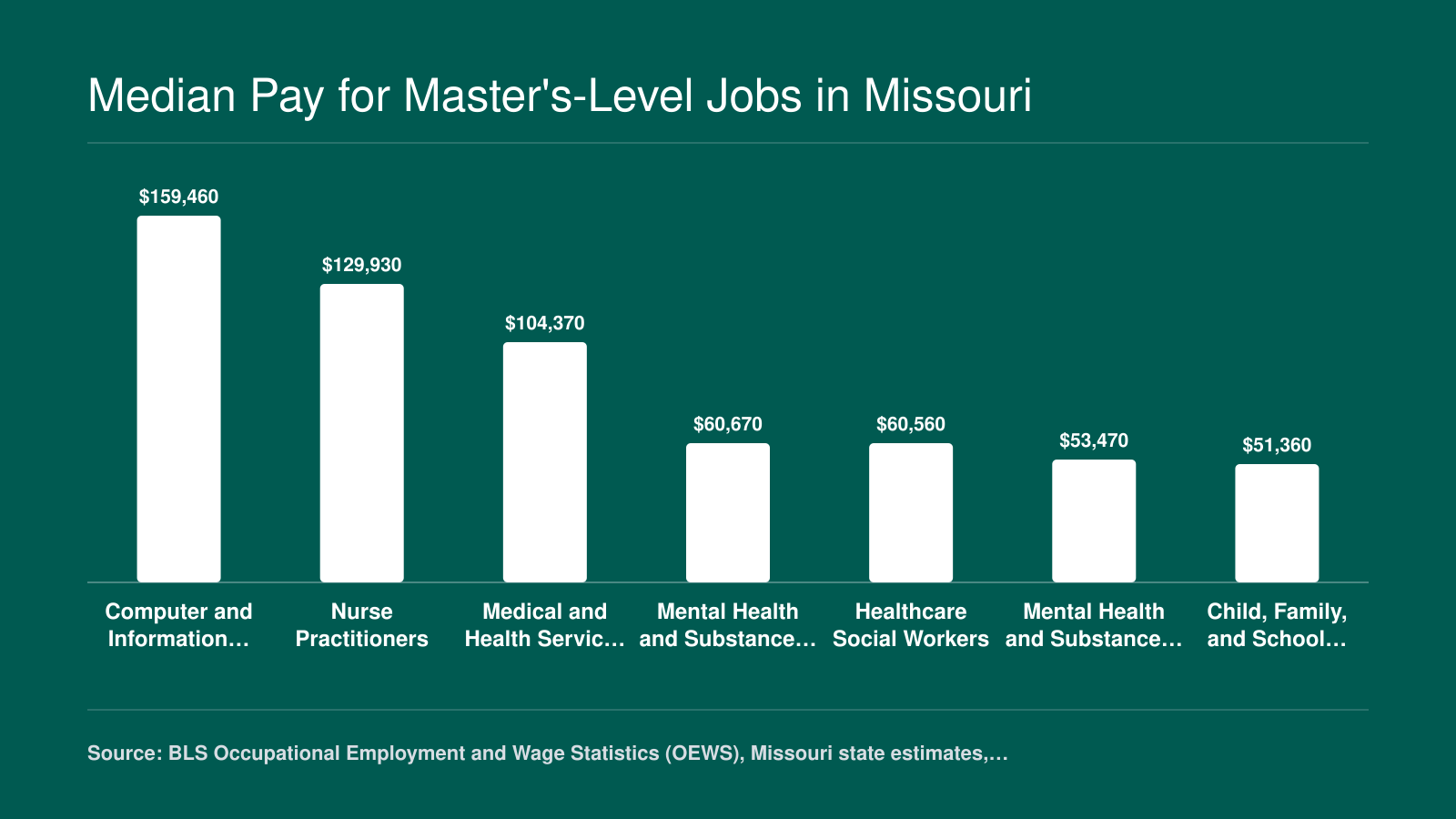
In 2025, U.S. master's degree holders age 25 and over earned a median of $1,876 per week, about $298 more than bachelor's holders at $1,578, according to the Bureau of Labor Statistics. Note that BLS excluded October 2025 data, so comparisons with other years are not exact.
Graduate schools in Missouri with the most master's programs
| School | City | Type | Master's programs | Online | Grad tuition / yr |
|---|---|---|---|---|---|
| University of Missouri | Columbia | Public | 72 | 30 | $13,681 |
| Missouri State University | Springfield | Public | 58 | 41 | $8,204 |
| Saint Louis University | Saint Louis | Private nonprofit | 52 | 24 | $25,590 |
| Northwest Missouri State University | Maryville | Public | 51 | 42 | $8,096 |
| University of Central Missouri | Warrensburg | Public | 47 | 36 | $10,296 |
| University of Missouri-St Louis | Saint Louis | Public | 47 | 19 | $15,480 |
| Lindenwood University | Saint Charles | Private nonprofit | 41 | 39 | $11,246 |
| University of Missouri-Kansas City | Kansas City | Public | 41 | 17 | $13,726 |
| Washington University in St Louis | St. Louis | Private nonprofit | 39 | 7 | $65,146 |
| Missouri Baptist University | Saint Louis | Private nonprofit | 35 | 27 | $11,538 |
| Avila University | Kansas City | Private nonprofit | 34 | 29 | $10,800 |
| Maryville University | Saint Louis | Private nonprofit | 34 | 28 | $16,246 |
| Southeast Missouri State University | Cape Girardeau | Public | 32 | 14 | $7,702 |
| Webster University | Saint Louis | Private nonprofit | 31 | 27 | $13,736 |
| Columbia College | Columbia | Private nonprofit | 29 | 27 | $8,477 |
Program counts are the verified master's listings in our directory; tuition is the school-wide average for a full-time graduate student (IPEDS).
Common Questions About Master's Programs in Missouri
Do Missouri graduate schools require the GRE or GMAT?
Which Missouri master's programs are offered fully online?
Can out-of-state students pay in-state or reduced tuition for a Missouri master's?
Can I start with a graduate certificate and apply those credits to a Missouri master's later?
Compare programs nationwide
Many Missouri residents study online. Every ranked list above has an online lens, or browse every field.
Online master's programs Browse all fields