Best Master's in Finance Programs in Missouri
Compare 8 accredited Finance programs in Missouri at 6 schools, with graduate earnings, cost, debt, and completion data from IPEDS and the U.S. College Scorecard.

Missouri's master's in finance market is small, and its programs split sharply on price. Published tuition runs from $8,477 at Columbia College to $65,146 at Washington University in St Louis, with Mizzou and UMKC charging nonresidents more than double their in-state rates.
Formats and test policies differ too. Some programs run fully online, others meet on campus in the evening, and STEM designation is not universal.
For F-1 graduates, that label can make a 24-month OPT extension available.
Key Points
- Webster University's Finance (MS) graduates earned a median of $81,378 one year after finishing.
- Mizzou and UMKC publish graduate tuition well below the private school's sticker price.
- Only WashU Olin's program pages confirm STEM designation, so verify CIP codes elsewhere.
Best Master's in Finance Schools in Missouri: 2027 Rankings
Six Missouri schools offer a master's in finance, in campus, online, and hybrid formats. Each card shows the city, format, and concentration where one is listed. Graduation rates are institution-wide figures for the whole school, not program rates. Program-level earnings appear only where federal data reports them.
Washington University in St Louis
#1St. Louis, MO · ~$65,000/yr (est.)
Best for: Career changers targeting STEM-designated finance tracks
Washington University in St. Louis runs its finance master's through Olin Business School, with three specialized STEM-designated tracks: corporate finance, quantitative finance, and wealth and asset management. Every student takes an experiential learning course, and the programs include Bloomberg Labs access and one-on-one career coaching. The school's overall graduation rate is 94%. Federal data shows median earnings of $165,087 four years after completion for its finance master's graduates.
- Two-semester, full-time program starting each fall
- Capstone required, plus an experiential learning course
- STEM designated, which can extend work eligibility for international graduates
- Prepares for CFA Level 1
- Coursework covers securities research, derivatives, and fixed income
- Three-semester program starting each fall
- Internship between the second and third semesters
- STEM designated curriculum
- Careers include risk manager and financial engineer
- Bloomberg Labs access and a dedicated career coach
- Three-semester program with one fall start per year
- STEM-designated program
- Prepares for CFA, CFP, and Series 7
- Small-scale classes with 1:1 career coaching
- Access to the Wells Fargo Advisors research center
Saint Louis University
#2Saint Louis, MO · ~$26,000/yr (est.)
Best for: Working professionals who need evening classes
Saint Louis University's Chaifetz School of Business offers a 30-credit Master of Science in Finance that meets in person on weekday evenings. The curriculum leans into AI, machine learning, algorithmic trading, and fintech analytics, with electives in real estate, financial planning, and blockchain. Graduates are hired by firms such as Edward Jones, Stifel, Morgan Stanley, and Boeing. The school's overall graduation rate is 80%.
- 30 credit hours, finished in 10 to 12 months
- In-person evening classes, starting each fall
- Rolling admissions with an average decision in two weeks
- 3.0 GPA minimum and two letters of recommendation
- Prerequisite courses required; passing the CFA exam may waive a course
- $42,000 total program tuition
- Dignity-based leadership workshops
University of Missouri
#3Columbia, MO · ~$14,000/yr (est.)
Best for: Remote learners needing flexible full- or part-time pacing
The University of Missouri's Trulaske College of Business delivers its Master of Science in Finance fully online through the Department of Finance. Full-time students can finish in as few as two semesters plus a summer, and part-time students can spread the 30 credits over four semesters and two summers. Online students pay the online rate regardless of residency, so Missouri residents do not get a separate in-state price for this version. The school's overall graduation rate is 75%.
- 30 credit hours, fully online
- Full-time: as few as two semesters plus a summer session
- Part-time: four semesters plus two summers at six credits each
- Optional one-week international experience
- Offered by the Department of Finance
Webster University
#4Saint Louis, MO · ~$14,000/yr (est.)
Webster University's Master of Science in Finance is offered on the St. Louis-area campus in Webster Groves and online, with scheduling aimed at working professionals. Coursework spans corporate finance, investments and markets, and financial institutions, ending in a capstone on mergers and acquisitions and firm valuation. Federal data shows median earnings of $81,378 one year after completion for its finance master's graduates. The school's overall graduation rate is 64%.
- Hybrid format with a fully online option
- Capstone covering mergers and acquisitions and firm valuation
- Core curriculum in corporate finance, investments, and financial institutions
- Small classes taught by working professionals
- Financial aid and scholarships available
Columbia College
#5Columbia, MO · ~$8,000/yr (est.)
Columbia College offers a fully online Master of Science in Finance at $600 per credit hour, with no entrance exam required. Eight-week courses and six start dates a year let working adults begin and finish on their own schedule. The curriculum follows CFA Institute materials and prepares students for the CFA Level I exam. The school's overall graduation rate is 42%.
- 30 credit hours, completed in about 12 to 18 months
- Fully online, with six start dates per year
- No entrance exam required; 3.0 GPA minimum
- CFA Level I-aligned curriculum using CFA Institute texts
- Portfolio Theory and Management capstone with real market data
- Electives in behavioral finance and alternative investments
- Military benefits and employer tuition reimbursement supported
University of Missouri-Kansas City
#6Kansas City, MO · $14,000 – $32,000/yr (est.)
The University of Missouri-Kansas City offers a 30-credit Master of Science in Finance through the Henry W. Bloch School of Management, with evening classes and full- or part-time study. Students choose a STEM-designated elective and three more finance courses to tailor the degree toward investments, banking, or corporate finance. Federal data shows median earnings of $104,656 five years after completion for its finance master's graduates. The school's overall graduation rate is 55%.
- 30 credit hours, typically a two-year program
- Full-time and part-time options with evening classes
- Starts fall, spring, or summer
- STEM designated program
- Prepares for CFA certification
- Prerequisite courses required
- 24 of 30 credits must be taken at UMKC
Cost & outcomes by school
Federal data for the highest-earning Finance programs, independent of the ranking above. Earnings are this field's master's graduates four years after completing, where the Scorecard reports them.
| School | Earnings | Tuition / yr | Debt | Grads/yr | Format |
|---|---|---|---|---|---|
| Washington University in St Louis MO | $165,087 | $65,146 | — | 105 | Campus |
| Webster University MO | $97,110 | $13,736 | $61,500 | 10 | Hybrid |
| Columbia College MO | — | $8,477 | — | — | Online |
| Saint Louis University MO | — | $25,590 | — | — | Campus |
| University of Missouri MO | — | $13,681 | — | 9 | Online |
| University of Missouri-Kansas City MO | — | $13,726 | — | 5 | Campus |
Sources: U.S. Department of Education. Tuition and graduates: IPEDS. Earnings and debt: College Scorecard, this field's master's graduates; a dash means no figure is reported.
Online and Hybrid Master's in Finance Programs in Missouri
An online or hybrid master's in finance lets you take graduate coursework in corporate finance, investments, and valuation without relocating to a campus. Among online master's programs in Missouri, the schools here fall into three groups.
- Fully online: University of Missouri (Trulaske) and Columbia College.
- Hybrid or mixed: Webster University, which also lists a fully online option.
- Campus-based: Washington University in St Louis, Saint Louis University, and UMKC.
Formats that fit a full-time job
Trulaske's MS in Finance is one of the best online master's in finance programs: it is 100% online with no campus attendance required. It is 30 credits, and at 6 credits per semester a part-time student finishes in four semesters plus two summers. Columbia College's online MS in Finance is also 30 credits, with start dates throughout the year, including fall and spring. Webster describes flexible scheduling for working professionals.
On campus, UMKC lists part-time study, evening classes, and fall, spring, and summer starts. Saint Louis University offers in-person evening classes. WashU's program is a two-semester, fall-start format, so it suits full-time students better than people holding a job.
By city
In Kansas City, UMKC's evening classes are the realistic in-person route. In St. Louis, Saint Louis University's evenings or Webster's flexible format are the closest fits. Springfield has no campus among these schools, so an online program such as Trulaske's or Columbia College's is the practical choice. Online programs carry the same MS in Finance title, but confirm with admissions whether the curriculum matches the campus version.
Which Missouri Master's in Finance Programs Waive the GRE or GMAT?
Some programs name a test requirement outright; others leave applicants guessing. Here is where each one lands, based on what schools actually publish.
What the Schools Say
- Test optional or not required: The University of Missouri's online MS Finance treats the GMAT and GRE as optional; its graduate business FAQ confirms scores are not required, aligning it with Master's in Finance Programs With No GMAT or GRE Required. Columbia College states plainly that no entrance exam is required.
- Recommended, not required: Washington University's Olin MS Finance lists test scores as recommended rather than mandatory.1 Its published rounds reflect a 2024-2025 cycle rather than a confirmed 2026 policy.
- Case by case: UMKC's Bloch MS Finance evaluates applicants on GPA, resume, and goal statements, and notes that some candidates may be admitted without the GMAT.2 It does not spell out who qualifies.
- No policy published: Webster University and Saint Louis University's Chaifetz MS Finance pages do not state a current requirement, test-optional stance, or waiver criteria.3
Waivers and a Caveat
Where waiver criteria appear, they tend to hinge on work experience or prior academic performance, a pattern shared by many No-GRE master's programs; SLU directs those inquiries to its graduate business office.3 A CFA or CPA can also carry weight.
Note that STEM-designated tracks drawing international applicants may still expect scores. For context, WashU's undergraduate admit rate is roughly 12 percent, while Mizzou, UMKC, and SLU admit the majority of undergraduate applicants.
Related Articles
What a Master's in Finance Costs in Missouri, and the Certifications It Supports
Sticker price is the sharpest tradeoff on this page, as our Most Affordable Master's in Finance Programs ranking makes clear: the public programs and the private research school are not playing the same pricing game, and the gap is large.
Public versus private pricing
Mizzou and UMKC publish graduate tuition near $13,700 for residents and roughly $32,000 to $32,600 for non-residents, so residency does most of the work on cost. Webster bills $800 per credit across 36 credits, which works out to about $28,800 before fees, and advertises an $800 first-course waiver (eligibility conditions apply). Columbia College lists $600 per credit over 30 credits. Saint Louis University quotes $42,000 in total tuition for its 30-credit program1. At the top end, WashU Olin estimates $81,500 for the two-semester corporate finance track ($40,750 per semester) and $102,900 for the three-semester quantitative and wealth and asset management tracks, plus a $900 program fee each semester.
Aid and discounts
Olin considers every admitted applicant for merit scholarships automatically. Webster lists limited scholarships, including awards for military and first responders. Columbia College accepts military benefits and supports employer reimbursement. Named assistantships specific to these finance degrees are not published.
Licensure and credentials
Most finance jobs require no Missouri license; advisory and brokerage roles run through FINRA exams instead. Several programs align coursework with CFA Level I, and SLU may waive FIN 6000 for candidates who have passed a qualifying certification exam1. For CPA licensure, Missouri requires 150 semester hours including 60 business and 33 accounting credits2 (see the Master's in Accounting in Missouri requirements), though a master's is not required to sit, and an alternative pathway adding two years of experience takes effect August 28, 2026.3
What Missouri Master's in Finance Grads Earn One Year Out
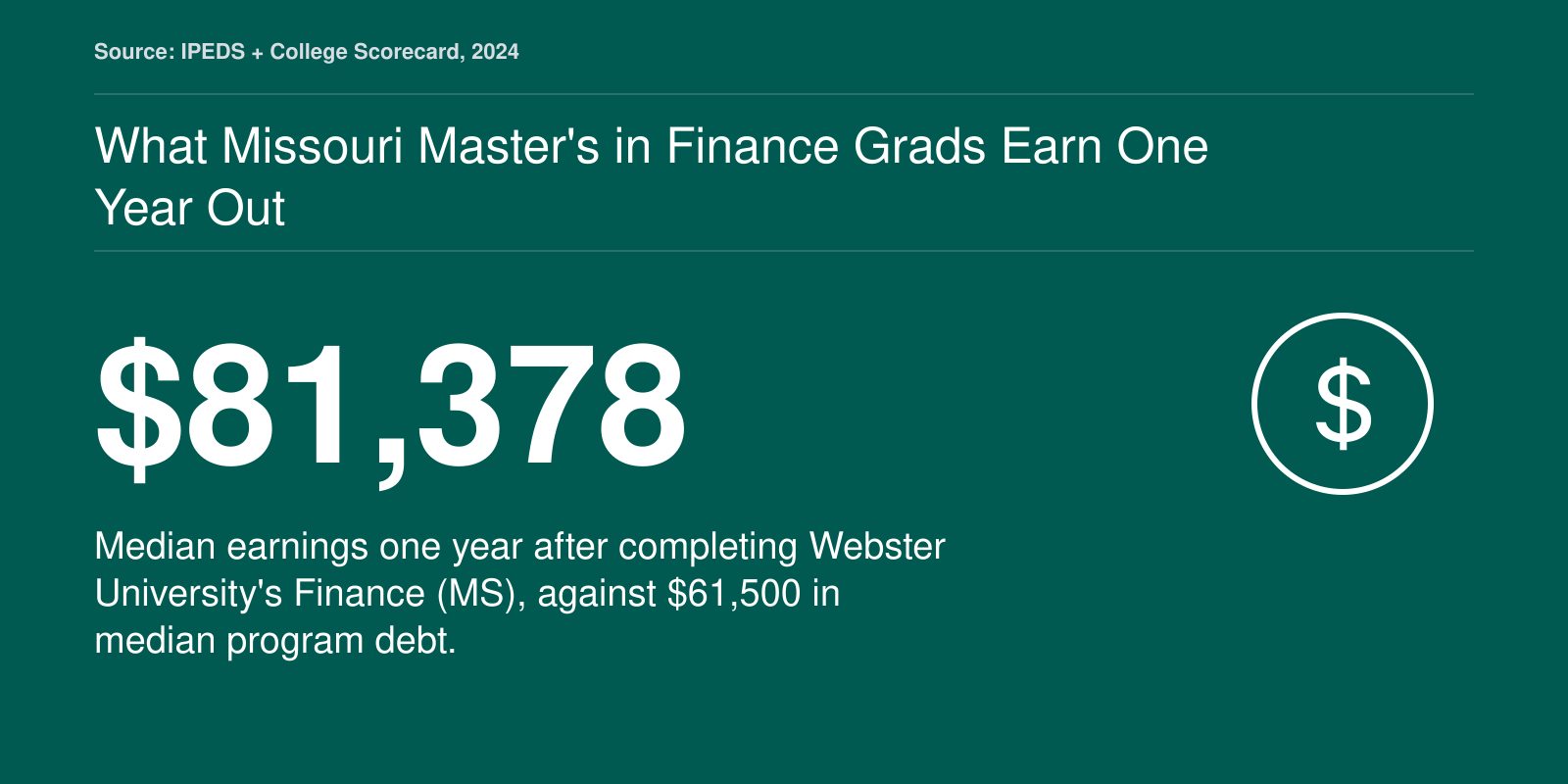
Webster University's Finance (MS) graduates earned a median of $81,378 one year after completing the degree. Webster is the only school here with a program-level one-year earnings figure in federal data, so the others are left out rather than filled in with institution-wide numbers. Set against median program debt of $61,500, that is roughly $1.30 of first-year earnings for every $1 borrowed.
STEM status for a finance master's depends on the program's CIP code, such as 27.0305 Financial Mathematics, appearing on the DHS STEM Designated Degree Program List, not on the title. If it qualifies, F-1 graduates may add a 24-month STEM OPT extension, for up to 36 months of OPT in total (DHS Study in the States).
STEM-Designated MS Finance: Mizzou vs. Washu vs. Webster
Only WashU Olin's published program pages confirm STEM designation here. The Mizzou and Webster entries show what could not be verified, so confirm STEM status, credit hours, and CIP code with each admissions office before you apply. UMKC and SLU also have no STEM-designated finance master's confirmed in the sources used for this page.
| Program | STEM status | Credits and length | Tracks, CFA prep and career focus | Best fit |
|---|---|---|---|---|
| WashU Olin MS in Corporate Finance | Yes | 30.5 credits (23 required, 7.5 elective); 10 months | Corporate finance track covering valuation, financing, M&A, and derivatives; prepares for CFA Level 1 | Career changers who want a fast, corporate-finance-focused degree |
| WashU Olin MS in Quantitative Finance | Yes | Official 2026 credits and length not confirmed here | Quantitative track; CFA coverage not confirmed here | Math-heavy students; check Olin for the current curriculum |
| WashU Olin MS in Wealth & Asset Management | Yes | 39 credits (28.5 required, 10.5 elective); 3 semesters | Investments and wealth track with Python and SQL; prepares for CFA Level 1, CFP, Series 7, or CAIA | Aspiring portfolio managers, advisors, and endowment professionals |
| WashU Olin Flex MS in Finance | Not confirmed here | 30 credits (9 core, 21 elective); about 8 months | Flexible elective-driven design; CFA-specific curriculum not confirmed | Students who want to build a custom course mix |
| Mizzou Trulaske MS in Finance | Not confirmed here; verify with the school | Not confirmed here | Tracks and CFA alignment not confirmed here | Budget-minded students open to a public flagship; verify details first |
| Webster University MS in Finance | Not confirmed here; verify with the school | Not confirmed here | Tracks and CFA alignment not confirmed here | Working professionals who want flexibility; verify details first |
Frequently Asked Questions About Master's in Finance Programs in Missouri
Deadlines and prerequisites change by intake, so confirm every date on the program's admissions page before you apply. The answers below reflect what the schools publish and flag where we found no clear policy.
When are application deadlines for Missouri master's in finance programs?
Can I get a master's in finance in Missouri without a business undergraduate degree?
Is a master's in finance or an MBA better for a finance career in St. Louis or Kansas City?
Compare Finance programs on the data that matters
Explore more Business & Management specializations or browse every graduate field.
All Business & Management programs