Most Affordable Master's in Finance Programs
Compare 340+ accredited most affordable Finance programs at 290+ schools, with graduate earnings, cost, debt, and completion data from IPEDS and the U.S. College Scorecard.

In-state graduate tuition and fees across the programs below run from $4,879 at Florida Atlantic University to $9,987 at the University of Texas Rio Grande Valley, a spread of more than $5,000 that shows how much school choice alone moves the upfront cost of master's in finance programs. The ranking below weighs net price and aid, not just the sticker rate.
An affordable finance degree still has to survive the full cost of attendance: fees, books, software, and the residency premium that raises out-of-state tuition by as much as $12,600. A low-cost program only pays off if it clears AACSB accreditation and produces early-career earnings that justify the debt.
Key Points
- Out-of-state tuition is $12,600 higher at Cal State San Bernardino.
- CFA Institute counts 1,200 affiliated programs covering 70% of curriculum.
- UTRGV's finance master's is fully online, unlike several hybrid programs.
10 Most Affordable Master's in Finance Programs for 2027
This ranking puts net price and financial aid first, because list price alone hides what a degree will actually cost you. The ten programs below pair that affordability with finance training that can pay off in analyst, portfolio, and risk roles.
CUNY Bernard M Baruch College
#1New York, NY · $11,000 – $21,000/yr (est.)
Best for: Aspiring analysts targeting Manhattan internships
CUNY Bernard M. Baruch College pairs a Manhattan location with a finance master's built around analytical tools, CFA and FRM preparation, and a flexible 30-credit structure. Students can study full time, part time, or fully online, with electives spanning venture capital, data science in finance, and risk management. Graduates have landed roles at Morgan Stanley and Moody's.
- 30-credit curriculum often finished in two semesters plus summer
- Full-time, part-time, and fully online paths
- CFA Institute University Affiliation Program with CFA and FRM preparation
- STEM-designated with 24-month OPT for graduates
- Career outcomes include analyst roles at Morgan Stanley and Moody's
CUNY Brooklyn College
#2Brooklyn, NY · $10,000 – $15,000/yr (est.)
Best for: Working professionals needing asynchronous online classes
Brooklyn College's finance master's blends core theory with quantitative methods, data analytics, and investment valuation in a 30-credit, roughly one-year format. Students choose between quantitative finance and risk management or investment management and asset valuation, with an asynchronous online path and a downtown Manhattan location near Wall Street. The STEM-designated curriculum covers ESG, sustainable finance, Python, and R.
- 30-credit program that can be completed within one year
- Two concentration options in quantitative finance and investment management
- Fully online asynchronous option available
- STEM-designated with ESG, Python, and R coursework
- Downtown Manhattan location near Wall Street
The University of Texas Rio Grande Valley
#3Edinburg, TX · $5,000 – $10,000/yr (est.)
Best for: Cost-conscious students needing fully online format
UT Rio Grande Valley offers a fully online, accelerated finance master's built for students who want to enter or advance in finance without relocating. The 30-credit degree runs about 10 months with seven-week terms and covers corporate finance, financial statement analysis, budgeting, and global markets. Electives include wealth management, retirement planning, healthcare finance, and entrepreneurial finance.
- $14,167 total program tuition and $472 per credit
- 30 credit hours completed in about 10 months
- Seven-week course terms and accelerated format
- Coursework in wealth management, retirement planning, entrepreneurial finance, and healthcare finance
- Prepares for analyst, advisor, loan officer, and risk/credit roles
California State University-San Bernardino
#4San Bernardino, CA · ~$10,000/yr (est.)
California State University, San Bernardino delivers a 33-unit finance master's centered on financial analytics, portfolio management, fixed income, and derivatives. Admission is open to any undergraduate major with no GMAT or GRE required, and a blended option allows CSUSB undergraduates to begin graduate work early. The program emphasizes investment analysis and requires an 80 percent score on a comprehensive exam.
- 33 total credit hours with investment analysis and portfolio management focus
- No GMAT or GRE required
- Open to any undergraduate major with 2.8 GPA minimum
- Comprehensive exam requires 80% score to pass
- Blended 4:1 option for CSUSB undergraduates
- Graduate assistantships may be available
CUNY Queens College
#5Queens, NY · ~$12,000/yr (est.)
Queens College's risk management master's with a finance/CFA concentration teaches students to manage exposure across banking, insurance, and corporate settings. Evening classes support working professionals, and the curriculum aligns with CFA Institute and actuarial exam content. Students can choose finance electives in portfolio management, accounting, and financial analysis.
- 30 total credit hours with Finance/CFA concentration
- Evening classes for working professionals
- Prepares for CFA Charterholder exams and actuarial society body of knowledge
- Three concentration options
- Finance electives in portfolio management and financial analysis
- Graduates placed in financial institutions, consulting, assurance, and government
University of Florida
#6Gainesville, FL · ~$13,000/yr (est.)
The University of Florida's Hough master's in finance combines financial theory with hands-on portfolio management through an Asset Allocation Project and a Capital Markets Lab with Bloomberg terminals. Built largely as a combination pathway for UF undergraduates, the program offers concentrations in corporate finance, financial markets and institutions, and investments. Graduates pursue analyst roles across investment banking, corporate finance, and asset management.
- 32 total credit hours with three concentration options
- No entrance exam required; GMAT accepted
- CFA University Affiliation Program
- Capital Markets Lab with Bloomberg terminals and full Capital IQ suite
- Hands-on Asset Allocation Project managing a real portfolio
- 16 graduate credits before bachelor's for UF undergraduates
Florida International University
#7Miami, FL · ~$11,000/yr (est.)
Florida International University's master's in finance is a 12-month, cohort-based program with in-person and fully online options across Miami locations. Students can pursue concentrations in Financial Innovation, Financial Management, and International Banking, with CFA Level I preparation and Bloomberg Certification built in. The curriculum spans valuation, derivative pricing, risk management, and merger analysis.
- $30,000 total program tuition for Florida residents
- 12-month cohort-based format with weekday evening and Saturday classes
- CFA Institute University Affiliation Program and Level I exam preparation
- Bloomberg Certification with access to Bloomberg Lab
- Fully online option available
- FinTech, Python coding, and big data focus
- Fully online option with 12-month completion
- Prepares for CFA Level I exam
- Careers in corporate finance and investment banking
- Two concentration options with Friday evening and Saturday classes
- Spring start at Brickell facility available
- Classes at Modesto Maidique Campus
- Financial aid and scholarships available
- Three concentration options with international banking focus
- Fall August and Spring January starts
- Tuesday and Thursday evening classes available
- Brickell facility and Modesto Maidique Campus locations
Florida Atlantic University
#8Boca Raton, FL · $7,000 – $18,000/yr (est.)
Florida Atlantic University's AACSB-accredited finance master's runs 16 months with evening classes in eight-week terms, available in Boca Raton or live online. Students gain hands-on trading experience in a simulated trading room, earn Bloomberg Certification, and complete CFA preparation courses. The program is designed for working professionals aiming at investment banking, hedge funds, and financial management.
- 16-month AACSB-accredited program
- Fully online option available with synchronous classes
- Bloomberg Certification included
- CFA preparation courses
- Evening classes Monday and Wednesday in 8-week terms
- Trading Room replicates real trading
- Finance boot camp
- Careers in investment banking and hedge funds
University of South Florida
#9Tampa, FL · ~$10,000/yr (est.)
The University of South Florida's MS in Financial Analytics blends analytics, investments, and planning in a STEM-designated, hybrid format. Students can choose a Financial Analysis concentration and finish 30 credits in about three semesters full time, with part-time options available. The program prepares students for CFA, CFP, and related credentials and places graduates at major financial firms.
- 30 total credit hours, often finished in three semesters
- STEM-designated with up to 36 months OPT for international students
- Four concentration options including Financial Analysis
- Prepares for CFA, CFP, CFM, CTP, and ChFC credentials
- GMAT/GRE waiver with 3.5 GPA or CFA Level 1
- Hybrid on-campus and online coursework
- Graduates hired by leading global financial firms
San Jose State University
#10San Jose, CA · ~$10,000/yr (est.)
San Jose State University's new master's in finance focuses on corporate finance and financial management within a department known for accounting and finance education. Located in Silicon Valley, the campus-based program gives students access to a dynamic business environment. Specific curriculum details are still emerging, but the degree is designed for advanced roles in corporate finance, financial analysis, and investment management.
- New campus-based finance master's program
- Corporate Finance concentration
- Silicon Valley location near tech finance employers
- Department houses finance and corporate accounting concentrations
Cost & outcomes by school
Federal data for the highest-earning Finance programs, independent of the ranking above. Earnings are this field's master's graduates four years after completing, where the Scorecard reports them.
| School | Earnings | Tuition / yr | Debt | Grads/yr | Format |
|---|---|---|---|---|---|
| University of Pennsylvania PA | $316,195 | $47,844 | $41,000 | 2 | Campus |
| Sul Ross State University TX | — | $6,661 | — | — | Campus |
| Worcester State University MA | — | $6,813 | — | — | Campus |
| University of South Dakota SD | — | $7,118 | — | — | Hybrid |
| Wichita State University KS | — | $7,986 | — | — | Hybrid |
| New Mexico Highlands University NM | — | $8,016 | — | — | Hybrid |
| University of North Carolina at Charlotte NC | — | $8,037 | — | — | Campus |
| Abraham Lincoln University CA | — | $8,160 | — | — | Online |
| Columbia College MO | — | $8,477 | — | — | Online |
| The University of Texas at Tyler TX | — | $8,480 | — | — | Hybrid |
| Concordia University-Saint Paul MN | — | $8,550 | — | — | Online |
| The University of Texas Rio Grande Valley TX | — | $8,589 | — | — | Online |
Sources: U.S. Department of Education. Tuition and graduates: IPEDS. Earnings and debt: College Scorecard, this field's master's graduates; a dash means no figure is reported.
Cost, debt & payoff
Median earnings of this field's master's graduates (4 yrs after completing) vs. their median federal loan debt · U.S. College Scorecard
Across these programs the median graduate earns about $113,855 and finishes with roughly $39,725 in debt — a ratio that clears a common rule of thumb (keep debt below first-year salary). Tuition and debt vary widely school to school, so check the per-school figures in the table above before you shortlist.
How We Rank the Most Affordable Finance Master's Schools
An affordable ranking of master's in finance programs starts with the real price of earning the degree, not the sticker figure a school advertises. We build these rankings from a handful of federal data points, each measuring a different piece of what you actually pay and what you get back.
The Cost Inputs
We look first at graduate tuition and fees tied to the finance program itself, not undergraduate rates. Alongside that, we factor in institution-level net price, the average a student pays after grants and scholarships are subtracted, and we apply the same framework to online master's in finance programs.
One honest caveat: net price is a campus-wide average, pulled across all students at the school. It reflects undergraduate aid patterns as much as graduate ones, so the number a finance master's student actually pays can land higher or lower. Treat it as a directional signal, not a personalized quote.
The Outcome Inputs
We also pull graduation rates and, where published, program outcomes drawn from federal data for finance degrees at the master's level. That includes typical earnings after graduating and student borrowing for the field. Some smaller programs enroll too few students for the government to report these figures without compromising privacy, so a few schools here simply have no published earnings or debt data. We note that rather than guess.
What This Ranking Does Not Measure
Cost and outcomes are concrete; curriculum quality and reputation are not. We do not score teaching, faculty, or prestige here. For how accreditation and career outcomes shape program value, see the accreditation and outcomes sections further down this page.
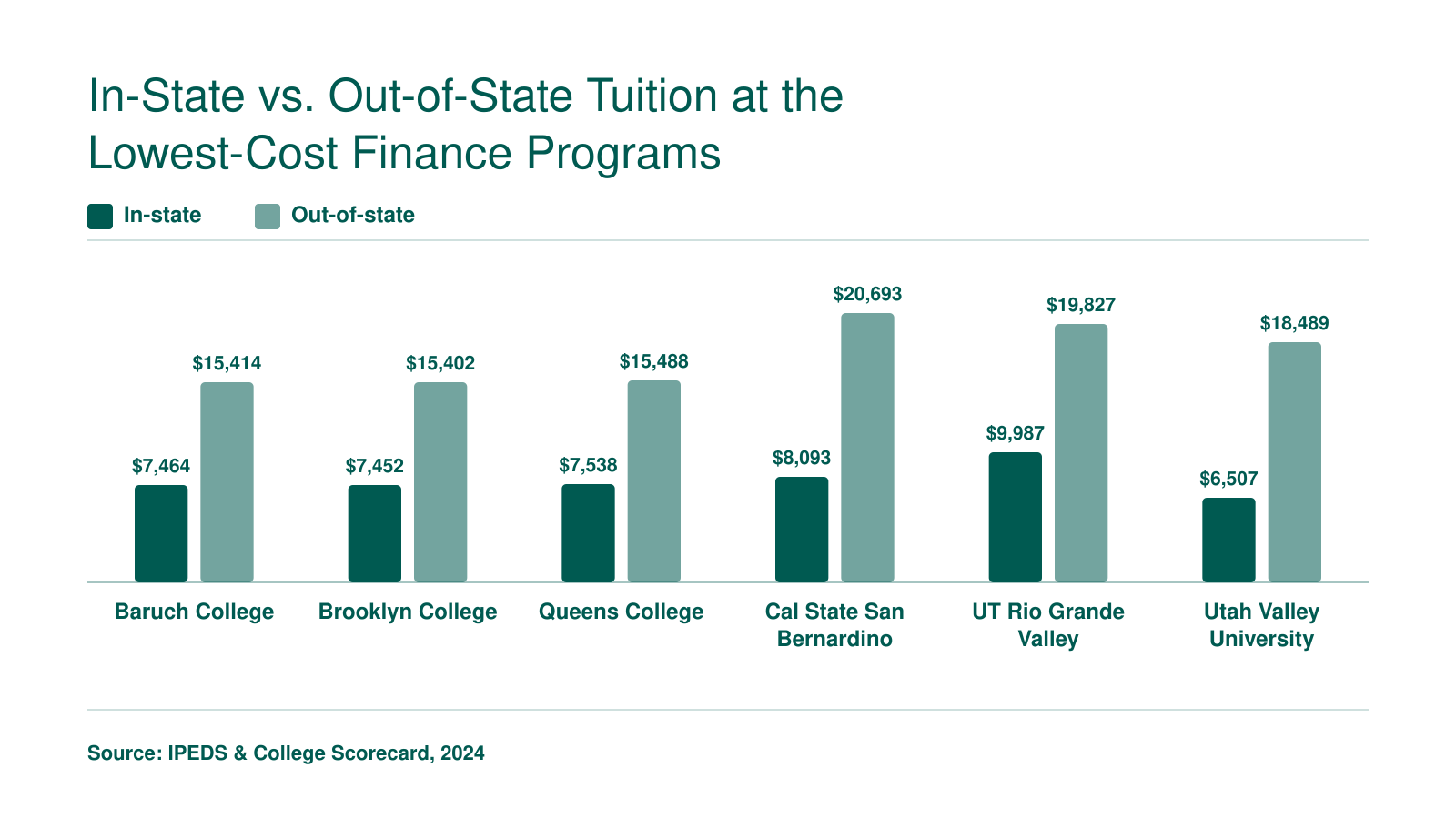
In-State vs. Out-of-State Tuition at the Lowest-Cost Finance Programs
Published graduate tuition and required fees vary widely by residency status. Among the programs below, the out-of-state rate adds a substantial premium, but its size is not constant. The largest gap sits at $12,600 at Cal State San Bernardino, while the three CUNY colleges are closest at $7,950.
What Does an Affordable Finance Master's Actually Cost?
How much does a master's in finance really cost once fees, books, and software are added to the per-credit rate? Usually more than the tuition quote suggests, because most schools publish tuition and fees on separate schedules.
Build Your All-In Estimate
Start with this formula:
- Tuition: total credits × cost per credit
- Fees: technology or distance-learning fees plus any per-term mandatory fees
- Materials: books, case packs, and a financial calculator
- Tools and exams: modeling software, Bloomberg certification, or CFA exam registration if you plan to sit for it during the program
The tuition line is the easy part. Purdue's 2025-26 rates put its 36-credit MS in Finance at $696 per credit for Indiana residents, or $25,056 in tuition, and the bursar notes that other estimated expenses aren't billed through its office.1 The University of Oklahoma's online master's in finance charges $1,015 per credit across 32 credits, $32,480 in total, with books excluded.
Where Fees Add Up
Published fee schedules show how quickly the extras grow. Indiana University's Kelley School lists $2,111 in mandatory fees plus $1,379 in program fees for its 36-credit, one-year finance master's, rising to $2,298 and $1,562 on the 18-month track.3 That's roughly $3,500 to $3,900 in fees alone. George Mason lists $3,924 in mandatory fees alongside $26,658 in in-state tuition for 2025-26, a sum near 15 percent of that tuition figure, though its schedule doesn't make clear whether the fee is billed per term, per year, or once.2
The same gap applies to the lowest-cost programs ranked here. UTRGV advertises $472 per credit and $14,167 in total program tuition for its online MSF, and Baruch's published in-state graduate tuition is $11,452. Treat headline numbers like these as a floor, not a final bill.
Three Questions to Ask Admissions
- Which fees are charged per credit, per term, or once, and do online students pay a separate distance-learning fee?
- Are software licenses, Bloomberg access, or exam-prep materials included in tuition, or billed separately?
- Does my total cost change if I stretch the program over extra terms or switch to part-time study?
Which Low-Cost Finance Programs Offer the Best Career Outcomes?
Low tuition only becomes a career advantage when the earnings and debt numbers behind the degree hold up. Several finance master's programs below publish program-level federal earnings data, and a few also report the median debt a graduate carries and the corresponding ten-year monthly payment, which makes the cost-to-outcome tradeoff easier to see.
What the earnings and debt picture shows
- Florida State: Median earnings of $104,012 five years after completing the program, with median program debt of $27,096 and a ten-year monthly payment around $308. - Florida International: Median earnings of $91,950 five years after completing, with median program debt of $30,705 and a ten-year monthly payment around $349. - Saint Peter's: Median earnings of $90,388 five years after completing, with median program debt of $49,332 and a ten-year monthly payment around $561. Other published program-level figures include Georgia State at $108,935 five years after completion, FAU at $99,143 four years out, and UHCL at $107,792 four years out, though those programs do not publish a program-level debt figure.
CFA and FRM preparation worth noting
Baruch College carries CFA Institute University Affiliation and builds in preparation for both the CFA and FRM exams, a useful signal for students targeting investment analysis or risk roles. Florida International University is also a CFA Institute University Affiliation Program and prepares students for the Level I CFA exam, with a Bloomberg Lab and dedicated career services. Florida reports a 98% job placement rate and a $96,200 average salary, while Georgia State reports an 88% job placement rate and a $136,000 average top-quartile salary; these are school-published placement metrics, not federal program-level outcomes.
The value takeaway
These examples show that a low list price is not the same as a strong outcome. Programs that pair modest tuition with published earnings and manageable debt, such as Florida State and Florida International, can be a safer value than a slightly cheaper program that discloses little about jobs or debt. When the numbers are unclear, treat the cheaper price as a risk, not a saving.
Top Early-Career Earnings Among Ranked Finance Master's Programs
Related Articles
Online vs. Campus: How Format Changes Your Total Cost and Timeline
Format is no longer a clean either-or choice in finance graduate education, because many campus programs now run a parallel online or live-virtual track. UTRGV's program is delivered online. Brooklyn College, Queens College, Florida Atlantic and South Florida use hybrid formats. Baruch and FIU are campus programs that also advertise a fully online option, and FAU lets students attend in person or live-virtually.
How Long It Takes
Most programs below are built around 30 to 33 credits, so pace drives the timeline more than credit load:
- UTRGV: 30 credits in a 10-month program with 7-week terms.
- FIU: A 12-month cohort with weekday evening and Saturday classes.
- FAU: 16 months, using 8-week terms.
- Baruch and USF: Both offer full-time and part-time options, and USF's full-time path can finish in three semesters.
Part-time study commonly stretches toward two years. Outside this list, Cincinnati's online MSF runs 30 to 38 credits over 12 to 24 months depending on the plan.
Where Residency Changes the Bill
On campus, public universities charge nonresidents more. UTRGV's published tuition is $8,589 in-state versus $15,971 out-of-state, and Florida's is $12,737 versus $30,130. FIU lists $30,000 in total program tuition, with nonresident tuition approximately $33,600.
Some online programs flatten that gap. Kentucky's online public financial management master's charges $847 per credit regardless of residence, and Wisconsin-Whitewater says its online per-credit rate applies equally to residents, out-of-state and international students. UTRGV's online program lists $472 per credit, about $14,167 in total. Confirm whether any quoted rate includes fees, books or materials.
What International Students Should Know
International students at public universities are generally billed the nonresident rate for campus study. A fully online program usually cannot support an F-1 visa, since federal rules sharply limit how much online coursework counts toward full-time enrollment. Campus STEM-designated programs such as Baruch's and USF's add OPT work authorization after graduation. Before enrolling in any format, ask whether exams are proctored or an on-campus component is required. Cal State San Bernardino, for instance, requires a comprehensive exam and 24 units completed at CSUSB.
CFA Institute counts 1,200 affiliated degree programs worldwide in 2026, and each must cover at least 70% of the CFA Program Candidate Body of Knowledge. Affiliated universities can also award Student Scholarships that, for awards made since March 4, 2026, cut CFA exam registration to $600 (plus applicable tax), a direct saving on the credential's cost.
Finance programs by state
Frequently Asked Questions About Affordable Finance Master's Programs
Transfer limits, test waiver rules, and residency pricing are common decision points for applicants comparing affordable finance master's programs. The answers below summarize catalog policies from public universities rather than a single national standard, so confirm current requirements with the program before applying.
How many transfer credits do affordable finance master's programs accept?
How long does an affordable master's in finance take for part-time students?
Can international students get an affordable finance master's degree, and do they pay out-of-state rates?
Do affordable finance master's programs require the GMAT or GRE?
Compare Finance programs on the data that matters
Explore more Business & Management specializations or browse every graduate field.
All Business & Management programs