Best Master's in Finance Programs in Maryland
Compare 4 accredited Finance programs in Maryland at 3 schools, with graduate earnings, cost, debt, and completion data from IPEDS and the U.S. College Scorecard.

Johns Hopkins finance graduates report median earnings near $99,800 a year after completing the degree, one signal of what Maryland's proximity to Baltimore and Washington, D.C. can return. The corridor packs federal agencies, asset managers, and commercial banks into commuting range, which shapes both recruiting and starting pay.
The programs ranked here draw on federal IPEDS and College Scorecard data, listing the top 10 masters in finance programs across campus and online formats. The real tension is cost against outcome: a $64,730 flat-rate private degree and a public program under $17,000 in-state both serve this market, but graduate earnings and debt diverge sharply between them.
Key Points
- Johns Hopkins graduates earned a median $99,791 one year out, against $50,975 in program debt.
- Johns Hopkins Carey lists the GMAT and GRE as optional for its MS in Finance.
- Graduate tuition and fees at the University of Baltimore run $16,574 in-state and $23,468 out-of-state.
The Top Master's in Finance Schools in Maryland
Maryland's finance master's options span a flagship public business school, a research university with a STEM-designated online degree, and a commuter-friendly public in Baltimore. Where a program-level earnings figure is available, it is shown with its time window. Graduation rates are institution-wide, not specific to the finance program.
University of Maryland-College Park
#1College Park, MD · ~$18,000/yr (est.)
Best for: Full-time students targeting corporate finance roles
The University of Maryland's Robert H. Smith School of Business offers a 30-credit Master of Finance with a Corporate Finance focus, completed in two or three semesters on the College Park campus. Coursework covers mergers and acquisitions, capital budgeting, valuation and risk, with AI and financial technology built into the modeling. Applied projects with firms such as Capital One, Deloitte and Google round out the curriculum. Program-level earnings for finance master's graduates were about $68,027 one year after completion, and the university's institution-wide graduation rate is roughly 89%. Smith bills Maryland residents $1,631 per credit for 2026-27 versus $2,115 for non-residents.
- 30 credit hours, finished in two or three semesters
- Corporate Finance concentration on the College Park campus
- Four concentration options within the Smith finance master's
- Projects with Capital One, Deloitte and Google
- Selected students help manage Smith's Global Equity Fund
- AI and fintech modeling woven through the curriculum
- Open to applicants from non-business backgrounds
Johns Hopkins University
#2Baltimore, MD · ~$65,000/yr (est.)
Best for: Working professionals needing flexible online study
Johns Hopkins delivers its Master of Science in Finance through the Carey Business School, pairing financial theory with Python-based data science and AI coursework. The curriculum is aligned with the CFA exams, the program is STEM-designated, and students can manage a real portfolio through the Student Managed Investment Fund. Program-level earnings were about $99,791 one year after completion, the strongest early figure in this group, and the institution-wide graduation rate is roughly 94%. Tuition is $2,060 per credit on the part-time online track, and the entrance exam is not required.
- 30 credit hours, roughly 2 to 3 years part-time
- Fully online option with fall, spring and summer starts
- $2,060 per credit; employer reimbursement supported
- Test optional; no entrance exam required
- CFA-aligned, STEM-designated curriculum
- Python-based courses including machine learning for finance
- Scholarships up to $25,000 available
- 12-month full-time program of 36 credit hours
- $94,500 total program tuition
- Financial Econometrics concentration; fall start
- Baltimore and Washington, D.C. campuses
- Manages a $500k+ student investment portfolio
- Electives in fintech and machine learning
- Test optional; prepares students to sit for CFA exams
University of Baltimore
#3Baltimore, MD · $17,000 – $23,000/yr (est.)
Best for: Evening students balancing work and study
The University of Baltimore's Master of Science in Finance is a 30-credit, STEM-designated degree centered on quantitative analysis, risk assessment and mathematical modeling. Classes are built for working adults, with 6 p.m. on-campus sessions, some hybrid courses and asynchronous online options. Students can finish in as few as 18 months, apply on a rolling basis and skip test scores. The institution-wide graduation rate is about 38%, so applicants should weigh outcomes carefully.
- 30 credit hours with 18 core credits and 12 elective credits
- Can be completed in as few as 18 months
- Hybrid format with evening on-campus classes at 6 p.m.
- Asynchronous online classes available
- Rolling admissions; no entrance exam required
- STEM-designated program
- Full-time and part-time options
Cost & outcomes by school
Federal data for the highest-earning Finance programs, independent of the ranking above. Earnings are this field's master's graduates four years after completing, where the Scorecard reports them.
| School | Earnings | Tuition / yr | Debt | Grads/yr | Format |
|---|---|---|---|---|---|
| Johns Hopkins University MD | $152,415 | $64,730 | $50,975 | — | Online |
| University of Baltimore MD | — | $16,574 | — | — | Hybrid |
| University of Maryland-College Park MD | — | $18,276 | — | 3 | Campus |
Sources: U.S. Department of Education. Tuition and graduates: IPEDS. Earnings and debt: College Scorecard, this field's master's graduates; a dash means no figure is reported.
Online and Hybrid Master's in Finance Options in Maryland
Can you earn a master's in finance in Maryland without relocating or quitting your job? Yes, with two of the schools here. Johns Hopkins appears among the Best Online Master's in Finance Programs and delivers its part-time MS in Finance online, over 24 to 36 months and 30 credits. Tuition is $2,060 per credit, or $61,800 total before scholarships and fees. Its listing gives one rate for all students, with no separate in-state or out-of-state price. University of Baltimore's MS in Finance is hybrid, combining asynchronous online classes with evening on-campus classes at 6 p.m., and it can be finished in as few as 18 months. No separate online per-credit price is published in the material reviewed, so confirm with the school before budgeting.
University of Maryland-College Park's Smith School program, one of the Master's Programs in Maryland, is campus-based. Its listed rates are $1,631 per credit for Maryland residents and $2,115 for out-of-state students, with no separate online pricing published for this degree.1
Before enrolling, ask each school:
- Format: Are live sessions required, or is coursework asynchronous?
- Pacing: Can you take one course at a time?
- Residencies: Is any on-site attendance required?
Which Maryland Finance Master's Programs Waive or Make the GRE Optional?
Skipping the GMAT or GRE saves months of prep, but only some Maryland finance programs say plainly that you can; even among graduate programs that don't require GRE or GMAT, policies vary.
- Johns Hopkins University: Carey lists the GMAT and GRE as optional for both its full-time (15-month) and part-time MS in Finance. Its admissions pages set no minimum GPA and name no required math course. Instead, they weigh career goals, academic and professional background, and what you add to the cohort.
- University of Baltimore: The MS in Finance is listed as test optional, with no entrance exam required and rolling admissions.
- University of Maryland-College Park: Smith's Master of Finance accepts all majors and notes that quantitative coursework helps, but its program page publishes no testing policy. A third-party profile reports that the GMAT or GRE is required unless you qualify for waiver review, such as with a 3.2 GPA in a quantitative degree or 24 months of relevant post-college work. That profile also lists statistics with a B or higher as a prerequisite. Confirm both points directly with Smith. UMD's separate Quantitative Finance master's lists the GMAT or GRE as a requirement.
Where no prerequisites are listed, a foundation in calculus, statistics, or economics still makes the coursework easier.
For applicants who would rather not test, Johns Hopkins and the University of Baltimore are the clearest Maryland examples of Master's in Finance Programs With No GMAT or GRE Required; UMD depends on a waiver.
The GRE may be optional at some Maryland programs, but the cost and salary data still tell you which degree is worth the tuition.
Master's in Finance Tuition in Maryland, Plus CFA and FRM Preparation
Public per-credit pricing and private flat-rate pricing produce very different bills in Maryland. Federal data put graduate tuition and fees at $16,574 in-state and $23,468 out-of-state at the University of Baltimore. At the University of Maryland-College Park, the figures are $18,276 and $38,207. Johns Hopkins University charges $64,730 regardless of residency. Average net price runs $13,868, $15,678 and $18,809 respectively, a key benchmark in Most Affordable Master's in Finance Programs. Treat net price as an institution-wide average after aid, not a quote for what a finance master's student will pay.
Full Degree Cost
Annual figures understate the total. Johns Hopkins Carey projects $99,750 for its 15-month, 36-credit MS in Finance in 2026-2027, pending trustee approval, so confirm the final rate before budgeting. Shorter Carey formats require fewer credits, a common feature among Accelerated Master's in Finance Programs. Smith charges $1,631 per credit in-state and $2,115 out-of-state for Spring 2026, before mandatory fees and any annual increases. The University of Baltimore's 30-credit MS in Finance publishes no single program total, so build your own estimate from its graduate business rates.
Credentials, Accreditation and STEM Status
Maryland issues no state license for finance professionals. The credentials employers look for are the CFA charter, the FRM certification and FINRA registrations. Carey is AACSB accredited1 and builds the CFA body of knowledge2 into its coursework, though formal affiliation status is not confirmed. Smith's MFin is described as preparing students for both the CFA and FRM exams. For international students, STEM designation can extend OPT work authorization to as long as 36 months. Carey's full-time formats are listed as STEM-designated; we could not confirm designation for the University of Baltimore program. Confirm Smith's status directly with the school.
Related Articles
Masters in Finance Maryland Salary: What Graduates Earn
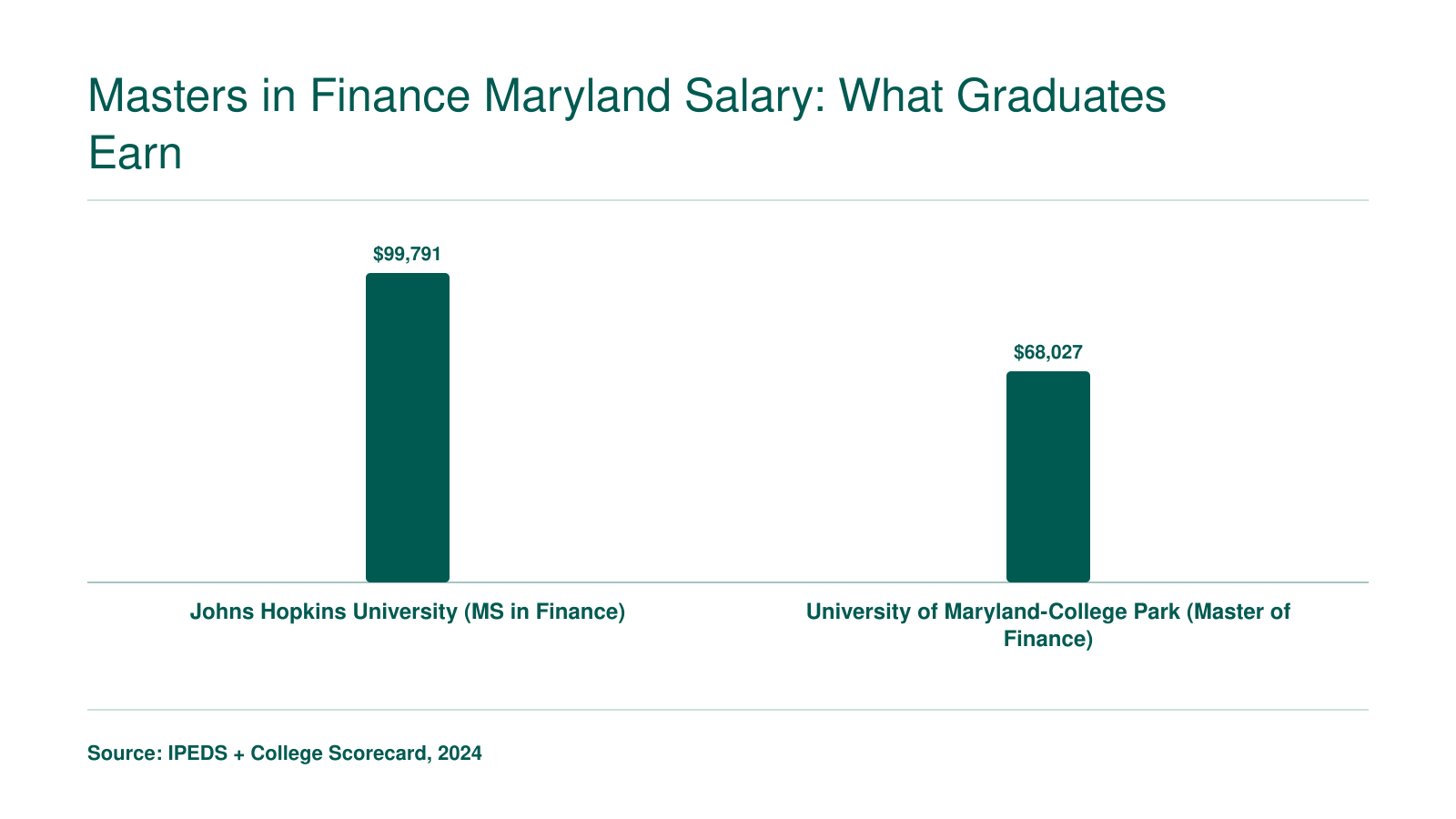
The chart shows median earnings one year after completing the master's, using program-level federal data rather than institution-wide figures. Johns Hopkins graduates earned a median of $99,791 in that window, against median program debt of $50,975, so first-year pay alone covers the debt about twice over. Johns Hopkins also reports median earnings of $130,390 five years out.
Internships, Employer Recruiting, and Career Services
Internships and recruiting for these Maryland finance programs run through specialized business-school channels, not just the campus career center. Johns Hopkins Carey's MS in Finance lists representative employers including JPMorgan Chase, Morgan Stanley, Deloitte, EY, PwC, Blackstone, Accenture, and the World Bank, among others. Career services include peer advisors, professional coaches, interviewing prep, and employer-facing workshops, while the Student Managed Investment Fund adds hands-on portfolio experience.1
At Maryland Smith, finance postings on SmithCareers include roles such as IMC Trading quantitative research intern, and students can use HireSmith resume review. Applied projects name Capital One, Deloitte, and Google, and students manage the Smith Global Equity Fund. Smith's published outcomes cite an 80% job placement rate and $87,000 average salary.
For part-time and online students, the Baltimore-Washington corridor is a practical advantage: many internships in asset management, consulting, and government sit within commuting distance of Baltimore and Washington, D.C., so you can build work experience while completing coursework.
Maryland Master's in Finance FAQs
These answers draw on published admissions information where it exists. Deadlines and requirements change each cycle, so confirm every date and score on the school's own admissions page before you apply.
What are the application deadlines for Maryland master's in finance programs?
What do international students need to apply?
Which Maryland finance master's programs are STEM designated?
Is a master's in finance in Maryland worth it?
Compare Finance programs on the data that matters
Explore more Business & Management specializations or browse every graduate field.
All Business & Management programs