Accelerated Master's in Finance Programs
Compare 340+ accredited fastest Finance programs at 290+ schools, with graduate earnings, cost, debt, and completion data from IPEDS and the U.S. College Scorecard.

Georgetown's MS in Finance takes 21 months on its traditional track but 10 on the full-time accelerated track, and the University of Delaware's can be finished in nine. The appeal is simple: less time out of the workforce and fewer semesters of tuition.
The cost is intensity. A one-year format packs coursework, CFA preparation, and job recruiting into the same few months.
Prices vary as much as timelines. FIU lists $30,000 in total online tuition, and Fairfield lists $38,550. A shorter degree is only a bargain if graduate earnings follow.
Key Points
- Net price after aid is often far lower than sticker tuition.
- One-year median earnings are $69,066 at Texas Tech, $110,674 at Georgetown.
- Most ranked programs in 2027 are campus-based, favoring recruiting access.
Best Accelerated Master's in Finance Programs for 2027
These ten accelerated finance master's programs combine short timelines with focused finance curricula. The options below highlight cost, format, and concentrations to help you compare.
Georgetown University
#1Washington, DC · $60,000 – $65,000/yr (est.)
Best for: Aspiring investment bankers seeking global exposure
Georgetown University's McDonough School of Business offers a hybrid Master of Science in Finance that combines online coursework with in-person residencies in Washington, D.C., and abroad. Students can choose a 21-month traditional track or an intensive 10-month full-time accelerated track, completing 32 credits and a global consulting project. The program prepares graduates for investment banking, corporate finance, asset management, and consulting roles.
- Hybrid format pairs online learning with three in-person residencies
- Traditional track spans 21 months; accelerated full-time track runs 10 months
- 32 total credit hours, including 29 core and 3 elective credits
- Minimum 3.0 GPA required to graduate
- Weekly MSFLive case discussions with McDonough faculty
- Accelerated pathway lets seniors count up to 12 MSF credits toward undergrad
- Graduate tuition and fees are $68,017 in-state and out-of-state
Rutgers University
#2New Brunswick, NJ · ~$23,000/yr (est.)
Best for: CFA exam candidates near New York City
Rutgers Business School's Master of Financial Analysis is a one-year, 33-credit program built around the CFA charter. The test-optional, STEM-designated curriculum aligns with all three CFA exam levels and offers up to 36 months of practical training for international students. Classes meet on the Livingston campus near New York City, with career services supporting financial analyst, investment associate, and portfolio manager placements.
- 33-credit, one-year program with full-time and part-time options
- Test optional; no entrance exam required
- STEM-designated with up to 36 months of OPT
- CFA Institute-affiliated curriculum aligned to all three exam levels
- Located on Livingston campus, 25 miles from New York City
- Spring start; application deadline December 15, 2026
- Graduate tuition and fees are $17,929 in-state and $37,441 out-of-state
University of Miami
#3Coral Gables, FL · ~$47,000/yr (est.)
Best for: Career changers using Miami's Bridge pathway
The University of Miami's MS in Finance is a STEM-designated degree that can be completed in one year, with full-time, part-time, and fully online formats. Students can shape the program around clusters such as financial analytics, fintech, corporate finance, and international finance, and a Bridge to MSF track supports career changers. Miami's location offers access to more than 60 international banks and a growing fintech and private equity market.
- STEM-designated one-year program with full-time and part-time options
- Nine concentration options, including Financial Analytics and Fintech
- Fully online option available with spring and fall starts
- Bridge to MSF pathway for students without finance backgrounds
- CFA-affiliated; prepares for CFA and Bloomberg certification
- Located near more than 60 international banks in Miami
- Graduate tuition and fees are $62,616 in-state and out-of-state
Virginia Polytechnic Institute and State University
#4Blacksburg, VA · ~$19,000/yr (est.)
Virginia Tech's MSBA in Finance is a 12-month, 30-credit cohort experience on the Blacksburg campus, delivered by the Pamplin College of Business. Students take five MBA core courses and five finance courses covering analysis, valuation, investments, derivatives, and global markets. The program points graduates toward corporate finance, consulting, risk management, capital markets, and investment management.
- 12-month, 30-credit program on the Blacksburg campus
- Cohort-based format with five MBA core and five finance courses
- Curriculum covers valuation, investments, derivatives, and global markets
- Taught by Pamplin Department of Finance faculty
- Program reports top 7% ROI among business master's
- Graduate tuition and fees are $15,948 in-state and $37,764 out-of-state
Florida International University
#5Miami, FL · ~$11,000/yr (est.)
Florida International University's online Master of Science in Finance is a 12-month program concentrated in financial innovation, with coursework in fintech, Python coding, and big data alongside corporate finance and investment banking. It is a CFA University Affiliation Program with preparation for CFA Level I and offers spring and fall starts. Tuition is lower for Florida residents than for out-of-state and international students.
- 12-month fully online program with spring and fall starts
- Concentration in financial innovation covers fintech, Python, and big data
- CFA University Affiliation Program with Level I exam prep
- $30,000 total program tuition for Florida residents; $33,600 for others
- Financial aid and scholarships available
The University of Alabama
#6Tuscaloosa, AL · ~$12,000/yr (est.)
The University of Alabama's MS in Finance is a campus program in Tuscaloosa with four concentrations, including corporate finance, financial engineering, and actuarial focuses. The 30-credit curriculum requires a capstone and selective admission, while an Accelerated Master's Program option supports undergraduates. Graduate tuition and fees are $12,180 in-state and $34,172 out-of-state.
- Corporate finance focus covers valuation, M&A, and corporate incentives
- 30 credit hours with a required capstone project
- Minimum 3.5 GPA and GRE or GMAT scores expected
- Open to non-business undergraduates; calculus and microeconomics recommended
- Accelerated Master's Program option available
- Financial engineering focus covers valuation of stocks, bonds, and derivatives
- Examines financial intermediaries and corporate behavior determinants
- 30-credit curriculum ending in a capstone
- Open to students without an undergraduate business degree
- Actuarial focus expects a background in accounting and statistics
- Covers interest rates, asset valuation, and corporate finance
- Higher admission standards than other finance options
- 30 credit hours, capstone, and early graduate credit path
Indiana University-Bloomington
#7Bloomington, IN · $12,000 – $33,000/yr (est.)
Indiana University Bloomington's Kelley School of Business offers a full-time MS in Finance that can be completed in about a year, with an online option available. Business majors may finish in 10 months, while a summer internship route extends the timeline to 18 months. The program emphasizes client projects, career services, and a global alumni network of more than 141,000.
- One-year full-time program; business majors may finish in 10 months
- Fully online option available; summer internship can extend to 18 months
- Core courses plus electives tailored to corporate finance or fintech
- Real-client projects and dedicated career services
- Reported mean base salary and signing bonus total $101,550
- Global alumni network exceeds 141,000
- Graduate tuition and fees are $12,144 in-state and $41,891 out-of-state
Fairfield University
#8Fairfield, CT · ~$21,000/yr (est.)
Fairfield University's MS in Finance is a 30-credit, 12-month STEM-designated degree in the Dolan School of Business. Students can specialize in business analytics, corporate finance, or accounting, with full-time and part-time options and online or hybrid course formats. The program is a CFA Institute University Affiliation member and offers a five-year bachelor's to master's pathway.
- $38,550 total program tuition; $1,285 per credit
- 12-month, 30-credit STEM-designated MSF
- Specializations in business analytics, corporate finance, or accounting
- Rolling admission with spring, fall, and summer start dates
- Accelerated 7-week intensive courses plus online and hybrid formats
- Five-year bachelor's to master's pathway available
University of Delaware
#9Newark, DE · $20,000 – $25,000/yr (est.)
The University of Delaware's MS in Finance is a STEM-designated 30-credit program that full-time students can finish in as few as nine months, with an 18-month standard route. The Geltzeiler Trading Center gives students real-time data experience in valuation, financial modeling, and risk management. A 4+1 option and an MBA/MS dual degree add flexibility.
- $1,149 per credit; 30 total credit hours
- Full-time students can finish in nine months; standard route is 18 months
- STEM-designated with 24 months of OPT for international students
- Hands-on training in the Geltzeiler Trading Center
- Rolling admission with fall and spring starts
- 4+1 bachelor's to master's and MBA/MS dual degree options
University of Connecticut
#10Storrs, CT · ~$23,000/yr (est.)
UConn's Master of Science in Financial and Enterprise Risk Management is a 36-credit program at the Stamford campus, available full time or part time. It covers capital markets, econometrics, derivatives pricing, and credit, equity, and fixed income risk, with an optional quantitative methods concentration. An accelerated track allows undergraduates to share up to 12 credits toward the master's.
- 36-credit curriculum with full-time and part-time options
- Stamford campus location near southwestern Connecticut and New York markets
- Optional Quantitative Methods in Risk Management concentration
- Accelerated track lets undergraduates share up to 12 credits
- Covers capital markets, econometrics, derivatives pricing, and risk management
- Graduate tuition and fees are $21,044 in-state and $43,712 out-of-state
Cost & outcomes by school
Federal data for the highest-earning Finance programs, independent of the ranking above. Earnings are this field's master's graduates four years after completing, where the Scorecard reports them.
| School | Earnings | Tuition / yr | Debt | Grads/yr | Format |
|---|---|---|---|---|---|
| The University of Texas Rio Grande Valley TX | — | $8,589 | — | — | Online |
| California State University-Long Beach CA | — | $8,898 | — | — | Campus |
| Herzing University-Birmingham AL | — | $9,370 | — | — | Online |
| Herzing University-Atlanta GA | — | $9,370 | — | — | Online |
| Herzing University-Madison WI | — | $9,370 | — | — | Online |
| Herzing University-Orlando FL | — | $9,370 | — | — | Online |
| Herzing University-New Orleans LA | — | $9,370 | — | — | Online |
| Herzing University-Kenosha WI | — | $9,370 | — | — | Online |
| Herzing University-Brookfield WI | — | $9,370 | — | — | Online |
| Herzing University-Tampa FL | — | $9,190 | — | — | Online |
| Herzing University-Nashville TN | — | $9,370 | — | — | Online |
| California State University-Sacramento CA | — | $9,542 | — | — | Hybrid |
Sources: U.S. Department of Education. Tuition and graduates: IPEDS. Earnings and debt: College Scorecard, this field's master's graduates; a dash means no figure is reported.
Cost, debt & payoff
Median earnings of this field's master's graduates (4 yrs after completing) vs. their median federal loan debt · U.S. College Scorecard
Across these programs the median graduate earns about $113,855 and finishes with roughly $39,725 in debt — a ratio that clears a common rule of thumb (keep debt below first-year salary). Tuition and debt vary widely school to school, so check the per-school figures in the table above before you shortlist.
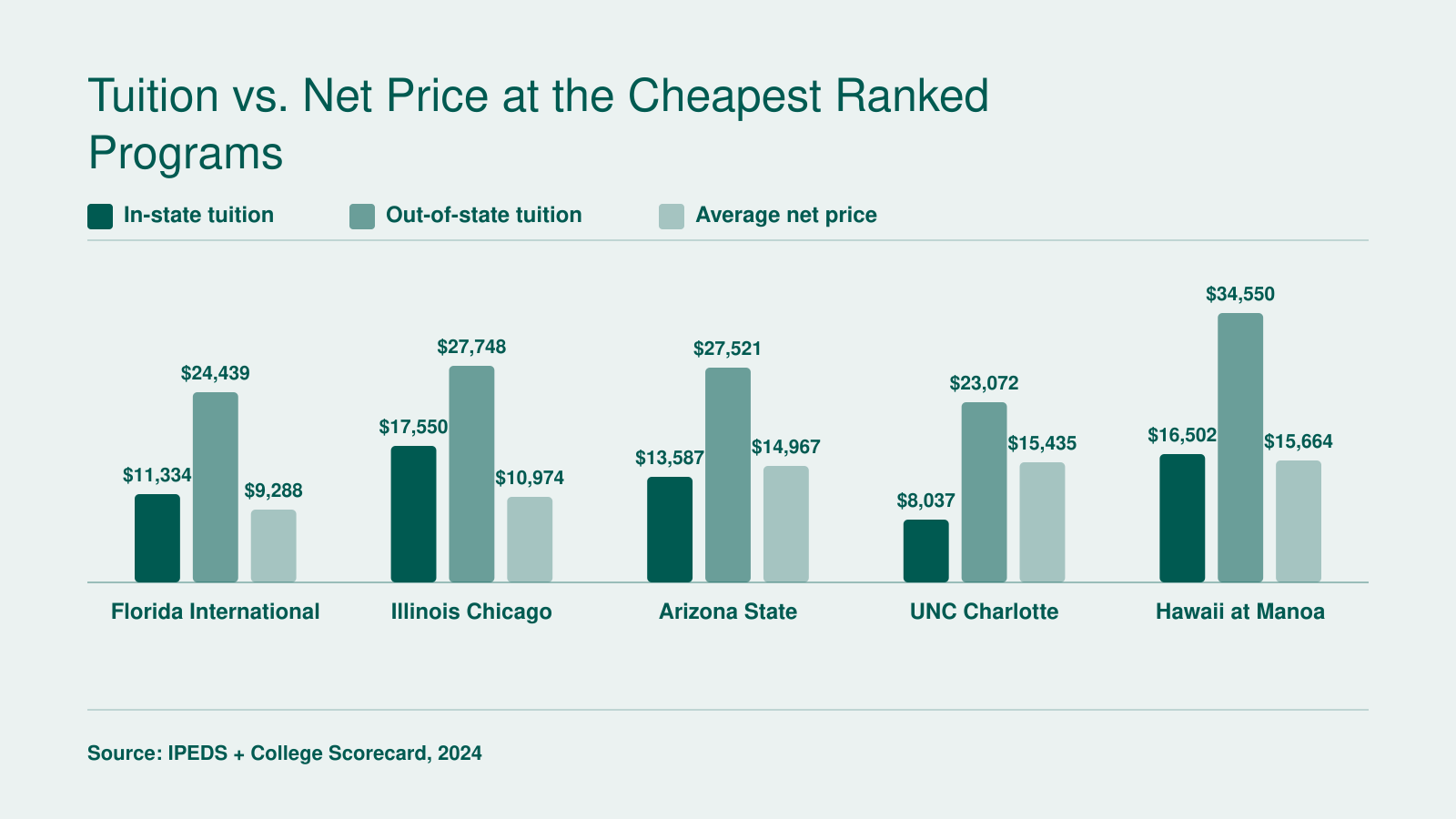
Tuition vs. Net Price at the Cheapest Ranked Programs
Sticker tuition varies widely, but net price after aid is often much lower. The chart compares published in-state tuition, out-of-state tuition, and each school's institution-wide average net price after grants and scholarships. Treat net price as an approximation rather than a program-specific quote. Merit aid can close the gap further: Oregon's Inclusive Excellence award provides $10,000 to selected students, and Loyola's AMP lets current undergraduates earn graduate credits at undergraduate rates.
Accelerated Finance Master's Salary Outcomes and ROI
Which accelerated Master's in Finance pays for itself fastest? Median earnings vary widely across the schools ranked here. One year after completion, Texas Tech graduates earn a median of $69,066. Four years out, University of Miami and Arizona State University report medians of $112,491 and $107,624, respectively. Georgetown University's five-year median reaches $149,302, while Florida International University's is $91,950.
Debt and monthly payments
Georgetown's higher five-year median comes with a median program debt of $74,347 and a 10-year monthly payment of $846. FIU's five-year median is lower but carries $30,705 in debt and $349 per month. That gap changes how quickly each graduate's salary can repay the degree's debt, a key metric of master's in finance cost.
Workplace signal
Where reported, employment one year out is strong: 95.7% at Miami, 96.2% at FIU, and 90.8% at Georgetown.
The 12-month format itself strengthens ROI beyond these figures. You pay one fewer year of tuition and start earning a full salary a year sooner, which shortens the break-even timeline even before salary differences appear.
Top First-Year Earnings Among Ranked Programs
Georgetown University's Master of Science in Finance reports the highest first-year median earnings among the ranked programs: $110,674.
Related Articles
Admission Requirements for Accelerated Finance Master's Programs
Admission standards vary, but accelerated finance master’s programs generally expect a bachelor’s degree, quantitative coursework, and a clear application file. Several schools publish specific GPA and credit-sharing rules.
- Bachelor’s degree and GPAYeshiva University’s MS in Finance requires a minimum 3.4 GPA; Wayne State’s bulletin lists a 3.3 AACSB business GPA or 3.3 in any regionally accredited major, while Rowan’s 4+1 track needs a 3.0 and USC Marshall sets a 3.0 USC GPA for its combined path. UMass Amherst uses holistic review and does not automatically exclude applicants below 3.0 if quantitative evidence is strong.
- Quantitative prerequisitesExpect calculus, statistics, and economics or finance coursework. UMass Amherst recommends calculus, statistics, and probability; Yeshiva requires one semester each of statistics and mathematics; Minnesota Carlson requires statistics; Schulich requires two 2000-level quantitative courses in calculus, statistics, economics, linear algebra, or probability, with exemptions for CFA or FRM credentials.
- 4+1 and combined-degree credit sharingUM-Dearborn allows up to 15 graduate credits to count toward the undergraduate finance major, and Rowan allows up to 12 approved graduate finance credits during the bachelor’s. Rowan requires a B or higher in each shared course for master’s credit.
- Transfer-credit limitsUM-Dearborn caps outside graduate transfer credit at 9 equivalent credits, while Wayne State caps transfer at 6 equivalent graduate credits with a B or better and currency within six years, provided they were not counted toward another degree.
- Test requirementsUSC Marshall and many accelerated tracks do not require the GMAT or GRE. Minnesota Carlson is test-optional at or above a 3.0 GPA, while UMass Amherst may request GMAT or GRE scores if quantitative preparation is not evident from transcripts.
- Application materialsCommon application materials include official transcripts, a resume, letters of recommendation, and a statement of purpose or essay. Schools with conditional or holistic admission, such as Golden Gate and UMass Amherst, often use the essay to address any GPA or preparation gaps.
How to Choose: Format, Test Waivers, and AACSB Accreditation
Choosing an accelerated finance master's means trading flexibility against recruiting access; the format you pick largely decides which one you get.
Online, campus, or both
Most of the programs ranked here are campus-based, with fully online delivery at Florida International University and a hybrid structure at Georgetown. Brooklyn College's one-year program runs either fully online asynchronously or in person. Campus formats concentrate on-site recruiting, cohort networks, and career services, which matters most to career switchers breaking into investment banking or corporate finance. An Online Master's in Finance suits working professionals who need to keep earning while they study.
Test waivers vary by school
There is no single standard. Rowan makes the GMAT/GRE optional only if you meet a defined condition: a Rowan finance graduate certificate with a 3.5 GPA, an AACSB business degree with a 3.3 undergraduate GPA (or 3.0 plus seven years of work experience), or the CFA.1 Illinois Gies waives the exam entirely through its Fast-Track route for undergraduates with a junior-year GPA of at least 3.3.2 Golden Gate and MTSU require no exam at all, making them master's in finance no GMAT or GRE programs.34
Verify accreditation
AACSB accreditation attaches to the business school, not the university, and signals curricular rigor to finance recruiters. Confirm it through AACSB's accredited-schools search before applying.
Finance programs by state
Frequently Asked Questions About Accelerated Finance Master's Degrees
Can you earn a master's in finance in one year?
Is an accelerated finance master's degree worth it?
Are accelerated MS in Finance programs STEM-designated?
Do accelerated finance master's programs prepare you for the CFA exam?
Compare Finance programs on the data that matters
Explore more Business & Management specializations or browse every graduate field.
All Business & Management programs