Best Master's in Finance Programs in Ohio
Compare 12 accredited Finance programs in Ohio at 8 schools, with graduate earnings, cost, debt, and completion data from IPEDS and the U.S. College Scorecard.

Ohio concentrates finance employment in Columbus, Cincinnati, and Cleveland across banking, insurance, and corporate treasury, while in-state tuition frequently undercuts coastal programs. This ranking places campus and online master's in finance options side by side, covering tuition, net price, graduate earnings, STEM designation, GMAT or GRE policies, deadlines, and CFA or licensure paths. The practical question isn't just which name you recognize; it's whether the salary payoff justifies the remaining cost.
Key Points
- Toledo and Ohio State lead the public universities on net price.
- Cincinnati's online finance master's is asynchronous and lists no live-session requirement.
- Ohio securities licensing depends on exams like the Series 65, not degrees.
Ranked: Top Master's in Finance Programs in Ohio
These eight Ohio institutions offer finance master's options on campus, online, or in a hybrid format, drawn from federal IPEDS and College Scorecard data and program research for 2026. Graduation rates describe the whole university, and net price is an approximate institution-wide average after aid, not a quote for any single program. Several listings are MBA concentrations rather than stand-alone finance degrees, and we say so where it applies.
Ohio State University
#1Columbus, OH · ~$14,000/yr (est.)
Best for: Recent graduates wanting a two-semester program
Ohio State's Specialized Master in Business-Finance is a two-semester, STEM-designated degree in Columbus with a capstone, a practicum, and full-semester training in Bloomberg, Capital IQ, and Crystal Ball. Domestic students entering in autumn 2026 can complete the final semester online. The university has a graduation rate of 88%, and its approximate net price after aid is about $17,300 a year.
- Two-semester program that starts each fall
- STEM-designated curriculum with OPT work permission up to three years
- Capstone and practicum with real company projects
- Electives in corporate finance, investments, risk, and real estate
- Alumni mentor program
- Final semester can be online for autumn 2026 domestic entrants
Case Western Reserve University
#2Cleveland, OH · ~$54,000/yr (est.)
Best for: Quant-minded students choosing analytics specializations
Case Western Reserve's Master of Finance, housed in the Weatherhead School of Management in Cleveland, can be finished in about nine months or extended with a specialization. Students work in the Bloomberg Lab and on corporate projects. The university has a graduation rate of 87%, and its approximate net price after aid is about $41,200, well above the public options on this list.
- 30 credit hours, 9-month core option
- Five concentration options, most STEM-eligible
- Test optional; GMAT or GRE not required
- Two recommendation letters and a $100 application fee
- Bloomberg Lab for investment research
- Seminars in private equity and REITs
University of Dayton
#3Dayton, OH · ~$20,000/yr (est.)
Best for: Working professionals needing a self-paced online track
The University of Dayton offers a 30-credit Master of Finance that can be completed fully online and asynchronously in 12 to 24 months. It is STEM-designated, includes CFA Level I preparation, and gives access to two investment centers. A GMAT or GRE is listed as required. The university has a graduation rate of 80%, and its approximate net price after aid is about $29,500.
- 30 credit hours; finish in 12 to 24 months
- Fully online, asynchronous option
- GMAT or GRE listed as required
- STEM-designated with 24-month OPT extension
- CFA Level I prep course and optional Fintech certificate
- No thesis or capstone required
- Davis Center and Hanley Center ESG investing access
University of Cincinnati
#4Cincinnati, OH · ~$15,000/yr (est.)
The University of Cincinnati lists five MS in Finance concentrations in its Lindner College of Business, so this one school appears under several listings. The STEM-designated degree can be finished in two semesters full-time or part-time, with a fully online option noted. The university has a graduation rate of 75%, and its approximate net price after aid is about $25,600.
- 30 credit hours, as few as two semesters
- Full-time and part-time options
- 18 core finance credits plus electives
- Johnson Investment Institute project experience
- Corporate finance concentration of the same MS
- Real-world projects with industry partners
- Employers include Goldman Sachs, Fifth Third, and EY
- Investment management concentration of the same MS
- Equity analysis and investments coursework
- Dedicated graduate career advisor
- Financial planning concentration of the same MS
- Option to add one of 20+ graduate certificates
- 24-month OPT extension for international students
- Risk management concentration of the same MS
- Company visits to Fortune 500 headquarters in Cincinnati
- STEM-designated master's program
Ohio University
#5Athens, OH · ~$10,000/yr (est.)
Ohio University in Athens offers a finance concentration within its online MBA rather than a stand-alone finance master's. The concentration is three courses and nine credits, and no entrance exam is required. Online students must attend a leadership conference in Athens at least once. The university has a graduation rate of 65%, and its approximate net price after aid is about $21,600.
- Three concentration courses, nine credits
- Covers financial markets, investments, and advanced corporate finance
- No entrance exam required
- Up to six transfer credits accepted
- 15% online incentive scholarship may be available
- Required leadership conference in Athens
Xavier University
#6Cincinnati, OH · ~$19,000/yr (est.)
Xavier's Master of Science in Finance in Cincinnati is a hybrid program with about 70% of classes on campus and a capstone managing part of the university's endowment. Full-time students can finish in nine months, and the GMAT or GRE is optional. The university has a graduation rate of 69%, and its approximate net price after aid is about $33,000. Tuition is listed at $966 per credit for 2026-27.
- 30 credit hours; as little as nine months full-time
- Full-time and part-time options with a fall start
- Test optional; two recommendation letters
- Two concentration options
- STEM-certified degree
- Bloomberg and CapIQ training on a replica trading floor
- Capstone managing a $1.7 million endowment fund
University of Toledo
#7Toledo, OH · $18,000 – $29,000/yr (est.)
The University of Toledo's finance option is a 33-credit MBA with a finance focus, available fully online and STEM-designated. A student-managed portfolio course runs an endowed fund of over $4 million. It is an MBA, not a stand-alone finance degree. The university has a graduation rate of 57%, and its approximate net price after aid is about $17,200, among the lowest here.
- 33 credit hours, fully online option
- STEM-designated program
- Eight MBA core courses plus three finance electives
- Student-managed portfolio course using the Neff trading facility
- Electives include derivatives and financial modeling
DeVry University-Ohio
#8Columbus, OH · ~$10,000/yr (est.)
DeVry University-Ohio offers an online Master of Accounting and Financial Management with a finance concentration, so it suits students blending accounting and finance more than pure finance. The program is ACBSP-accredited and built around CPA and CMA preparation. The university has a graduation rate of 39%, the lowest on this list, and its approximate net price after aid is about $25,000.
- 39 credit hours across 13 courses
- Can finish in 1 year and 4 months on an accelerated schedule
- Becker-powered CPA exam prep and CMA-aligned classes
- Capstone from a CFO perspective
- Military benefits and employer reimbursement supported
- Prior learning credit and course waivers may shorten the program
Cost & outcomes by school
Federal data for the highest-earning Finance programs, independent of the ranking above. Earnings are this field's master's graduates four years after completing, where the Scorecard reports them.
| School | Earnings | Tuition / yr | Debt | Grads/yr | Format |
|---|---|---|---|---|---|
| Case Western Reserve University OH | $120,292 | $53,980 | — | 100 | Campus |
| Xavier University OH | $119,687 | $19,218 | — | 3 | Hybrid |
| DeVry University-Ohio OH | — | $9,832 | — | — | Online |
| University of Cincinnati OH | — | $14,902 | — | — | Campus |
| University of Toledo OH | — | $17,605 | — | 50 | Online |
| Ohio University OH | — | $9,720 | — | 4 | Hybrid |
| Ohio State University OH | — | $13,901 | — | — | Campus |
| University of Dayton OH | — | $19,580 | — | — | Online |
Sources: U.S. Department of Education. Tuition and graduates: IPEDS. Earnings and debt: College Scorecard, this field's master's graduates; a dash means no figure is reported.
How We Rank Ohio Master's in Finance Programs
Outcomes, not reputation, decide where an Ohio Master's in Finance program lands on this list. Every school is judged on what the degree costs and what it pays back: graduate tuition, net price after grants and aid, the earnings of graduates from the finance program itself, and the median debt those graduates carry, all drawn from federal College Scorecard data.
Program-level figures carry the weight. When Scorecard publishes earnings or debt for a school's finance master's, those numbers drive the comparison. Institution-wide figures appear only as background, because a university's overall averages can blur what finance graduates earn and owe.
Campus and online Master's Programs in Ohio compete on the same list. Each card shows its delivery format, so a working professional who needs an online option, or a career changer who wants a full-time campus cohort, can filter the results for themselves.
Most Affordable Master's in Finance Programs in Ohio: Tuition Comparison
The schools below are ordered from lowest to highest institution-wide net price, with the public universities led by Toledo and Ohio State. At public universities the residency gap is large: Ohio State's federal program tuition figure is $13,901 in-state against $42,740 out-of-state, while Ohio University's is $9,720 against $17,712. For a rough answer to the cost question, the program tuition figures here run from about $9,720 to $42,740 depending on school and residency, and the only published full-program total is $51,750 at Case Western Reserve. Net price is an institution-wide average, graduate aid differs, and fees are not included, so confirm current rates on each school's bursar page.
| School and program | Format | Net price (institution-wide) | Program tuition, in-state | Program tuition, out-of-state | Credit hours | Per-credit rate and total cost |
|---|---|---|---|---|---|---|
| University of Toledo, MBA Finance concentration | Online | $17,249 | $17,605 | $29,426 | 33 | N/A |
| Ohio State University, Specialized Master in Business, Finance | Campus | $17,339 | $13,901 | $42,740 | N/A (two semesters, optional online third semester) | N/A |
| Ohio University, Online Finance MBA Concentration | Hybrid | $21,637 | $9,720 | $17,712 | N/A (concentration is 9 credits) | N/A |
| DeVry University-Ohio, Master of Accounting and Financial Management | Online | $25,001 | $9,832 | $9,832 | 39 | N/A |
| University of Cincinnati, MS in Finance | Campus (online option available) | $25,648 | $14,902 | $26,674 | 30 to 38 | N/A |
| Case Western Reserve University, Master of Finance (Fall 2026 entrants) | Campus | N/A | N/A | N/A | 30 | $1,725 per credit; $51,750 total tuition |
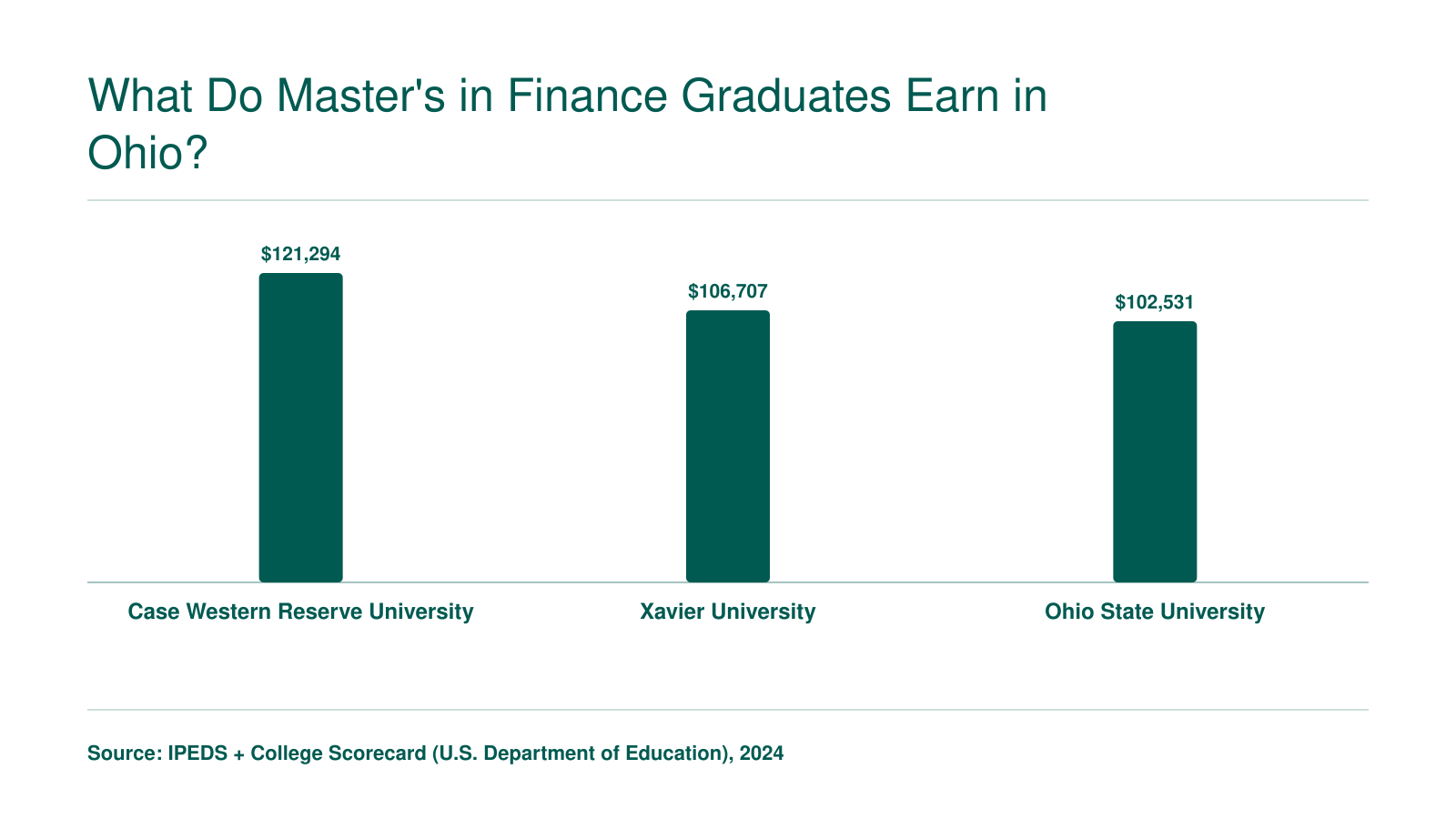
What Do Master's in Finance Graduates Earn in Ohio?
The chart compares median earnings of master's in finance graduates five years after finishing, drawn from federal program-level data. These are program figures, not school-wide averages, and cohorts at individual programs can be small, so treat the gaps as directional.
Related Articles
Online and Hybrid Master's in Finance Options in Ohio
STEM designation now matters as much as delivery format when applicants compare finance degrees, including an MBA in Finance.
Cincinnati's Online Master of Science in Finance is the clearest online route here. The online version is described as asynchronous, with no live-session requirement stated1, and runs 30 to 38 credits over one to two years. Full-time students can finish in as few as two semesters, and part-time takes about four to five.
Ohio State's Specialized Master in Finance is campus-based, with the first autumn and spring in person only. Domestic students entering autumn 2026 or later may take the final 9-credit semester online. International students may not. The program normally runs two semesters, and no part-time timeline is published.
Case Western's MFin is 30 credits over two semesters, or up to 39 credits and two years with a specialization. Its page does not establish online or hybrid delivery, so confirm directly.
STEM and F-1 status
Ohio State and Cincinnati are confirmed STEM-designated. Case Western calls the MFin and four specializations (including FinTech and Risk Management Analytics) "STEM-eligible," which is not the same thing. None of the pages state a CIP code, so ask admissions. STEM-coded programs let F-1 graduates seek up to 36 months of OPT. Online formats usually do not qualify for F-1 status.
Which Ohio Master's in Finance Programs Waive the GMAT or GRE?
No, you likely don't need a GMAT or GRE to apply to the strongest finance master's programs in Ohio, several are No-GRE master's programs, though the answer depends on where you apply. Programs here fall into three groups.
Test optional
Ohio State's Fisher Specialized Master in Finance is test-optional: there's no minimum score, and applicants simply choose to apply without scores, in which case the rest of the application carries more weight. Quantitative ability can be shown through coursework instead. Scores stay valid five years, and as of October 2024 Fisher does not accept at-home GRE scores. The University of Cincinnati's Lindner MS Finance made the GMAT and GRE optional for all applicants starting fall 2025; submitted scores are reviewed holistically, and waivers exist for qualifying students.
Work experience and fit
Neither program requires prior work experience. Fisher's SMF is built largely for recent graduates: most admitted students arrive with under a year of full-time experience.
No published policy
For the remaining schools on this list, we found no current test policy on their admissions pages. Treat those as unverified rather than assuming a waiver, and confirm directly before you apply.
Application Deadlines and Materials for Ohio Finance Master's Programs
Requirements vary by school, so confirm every date and document on each program's admissions page before you apply. The details below reflect what is published for Ohio State; deadlines for other schools here were not verified for Fall 2027.
- Bachelor's degreeOhio State asks for a four-year bachelor's degree or equivalent from a regionally accredited institution. Check each school's policy for other degree types.
- Transcripts and minimum GPAOhio State's graduate minimum is a 3.0 cumulative GPA on a 4.0 scale for your last degree earned. No higher finance-specific minimum was confirmed.
- Resume, recommendations and statement of purposeThese are typical program-specific materials. Confirm the number of recommenders and any essay prompts on the program page.
- GMAT or GREOhio State's Specialized Master in Finance is reported as not requiring the GMAT or GRE for 2026 applicants, but sources conflict. Verify the policy for your entry term.
- English proficiency (international applicants)Expect to submit TOEFL, IELTS or similar scores unless you qualify for a waiver. Minimum scores are set by each school.
- DeadlinesOhio State sets deadlines by program, and no Fall 2027 finance dates were confirmed. Look for priority and final rounds, and apply early if you want scholarship consideration.
- Quantitative prerequisitesNo official prerequisite list was confirmed. Programs commonly look for calculus, statistics and accounting, though some welcome any major with strong quantitative aptitude. Ask admissions directly.
CFA, FRM, and Licensure Paths in Ohio Master's in Finance Programs
The CFA and FRM are professional credentials earned by passing exams, separate from your degree, and some master's programs are built to help with that. Ohio State's Specialized Master in Finance says it prepares students for the CFA, CAIA, and FRM, and admissions describes a curriculum that supports the CFA and FRM. Published sources do not confirm a formal CFA affiliation for that program, so ask admissions directly. Case Western's Weatherhead Master of Finance has been accepted into a CFA university recognition program, though no formal FRM partnership is established.
On employers, Fisher lists recruiting partners including KPMG, EY, Huntington, Goldman Sachs, JPMorgan Chase, Citi, and Nationwide. It reports an average outgoing SMF salary of $75,000 to $80,000 for the last two years. A 94% employment figure covers its specialty master's programs1, and it may not apply to the SMF alone. Weatherhead publishes typical roles but no named recruiting partners.
Weigh prep against tuition: a curriculum that overlaps with exam content can reduce what you spend on outside review courses.
Ohio Licensing for Finance Careers
Frequently Asked Questions About Master's in Finance Degrees in Ohio
Is a master's in finance or MBA better for finance careers?
What is the average cost of a master's in finance in Ohio?
Does STEM designation matter if I'm a U.S. student?
Can I work full time while earning a master's in finance in Ohio?
Compare Finance programs on the data that matters
Explore more Business & Management specializations or browse every graduate field.
All Business & Management programs