Best Master of Arts in Teaching (MAT) Programs
Compare 1,000+ accredited Teaching programs at 570+ schools, with graduate earnings, cost, debt, and completion data from IPEDS and the U.S. College Scorecard.

For career changers and new teachers, the MAT is the fastest graduate route into a licensed classroom job, whether in elementary education or secondary classrooms. MAT programs often run 12 to 24 months and combine curriculum and instruction coursework with supervised student teaching. Across the ten ranked programs, graduate tuition ranges from about $12,700 at the University of Florida to $66,500 at Duke, while average net price after aid ranges from roughly $6,500 to $41,700.
Paid residencies and one-year online licensure routes can shift that debt math. State approval, not campus format, determines whether the license transfers to the district where you plan to teach, and the lower-debt programs are concentrated at public universities with in-state tuition or structured residencies.
Key Points
- The MAT leads to initial licensure; the MEd serves teachers already licensed.
- Paid residencies cut debt through a year of stipend-backed co-teaching.
- Confirm state licensure approval before comparing tuition, schedules, or online formats.
10 MAT Programs Ranked by Outcomes and Value
These MAT programs balance tuition, debt, and early-career earnings with school-based training and licensure preparation. The strongest options below stand out for either affordable in-state tuition, paid residencies, or clear pathways to initial certification. Rankings are ordered by the outcomes and value factors described in this guide.
University of California-Berkeley
#1Berkeley, CA · ~$16,000/yr (est.)
Best for: Aspiring teachers wanting California credential plus MA
In-state graduate tuition is about $16,350, with out-of-state students paying roughly $50,550. The 15-month, campus-based BTEP combines a California teaching credential with a Master of Arts in Education, and recent program completers report median four-year earnings near $75,800. The university's overall graduation rate is 93%.
- 15-month campus-based combined credential and master's
- Concentrations in Multiple Subject, English, History/Social Science, Math, or Science
- Gradual immersion with student teaching in Bay Area schools
- No GRE required; fellowship consideration for admitted students
Rice University
#2Houston, TX · ~$57,000/yr (est.)
Best for: Rice undergraduates pursuing Texas secondary certification
Tuition is about $64,100 for all MAT students. Rice offers campus-based tracks for current Rice undergraduates, new teachers, and experienced teachers pursuing principal certification, with full-time paid internships in Houston-area schools for pre-service candidates. The institution reports a 95% graduation rate overall.
- Fifth-year option for current Rice undergraduates
- 30 credit hours and 10 courses
- 75 clinical hours plus paid Houston internship
- Prepares for Texas TExES and teacher certification
- For new teachers seeking grades 7-12 certification
- 30 credit hours and field-based experience
- Two-semester supervised teaching internship
- Culturally responsive pedagogy emphasis
- Designed for experienced certified teachers
- Prepares for Texas principal certification
- Includes two-semester principal practicum
- Non-thesis instructional leadership curriculum
University of Virginia
#3Charlottesville, VA · ~$24,000/yr (est.)
Best for: Career changers needing one-year Virginia licensure
In-state graduate tuition runs about $21,800; nonresidents pay about $59,500. UVA's one-year Master of Teaching offers mostly campus-based licensure tracks in ESL, English, elementary, and science, plus an online special education option, and is CAEP-accredited. Recent program data show median first-year earnings around $54,100 with median debt around $21,100, and the university reports a 96% institution-wide graduation rate.
- One-year ESL preK-12 licensure track
- Internships in elementary and secondary ESL classrooms
- Praxis ESL exam required for licensure
- June through May cohort in Charlottesville
- One-year English education licensure track
- Prepares for Virginia initial teaching licensure
- Diverse school internships with mentor teachers
- One-year elementary education licensure track
- Strong national reputation in elementary teacher preparation
- Internships in different school settings
- One-year science education licensure track
- Noyce Scholarship up to $18,000 per year
- Endorsements in Biology, Chemistry, Earth Science, or Physics
- Online, part-time special education licensure track
- Flexible spring, summer, or fall starts
- Transfer up to 6 credits; personalized plan of study
University of Florida
#4Gainesville, FL · ~$13,000/yr (est.)
In-state graduate tuition is about $6,380, with out-of-state students paying around $28,660. The campus-based MAT in Teaching Mathematics requires 39 credits and includes a teaching internship, and program data show median first-year earnings around $50,800 with median debt around $24,500. The university reports a 91% institution-wide graduation rate.
- 39 credit hours with teaching internship
- Minor field and one semester college teaching
- Teaching portfolio and final oral examination
- Prepares for middle school, high school, or community college teaching
Duke University
#5Durham, NC · ~$67,000/yr (est.)
In-state and out-of-state graduate tuition is about $68,760. Duke's 12-month, campus-based MAT combines secondary concentrations in English, social studies, science, and math with a 27-week internship in Durham Public Schools. Program data show median first-year earnings around $48,600, and the university reports a 97% institution-wide graduation rate.
- Secondary English certification pathway
- English methods plus culturally responsive teaching
- Secondary social studies certification pathway
- Social studies methods and NC licensure prep
- Secondary science certification pathway
- Science methods and 27-week Durham internship
- Secondary math certification pathway
- Math methods and Durham Public Schools internship
University of North Carolina at Chapel Hill
#6Chapel Hill, NC · ~$13,000/yr (est.)
In-state graduate tuition is about $8,994; out-of-state students pay about $41,203. UNC's full-time, 13-month campus MAT offers elementary, secondary, and special education tracks leading to North Carolina initial licensure. Program data show median first-year earnings around $44,950 with median debt around $23,462, and the institution reports a 91% graduation rate overall.
- 13-month full-time elementary licensure track
- Add-on licensure in special education available
- Two-semester student-teaching internship
- 13-month secondary licensure track
- 40 credit hours and student-teaching internship
- Strong national reputation in secondary teacher preparation
- 13-month special education licensure track
- Special education program with national recognition
- North Carolina Teaching Fellows eligible
University of Washington-Seattle Campus
#7Seattle, WA · ~$19,000/yr (est.)
In-state graduate tuition is about $12,973; out-of-state students pay about $43,209. UW's one-year Master in Teaching is a field-based hybrid campus program with elementary and secondary options, leading to a Washington Residency Certificate. Program data show median first-year earnings around $72,769 with median debt around $30,990, and the university reports an 85% institution-wide graduation rate.
- One-year elementary teacher preparation
- Field-based hybrid with urban partner schools
- Earns Washington Residency Certificate
- One-year secondary teacher preparation
- Endorsed for specific subject areas
- Inquiry-oriented coursework and fieldwork
Johns Hopkins University
#8Baltimore, MD · ~$65,000/yr (est.)
Tuition is about $65,230 for all students, but the TeachingWell residency model fully funds tuition in exchange for a four-year teaching commitment in a Maryland partner school. The campus-based, 39-credit program focuses on secondary science and offers a paid residency with a Noyce Scholarship stipend up to $10,000. Program data show median earnings around $63,385 four years after completion, and the university reports a 94% institution-wide graduation rate.
- 39 credit hours, starts summer
- Full-tuition residency with paid teaching role
- Noyce Scholarship stipend up to $10,000
- Prepares for Maryland certification
- STEM focus on environmental issues
- Whole Teacher Support Team coaching
Boston College
#9Chestnut Hill, MA · ~$38,000/yr (est.)
Graduate tuition is about $70,702 for all MAT students. Boston College's campus-based MAT in English combines literary study with secondary teaching preparation and includes a comprehensive examination. Program data show median first-year earnings around $56,482, and the university reports a 91% institution-wide graduation rate.
- Campus-based secondary English MAT
- Covers evolution of English language and grammar
- Broad literature including female authors and authors of color
- Literary theory and criticism included
- Comprehensive examination required
Washington University in St Louis
#10St. Louis, MO · ~$65,000/yr (est.)
Graduate tuition is about $65,790 for the MATL and related teacher residency paths. WashU's campus and hybrid offerings include a teacher residency with full-year apprenticeship and stipend plus an alternative certification route. The university reports a 94% institution-wide graduation rate.
- 30 credit hours, 2-year program
- Full-year classroom residency with stipend
- Pathways for certified teachers and new teachers
- Collaboration with Teach St. Louis
- Classics MAT pathway for Latin teachers
- Missouri teaching certification options
- Consult education advisor early
Cost & outcomes by school
Federal data for the highest-earning Teaching programs, independent of the ranking above. Earnings are this field's master's graduates four years after completing, where the Scorecard reports them.
| School | Earnings | Tuition / yr | Debt | Grads/yr | Format |
|---|---|---|---|---|---|
| California State University-Fresno CA | $97,033 | $8,865 | $20,500 | 18 | Online |
| University of the District of Columbia DC | $89,963 | $9,604 | — | 12 | Campus |
| California State University-Northridge CA | $89,925 | $8,982 | $20,500 | 7 | Campus |
| Boricua College NY | $89,128 | $19,100 | $13,140 | — | Campus |
| Pace University NY | $85,077 | $30,770 | $36,772 | 112 | Online |
| University of Massachusetts Global CA | $84,909 | $13,680 | — | 163 | Online |
| University of Washington-Seattle Campus WA | $80,738 | $18,792 | $30,990 | 103 | Campus |
| CUNY Brooklyn College NY | $80,655 | $11,524 | $27,668 | 124 | Campus |
| University of California-Irvine CA | $79,921 | $14,827 | $30,500 | 136 | Campus |
| CUNY Lehman College NY | $78,311 | $11,570 | $25,825 | 79 | Campus |
| San Francisco State University CA | $77,699 | $9,370 | $18,834 | — | Campus |
| Relay Graduate School of Education NY | $76,883 | — | $9,348 | 816 | Hybrid |
Sources: U.S. Department of Education. Tuition and graduates: IPEDS. Earnings and debt: College Scorecard, this field's master's graduates; a dash means no figure is reported.
Cost, debt & payoff
Median earnings of this field's master's graduates (4 yrs after completing) vs. their median federal loan debt · U.S. College Scorecard
Across these programs the median graduate earns about $58,919 and finishes with roughly $27,974 in debt — a ratio that clears a common rule of thumb (keep debt below first-year salary). Tuition and debt vary widely school to school, so check the per-school figures in the table above before you shortlist.
How We Ranked These MAT Programs
These rankings are built on verifiable public data, not marketing claims. For each MAT program, we compare graduate tuition and fees, average net price, program-level earnings and debt from College Scorecard, and the institution's graduation rate. A program ranks higher when it delivers stronger early-career earnings and a lower net cost after aid. That keeps the comparison grounded in what a typical graduate experiences.
What We Don't Use
Reputation surveys and paid placement do not influence the list. Those signals tell you how a school has been marketed, not how well it serves classroom teachers. We leave them out because they are the trust gap in many competitor rankings, and they add no value to your cost and earnings comparison.
Where the Data Has Limits
Average net price is calculated across the whole institution after aid, so your own cost may differ. Graduation rates cover the whole school, not the MAT cohort alone. Where program-level figures are not yet reported, we say so instead of guessing. A lower-ranked program may still be the smarter pick if your in-state or online tuition is lower.
How to Use This List
Start with what fits your life: online, in-person, one-year, or residency-based. Then narrow by specialization such as early childhood education, elementary, secondary, or special education. Finally, compare the cost and outcome figures side by side. The best MAT for you is often the one with a workable format and a lower debt burden, not just the biggest name.
Most Affordable MAT Programs: Tuition, Net Price, and Debt
Sticker graduate tuition is not the same as final cost: the table shows in-state and out-of-state tuition, the average net price after grant and scholarship aid, and median debt for the lowest-cost ranked programs. An out-of-state online student may pay the higher out-of-state rate unless the school has a same-rate tuition policy, so check residency rules before comparing annual figures. Published tuition also omits per-credit and mandatory fees, such as Randolph College's $400 per credit plus a $350 student fee, the University of Georgia's $431 per-semester fee, and the University of Illinois Urbana-Champaign's $3 per-credit technology fee.
| School | In-State Graduate Tuition | Out-of-State Graduate Tuition | Average Net Price | Median Graduate Debt |
|---|---|---|---|---|
| University of Florida | $6,381 | $28,659 | $6,541 | $15,000 |
| California State University, Fullerton | $7,470 | $20,070 | $6,555 | $13,750 |
| University of North Carolina at Chapel Hill | $8,994 | $41,203 | $11,655 | $14,000 |
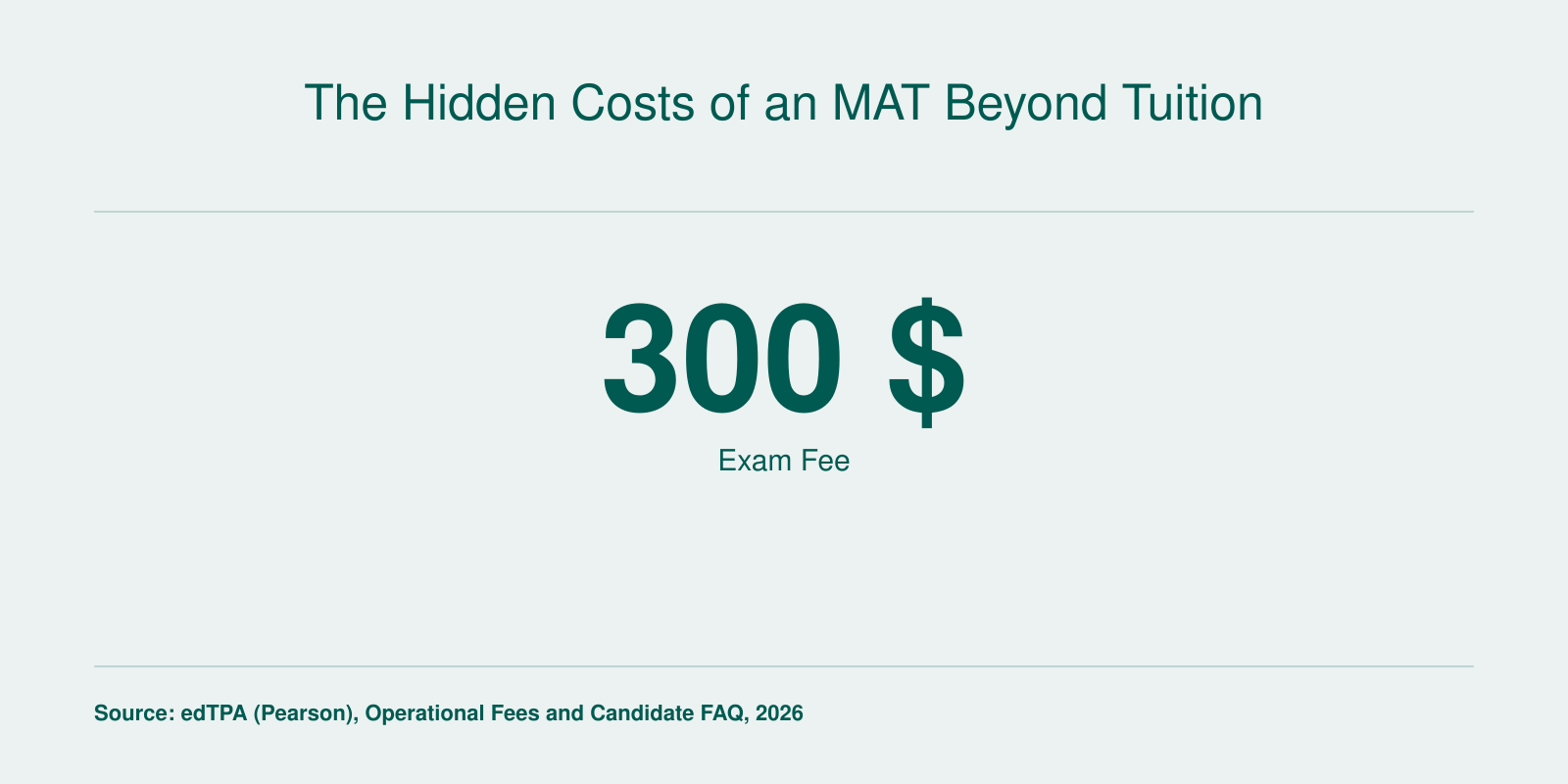
The Hidden Costs of an MAT Beyond Tuition
Paid Teacher Residencies: The Lower-Debt Path to an MAT
Paid teacher residencies trade schedule freedom for lower debt: you spend about a year co-teaching under a mentor while drawing a stipend, and in many programs you agree to teach in a partner district for several years after. That structure can cut graduate school borrowing sharply, but only if you are willing to stay in a specific school system.
How the Model Works
Instead of an unpaid student-teaching placement, a residency pays you during that clinical year. For example, USC Rossier's MAT residency places candidates in one LAUSD school or an Ednovate high school and requires four years of teaching at LAUSD, Ednovate, or Alliance afterward.1 The program also pairs that commitment with substantial support, reported as a $42,000 scholarship plus a $20,000 living stipend2, though the current page may not confirm the stipend for 2026 applicants.
What Programs Pay
Documented stipends cluster around $20,000 to $30,000, but funding mechanisms differ. Clemson's Pee Dee residency pays $25,000 during the residency year and places about 16 residents annually in participating districts, with no published post-completion commitment length.3 Santa Clara University pays $25,000 during student teaching through SCCOE and asks graduates to teach in California public schools for at least four years.4 Sacred Heart covers 30 graduate credits and reports living support up to $30,000 annually, roughly $3,000 per month5, with a three-year commitment in some district partnerships6. NYU Steinhardt's compensated pathway offers a $30,000 stipend plus benefits.7
The Trade-Off and What to Ask
The savings are real, but the constraints are real too. A residency can mean less part-time or online flexibility and a multi-year obligation that may limit later job moves. If you also receive a TEACH Grant, ask whether its federal teaching service requirement stacks with the residency's commitment. Before enrolling, ask admissions directly: is the clinical placement paid, and is there a separate residency track with a service contract?
Related Articles
MAT vs Med: Which Degree Fits Your Career Goal?
The core split is simple. The MAT prepares people without an education background for initial licensure and classroom teaching, while the MEd usually serves licensed teachers moving into curriculum and instruction, leadership, or specialist roles. Alternative certification is a third route that is cheaper and faster but less structured. Check your state's licensing rules before you commit to any of the three.
| Factor | MAT | MEd | Alternative Certification |
|---|---|---|---|
| Primary purpose | Initial licensure and classroom teaching | Advanced study for educators moving into leadership, curriculum, or specialist work | State-approved route to a teaching license |
| Initial licensure | Many programs are designed to meet some or all state requirements; the state agency issues the license after all requirements, including any exams, are met | Generally not provided in most states; may offer advanced endorsements | Lets career changers teach while finishing coursework, exams, and supervised teaching |
| Typical applicant | Bachelor's degree holders in non-education fields who want to teach | Experienced teachers, or those pursuing another education path such as administration | Career changers who want the fastest, lowest-cost route to a license |
| Coursework focus | Practice-focused instruction, content knowledge, and fieldwork | Educational leadership, administration, curriculum design, and policy | Licensure coursework, exams, and supervised teaching |
| Typical length | 12 to 24 months full-time | 12 to 24 months full-time for programs that include licensure | As little as 9 to 16 months |
| Career paths | Licensed K-12 teacher, subject-specific teaching, ESL, special education | Principal, superintendent, curriculum coordinator, instructional designer, policymaker, consultant | Classroom teaching, often sooner than a degree route |
| Leaving the classroom | Primarily prepares you for teaching and classroom management | An MEd in curriculum and instruction or instructional design can open non-classroom paths | Not designed for this, but many programs apply credits toward an MEd later |
| Rule of thumb | Choose it if you need a license and want structured classroom practice | Choose it if you are already licensed and want to lead, coordinate, or leave the classroom | Choose it if speed and cost matter most and your state accepts the route |
Before you compare tuition or schedules, confirm the program leads to licensure in the state where you plan to teach. State approval matters more than whether classes meet online or on campus.
Teaching programs by state
MAT Program FAQs
These answers draw on current admissions pages and our ranked program data. Policies change, so confirm details with each school before you apply.
Do MAT programs require GRE scores?
Are there one-year MAT programs?
What is the cheapest online MAT program?
What are typical master's in education requirements for admission?
Compare Teaching programs on the data that matters
Explore more Education & Teaching specializations or browse every graduate field.
All Education & Teaching programs