Best Master of Arts in Teaching (MAT) Programs in Kansas
Compare 12 accredited Teaching programs in Kansas at 8 schools, with graduate earnings, cost, debt, and completion data from IPEDS and the U.S. College Scorecard.
A bachelor's degree with no teaching license is the common starting point for the programs here: a Master of Arts in Teaching lets career changers and recent graduates earn a Kansas license and a master's in one move. For the most affordable Master of Arts in Teaching programs, estimated net price after aid runs from about $15,784 to $27,891, and the ranked programs mix campus, hybrid, and fully online formats on one list.
The tension is real. The cheapest published in-state tuition doesn't always track with the fastest route to a classroom, and online coursework still carries in-person clinical requirements that no Kansas program waives.
Key Points
- Kansas State University's MAT skips the GRE, using a video essay instead.
- Emporia State University's MAT lists Kansas's lowest in-state tuition at $8,843.
- Special education accounted for 378 Kansas educator vacancies in spring 2026.
Top Master's in Teaching Programs in Kansas: 2027 Rankings
A lower price tag matters only if a program actually gets you to the classroom. These Kansas master's in teaching programs stood out for manageable cost, student completion, and clear licensure pathways. Use the cards below to compare formats, concentrations, and required exams before you apply.
Kansas State University
#1Manhattan, KS · $12,000 – $26,000/yr (est.)
Best for: Bachelor's holders needing Kansas licensure
Kansas State University's MAT is built for bachelor's degree holders who want a fast, practice-heavy route into teaching. Coursework is online with field placements in accredited schools, and students can complete the degree in 12 months. KSDE approval means completers are positioned to apply for a Kansas Initial Teaching License after meeting state requirements, including Praxis content testing.
- 12-month program for bachelor's degree holders
- Online coursework plus field experiences in accredited schools
- Required practicum and internship with placed assignments
- Placement considers location and travel needs
- Completers can apply for Kansas Initial Teaching License
- KSDE-approved initial licensure pathways
- Tracks in elementary, elementary special education, and secondary education
Pittsburg State University
#2Pittsburg, KS · ~$9,000/yr (est.)
Best for: Paraeducators seeking special education licensure
Pittsburg State stands out for its 100% online MAT options in special education and secondary teaching. The special education track is designed for paraeducators with at least one year of experience, while the secondary path provides an alternative licensure route for career changers. Both routes include hands-on practicum or classroom experience and lead toward Kansas teaching licensure.
- Designed for paraeducators with non-teaching bachelor's degrees
- At least one year of experience with high-incidence needs
- 3.0 GPA minimum and 2 letters of recommendation
- Hands-on practicum with high-incidence disabilities
- Leads to Kansas teaching license in High Incidence K-6
- Covers literacy, behavior analysis, and assessment
- Entrance exam required
- Exams: Praxis
- 3.0 GPA minimum and 2 letters of recommendation
- Capstone required
- 100% online program
- Alternative licensure for non-teaching bachelor's degrees
- Prepares for grades 6-12 or PreK-12 licensure
- Gorilla Advantage: in-state tuition for 32 states
Benedictine College
#3Atchison, KS · ~$7,000/yr (est.)
Best for: Catholic school career changers
Benedictine College offers a hybrid MAT designed for non-education bachelor's degree holders. The elementary track prepares candidates for PreK-6 licensure, and secondary tracks are available in 11 disciplines. The program emphasizes small class sizes and faith-integrated instruction, making it a fit for those interested in Catholic and other school settings.
- Elementary licensure for grades PreK-6
- Designed for non-education bachelor's degree holders
- Leads to Kansas teaching license
- Hybrid format with faith-integrated instruction
- Small class sizes and dedicated faculty
- Secondary licensure available in 11 subjects
- For non-education bachelor's degree holders
- Leads to Kansas teaching license
- Faith-integrated hybrid instruction
- Focus on middle and high school teaching
Emporia State University
#4Emporia, KS · ~$9,000/yr (est.)
Emporia State's 33-credit online Master of Education in Teaching is tied to the Restricted Licensure program for first-time Kansas license seekers. Students take all education courses online and can start in spring, fall, or summer. Admission requires a bachelor's degree awarded at least two years before applying and a 2.75 GPA, with pathways for library/media specialists and school counselors.
- 33 total credit hours
- Full-time and part-time options
- 3 start dates per year
- Fully online option available
- Associated with Restricted Licensure program
- Up to nine transfer credits accepted
- Leads to Kansas teaching licensure
MidAmerica Nazarene University
#5Olathe, KS · ~$14,000/yr (est.)
MidAmerica Nazarene's online MEd in Secondary Education serves career changers who already hold a content-area degree and want to teach grades 6-12. The program combines Transition to Teaching restricted licensure coursework with MEd core classes, including classroom management and action research. A 3.0 GPA is required, and a valid teaching license is preferred.
- Prepares for grades 6-12 teaching
- Includes MEd core courses and restricted licensure work
- 3.0 GPA minimum
- Online courses via Moodle
- Laptop and broadband required
- Valid teaching license preferred
- Action research taken sequentially
University of Saint Mary
#6Leavenworth, KS · ~$9,000/yr (est.)
University of Saint Mary offers a hybrid MAT in Secondary Education for bachelor's degree holders aiming at Kansas grades 6-12 licensure. Concentrations include Secondary and Secondary ESOL, with 8-week courses meeting one night per week remotely or at the USM-Johnson County campus. Admission includes a passing Praxis II content score, recommendation letters, and an interview.
- Secondary and Secondary ESOL concentrations
- Entrance exam required
- Exams: Praxis
- $430 per credit hour
- 8-week accelerated courses
- Classes meet one night per week
- Remote or in-person class options
- Leads to Kansas initial teaching license
Friends University
#7Wichita, KS · ~$12,000/yr (est.)
Friends University's MAT is a 30-credit, 18-month program designed for licensed educators who want to advance without leaving the classroom. The curriculum covers contemporary issues, assessment, and action research, and courses run in 8-week terms across classroom, hybrid, and online formats. Applicants need a teaching license, two years of teaching experience, and a 3.0 GPA.
- 30 total credit hours, 18-month completion
- For licensed educators advancing skills
- 3.0 GPA minimum and teaching license required
- Two years of teaching experience required
- Eight-week course terms
- Classroom, hybrid, and online formats
- Action research project capstone
- Individualized research study plan
Ottawa University-Kansas City
#8Overland Park, KS · ~$13,000/yr (est.)
Ottawa University's online Master of Arts in Education offers an Elementary Education concentration for Kansas licensure. The 36-credit program includes foundation courses, a concentration, and a master's research project, with flexible online scheduling for working educators. It also offers Kansas and Arizona certification pathways.
- Elementary Education concentration for Kansas licensure
- 36 total credit hours
- Fully online option available
- Kansas licensure and Arizona certification pathways
- Master's research project required
- Learn on your own time, day or night
Cost & outcomes by school
Federal data for the highest-earning Teaching programs, independent of the ranking above. Earnings are this field's master's graduates four years after completing, where the Scorecard reports them.
| School | Earnings | Tuition / yr | Debt | Grads/yr | Format |
|---|---|---|---|---|---|
| Friends University KS | $62,988 | $11,988 | $17,075 | — | Hybrid |
| Emporia State University KS | $53,602 | $8,843 | $23,075 | 81 | Online |
| Kansas State University KS | $53,073 | $12,089 | $23,050 | 126 | Hybrid |
| Pittsburg State University KS | $52,964 | $9,470 | $25,428 | 82 | Online |
| University of Saint Mary KS | $48,991 | $9,073 | — | 6 | Hybrid |
| Benedictine College KS | — | $6,670 | — | — | Hybrid |
| Wichita State University KS | — | $7,986 | — | — | Hybrid |
| MidAmerica Nazarene University KS | — | $13,597 | — | 4 | Online |
Sources: U.S. Department of Education. Tuition and graduates: IPEDS. Earnings and debt: College Scorecard, this field's master's graduates; a dash means no figure is reported.
Cost, debt & payoff
Median earnings of this field's master's graduates (4 yrs after completing) vs. their median federal loan debt · U.S. College Scorecard
Across these programs the median graduate earns about $52,964 and finishes with roughly $25,428 in debt — a ratio that clears a common rule of thumb (keep debt below first-year salary). Tuition and debt vary widely school to school, so check the per-school figures in the table above before you shortlist.
Online and Hybrid Master's in Teaching Options in Kansas
Flexibility and classroom presence pull in opposite directions here: coursework can live entirely online, but no Kansas MAT lets you earn licensure without real time in front of students. Knowing where each program lands saves you from scheduling surprises.
Fully online vs. hybrid
Kansas State delivers its Secondary and Unified Elementary/Special Education tracks online and asynchronously, so you move through each semester's work on your own schedule rather than logging in for fixed class times. Pittsburg State, Emporia State, MidAmerica Nazarene, and Ottawa University-Kansas City also publish fully online master's programs in Kansas. Benedictine College, University of Saint Mary, and Friends University run hybrid formats that mix remote coursework with some in-person meetings; Saint Mary's classes, for instance, meet one night a week.
Field placements and out-of-state access
K-State arranges clinical work in accredited schools near where you live, including roughly 12 weeks of full-time student teaching, though placement availability varies by location and longer commutes are possible. Qualified out-of-state applicants can enroll at K-State, but confirm with admissions that your clinical placement and target state's licensure line up before you commit.
Which Kansas MAT Programs Waive the GRE?
A GRE score and a video essay measure very different things, and Kansas State University's MAT relies on the essay. K-State's MAT tracks (Elementary, Secondary, or Unified Elementary and Special Education) are No-GRE master's programs: none requires the GRE for admission.
What K-State asks for instead:
- GPA: A bachelor's degree with a 3.0 GPA overall or in your final two years. The Unified track also accepts your most recent 60 credit hours, and it requires no prior teaching experience.
- Application materials: A video essay, a resume, and three references.
- Praxis timing: The Secondary track requires a passing Praxis content test in your intended licensure area before you are admitted. The Elementary and Unified tracks require no test to enter. Their Praxis exams come later, for Kansas certification.
We could not confirm a current GRE policy on the official admissions pages for Pittsburg State University, Benedictine College, Emporia State University, MidAmerica Nazarene University, University of Saint Mary, Friends University, or Ottawa University-Kansas City. Don't assume these schools waive the test.
Before you apply, email each admissions office and ask for its GRE policy, GPA minimum, and any Praxis requirement in writing.
Related Articles
Most Affordable MAT Programs in Kansas: Tuition and Net Price
Among the most affordable MAT options on this page, in-state tuition runs from $8,843 to $12,089, while estimated net price after aid ranges from $15,784 to $27,715. Emporia State University lists the lowest published in-state tuition at $8,843 with a net price of $16,261. Public institutions in this group report net prices from $15,784 to $19,406, while the private options report $22,519 and $27,715. Net price is an institution-wide average after aid, not a per-student quote. Kansas State's online MAT lists a flat $570.43 per credit charge for 2025-2026, with no residency difference and no published total credit requirement.
| School | Type | In-state tuition | Out-of-state tuition | Net price after aid |
|---|---|---|---|---|
| Pittsburg State University | Public | 9470 | 20302 | 15784 |
| Emporia State University | Public | 8843 | 19154 | 16261 |
| Kansas State University | Public | 12089 | 25824 | 19406 |
| University of Saint Mary | Private | 9073 | 9073 | 22519 |
| Friends University | Private | 11988 | 11988 | 27715 |
Kansas schools reported 1,588 educator vacancies in spring 2026, with special education alone accounting for 378 of them, according to the Kansas State Department of Education. Newly licensed MAT graduates, especially those certified in high-need fields, walk into a hiring market with real openings.
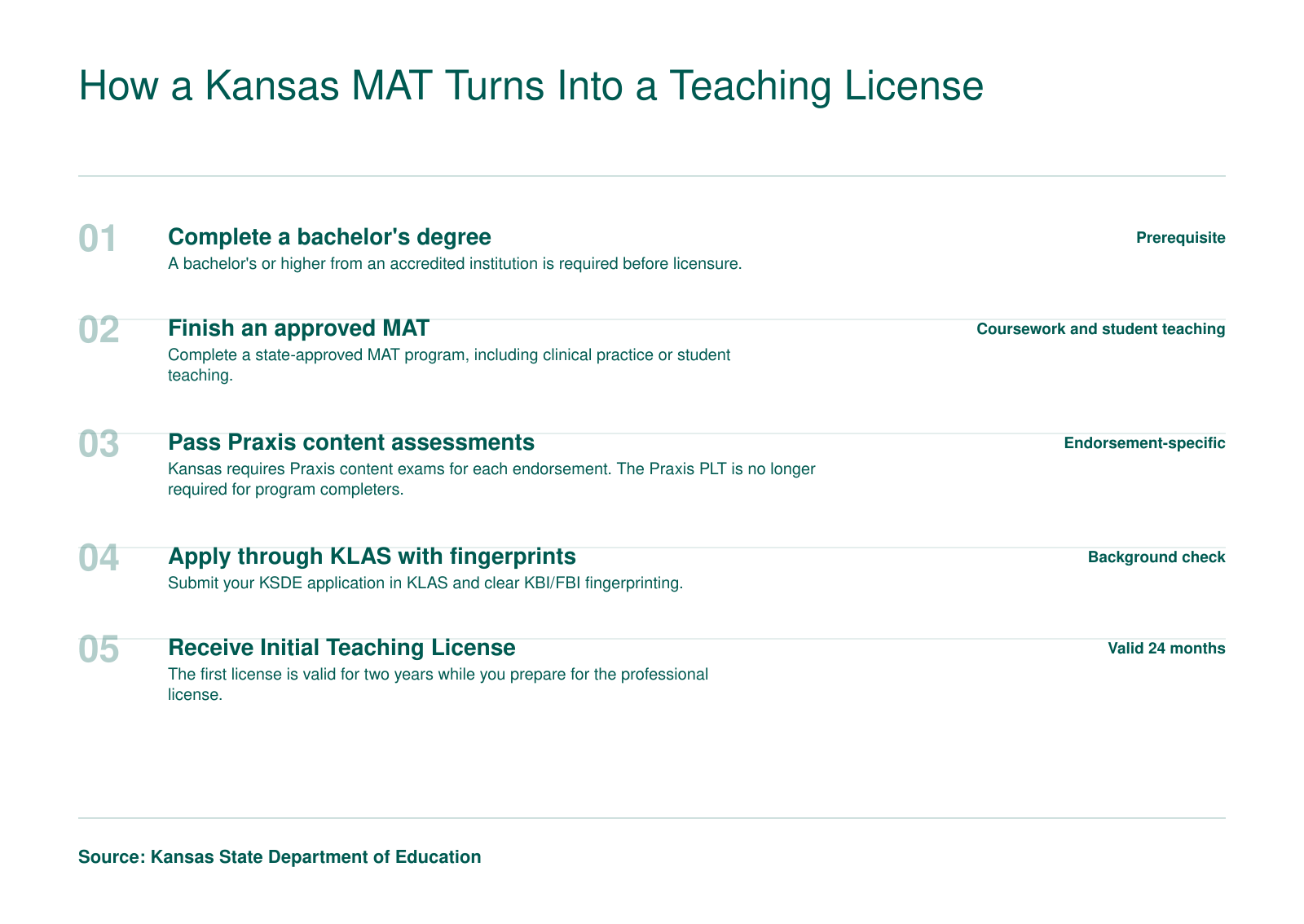
How a Kansas MAT Turns Into a Teaching License
Kansas program completers apply through KSDE after finishing an approved MAT and required Praxis content assessments. Out-of-state candidates do not receive automatic reciprocity; they must submit a standard license in good standing and comparable exam evidence.
Career Outcomes for Kansas MAT Graduates
The table below pairs median earnings one year and five years after finishing with program median debt and the share employed one year after finishing for the MAT programs on this page. Friends University publishes 2024-25 Praxis pass rates of 100 percent for elementary K-6 reading, math, and science, although the candidate counts in that report are not fully consistent.
| Institution and program | Median earnings one year after finishing | Median earnings five years after finishing | Median debt | Share employed one year after finishing | Published Praxis pass rate (2024-25) |
|---|---|---|---|---|---|
| Kansas State University, Master of Arts in Teaching (MAT) | $46,704 | $101,078 | $23,050 | 94.3% | N/A |
| Friends University, Master of Arts in Teaching | $55,903 | $57,755 | $17,075 | 98.6% | Reported 100% (reading, math, science) |
| Emporia State University, Master of Education in Teaching | $51,665 | $55,525 | $23,075 | 95.6% | N/A |
| Pittsburg State University, MAT Special Education High-Incidence Grades K-6 | $49,852 | $54,297 | $25,428 | 100% | N/A |
| University of Saint Mary, MAT Secondary Education | $43,355 | N/A | N/A | 100% | N/A |
Kansas MAT Questions, Answered up Front
Before comparing programs, these answers cover cost, time, online format, and licensure. Use them to narrow your list without hunting through every admissions page.
Is a Master of Arts in Teaching worth it in Kansas?
What is the cheapest MAT program in Kansas?
Can I get a Kansas teaching license online?
How long does a MAT program take in Kansas?
Do Kansas MAT programs require the GRE?
When are application deadlines for Kansas MAT programs, and what prerequisites do they expect?
Can I teach in Kansas while earning my MAT?
Compare Teaching programs on the data that matters
Explore more Education & Teaching specializations or browse every graduate field.
All Education & Teaching programs