Most Affordable Master of Arts in Teaching (MAT) Programs
Compare 1,000+ accredited most affordable Teaching programs at 570+ schools, with graduate earnings, cost, debt, and completion data from IPEDS and the U.S. College Scorecard.

Career changers who want to teach face a lopsided trade: a master's that leads to a license can cost more than a first-year teacher's paycheck comfortably repays. In-state graduate tuition across the schools ranked here runs from $5,376 at Salish Kootenai College to $12,737 at the University of Florida, so the price can more than double depending on where you enroll.
Licensure is granted by states, not universities, so a cheap degree your state won't recognize is the most expensive choice.
Key Points
- An MAT, not an M.Ed., is the license-focused degree for career changers.
- Praxis Subject Assessments cost $130 to $156 each in 2027.
- Budget for 12 to 16 weeks of unpaid student teaching.
The 10 Most Affordable Master of Arts in Teaching Programs
The schools below keep costs low while still preparing you for a real classroom role. You will see a mix of fully online MAT options, campus-based math or English tracks, and a few faith-focused or Indigenous education alternatives. Compare each card by net price, format, and the concentration that fits your district.
The University of Texas Rio Grande Valley
#1Edinburg, TX · $5,000 – $10,000/yr (est.)
Best for: Online bilingual and special education teacher candidates
The University of Texas Rio Grande Valley offers a fully online MAT that is built around Texas teacher certification. Students choose between Bilingual Education and Special Education concentrations, with clinical teaching or internship placements built into the degree. A Graduate Select Scholarship can reduce cost for qualifying candidates.
- Fully online alternative certification program
- Bilingual Education and Special Education concentrations
- Meets Texas Education Agency certification requirements
- Clinical teaching, residency, or internship placements
- Graduate Select Scholarship up to $1,000
Salish Kootenai College
#2Pablo, MT · ~$5,000/yr (est.)
Best for: Working educators serving Indigenous communities
Salish Kootenai College offers a 15-month, cohort-based Master of Education in Curriculum and Instruction with an Integrative Indigenous Education emphasis. The program is designed for working educators and focuses on weaving Indigenous languages and cultures into classroom and community settings. Its Indian Education for All integration makes it a distinct choice for teachers serving reservation communities.
- 15-month cohort-based structure
- Emphasis in Integrative Indigenous Education
- Built for working educators
- Integrates tribal languages and cultures
- Supports Indian Education for All
- Community-centered educational experiences
International Baptist College and Seminary
#3Chandler, AZ · $5,000 – $10,000/yr (est.)
Best for: Faith-based Christian school educators
International Baptist College and Seminary offers a faith-based Master of Christian Education on its Chandler, Arizona campus. The 33-credit program includes a directed field experience and on-site educational training in the United States or on the mission field. Graduates typically pursue roles in Christian schools, church education, homeschool coordination, or missions.
- 33 total credit hours
- Directed field experience included
- On-site training in US or mission field
- Education or ministry background expected
- Prepares Christian school teachers and administrators
- Christian thesis writing course required
California State University-San Bernardino
#4San Bernardino, CA · ~$10,000/yr (est.)
Cal State San Bernardino offers a campus-based MAT in Teaching Mathematics for credentialed single-subject teachers. The program emphasizes advanced mathematics, including calculus, linear algebra, geometry, and statistics, and requires a written scholarly paper. Personalized advising and conditional admission options make it accessible for working secondary math teachers.
- Requires valid teaching credential
- Three letters of recommendation
- Advanced calculus, linear algebra, geometry, statistics
- Written scholarly paper required
- Conditional admission possible
- Designed for secondary math teachers
CUNY Lehman College
#5Bronx, NY · ~$12,000/yr (est.)
CUNY Lehman College offers a Master of Science in Education in Mathematics Education that leads to New York State certification for grades 5-9 or 7-12. The campus program provides sequences for math majors and non-majors, plus an optional Students with Disabilities specialization. With 100 field hours before student teaching and an internship certificate after half the credits, it supports both career changers and current paraprofessionals.
- Leads to New York State certification, grades 5-9 or 7-12
- Sequences for math majors and non-majors
- 100 field hours before student teaching
- Internship certificate after half the credits
- Optional Students with Disabilities specialization
- Fall and spring start dates
California State University-Fresno
#6Fresno, CA · ~$9,000/yr (est.)
Cal State Fresno offers a fully online MAT for credentialed practicing teachers. The three-semester cohort focuses on social justice, multiculturalism, and action research, and the degree ends with a project, comprehensive exam, or thesis. Up to nine graduate units can be transferred, making it a flexible advancement path for working educators.
- Three-semester cohort
- Fully online program
- Focus on social justice and multiculturalism
- Action research methodology
- Transfer up to 9 graduate units
- Designed for credentialed practicing teachers
California State University-Sacramento
#7Sacramento, CA · $10,000 – $20,000/yr (est.)
Sacramento State offers a five-course MAT sequence for teachers who already hold a Multiple Subject, Single Subject, or PK-3 credential from Sacramento State. The campus program runs across summer, fall, and spring, and students have up to seven years from credential admission to finish. Coursework is rooted in inquiry-based education and social justice.
- Five total courses
- Apply by March 1, 2027
- Requires Sacramento State teaching credential
- Inquiry-based and problem-based curriculum
- Up to seven years to complete MAT
- Social justice and equity foundation
University of Florida
#8Gainesville, FL · ~$13,000/yr (est.)
The University of Florida offers a campus-based MAT in Teaching Mathematics that requires at least 39 credit hours. Students complete a teaching internship, build a teaching portfolio, and pass a final oral examination. It prepares graduates for math teaching roles in middle schools, high schools, or community colleges.
- At least 39 credit hours
- Teaching internship required
- Teaching portfolio required
- Final oral examination
- One semester college teaching
- Prepares for middle, high school, or community college teaching
The University of Texas at El Paso
#9El Paso, TX · $5,000 – $10,000/yr (est.)
UTEP offers several MAT tracks in El Paso, including Mathematics and English. The math track can be completed through a thesis or non-thesis path, while the English track emphasizes traditional and multimodal literacies and dual credit teaching. Some options are designed for in-service teachers and do not lead to teaching certification.
- No entrance exam required
- Thesis or non-thesis track
- 30 to 36 credit hours
- For teaching at college or high school
- Does not lead to teaching certification
- Designed for in-service teachers grades 8-12
- Requires 2 years teaching experience
- Requires 18 math hours including Calculus 2
- B or better in Calculus I and II
- Ideal for alternative certification teachers
- Designed for English/Language Arts teachers
- Focus on traditional and multimodal literacies
- Prepares for dual credit teaching
- Three exit options: exam, practicum, thesis
- Borderlands setting
Florida International University
#10Miami, FL · ~$11,000/yr (est.)
Florida International University offers a Master of Science in Curriculum and Instruction with seven tracks, including Curriculum Development, Elementary Education, English Education, Learning Technologies, Mathematics Education, Science Education, and Social Studies Education. Some tracks, including Curriculum Development and Elementary Education, are available fully online. Students work with faculty in urban education and gain experience in the nation's third-largest school district.
- Seven concentration options
- Fully online option available
- Curriculum Development and Elementary Education tracks fully online
- Faculty leaders in urban education
- Experience in third-largest school district
- Prepares for classrooms and communities
Cost & outcomes by school
Federal data for the highest-earning Teaching programs, independent of the ranking above. Earnings are this field's master's graduates four years after completing, where the Scorecard reports them.
| School | Earnings | Tuition / yr | Debt | Grads/yr | Format |
|---|---|---|---|---|---|
| California State University-Fresno CA | $97,033 | $8,865 | $20,500 | 18 | Online |
| University of the District of Columbia DC | $89,963 | $9,604 | — | 12 | Campus |
| California State University-Northridge CA | $89,925 | $8,982 | $20,500 | 7 | Campus |
| Boricua College NY | $89,128 | $19,100 | $13,140 | — | Campus |
| Pace University NY | $85,077 | $30,770 | $36,772 | 112 | Online |
| University of Massachusetts Global CA | $84,909 | $13,680 | — | 163 | Online |
| University of Washington-Seattle Campus WA | $80,738 | $18,792 | $30,990 | 103 | Campus |
| CUNY Brooklyn College NY | $80,655 | $11,524 | $27,668 | 124 | Campus |
| University of California-Irvine CA | $79,921 | $14,827 | $30,500 | 136 | Campus |
| CUNY Lehman College NY | $78,311 | $11,570 | $25,825 | 79 | Campus |
| San Francisco State University CA | $77,699 | $9,370 | $18,834 | — | Campus |
| Relay Graduate School of Education NY | $76,883 | — | $9,348 | 816 | Hybrid |
Sources: U.S. Department of Education. Tuition and graduates: IPEDS. Earnings and debt: College Scorecard, this field's master's graduates; a dash means no figure is reported.
Cost, debt & payoff
Median earnings of this field's master's graduates (4 yrs after completing) vs. their median federal loan debt · U.S. College Scorecard
Across these programs the median graduate earns about $58,919 and finishes with roughly $27,974 in debt — a ratio that clears a common rule of thumb (keep debt below first-year salary). Tuition and debt vary widely school to school, so check the per-school figures in the table above before you shortlist.
MAT vs. M.Ed.: Which Degree Actually Gets You Licensed?
The Master of Arts in Teaching (MAT) is the degree to choose when you need a first teaching license, especially if you are changing careers. Most MAT programs, including online master of arts in teaching programs, build in the clinical practice, pedagogy coursework, and exam preparation a state requires to recommend you for initial certification. An M.Ed. usually works the other way: it serves teachers who already hold a license or people pursuing non-licensure roles, and it does not automatically produce a new license unless the program specifically runs an initial-certification track.
No bachelor's in education is required for an MAT. Programs typically expect an accredited bachelor's degree plus enough subject-area coursework in the field you want to teach, a bar that shifts by endorsement and state. Many also require passing a basic skills test such as Praxis Core or a state equivalent, followed by content exams before student teaching.
Alternative certification is a separate option for bachelor's holders. States offer routes that let you teach on a provisional or intern credential while finishing coursework, often in one to two years, but supervision, costs, and full-licensure outcomes vary. If you do not yet hold a license, confirm the program is explicitly labeled as leading to initial certification in your state and endorsement area.
What an MAT Really Costs Beyond Tuition
A single Praxis Subject Assessment costs $130 for selected-response tests and $156 for constructed-response ones in 2026-27,1 and that is before anything else on the bill. Praxis Core is $90 per test, or $150 if you take Reading, Writing, and Mathematics together on one date.1 Extra score reports are $50 each.1
How much does a master of arts in teaching cost overall? Program-level rates vary too much to give one reliable figure. As a rough guide, many MATs require somewhere around 30 to 45 credits, so multiply a program's per-credit rate by its credit total and treat the result as a floor, not the final price.
Commonly missed costs:
- Program fees: Technology and student fees are often billed on top of tuition.
- edTPA: Confirm the current registration fee with your program, since a 2026 amount was not verified here.
- Background checks: Published examples run from $15 to $87, depending on state and vendor.23
- Lost income: Unpaid student teaching can mean a full semester without a paycheck.
Before you apply, ask each program for its full cost-of-attendance sheet instead of relying on per-credit tuition.
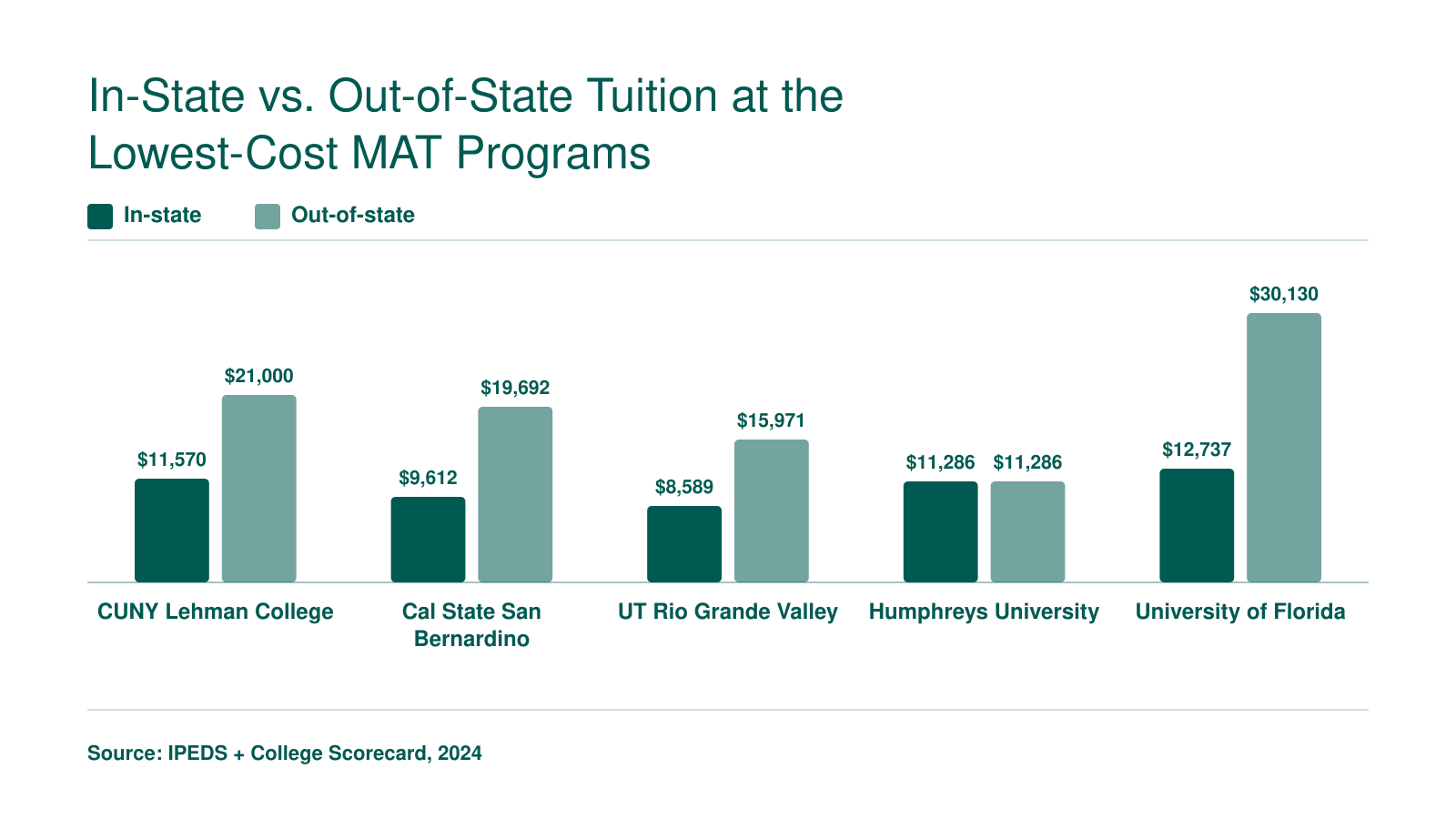
In-State vs. Out-of-State Tuition at the Lowest-Cost MAT Programs
These figures show the graduate tuition charged to in-state and out-of-state MAT students at the lowest-cost programs on this page. The gap can be five figures at public universities, so residency has real financial weight for on-campus students. Some hybrid and online options, such as Humphreys University, list one tuition rate for everyone.
Can You Finish an MAT Online Without Visiting Campus?
No licensure-track MAT is entirely remote, even in accelerated MAT programs. Coursework can be fully online, but every path to a teaching license ends with supervised time in a real classroom. Concord University's online MAT, for example, builds in a 16-week full-time placement worth six credits1, and Oregon State's online MAT-CBEE carries a 12-credit student-teaching internship. Eastern Illinois runs its secondary option as a full-year residency on the placement district's calendar.2
How placements get arranged varies, and it is the question to ask before you apply. Some programs work within an established district network: Belmont places candidates through Metro Nashville and nearby districts3, and NYU Steinhardt's residency uses partner schools in New York, Florida, Connecticut, and Washington, D.C.4 Others expect you to help identify a host school near home. Few guarantee placement in your own state.
Budget for the rest of it too: Eastern Illinois holds an in-person orientation2, Henderson State requires five orientation days5, and a full-time student-teaching semester usually means no paycheck. Paid residencies exist (Belmont's instructional-aide internship, some NYU tracks3 6) but often carry a post-program teaching commitment.
Accreditation and Licensure Portability: Avoid a Degree Your State Won't Accept
CAEP and AAQEP accreditation signal that a program meets a quality standard, but they are programmatic accreditations and neither one issues a teaching license. What qualifies you is completing a state-approved educator preparation program. Confirm that approval with the state agency, not just the school's brochure.
Moving states adds a layer. The NASDTEC Interstate Agreement covers all 50 states, DC, and several other jurisdictions, but it is a set of non-binding agreements, not full reciprocity. Portability is conditional, and the receiving state can still require its own exams, coursework, or training. A 2025 review found 43 states plus DC require some out-of-state candidates to take extra assessments.
Kansas shows how this works in practice. Out-of-state applicants need Praxis subject tests or a comparable exam, with experience thresholds that can change the requirement, and a recency rule of one year of teaching or eight credits within six years. Rules change, so check the current version.
Online students should find the program's state authorization and professional licensure disclosure page before enrolling. It must say, for your home state, whether the curriculum meets, does not meet, or has not been determined to meet that state's requirements.
Related Articles
Cutting Your MAT Bill: TEACH Grants, Loan Forgiveness, and State Incentives
Federal aid for future teachers keeps shifting, so confirm current terms before you build a budget around it.
The TEACH Grant is scheduled at about $4,000 a year for full-time graduate students, but a sequestration cut trims the net award, and first disbursements have been capped near $3,772. In return, you teach full-time for four years within eight, in a high-need field at a low-income school. Fall short, and the grant converts to an unsubsidized loan.
Loan forgiveness
Teacher Loan Forgiveness cancels up to $17,500 on Direct Subsidized, Direct Unsubsidized, and Stafford loans after five straight years at a qualifying low-income school.1 That top amount goes to highly qualified special education teachers and secondary math or science teachers; other teachers can receive up to $5,000. Public Service Loan Forgiveness requires 120 qualifying payments on Direct Loans while working full-time for a government or nonprofit employer, with no low-income school requirement.2 The same years cannot count toward both, so using Teacher Loan Forgiveness means 120 additional payments for PSLF.3
State aid and subject choice
Check your state education agency for shortage scholarships and paid residency stipends, since terms vary widely. Special education, STEM, and ESL endorsements usually qualify for the most aid.
What MAT Graduates Earn a Year Out
One year out, the top median earnings among the programs below belongs to Boricua College.
Teaching programs by state
Compare Teaching programs on the data that matters
Explore more Education & Teaching specializations or browse every graduate field.
All Education & Teaching programs