Best Master of Arts in Teaching (MAT) Programs in Minnesota
Compare 13 accredited Teaching programs in Minnesota at 10 schools, with graduate earnings, cost, debt, and completion data from IPEDS and the U.S. College Scorecard.

The fastest Minnesota MAT is not automatically the one that gets you licensed, even among Accelerated Master of Arts in Teaching Programs. Bethel finishes in as few as 17 to 23 months and Hamline in 18 to 24, while Minnesota State Mankato runs two to three years, but only a program approved by the Professional Educator Licensing and Standards Board leads to a PELSB license.
Campus, online, and hybrid programs are ranked together.
Price gaps between private and public schools are real, but a license from an approved program carries the same standing either way, even for the Most Affordable Master of Arts in Teaching Programs.
Key Points
- Walden and Southwest Minnesota State list fully online MAT tracks for working career changers.
- Most Minnesota MAT programs skip the GRE, and Walden requires no entrance exam.
- Hamline charges $658 per credit for 2026-2027, so compare cost against PELSB licensure fit.
Ranked: The 10 Best MAT Schools in Minnesota
What separates the top tier is how cost, completion, and graduate outcomes line up together, not any single number. Graduation rates below describe each school as a whole, not the teaching program itself. Earnings are quoted only where federal data reports them for the program, and each figure is tied to its time window.
University of St Thomas
#1Saint Paul, MN · ~$21,000/yr (est.)
Best for: Science and math licensure candidates
The University of St. Thomas in Saint Paul pairs an initial license with an MA in Teaching across eight licensure areas, including elementary, math, social studies, Spanish, and the sciences. Its listed graduate tuition is $20,754, the highest in this group, and the institution-wide graduation rate is 76%. Program-level data shows median earnings of $52,637 one year after completion. A 15-month urban teacher residency with district employment, a stipend, and a three-year teaching commitment is a distinctive route for those who qualify.
- Eight licensure areas, from elementary K-6 to physics 9-12
- Chemistry and physics candidates also earn a general science endorsement
- On-campus and blended class options
- Two start dates per year: fall and summer
- Study abroad option in Taiwan
- Faculty active in K-12 classrooms
Bethel University
#2Saint Paul, MN · ~$10,000/yr (est.)
Best for: Working career changers needing blended classes
Bethel University in Saint Paul built its blended MA in Teaching for career changers seeking an initial Minnesota license in middle or high school subjects. Listed graduate tuition is $10,260, and the institution-wide graduation rate is 71%. Coursework is mostly online with occasional Saturday sessions on campus, which suits working professionals in the Twin Cities. The program publishes an 85% job placement rate, though no program-level earnings figure is available.
- Ten concentration options, including a dual licensure option
- Finish in 17 to 23 months, plus a required thesis
- Blended online and Saturday on-campus format
- Field experiences followed by extended student teaching
- Level 1 ENVoY classroom management training
- Christ-centered perspective; scholarships available
The College of Saint Scholastica
#3Duluth, MN · ~$15,000/yr (est.)
Best for: Duluth-area teacher candidates
The College of Saint Scholastica in Duluth offers a Master of Science in Teaching that combines the Graduate Teaching Licensure with a research-focused master's layer. Listed graduate tuition is $14,664, and the institution-wide graduation rate is 71%. Program-level earnings were a median of $55,476 one year after completion, with about 98% of graduates employed in that window. It is a strong fit for candidates in northeastern Minnesota who want a capstone built around their own classroom.
- 40 total credit hours
- Leads to initial Minnesota teaching license
- Two research courses added beyond the licensure program
- Capstone examines a Problem of Practice
- 3.0 GPA minimum; C minimum course grade
- Up to six education credits transferable within seven years
Hamline University
#4Saint Paul, MN · ~$13,000/yr (est.)
Hamline University in Saint Paul offers the broadest MAT menu here, with 12 Minnesota licensure areas and synchronous online classes, some with on-campus attendance. Listed graduate tuition is $12,519 and the program lists $634 per credit. Institution-wide graduation is 60%, while program-level earnings reached a median of $59,462 one year after completion, the highest in this ranking. Rolling admissions, three starts a year, and evening classes suit working adults and paraprofessionals.
- 12 licensure areas, from elementary to special education
- Completes in 18 to 24 months
- Rolling admissions with summer, fall, and spring starts
- Student teaching and a capstone project required
- No prerequisite coursework required
- Synchronous online classes with hybrid on-campus option
- 18-month program with online or hybrid format
- Synchronous evening classes, 5:30 to 9 p.m.
- Field experiences in adult learning settings
- TeachMN free coaching and scholarships
- Elementary licensure with evening classes for working professionals
- Completes in 18 to 24 months
- Online sessions on weeknights plus hybrid on-campus option
- TeachMN free coaching and reimbursement
Minnesota State University-Mankato
#5Mankato, MN · $10,000 – $20,000/yr (est.)
Minnesota State University-Mankato is a public option with a listed graduate tuition of $9,540 for in-state students. The institution-wide graduation rate is 54%, and program-level earnings were a median of $58,830 one year after completion, with every reported graduate employed. The MAT leads to a Minnesota license for grades 5-12 or K-12, and a job-embedded student teaching option lets people already teaching earn licensure while working. It is a good value for budget-minded candidates.
- 31 total credit hours; completes in two to three years
- CAEP accredited
- Online core courses, synchronous and asynchronous
- Job-embedded student teaching option
- 2.8 GPA minimum and three recommendation letters
- Rolling admissions; fall start
Augsburg University
#6Minneapolis, MN · ~$14,000/yr (est.)
Augsburg University in Minneapolis runs a PELSB-approved MAT with small classes and weeknight scheduling, offered on campus and in a hybrid version. Listed graduate tuition is $13,766, and the institution-wide graduation rate is 52%. Program-level earnings were a median of $55,485 one year after completion. It suits career changers who want urban and suburban field placements and an equity-focused curriculum.
- Campus-based weeknight classes, 6 to 9:30 p.m.
- Fall, spring, and summer starts
- Urban and suburban field placements
- PELSB-approved initial license preparation
- Hybrid delivery option for the same MAT
- Small classes with faculty mentors
- TeachMN scholarship and free 1-on-1 coaching
- Application fee reimbursement
Concordia University-Saint Paul
#7Saint Paul, MN · ~$9,000/yr (est.)
Concentration is narrow at Concordia University-Saint Paul: a 36-credit MAT for aspiring K-6 teachers. Listed graduate tuition is $8,550, the lowest here, with an institution-wide graduation rate of 46%. Program-level earnings were a median of $42,754 one year after completion, the lowest reported in this group. It fits those set on elementary teaching, either as an initial license or as an add-on to an existing one.
- 36 total credit hours
- Leads to a K-6 teaching license
- Initial license or add-on license option
- Six-credit clinical experience in real classrooms
- Inclusion course covering diverse learners
Bemidji State University
#8Bemidji, MN · ~$10,000/yr (est.)
Bemidji State University offers a fast-track online MAT for people who hold a non-education bachelor's degree. Listed graduate tuition is $9,221, and the institution-wide graduation rate is 48%. Students meet virtually each semester and in person once a year, working in a cohort with K-12 mentors. No program-level earnings are reported. It is a practical choice for working adults in northern Minnesota.
- Fast-track route to a full Minnesota teaching license
- Cohort-based online format
- Virtual meetings each semester; one in-person session per year
- Fall and spring starts
- Designed for non-education degree holders
- No-cost student orientation
Southwest Minnesota State University
#9Marshall, MN · ~$10,000/yr (est.)
Southwest Minnesota State University in Marshall offers a Master of Science in Education rather than an initial-licensure MAT, so it suits existing teachers more than career changers. Listed graduate tuition is $9,324, with no out-of-state surcharge, and the institution-wide graduation rate is 45%. The program is available online, on campus, or through learning communities. It leans toward teacher leadership and National Board standards.
- Ten concentration options
- 3.0 GPA minimum
- Online, on-campus, or learning community delivery
- National Board teaching standards embedded
- Teach Grant and loan forgiveness eligible
- Focus on teaching in community and technical colleges
- Online, on-campus, or learning community delivery
- 3.0 GPA minimum
- Career services and veterans resources available
Walden University
#10Minneapolis, MN · ~$11,000/yr (est.)
Walden University is an online MAT in elementary education for career changers, and its program is approved for Minnesota teacher licensure. Total program tuition is listed at $25,095 at $340 per credit over 21 months, with no entrance exam. A federal graduation rate is not reported, so completion is harder to judge than at the schools above. Program-level earnings were a median of $47,427 one year after completion.
- Fully online option available
- 21-month program
- $25,095 total program tuition
- No entrance exam required and $0 application fee
- Hands-on K-6 field experiences
- Approved for Minnesota teacher licensure
- CAEP accredited
Cost & outcomes by school
Federal data for the highest-earning Teaching programs, independent of the ranking above. Earnings are this field's master's graduates four years after completing, where the Scorecard reports them.
| School | Earnings | Tuition / yr | Debt | Grads/yr | Format |
|---|---|---|---|---|---|
| University of St Thomas MN | $66,763 | $21,151 | — | 21 | Hybrid |
| Augsburg University MN | $64,001 | $13,766 | $47,833 | 37 | Campus |
| Hamline University MN | $63,173 | $13,113 | $35,449 | 49 | Hybrid |
| The College of Saint Scholastica MN | $61,491 | $15,084 | $28,271 | 73 | Hybrid |
| Minnesota State University-Mankato MN | $58,922 | $10,449 | — | 40 | Hybrid |
| Walden University MN | $55,860 | $10,885 | $38,929 | 195 | Online |
| Concordia University-Saint Paul MN | $54,947 | $8,550 | $38,441 | 67 | Campus |
| Bemidji State University MN | — | $10,099 | — | — | Campus |
| Bethel University MN | — | $10,260 | — | — | Hybrid |
| Saint Mary's University of Minnesota MN | — | $12,474 | — | — | Online |
Sources: U.S. Department of Education. Tuition and graduates: IPEDS. Earnings and debt: College Scorecard, this field's master's graduates; a dash means no figure is reported.
Cost, debt & payoff
Median earnings of this field's master's graduates (4 yrs after completing) vs. their median federal loan debt · U.S. College Scorecard
Across these programs the median graduate earns about $63,173 and finishes with roughly $36,945 in debt — a ratio that clears a common rule of thumb (keep debt below first-year salary). Tuition and debt vary widely school to school, so check the per-school figures in the table above before you shortlist.
Online and Hybrid Master's in Teaching Programs in Minnesota
Fully asynchronous Online Master of Arts in Teaching Programs and cohort-based hybrid formats both happen online, but the experience differs. Southwest Minnesota State and Walden list fully online MAT tracks among Master's Programs in Minnesota. Minnesota State Mankato mixes synchronous and asynchronous online courses, while The College of Saint Scholastica combines flexible online classes with a three-day summer residency and once-weekly virtual sessions.1 Bemidji State's online option is cohort-based, with virtual meetings at the semester start and end plus one in-person meeting each year. Bethel is primarily online with occasional Saturday sessions in the Twin Cities, and Hamline's fall ESL and special education pathway can be fully online, with live weeknight classes from 5:30 to 9 p.m.; other Hamline licenses mix in a few on-campus courses. Student teaching does not go remote. Expect in-person field experience in a Minnesota school, and Mankato offers a job-embedded option for current teachers. Working adults should ask whether the cohort runs on a fixed evening, weekend, or rotating schedule before choosing.
Related Articles
Do Minnesota MAT Programs Require the GRE?
If you have been dreading another standardized test, here is the good news: most Minnesota MAT programs are No-GRE master's programs, and many never ask for it at all. Walden University is one of many Master of Arts in Teaching Programs With No GRE Required and states plainly that no entrance exam is required for its online MAT.
Still, verify this program by program from each school's admissions page before you assume anything. Where a school publishes no graduate-test policy, treat that as unknown rather than a waiver. Winona State University's graduate catalog, for example, lists no additional tests and does not establish a MAT-specific GRE policy.1
One point worth keeping straight: graduate admissions testing is separate from Minnesota licensure exams. Clearing a program's admissions bar does not exempt you from the state's content and pedagogy tests (the MTLE series) required for your PELSB license. Those are two different hurdles, and you will likely face the licensure exams regardless of GRE policy.
Cost and Minnesota Licensure: What to Expect From a Master's in Teaching
The schools below are ordered by institution-wide average net price, not a personal quote, and the published tuition and fees column shows each program's listed graduate cost. For comparison, Hamline charges $658 per credit for 2026-2027 across 31 to 64 credits, depending on licensure area and transfer credits. Licensure costs come on top: the PELSB initial license application is $89 including fingerprints ($57 for existing Minnesota license holders), and the MTLE registration is $300 for candidates who still test, since completers of approved programs no longer need the Tier 3 or 4 exams.
| School | Program | Published graduate tuition and fees | Average net price (institution-wide) | Per-credit rate | Total credits |
|---|---|---|---|---|---|
| Bemidji State University | Master of Arts in Teaching | $10,099 | $15,261 | N/A | N/A |
| Southwest Minnesota State University | Master of Science in Education (Teaching, Learning) | $10,360 | $15,291 | N/A | N/A |
| Capella University | MS in Education, Special Education Teaching (does not lead to licensure) | $15,092 | $17,956 | $495 (locked rate) | 46 |
| Concordia University-Saint Paul | Teaching (MAT), K-6 license | $8,550 | $18,462 | N/A | 36 |
| Minnesota State University-Mankato | Master of Arts in Teaching | $10,449 | $19,139 | $639 resident, $895 nonresident, plus $48.39 fees per credit | 31 |
From Admission to PELSB License: The Minnesota MAT Pathway
Minnesota MATs prepare candidates in areas such as elementary K-6, secondary 5-12 subjects, K-12 fields like art and world languages, and special education. Offerings vary by school. To verify approval, search the licensure field and institution on PELSB's approved teacher preparation programs list before you enroll.
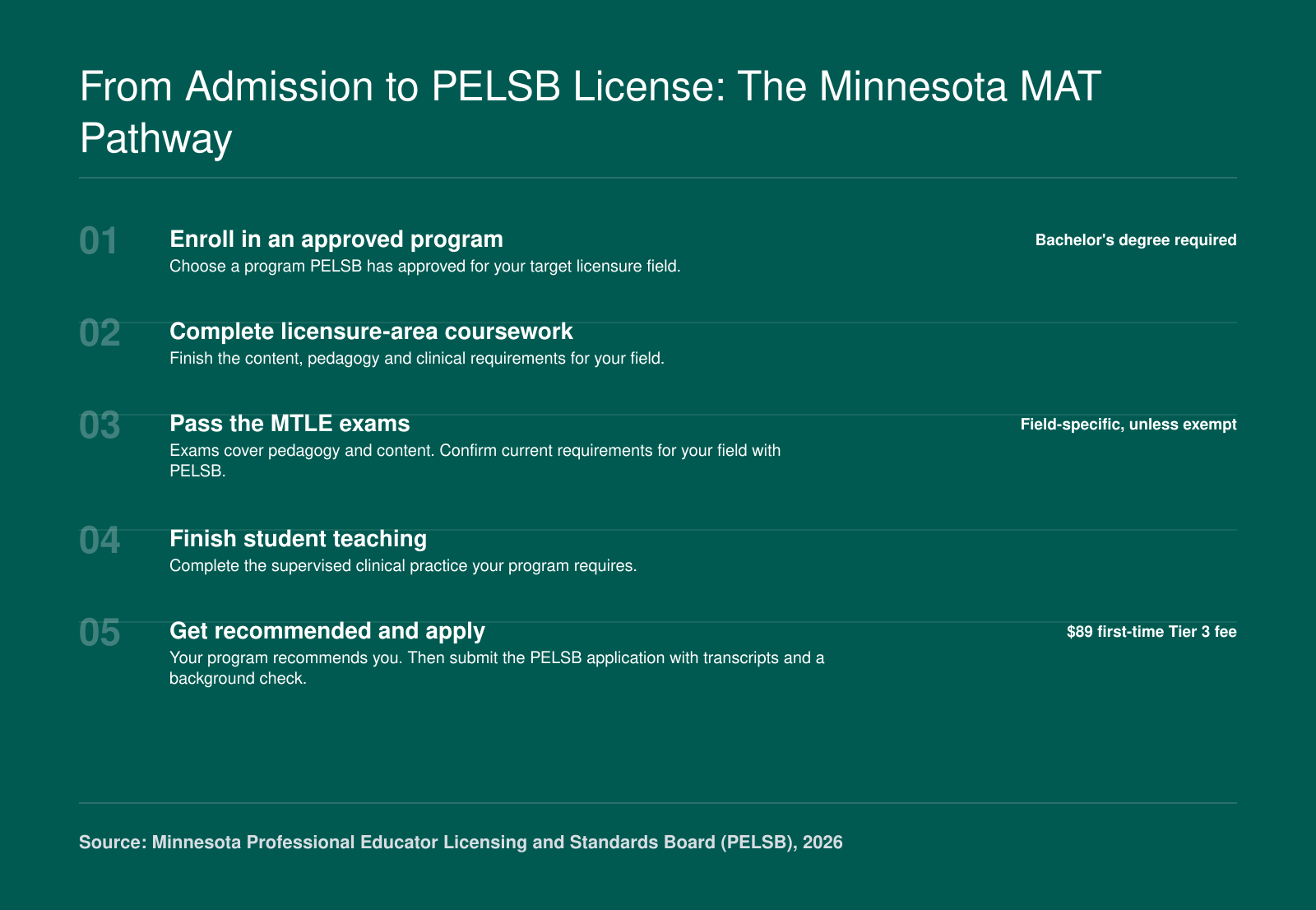
The cheapest master's in teaching only saves you money if it leads to the PELSB license your classroom career actually requires.
Quick Answers Before You Apply
Admission details change by cycle, so treat these answers as a starting point and confirm specifics with each admissions office before you apply.
What GPA and documents do Minnesota MAT programs typically ask for?
When do Minnesota MAT programs accept applications, and are there summer or fall cohort starts?
Can you earn a Minnesota art teaching license through an MAT program?
Compare Teaching programs on the data that matters
Explore more Education & Teaching specializations or browse every graduate field.
All Education & Teaching programs