Best Master's in Art Education Programs
Compare 210+ accredited Art Education programs at 200+ schools, with graduate earnings, cost, debt, and completion data from IPEDS and the U.S. College Scorecard.

A master's in art education can mean two different things: a licensure route into a K-12 classroom, or an advanced degree for people already teaching, working in museums, or running community arts programs. Columbia and Boston University offer MA programs that do not lead to initial teaching certification. Florida, Rutgers, Texas, and Case Western list licensure-linked options.
Average net price at the schools here runs from about $6,500 at the University of Florida to about $41,200 at Case Western Reserve University. Those are institution-wide figures, not program-specific.
On a district salary schedule, certification status usually matters more than the name on the diploma.
Key Points
- Published tuition runs from about $8,865 at Fresno State to $57,248 at Harvard.
- The three lowest-cost options here are all CUNY campuses in New York City.
- A master's degree and a teaching certificate are separate credentials, so verify licensure before enrolling.
Top 10 Master's in Art Education Programs for 2027
The top 10 mixes campus-based, hybrid, and fully online options, and it spans the Northeast, Southeast, Midwest, and Texas. Public flagships and private research universities are both represented, and the tuition gap between them is wide, so compare cost alongside program fit. Tuition figures below are graduate rates, net price is institution-level, and graduation rates describe the whole university, not the art education program.
Harvard University
#1Cambridge, MA · $55,000 – $60,000/yr (est.)
Best for: Arts leaders working beyond the traditional classroom
Harvard's Arts and Learning concentration sits inside the Graduate School of Education's residential Master's in Education in Cambridge, MA, and no formal artistic training is required. It suits students aiming at museum education, teaching artist work, arts administration, or arts policy more than a single school classroom. Graduate tuition is about $55,656 for all students, institution-level net price is about $19,066, and the university graduates roughly 98% of its students. Harvard Museums also runs a year-long object-based teaching partnership with a Cambridge public high school.
- Campus-based residential program with a cohort structure
- Arts and Learning is one of 8 concentration options
- No formal artistic training required to enroll
- Covers arts integration in schools, museums, and community centers
- Career paths include museum educator, teaching artist, and arts administrator
- Field experiences connect students with their cohort
Columbia University in the City of New York
#2New York, NY · ~$58,000/yr (est.)
Best for: Career changers pursuing art teacher licensure
Teachers College at Columbia in New York, NY offers three distinct routes: a two-year MA with optional concentrations (including Museum Education and Creative Technologies), an initial-certification MA, and a hybrid studio MA. Graduate tuition is about $55,184, institution-level net price is about $21,590, and the university graduates roughly 96% of its students. Check which track you apply to, since only the Initial track leads to PK-12 art certification.
- 34 credits over a minimum of two years
- Full-time or part-time, with spring, summer, or fall starts
- 5 concentrations, including Museum Education and Community Arts
- Does not lead to Initial Art Teacher's Certification
- Digital portfolio and academic writing sample required
- Next deadline is November 15, 2026 for spring 2027
- 40 credits, fall start only
- Leads to PK-12 art certification
- Year-long student teaching practicum
- Digital portfolio, writing sample, and two recommendations required
- Application deadline is January 15, 2027
- 32 credits in 14 months, with a summer start
- Online coursework plus six-week on-campus summer residencies
- Capstone exhibition at Macy Art Gallery
- Part-time study takes about 28 months
- International applicants are not eligible
University of Florida
#3Gainesville, FL · ~$13,000/yr (est.)
Best for: Florida residents seeking public-university value
The University of Florida in Gainesville offers a residential MA in Art Education through its School of Art + Art History, plus an online option. The Educator Preparation Institute track pairs the degree with Florida K-12 Art Teacher Certification. Florida residents pay about $10,770 in graduate tuition (about $27,335 out of state), and institution-level net price is about $6,541, the lowest in this group. The university graduates roughly 91% of its students.
- Residential master's within the School of Art + Art History
- Educator Preparation Institute track leads to Florida K-12 Art Teacher Certification
- Online master's option also available
- Research-grounded and tied to contemporary practice
University of Illinois Urbana-Champaign
#4Champaign, IL · ~$19,000/yr (est.)
Illinois Urbana-Champaign in Champaign, IL is the research-oriented pick, with a thesis-based MA that prepares students for doctoral study and a non-thesis M.Ed. for practicing educators. Students can draw on the Krannert Art Museum archive and the Everyday Arts Lab. Graduate tuition is about $15,986 in state and $31,114 out of state, institution-level net price is about $14,355, and the university graduates roughly 85% of its students.
- Thesis required
- Research-focused, with preparation for doctoral study
- Electives from studio art and art history
- Access to the Krannert Art Museum archive of over 8,000 works
- No thesis or capstone required
- Advanced professional development for art educators
- Electives from studio art and art history
- Access to the Everyday Arts Lab research site
Rutgers University
#5New Brunswick, NJ · ~$23,000/yr (est.)
Rutgers in New Brunswick, NJ offers a combined five-year BA/MAT in Art Education, so it fits students still finishing an undergraduate degree more than those who already hold one. The fifth year centers on supervised practice with a licensed art teacher and leads to an initial NJ license. Graduate tuition is about $20,616 in state and $35,064 out of state, institution-level net price is about $24,406, and the university graduates roughly 84% of its students.
- Earn a BA and a Master of Arts in Teaching in five years
- Three MAT classes in the fourth year
- Fifth year is supervised practice with a licensed art teacher
- Requires a 3.0 GPA, Praxis exams, and a current NJ Substitute license
- Two letters of recommendation and a personal statement required
- Graduates receive an initial license for public and private schools
Boston University
#6Boston, MA · $65,000 – $70,000/yr (est.)
Boston University offers the broadest format choice here: an on-campus MA, an online MA, and an MA with Initial License. Tuition is a flat $66,670 for graduate students, institution-level net price is about $24,402, and the university graduates roughly 89% of its students. Pick the track by goal, since the standard MA does not lead to an initial teaching license.
- On campus, full-time or part-time
- Terminal degree that also prepares for doctoral study
- Does not lead to an initial teaching license
- Individually selected areas of study across schools, museums, and community settings
- Complete in 18-24 months with 6 start dates per year
- Fully online option available
- Week-long Summer Studios in Boston
- No licensure goal needed to enroll
- 3 semesters and 40 credits, with a summer start
- Two Massachusetts initial license levels
- Full year of supervised practicums in greater Boston schools
The University of Texas at Austin
#7Austin, TX · ~$12,000/yr (est.)
UT Austin's MA lets students choose among school, museum, and community-based tracks, and every track includes an internship. Graduate tuition is about $12,006 in state and $22,954 out of state, institution-level net price is about $19,857, and the university graduates roughly 89% of its students. Tuition waivers for many out-of-state students and teaching assistantships help with cost. Note that applications will not be accepted during 2026-27 for the 2027-28 year.
- Two-year program with thesis or applied project
- 3 focus areas: schools, museums, or community-based programs
- Texas all-level P-12 art certification option
- Internship required in every track
- Second-year teaching assistantships and recruitment fellowships
- No applications accepted during 2026-27 for 2027-28
Case Western Reserve University
#8Cleveland, OH · ~$54,000/yr (est.)
Case Western Reserve in Cleveland, OH pairs its MA in art education with state teacher certification in art education through the Department of Art History and Art. Students work near the Cleveland Museum of Art, the Cleveland Institute of Art, and other University Circle institutions. Graduate tuition is about $53,930, institution-level net price is about $41,190, and the university graduates roughly 87% of its students.
- Campus-based MA in the Department of Art History and Art
- State teacher certification in art education available
- Access to University Circle cultural institutions
- Department also offers MA tracks in art history and museum studies
University of Minnesota-Twin Cities
#9Minneapolis, MN · ~$22,000/yr (est.)
The University of Minnesota-Twin Cities in Minneapolis, MN houses its MA in the Department of Curriculum and Instruction, with a K-12 focus and room for museum education and community arts interests. Graduate tuition is about $19,980 in state and $31,212 out of state, institution-level net price is about $16,778, and the university graduates roughly 85% of its students. Admissions are currently paused, so confirm the next open cycle before planning around this program.
- Thesis (Plan A) or final paper (Plan B) option
- Strong K-12 focus with museum education and community arts interests
- Interdisciplinary research alongside a PhD track in arts in education
- Admissions paused for 2027-28; resume for Fall 2028
University of Georgia
#10Athens, GA · ~$11,000/yr (est.)
The University of Georgia in Athens, GA delivers its Master of Art Education fully online through the Lamar Dodd School of Art, with an asynchronous format that moved online in 2025-26. It targets Georgia educators pursuing a Level 5 Teaching Certificate in Art, along with museum and community-center professionals. Graduate tuition is about $9,586 in state and $28,358 out of state, institution-level net price is about $13,936, and the university graduates roughly 90% of its students.
- Fully online, with no more than 5% of credit on campus
- Optional one-week summer studio residency
- Coursework in disability studies, culturally responsive practice, and digital technology
- Fits teachers seeking a Level 5 certificate and museum or community educators
Cost & outcomes by school
Federal data for the highest-earning Art Education programs, independent of the ranking above. Earnings are this field's master's graduates four years after completing, where the Scorecard reports them.
| School | Earnings | Tuition / yr | Debt | Grads/yr | Format |
|---|---|---|---|---|---|
| CUNY Brooklyn College NY | $88,100 | $11,524 | $20,500 | 108 | Campus |
| CUNY Queens College NY | $87,964 | $11,612 | $19,100 | 183 | Campus |
| CUNY Lehman College NY | $87,910 | $11,570 | $20,500 | 105 | Hybrid |
| CUNY City College NY | $86,151 | $11,402 | $20,504 | 85 | Campus |
| Adelphi University NY | $85,752 | $32,822 | $48,250 | 94 | Online |
| Azusa Pacific University CA | $83,642 | $17,015 | $48,742 | 66 | Hybrid |
| Hofstra University NY | $83,127 | $31,120 | $39,214 | 89 | Campus |
| Loyola University Maryland MD | $81,156 | $20,070 | $34,531 | 54 | Campus |
| CUNY Hunter College NY | $79,416 | $11,398 | $24,573 | 172 | Campus |
| Gordon College MA | $78,374 | $8,960 | — | 29 | Online |
| Utah State University UT | $78,061 | $7,828 | $12,000 | 20 | Campus |
| Teachers College at Columbia University NY | $76,686 | $37,918 | $51,964 | 227 | Campus |
Sources: U.S. Department of Education. Tuition and graduates: IPEDS. Earnings and debt: College Scorecard, this field's master's graduates; a dash means no figure is reported.
Cost, debt & payoff
Median earnings of this field's master's graduates (4 yrs after completing) vs. their median federal loan debt · U.S. College Scorecard
Across these programs the median graduate earns about $62,706 and finishes with roughly $25,940 in debt — a ratio that clears a common rule of thumb (keep debt below first-year salary). Tuition and debt vary widely school to school, so check the per-school figures in the table above before you shortlist.
How We Ranked These Art Education Master's Programs
Art education master's programs have split into two different products: licensure pathways for new teachers, and advanced degrees for practicing educators, museum staff, and arts administrators. That split is why a prestige list tells you so little. This comparison applies the same federal data to every school instead of relying on each university's own pitch.
What Goes Into the Ranking
- Cost: Published graduate tuition plus the average net price after grants and scholarships. Because net price is an average for the whole institution, not a personal quote, your actual cost may land higher or lower.
- Completion: Institution-wide graduation and first-year retention rates, which signal how well a school carries students to the finish.
- Outcomes: Earnings and debt from federal College Scorecard data. Program-level figures count where they are published, but for many art education master's programs they are not yet available, often because cohorts are too small to report.
What the Ranking Does Not Measure
It does not score studio facilities, faculty reputation, or how strong your portfolio needs to be. It also cannot tell you whether a program leads to a teaching license. Columbia's Teachers College and Boston University state that their MA programs do not lead to initial certification, while Rutgers, Florida, and UT Austin offer licensure routes. Confirm licensure fit for your state and the format you need, campus or online, before you shortlist anything.
The Arts Education Data Project's 2019 analysis estimated that roughly 2.1 million U.S. public school students, about 4 percent, attended schools offering no arts instruction at all, based on data from 17 states. Closing gaps like that one takes certified art teachers, which is exactly what a master's in art education prepares you to be.
Master's in Art Education Cost: Tuition, Net Price, and Debt
What these programs actually charge
Published graduate tuition across the programs here runs from roughly $8,865 a year at California State University-Fresno and $8,872 at the University of Central Florida up to $57,248 at Harvard University. Most public options cluster between about $8,900 and $12,700 for residents, including CUNY Hunter College at $11,398, CUNY Queens College at $11,612, and the University of Florida at $12,737.
Residency is the single biggest lever on that number. UCF charges in-state students $327.32 per credit versus $1,234.15 per credit out of state, which pushes its nonresident annual figure to $28,657. Florida State University jumps from $10,553 to $26,707, and the University of Florida from $12,737 to $30,130. The CUNY colleges have the narrowest gap, around $9,400 between resident and nonresident rates. Because these degrees range from roughly 30 to 44 credits, multiply the per-credit rate by your program's credit total rather than assuming a flat two-year price.
Why the debt picture is incomplete
Federal reporting does not yet publish median borrowing or typical monthly loan payments for art education master's programs at these schools, and program-level graduate earnings are likewise unavailable. That is a gap in federal reporting, not an omission here. Treat any average net price or school-wide earnings figure as context about the institution, not the program: net price is an average across the whole school after grants and scholarships, weighted heavily toward undergraduates, and campus-level earnings blend engineering, business, and nursing graduates with art teachers. Neither tells you what an art educator from that specific program borrows or earns.
Questions to ask before you deposit
Since the debt data is thin, get the numbers directly from the program:
- Assistantships: Ask whether graduate assistantships, studio tech positions, or teaching fellowships carry a tuition waiver and a stipend, and how many are available to first-year students.
- District reimbursement: If you are already certified and teaching, check your contract. Many districts reimburse coursework and move you up a salary lane for a master's.
- Credit transfer: Queens College accepts up to 12 transfer credits, which can cut a semester of tuition.
Three Lowest-Cost Art Education Master's Programs
All three of the lowest-cost options here are CUNY campuses in New York City, and all are on-campus programs with no online option. Hunter College suits in-state residents who already hold teacher certification, since its listing says admission to the NYS-certified track is suspended. City College suits residents who want a path to New York State initial certification, plus museum and community teaching work. Queens College suits working teachers, since it lists NYS classroom teacher certification as a requirement and waives the GRE for certified teachers. The lowest sticker price may not include a licensure track, so confirm certification fit with each program before you apply. Net price is an institution-wide federal figure, not specific to the program.
| School | State | Format | Graduate Tuition (In-State) | Graduate Tuition (Out-of-State) | Net Price |
|---|---|---|---|---|---|
| CUNY Hunter College | NY | On campus | $11,398 | $20,828 | $2,984 |
| CUNY City College | NY | On campus | $11,402 | $20,832 | $3,776 |
| CUNY Queens College | NY | On campus | $11,612 | $21,042 | $4,195 |
Related Articles
What You Need to Apply: Portfolio, Prerequisites, and Tests
Requirements vary by school and track, so treat this as a typical checklist and confirm details on each program's admissions page.
- Bachelor's degreeAn undergraduate degree is expected, and SAIC says a BFA is not required for its MA in Art Education.
- Studio-art prerequisitesInitial-licensure tracks are more likely to ask for studio coursework; we found no fixed credit minimum at SAIC or Teachers College, so check each program.
- PortfolioSAIC accepts up to 20 images or 10 minutes of time-based work (one image counts as about two minutes), while Teachers College requires a digital portfolio without a published piece count.
- Statement of purpose or teaching philosophyTeachers College asks for a statement and résumé, and SAIC requires two statements of 500–1,000 words each.
- Letters of recommendationTwo letters are the norm at both Teachers College and SAIC.
- Transcripts and GPAExpect to submit transcripts; we could not confirm a minimum GPA for these art education programs, so verify before applying.
- GRESAIC does not require it for any graduate program, and many schools have dropped it, but policies differ, so confirm with each school.
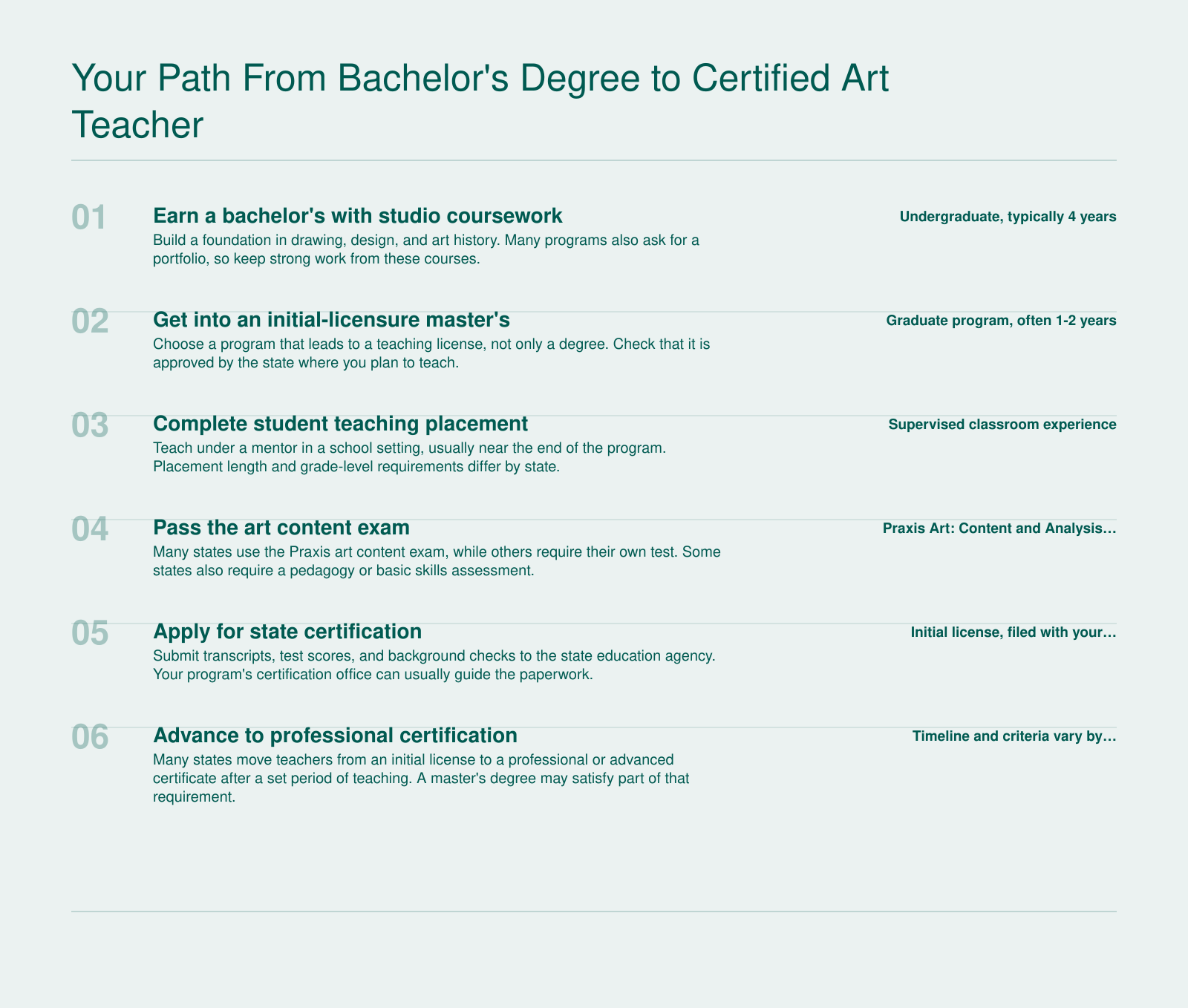
Your Path From Bachelor's Degree to Certified Art Teacher
Most initial-licensure routes follow the same general arc, from studio coursework to a professional certificate. Exams, required coursework, and even the order of steps vary by state, so confirm requirements with your state education department before you enroll.
Art Education programs by state
Master's in Art Education FAQs
A master's degree and a teaching certificate are separate credentials, and that distinction drives most of the questions below. Check each program's licensure disclosure and your destination state's rules before you enroll.
Can you teach with a master's in art education without certification?
What can you do with a master's in art education?
Can I earn a master's in art education without a BFA or art undergraduate degree?
Will a master's in art education from a New York or New Jersey school qualify me to teach in another state?
Compare Art Education programs on the data that matters
Explore more Education & Teaching specializations or browse every graduate field.
All Education & Teaching programs