Most Affordable Master's in Art Education Programs
Compare 210+ accredited most affordable Art Education programs at 200+ schools, with graduate earnings, cost, debt, and completion data from IPEDS and the U.S. College Scorecard.

A master's in art education can move a teacher up the salary schedule, but only if the tuition bill doesn't swallow the raise. Among the schools ranked here, average net price after aid runs from $2,984 at CUNY Hunter College to $10,440 at Cal State Long Beach.
The cheapest options are mostly public universities in New York and California, where in-state rates keep costs down. Residency, certification status, and delivery format shift the real price more than a school's name does.
Key Points
- Compare art education master's programs by net price, not sticker tuition.
- In-state status can lower annual tuition by roughly $9,400 to $10,100.
- Eastern Illinois requires existing art licensure for admission in 2027.
Top 10 Affordable Art Education Master's Programs for 2027
This ranking puts affordability first, using average net price after financial aid and cost-adjusted tuition data from IPEDS and College Scorecard, not reputation. Net price is an institution-wide average after aid, not an exact quote for every student; actual costs vary by enrollment status, residency, and aid package.
CUNY Hunter College
#1New York, NY · ~$11,000/yr (est.)
Best for: Aspiring PreK-12 art teachers in New York
Hunter College offers a Visual Arts Education MA that leads to Visual Arts PreK-12 certification. The program requires 44 credits for students without New York State teacher certification, while the 30-credit path for certified teachers has suspended admission. Admission is selective, requiring a bachelor's degree with a 3.0 GPA in visual art, specified art history and studio credits, two recommendations, a statement of purpose, a 10-image digital portfolio, and a faculty interview. The school's overall graduation rate is 57 percent.
- 44 total credit hours for non-NYS-certified students
- Leads to Visual Arts PreK-12 certification
- Requires a 10-image digital portfolio and faculty interview
- 9 credits of art history plus 24 studio art credits
- Fall and spring starts; March 15 and October 15 deadlines
CUNY Brooklyn College
#2Brooklyn, NY · $10,000 – $15,000/yr (est.)
Best for: Working educators needing rolling admissions flexibility
Brooklyn College offers an Art Teacher M.A. that leads to New York State certification for teaching art in grades pre-K through 12. Applicants with a bachelor's degree in art or art education choose one of two paths, and the degree requires 33 to 45 credits. Admission requires at least 30 credits in art and design, a 3.00 undergraduate index, a digital portfolio, two recommendations, a resume, and a personal statement. The school's overall graduation rate is 54 percent.
- Prepares for New York State art certification PK-12
- Two paths to the M.A. for art or art education majors
- Rolling admissions with 3.0 GPA minimum
- Requires digital portfolio, fingerprint clearance, and student teaching
- Courses scheduled for working students
California State University-Los Angeles
#3Los Angeles, CA · ~$9,000/yr (est.)
Best for: Portfolio-based applicants seeking interdisciplinary study
Cal State LA offers a Master of Arts in Art with an Art Education area of study. The 30-unit graduate degree also covers art history, animation, design, fashion, fiber and materials, and studio arts. Students take shared interdisciplinary courses and work with faculty mentors in their area, and admission is once a year for fall with a February 15 deadline. The school's overall graduation rate is 53 percent.
- 30 total credit hours with art education emphasis
- Six concentration options, including art education
- Shared interdisciplinary courses and faculty mentorship
- Fall start with February 15 application deadline
- PDF portfolio can include 5-15 images/videos or K-12 lesson plans
- Thesis or creative project culminating experience
CUNY City College
#4New York, NY · ~$11,000/yr (est.)
City College offers an MA in Art Education, P-12 with three graduate tracks for certified teachers, aspiring teachers, and teaching artists or arts administrators. The Initial Certification track leads to the MA and New York State Initial Certification to teach visual arts in preschool through 12th grade, while the Professional Certification track serves educators who already hold state certification. The Non-Certification track prepares graduates for museums, community centers, and other learning spaces. The school's overall graduation rate is 57 percent.
- Three tracks: Initial Certification, Professional Certification, Non-Certification
- Leads to New York State Initial Certification for visual arts P-12
- Prepares teaching artists for museums, community centers, and alternative sites
- Focus on social significance of art education
CUNY Queens College
#5Queens, NY · ~$12,000/yr (est.)
Queens College offers a Master of Science in Education in Art Education through the Secondary Education and Youth Services department. Admission requires GRE scores unless exempt, a 3.0 undergraduate GPA, three professional letters of recommendation, and a personal statement; the GRE is waived for New York State certified teachers. Students may transfer up to 12 credits and must complete the program within three years, with a one-year extension possible. The school's overall graduation rate is 53 percent.
- Leads to New York State classroom teacher certification
- GRE required unless exempt; waived for certified New York teachers
- Three professional letters of recommendation and personal statement
- Complete within three years, with one-year extension possible
- Transfer up to 12 credits
- Clinical component required for graduation
CUNY Lehman College
#6Bronx, NY · ~$12,000/yr (est.)
Lehman College lists the Art Education, Art Teacher (Pre-K through Grade 12) M.A. in its School of Education. Applicants submit a 500-word career objective essay, two or three recommendations, and a resume unless the program leads to teacher certification; the application fee is $75. Fall and spring entry have multiple review rounds, with priority review on March 15 for fall. The school's overall graduation rate is 51 percent.
- Housed in the School of Education
- Fall and spring starts; priority review March 15
- $75 application fee, nonrefundable
- 500-word career objective essay plus two or three recommendations
- No resume required for teacher certification tracks
- Financial aid available
- MMR and meningitis records required for hybrid study
California State University-Fresno
#7Fresno, CA · ~$9,000/yr (est.)
California State University, Fresno offers a Master of Arts in Art with an art education emphasis among 11 areas of interest, including crafts, computer art, interior design, and studio arts. The 30-unit program requires passing the Department of Art and Design Classified Standing Screening Review and completing a graduate writing requirement before candidacy. Students meet with an adviser in their concentration before completing 20 units. The school's overall graduation rate is 57 percent.
- 30 total credit hours
- 11 concentration options including art education
- Classified Standing Screening Review required for admission
- Graduate writing requirement before advancing to candidacy
- Adviser review required before completing 20 units
- Core coursework includes ART 230 or ART 260 and ART 298 or ART 299
California State University-Long Beach
#8Long Beach, CA · $9,000 – $19,000/yr (est.)
Cal State Long Beach offers a Master of Arts in Art Education through its School of Art, which was the first in the CSU system to offer the MFA degree. The school's art and design programs have been accredited by the National Association of Schools of Art and Design since 1970. Students can also pursue the Single Subject Credential in Art through a partnership with the teacher education program. The school's overall graduation rate is 69 percent.
- Housed in School of Art, accredited by NASAD since 1970
- First CSU art school to offer the MFA degree
- Partners with CSULB Single Subject Teacher Education Program for art credential
- Certificate options in Museum and Curatorial Studies and Biomedical Illustration
- Nearly 2,000 art majors and over forty full-time faculty
University of Florida
#9Gainesville, FL · ~$13,000/yr (est.)
The University of Florida offers a residential Master of Arts in Art Education through the School of Art + Art History, with an online option also available. The Educator Preparation Institute track combines the master's degree with Florida K-12 Art Teacher Certification. An online format using eight-week mini-semesters and an optional on-campus summer studio can reduce relocation costs for working educators, and applicants with U.S. degrees may not need GRE scores. The school's overall graduation rate is 91 percent.
- Residential MA plus an online master's option
- Educator Preparation Institute track pairs degree with Florida K-12 art certification
- Online format uses eight-week mini-semesters
- Optional on-campus summer studio component
- GRE may be waived for applicants with U.S. degrees
- Rooted in research and contemporary practice
Florida International University
#10Miami, FL · ~$11,000/yr (est.)
Florida International University offers a fully online Master of Science in Art Education through the College of Communication, Architecture + The Arts. The 36-credit program takes two years of full-time study and prepares students to teach art, art history, aesthetics, and criticism in K-12 school or studio settings. The curriculum blends research and theory with studio experience and reflects the urban, multicultural university community. The school's overall graduation rate is 74 percent.
- 36 total credit hours, typically two years full-time
- Offered fully online through the College of Communication, Architecture + The Arts
- Teaches art history, aesthetics, and criticism for K-12 settings
- Blends research, theory, and studio experience
- Accelerated pathway available for qualified students
Cost & outcomes by school
Federal data for the highest-earning Art Education programs, independent of the ranking above. Earnings are this field's master's graduates four years after completing, where the Scorecard reports them.
| School | Earnings | Tuition / yr | Debt | Grads/yr | Format |
|---|---|---|---|---|---|
| CUNY Brooklyn College NY | $88,100 | $11,524 | $20,500 | 108 | Campus |
| CUNY Queens College NY | $87,964 | $11,612 | $19,100 | 183 | Campus |
| CUNY Lehman College NY | $87,910 | $11,570 | $20,500 | 105 | Hybrid |
| CUNY City College NY | $86,151 | $11,402 | $20,504 | 85 | Campus |
| Adelphi University NY | $85,752 | $32,822 | $48,250 | 94 | Online |
| Azusa Pacific University CA | $83,642 | $17,015 | $48,742 | 66 | Hybrid |
| Hofstra University NY | $83,127 | $31,120 | $39,214 | 89 | Campus |
| Loyola University Maryland MD | $81,156 | $20,070 | $34,531 | 54 | Campus |
| CUNY Hunter College NY | $79,416 | $11,398 | $24,573 | 172 | Campus |
| Gordon College MA | $78,374 | $8,960 | — | 29 | Online |
| Utah State University UT | $78,061 | $7,828 | $12,000 | 20 | Campus |
| Teachers College at Columbia University NY | $76,686 | $37,918 | $51,964 | 227 | Campus |
Sources: U.S. Department of Education. Tuition and graduates: IPEDS. Earnings and debt: College Scorecard, this field's master's graduates; a dash means no figure is reported.
Cost, debt & payoff
Median earnings of this field's master's graduates (4 yrs after completing) vs. their median federal loan debt · U.S. College Scorecard
Across these programs the median graduate earns about $62,706 and finishes with roughly $25,940 in debt — a ratio that clears a common rule of thumb (keep debt below first-year salary). Tuition and debt vary widely school to school, so check the per-school figures in the table above before you shortlist.
What You'll Actually Pay: Net Price vs. Sticker Tuition
Published per-credit rates rarely tell the full price of a master's in art education. To compare programs fairly, use a simple formula: per-credit rate × required credits, plus mandatory fees, whether charged per credit or per term, over the number of credits or terms. At the University of Florida, the published 2024-25 breakdown shows $600 × 36 credits, or $21,600 in tuition, plus $35.75 per credit in mandatory fees ($1,287), for a total program cost of $22,887. That fee line is the gap many students miss when they compare sticker tuition alone, and the net price shown in rankings can be lower once aid is applied.
The geography math can change with an online master's in art education too. Some programs charge a flat e-tuition rate, which may erase the usual in-state/out-of-state premium; confirm that policy before assuming nonresident rates. And budget separately for art supplies, portfolio materials, and possible exam-proctoring fees, because tuition and university fees do not include them. Even a low per-credit figure can understate the real cost of completing the degree.
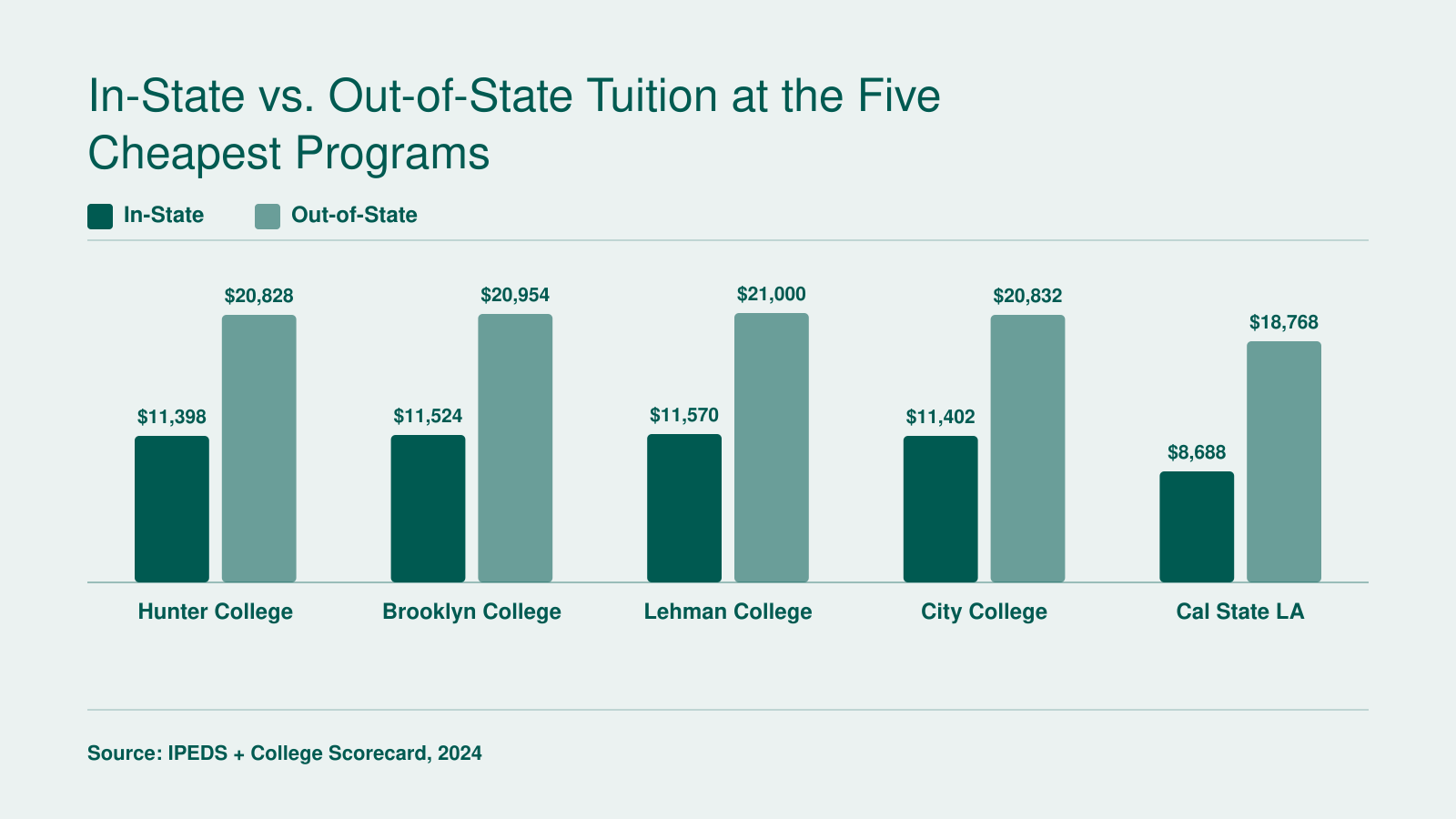
In-State vs. Out-of-State Tuition at the Five Cheapest Programs
Residency changes the sticker price by roughly $9,400-$10,100 per year at the five schools charted below. Online-only students often avoid that gap entirely, since many programs charge a single rate regardless of state.
Related Articles
Accreditation and Licensure: What to Check Before You Apply
Eastern Illinois University's online master's in art education (M.A.) requires existing art licensure and says plainly that it does not lead to teacher certification.1 That one detail shows why you should sort out three separate layers before applying.
- Institutional accreditation: Regional accreditation is the baseline for federal financial aid.
- CAEP: This accredits educator preparation. EIU's Department of Art holds it.1 For the other programs here, the sources reviewed do not establish CAEP status, so verify it directly.
- NASAD: This covers art and design units. It does not imply CAEP. UMass Dartmouth2, Kennesaw State3, and Cincinnati4 all show NASAD evidence.
Initial licensure or advanced degree?
Some programs prepare you to earn a first license, with student teaching. Others serve teachers who already hold one. UMass Dartmouth's online M.A.E. supports Professional Licensure for candidates with an initial license, and a separate 24-credit post-baccalaureate route leads to initial licensure.2
Out-of-state online students
Federal rules require licensure disclosures whether a program is online or on campus. Schools must say whether a program meets each state's requirements, and may notify you directly.5 NC-SARA does not create licensure reciprocity. Kennesaw State notes that completion does not guarantee licensure eligibility elsewhere.3
Before you apply, confirm on the program's disclosure page, or with your state education agency, that the program is approved for licensure in your state.
Admission Requirements if You Don't Have an Art Education Background
- Bachelor's degree and GPAPlan on an accredited bachelor's. Published minimum GPAs vary, commonly around 2.75–3.0; UMass Amherst lists 2.75, while Adelphi and Saint Michael's list 3.0.
- Studio art prerequisitesIf you were not an art major, expect credit requirements. UMass Amherst asks for about 35 art/art-history credits, Adelphi requires 30 art credit hours, and Saint Michael's expects a visual arts major or equivalent preparation.
- PortfolioMost programs require digital artwork. Counts range from 10 pieces at Saint Michael's to 15–20 images at Adelphi and UMass Amherst; FIU lists 15 artworks, and Teachers College requires a digital portfolio.
- Licensure statusIf you don't hold a teaching license, look for initial-licensure tracks designed to lead to certification. Advanced or non-licensure options may expect current certification, so confirm each program's track requirements.
- Student teaching or practicumInitial-licensure routes typically include field work: UMass Amherst schedules a full semester, Adelphi uses a full-time final semester, and Teachers College describes a year-long practicum.
Financial Aid, Teacher Discounts, and Assistantships
The TEACH Grant is still the main federal award aimed at future teachers, but its terms are stricter than many applicants expect. The statutory maximum is $4,000 per award year, though the 2026-27 amount is reported at $3,772 after sequestration.12 Graduate students can receive it for up to two years.3 In exchange, you agree to teach full-time for four years within eight years of leaving the school that awarded it,14 in a high-need field such as special education, math, science, or bilingual education,2 at a school serving low-income students. Art is not typically on that list.2 If you don't finish the service, the grant converts to a Direct Unsubsidized Loan with interest from the original disbursement dates.5
District tuition reimbursement and salary-schedule lanes often cover more. Reimbursement commonly runs $2,000 to $5,000 a year, with written pre-approval, a passing grade, an accredited program, and often a two- to three-year service commitment.
University discounts include educator or alumni rates and assistantships with tuition waivers, mostly for campus students. Before enrolling, ask whether any discount can be combined with federal aid.
Online vs. Campus Art Education Master's: Trade-Offs for Working Teachers
Online and hybrid art education master's programs suit working teachers because most coursework is asynchronous and students do not need to relocate. Most programs require 30 to 36 credits and take about two years part time, though timelines vary. The main trade-offs involve scheduled live sessions, short summer residencies, and studio access.
Pros
- Asynchronous coursework fits a full-time teaching schedule, with summer-friendly terms that do not require relocating for most of the degree.
- Some fully online programs charge a flat tuition rate for online students, simplifying cost comparisons and budgeting.
- Part-time pacing of roughly two years lets working teachers maintain income and classroom experience while earning the master's.
Cons
- Required synchronous online sessions can conflict with after-school duties, coaching, or family responsibilities across time zones.
- Short on-campus summer residencies, ranging from about one week to nine weeks, add travel and housing costs.
- Limited shared studio access and required in-person fieldwork reduce hands-on collaboration and demand local arrangements.
What Art Education Master's Graduates Earn
Art Education programs by state
Frequently Asked Questions About Affordable Art Education Master's Programs
What is the cheapest online master's in art education?
How much does a master's in art education cost?
What jobs can I get with a master's in art education?
Can I use an online degree from another state to get licensed where I live?
Compare Art Education programs on the data that matters
Explore more Education & Teaching specializations or browse every graduate field.
All Education & Teaching programs