Best Master's in Art Education Programs in Virginia
Compare 5 accredited Art Education programs in Virginia, with graduate earnings, cost, debt, and completion data from IPEDS and the U.S. College Scorecard.

Virginia's art education master's options split sharply between degrees that include initial PreK-12 visual arts licensure and degrees meant for teachers who are already licensed. Only a handful of programs exist, so each choice carries real weight for licensure, cost, and format. Program-level tuition runs from $8,730 online at Liberty University to over $17,000 in-state at George Mason and VCU.
Campus, hybrid, and online programs share one ranking, so a Richmond studio-based cohort sits beside a fully online option. Most students end up weighing a lower price against hands-on student teaching placements.
Key Points
- Program tuition ranges from $8,730 at online Liberty University to $17,964 in-state at George Mason.
- No school here can be confirmed as skipping the GRE for 2027.
- Choose a licensure-track program first if you don't yet hold a Virginia teaching license.
Best Master's in Art Education Programs in Virginia: 2027 Rankings
These five Virginia master's programs combine art education coursework with a path toward PreK-12 visual arts licensure, across campus, hybrid, and online formats. Graduation rates and net prices below describe each institution as a whole, not the art education program alone. Program-level earnings are not yet available, so weigh licensure fit and cost carefully.
George Mason University
#1Fairfax, VA · $15,000 – $20,000/yr (est.)
Best for: Studio art majors seeking Northern Virginia placement
George Mason University in Fairfax offers an MAT in Art Education that prepares studio art graduates for PreK-12 art licensure in Virginia. It includes a track for already licensed teachers and an accelerated BFA/MAT option. Its Northern Virginia location connects students to the Washington-area school market. Schools offering this program graduate about 68% of students, and the institution-wide average net price after aid is about $17,915.
- 30 credit hours, with 2 concentration options
- MAT I leads to PreK-12 art licensure; MAT II serves licensed art teachers
- MAT II requires a capstone project
- 3.0 GPA and Praxis Art Education (5134) required before internship
- B- or higher required in licensure coursework
- Studio major and prerequisite 2D, 3D, and art history coursework expected
- Accelerated BFA/MAT pathway totals 150 credits
- Includes student teaching internship and a group exhibition showcase
Virginia Commonwealth University
#2Richmond, VA · ~$17,000/yr (est.)
Best for: Licensed teachers advancing their classroom practice
Virginia Commonwealth University in Richmond serves both licensed teachers and BA or BFA holders who want a master's degree and a Virginia Visual Arts PreK-12 license together. The art unit is NASAD accredited, and Richmond's museums and community arts settings shape the program's research and fieldwork. We could not confirm current CAEP or Virginia Department of Education approval of the educator preparation pathway, so verify it before applying. Schools offering this program graduate about 63% of students, and the institution-wide average net price after aid is about $23,433.
- Two-year master's with 2 concentration options
- M.A.E. track for already licensed teachers
- M.A.E. + Licensure track for BA or BFA holders
- Completers who pass required assessments can apply for Visual Arts PreK-12 licensure
- Emphasis areas include museum education, technology, and urban education
- Research and fieldwork in school, museum, and community settings
Liberty University
#3Lynchburg, VA · ~$9,000/yr (est.)
Best for: Working adults needing fully online study
Liberty University in Lynchburg delivers its MAT in Visual Arts Education P-12 in an online format, with a fully online option available. The program is approved in Virginia, and graduates may seek licensure elsewhere through reciprocity, though receiving states can add requirements. Schools offering this program graduate about 65% of students, and the institution-wide average net price after aid is about $29,357.
- 45 credit hours with a 9-hour Visual Arts Education cognate
- Fully online option available
- Student teaching and practicum required before completion
- 3.0 GPA minimum; no more than two C grades
- Up to 50% transfer credit allowed; finish within five years
- Praxis Subject Assessment and background check required before student teaching
- Virginia teaching license required
University of Mary Washington
#4Fredericksburg, VA · ~$12,000/yr (est.)
The University of Mary Washington in Fredericksburg pairs a Master of Education in PreK-12 Education with a teaching license, with Visual Arts as one of four licensure areas. Evening, blended, or online courses suit working adults, and the internship is a semester of supervised student teaching in nearby schools. Schools offering this program graduate about 66% of students, and the institution-wide average net price after aid is about $20,667.
- Master's degree plus Virginia teaching license
- Visual Arts is one of four PreK-12 licensure areas
- Bachelor's degree with an art major required
- Transcript review, portfolio, and Praxis II scores may assess proficiency
- Evening, blended, or online courses
- Semester-long student teaching placement in local schools
Christopher Newport University
#5Newport News, VA · $13,000 – $23,000/yr (est.)
Christopher Newport University in Newport News offers a Master of Arts in Teaching with an Art (Visual Arts) endorsement option. The program partners with Newport News Public Schools and builds teaching skills through field experiences. Students can complete a bachelor's and master's in five years. Schools offering this program graduate about 72% of students, and the institution-wide average net price after aid is about $23,015.
- One endorsement chosen from 11 options, including Art (Visual Arts)
- Partnership with Newport News Public Schools
- Field experiences in content-area teaching
- Five-year bachelor's-to-master's option
- Emphasis on turning educational theory into classroom practice
Cost & outcomes by school
Federal data for the highest-earning Art Education programs, independent of the ranking above. Earnings are this field's master's graduates four years after completing, where the Scorecard reports them.
| School | Earnings | Tuition / yr | Debt | Grads/yr | Format |
|---|---|---|---|---|---|
| George Mason University VA | $61,859 | $17,964 | — | 9 | Campus |
| Virginia Commonwealth University VA | $60,431 | $17,252 | — | 20 | Campus |
| Liberty University VA | $57,678 | $8,730 | $32,189 | 101 | Online |
| University of Mary Washington VA | — | $12,462 | — | — | Hybrid |
| Christopher Newport University VA | — | $13,050 | — | — | Campus |
Sources: U.S. Department of Education. Tuition and graduates: IPEDS. Earnings and debt: College Scorecard, this field's master's graduates; a dash means no figure is reported.
Online and Hybrid Master's in Art Education Options in Virginia
Campus-based and online master's in art education programs lead to the same Virginia license, but they get you there differently. Most programs here are campus-based. VCU's Master of Art Education and George Mason's MAT in Art Education are both listed as on-campus, and neither program page describes an online option. Each requires 30 credits. VCU's licensure track adds 15 to 21 licensure-related credits on top of its 30.1 VCU's M.A.E. takes 24 months1; George Mason does not publish a typical completion time. Christopher Newport University's MAT is also campus-based.
Two schools offer more flexibility:
- Liberty University: The MAT in Visual Arts Education P-12 is 45 credit hours and has a fully online option. Students must finish within five years and complete a practicum before student teaching.
- University of Mary Washington: The M.Ed. in PreK-12 Education with a visual arts concentration is hybrid, with evening, blended, or online courses and a semester-long field-based internship.
Can you earn a master's in art education through one of the online master's programs in Virginia? Yes, through Liberty, and partly online through Mary Washington. Licensure tracks still require in-person student teaching in school placements, even when coursework is remote.
GRE Requirements: Which Virginia Art Education Master's Programs Waive the GRE
Among Education & Teaching Master's Programs, art education portfolios usually count for more than the GRE. For 2026, no school here can be confirmed as one of the No-GRE master's programs: VCU's own pages disagree, and George Mason publishes no policy we could find.
- VCU (M.A.E. in Art Education): The School of the Arts admissions page says GRE scores are no longer required. The VCU Bulletin says scores are required below a 3.2 undergraduate GPA and optional at 3.2 or higher.1 Ask the program which rule applies to your cycle. A portfolio is required, and you must identify which work is personal and which is student work. The Bulletin asks for 10 to 15 images with captions1, while the admissions page asks for 15 items. You also need 36 undergraduate credits in art and art history, which you can earn through undergraduate courses before applying. The Bulletin lists January 15 as the fall deadline.1 The admissions page accepts applications through March 15 but gives funding preference to January 15. International applicants submit one month earlier.
- George Mason University (M.A.T. in Art Education): No published GRE policy. A SlideRoom portfolio is required, but the number of pieces, format, and whether it should include student work are not specified. We found no studio-credit minimum or art bachelor's requirement. The catalog lists an October 15, 2026 standard deadline for spring entry, and no fall deadline is published.
Get any GRE waiver confirmed in writing from the admissions office before you pay an application fee.
Related Articles
What a Master's in Art Education Costs in Virginia
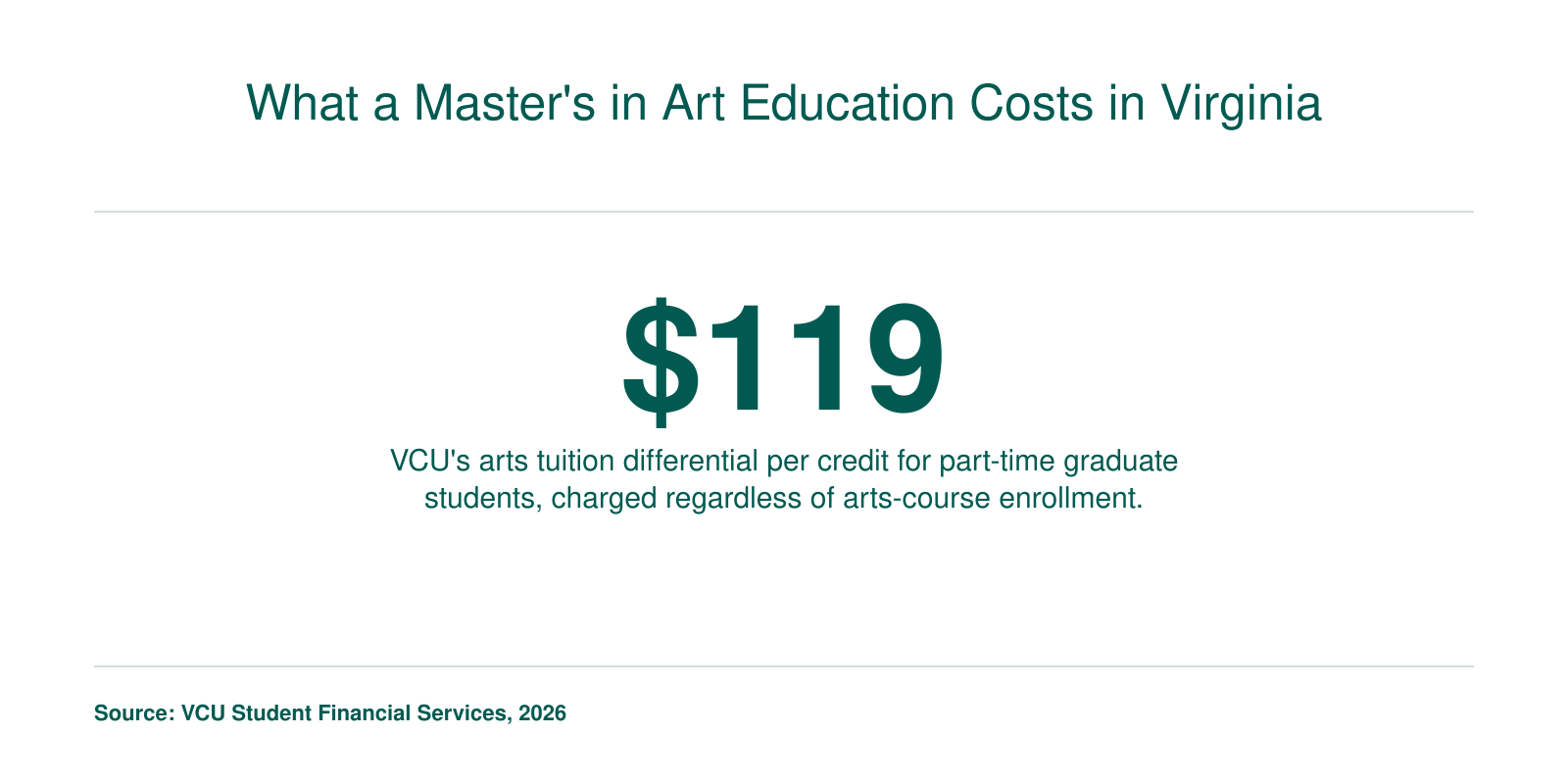
Program-level tuition and fees run from $8,730 at Liberty University (online, same rate in-state and out) to $17,964 in-state and $40,308 out-of-state at George Mason, with VCU at $17,252 in-state and $32,470 out-of-state. A total degree cost for the 30-credit programs at VCU and George Mason can't be calculated responsibly for 2026, because neither publishes a clear per-credit rate. Net price is an institution-wide approximate average, not a quote (about $17,915 at George Mason and $23,433 at VCU). At VCU, funding options include limited full-tuition graduate assistantships (20 hours a week), the Ruth Hibbs Hyland student-teaching scholarship, and the federal TEACH Grant of up to $4,000 a year with a four-year teaching commitment. George Mason does not publish program-specific awards.
Virginia Prek-12 Visual Arts Licensure
Career Outcomes and ROI: What Virginia Art Education Master's Graduates Earn
A licensure-track master's and an advanced degree for teachers who already hold a license pay off in different ways. The first qualifies you for a full-time art teaching job. The second typically moves a working teacher up the district salary scale. Either way, your paycheck after graduation is set mainly by the school division that hires you, not by the university name on your diploma.
Federal program-level earnings and debt figures are not yet published for George Mason University, the University of Mary Washington, Christopher Newport University, Virginia Commonwealth University or Liberty University. Because these programs graduate small cohorts, that gap may persist.
To estimate payback yourself:
- Check district pay scales: Many Virginia school divisions publish salary schedules that show the step or differential a master's adds.
- Total your real cost: Compare tuition for the full credit load, not the per-credit rate.
- Estimate time to recoup: Divide your expected debt by the annual raise the degree brings.
The takeaway: with similar starting pay across districts, the lowest-cost route to licensure offers the strongest return.
VCU vs. George Mason: Which Master's in Art Education Fits You?
Both programs carry 30 credits, but they serve different students. Each splits into a track for licensed teachers and a track for people seeking initial licensure, so compare tracks rather than school names.
| Factor | VCU Master of Art Education (M.A.E.) | George Mason MAT in Art Education |
|---|---|---|
| Degree type | M.A.E., with a standard track and a plus-licensure track | MAT, split into MAT I and MAT II |
| Licensure track | Plus-licensure adds 15-21 licensure credits for B.A. or B.F.A. holders seeking a Virginia PreK-12 visual arts license | MAT I leads to initial PreK-12 licensure; MAT II is continuing education for licensed teachers |
| Format and length | 30 credits for the standard track; plus-licensure adds credits. Delivery format is not detailed in the program pages reviewed. | 30 credits. Delivery format is not detailed in the catalog summary. |
| Cost | See the cost breakdown above. Licensure credits raise the VCU total. | See the cost breakdown above. Credits are bundled without published sub-splits. |
| Curriculum focus | Critically reflective practice and research (ARTE 704), seminar credits, comprehensive exams; studio work not required | Studio-based, with required studio work, school practicum, teaching internship, and a capstone project |
| Admissions note | B.A. or B.F.A. for plus-licensure | MAT I needs a BFA or equivalent with 12 two-dimensional, 12 three-dimensional, 9 art history/criticism, and 3 related fine arts semester hours. MAT II needs an undergraduate art education degree. |
| Best for | Licensed teachers seeking advancement (standard); career changers seeking initial licensure (plus-licensure) | Studio-trained career changers (MAT I); licensed art teachers (MAT II) |
Master's in Art Education in Virginia: FAQs
What is the difference between the MAT and MAE in art education?
Does VCU offer a master's in art education?
Which Virginia schools offer PreK-12 art education licensure?
Is George Mason or VCU better for art education?
Compare Art Education programs on the data that matters
Explore more Education & Teaching specializations or browse every graduate field.
All Education & Teaching programs