Best Master's in Secondary Education Programs
Compare 430+ accredited Secondary Education programs at 290+ schools, with graduate earnings, cost, debt, and completion data from IPEDS and the U.S. College Scorecard.

The 10 programs ranked here run from a 12-month cohort at William & Mary to two-year tracks at UT Austin and Vanderbilt, a spread that reflects who they serve. A career changer needs a program that ends in initial licensure, with student teaching built in. A licensed teacher chasing a raise needs advanced coursework, often with no certification component.
We ordered the list by graduate debt, net price, and earnings where reported, not by reputation. Costs, formats, licensure portability, and admissions follow.
Either way, a state issues the license, not a university, and that shapes where a degree pays off.
Key Points
- Median in-state graduate tuition across the 10 ranked programs is $10,384, before licensure add-ons.
- Online programs still require in-person student teaching, and state authorization can limit where you're placed.
- The NASDTEC Interstate Agreement isn't automatic reciprocity, so each state can add its own requirements.
10 Master's in Secondary Education Programs at a Glance
These 10 programs stand out for how they combine licensure preparation, subject-area depth, and clear value. Each entry highlights the concentrations, classroom experiences, and delivery formats that matter most to prospective secondary teachers.
University of California-Berkeley
#1Berkeley, CA · ~$16,000/yr (est.)
Best for: Equity-minded aspiring secondary English teachers
UC Berkeley's Berkeley Teacher Education Program (BTEP) combines a 15-month MA and California credential for future secondary English teachers. The program emphasizes social justice, equity, and culturally responsive pedagogy, with a teaching residency in diverse Bay Area schools. The university as a whole has a graduation rate of 92.8 percent.
- 15-month combined MA and California credential
- Secondary English Pathway with optional bilingual authorization
- Teaching residency in Bay Area schools
- Recognized with AERA equity award
The University of Texas at Austin
#2Austin, TX · ~$12,000/yr (est.)
Best for: Urban-focused Texas secondary teacher candidates
UT Austin offers campus-based master's programs in secondary English language arts and social studies. Both pathways lead to Texas teaching certification and an ESL endorsement, with full-time coursework and urban field experience. The university has a graduation rate of 88.9 percent, and the English program does not require the GRE.
- 42 credit hours, two-year full-time campus program
- Leads to Texas teaching certificate and ESL endorsement
- No GRE required for admission
- Urban school teaching focus with electives outside the department
- 36 credit hours, one calendar-year program
- Test optional, GRE accepted
- Summer start with priority December 15 deadline
- Earns Texas certification, social studies endorsement, and ESL endorsement
Vanderbilt University
#3Nashville, TN · ~$58,000/yr (est.)
Best for: Prospective STEM and humanities educators
Vanderbilt's Peabody College offers a Secondary Education M.Ed. with English, mathematics, social studies, and science concentrations. The two-year program includes a 96 percent job or graduate school placement rate, a guaranteed 30 percent Teacher Pathway scholarship, and a job-embedded option for working Tennessee teachers. The institutional graduation rate is 93.5 percent.
- 36 credit hours with two semesters of a foreign language
- Traditional student teaching or job-embedded pathway
- Guaranteed 30 percent Teacher Pathway scholarship
- 96 percent employment or graduate school within four months
- 33 credit hours, two-year program
- Job-embedded pathway available
- 96 percent job placement rate
- Priority decision deadlines in January and February
- Six concentration options and rolling admissions
- Licensure options include Music and Multilingual Education
- Two pathways: student teaching or job-embedded
- Field-based internship in secondary schools
- 33 credit hours, social studies licensure for grades 6-12
- Job-embedded teaching pathway
- Priority Decision 1 deadline January 3
- 33 credit hours, two-year program
- Two tracks: student teaching or job-embedded
- Field-based practicum work
- Prepare for public, private, or charter school teaching
University of Georgia
#4Athens, GA · ~$11,000/yr (est.)
The University of Georgia's online M.Ed. programs in secondary mathematics and science are designed for certified teachers seeking a Georgia T5 certification upgrade. Both programs offer flexible part-time scheduling, cohort or semester starts, and employer and military tuition support. The institution has a graduation rate of 89.7 percent.
- 33 credit hours, online, two-year cohort format
- Designed for certified secondary math teachers
- Prepares for Georgia T5 certification upgrade
- Summer and fall cohort starts
- Part-time schedule available
- 36 credit hours, online, flexible scheduling
- Focus on Next Generation Science Standards
- $15,372 total program tuition
- Full-time and part-time options with fall, spring, and summer starts
- Designed for certified secondary science teachers
William & Mary
#5Williamsburg, VA · $15,000 – $20,000/yr (est.)
William & Mary's one-year M.A.Ed. in Curriculum & Instruction offers English, mathematics, and science concentrations for aspiring Virginia secondary teachers. The cohort program includes a fall clinical field experience and a spring full-time student teaching internship. The university has a graduation rate of 89.4 percent.
- 44 credit hours, 12-month full-time cohort
- Fall clinical field experience with 60 hours of observation
- Spring full-time student teaching internship
- Prepares for Virginia teaching licensure and Praxis English assessment
- One-year, full-time cohort with fall and spring field experiences
- Prepares for Virginia licensure and Praxis Mathematics assessment
- Fall clinical field experience with 60+ hours
- Spring full-time student teaching internship
- 44 credit hours, 12-month full-time program
- Cohort-based learning community
- Fall clinical field experience and spring student teaching
- Prepares for Virginia 6-12 licensure
Johns Hopkins University
#6Baltimore, MD · ~$65,000/yr (est.)
Johns Hopkins University's TeachingWell M.Ed. combines four semesters of coursework with a paid residency year for secondary math and science candidates. The program provides full-tuition support, a living stipend, and four years of career coaching after graduation. The institutional graduation rate is 93.8 percent.
- 39 credit hours plus one-year paid residency
- Full-tuition support and living stipend
- Four years of career coaching after graduation
- Prepares for Maryland Secondary Mathematics certification
- 39 credit hours, full-tuition support
- Four-year career support after graduation
- Prepares for secondary STEM certification
- Robert Noyce Scholarship up to $10,000 available
- 39 credit hours, full-tuition support
- Focus on environmental issues and climate change
- Residency in approved Maryland school districts
- Robert Noyce $10,000 stipend available
Northwestern University
#7Evanston, IL · ~$55,000/yr (est.)
Northwestern's 18-month MSEd in Secondary Teaching prepares students for Illinois licensure in six subject areas. The first year is part-time, allowing candidates to work, and the program reports a 100 percent job placement rate for teaching seekers. The university has a graduation rate of 95.1 percent.
- 18-month program with 40 semester hours
- Part-time first year allows working
- Choose from six subject areas
- Illinois Professional Educator License with middle grades and high school endorsements
- 100 percent job placement rate for teaching seekers
- Optional ESL or Bilingual endorsements
- Clinical experiences every quarter
Boston College
#8Chestnut Hill, MA · ~$38,000/yr (est.)
Boston College's M.Ed. in Secondary Education offers STEM and humanities pathways leading to Massachusetts teacher licensure. Students complete pre-practicum and full-time practicum experiences in Boston-area schools and can add a Teaching English Language Learners certificate. The institutional graduation rate is 90.8 percent.
- 37 credit hours, full-time or part-time
- STEM and Humanities pathways
- Capstone required
- Prepares for Massachusetts licensure
- TELL Certificate opportunity
- 37 credit hours, full-time or part-time
- Massachusetts DESE approved
- Part-time option 2-3 years
- Practicum in urban and suburban schools
- 37 credit hours, full-time or part-time
- Pre-practicum and full practicum
- Donovan Urban Scholars Program available
- TELL Certificate opportunity
Lehigh University
#9Bethlehem, PA · ~$29,000/yr (est.)
Lehigh University's 18-month M.Ed. in Secondary Education leads to Pennsylvania 7-12 certification in eight subject areas, with an optional dual certification in special education. The on-campus program includes weekly practicum and final semester student teaching. The university has a graduation rate of 87.9 percent.
- 33 credit hours, 18-month on-campus program
- Eight subject areas for Pennsylvania 7-12 certification
- Weekly practicum and final semester student teaching
- 3.0 GPA minimum and two recommendation letters
- 33 credit hours, 18-month program
- Dual certification in Special Education PreK-12
- Eight certification areas offered
- Practicum 8-10 hours per week
- 30 credit hours, one additional year after bachelor's
- No GRE required, test optional
- Transfer up to 6 undergraduate credits
- Conditional admission with 2.75 GPA
University of Massachusetts-Amherst
#10Amherst, MA · $15,000 – $20,000/yr (est.)
UMass Amherst's 4+1 accelerated M.Ed. lets undergraduates earn a bachelor's and master's in five years, with mathematics, science, and English concentrations. The program offers two residency pathways, including a $3,000 stipend for Springfield placements. The institutional graduation rate is 83.3 percent.
- Five-year bachelor's plus master's pathway
- $3,000 stipend for Springfield placements
- Option to earn license in second subject
- Begin application junior year, transfer up to 12 credits
- Five-year bachelor's plus master's pathway
- Full-year teaching experience option
- $3,000 stipend in Springfield district
- Part-time fall teaching, full-time spring
- Five-year bachelor's plus master's pathway
- Transfer up to 12 undergraduate credits
- Option for second subject license
- $3,000 stipend in Springfield district
Cost & outcomes by school
Federal data for the highest-earning Secondary Education programs, independent of the ranking above. Earnings are this field's master's graduates four years after completing, where the Scorecard reports them.
| School | Earnings | Tuition / yr | Debt | Grads/yr | Format |
|---|---|---|---|---|---|
| California State University-Long Beach CA | $91,505 | $8,898 | — | — | Campus |
| University of Washington-Tacoma Campus WA | $80,738 | $18,987 | $30,990 | 20 | Hybrid |
| University of California-Irvine CA | $79,921 | $14,827 | $30,500 | 136 | Campus |
| Seattle University WA | $79,881 | $24,216 | $33,325 | 24 | Hybrid |
| Molloy University NY | $79,134 | $27,520 | $41,000 | 24 | Hybrid |
| Indiana University-Bloomington IN | $77,765 | $11,756 | — | 18 | Campus |
| California State University-Fullerton CA | $77,214 | $8,994 | $20,500 | 71 | Online |
| University of Massachusetts-Boston MA | $76,298 | $20,456 | $24,000 | 100 | Campus |
| College of Staten Island CUNY NY | $71,468 | $11,650 | $20,950 | 23 | Hybrid |
| Utah State University UT | $70,374 | $7,828 | $12,000 | 2 | Campus |
| Grand Canyon University AZ | $56,764 | $10,015 | $31,340 | 1,662 | Online |
| Fort Hays State University KS | — | $4,949 | — | — | Online |
Sources: U.S. Department of Education. Tuition and graduates: IPEDS. Earnings and debt: College Scorecard, this field's master's graduates; a dash means no figure is reported.
Cost, debt & payoff
Median earnings of this field's master's graduates (4 yrs after completing) vs. their median federal loan debt · U.S. College Scorecard
Across these programs the median graduate earns about $58,845 and finishes with roughly $30,750 in debt — a ratio that clears a common rule of thumb (keep debt below first-year salary). Tuition and debt vary widely school to school, so check the per-school figures in the table above before you shortlist.
How We Rank These Programs, and Why CAEP Accreditation Matters
How can you tell whether a master's in secondary education, or a special education master's degree, will actually prepare you for a license and a teaching job? Start with the outcomes that matter, then confirm two separate approvals.
The numbers to weigh first
We compare programs on four outcomes reported in federal College Scorecard data, just as we do for elementary education master's programs: program-level earnings after completion, median federal student debt, net price after aid, and the institution's overall graduation rate. Because net price is an institution-wide average after aid, your own cost will vary with your aid package.
CAEP, AAQEP, and the state approval that makes a license possible
CAEP (Council for the Accreditation of Educator Preparation) and AAQEP (Association for Advancing Quality in Educator Preparation) are national programmatic accreditors.1 State approval is separate: it is state government authorization to prepare candidates for that state's license.2 A program can hold national accreditation and still need state approval, and national accreditation alone does not guarantee licensure eligibility.2 Many states require you to complete a state-approved program before they will recommend you for initial licensure.3
Verify a program before you enroll
Check accreditation separately from state approval. For CAEP, use the Provider Search 2.0 directory; confirm the exact campus, the decision, and whether the status is Full or Probationary Accreditation.4 For AAQEP, check its accredited programs listing. Then cross-check the program on your state education department's approved-program list, because only state approval controls whether completers can be recommended for a license.
What a Master's in Secondary Education Really Costs
Tuition is only the first cost of getting licensed to teach, and the lowest-tuition programs are not always the cheapest once the full bill arrives. Start with the sticker price, then add what it leaves out.
Tuition and the Residency Gap
Among the ten ranked programs, listed in-state graduate tuition runs from $8,037 at UNC Charlotte to $18,987 at University of Washington-Tacoma. Vanderbilt, a private school, charges $57,868 regardless of residency. Out-of-state prices for the public schools range from $19,074 at Cal State Fullerton to $33,006 at UW Tacoma. Residency can swing the bill sharply: the University of Central Florida lists $8,872 in-state against $28,657 out-of-state, a gap of nearly $20,000.
Costs Tuition Quotes Leave Out
- Praxis exams: The Praxis Information Bulletin lists Core Combined at $150 for 2026-27. Subject Assessments are $130 for selected-response tests and $156 for constructed-response tests, and ETS may change fees without notice.
- edTPA: The edTPA Operational Fees page lists $300, though some programs provide vouchers covering all or part.
- Background checks and licensing: Fingerprinting, background checks, and state application fees vary by state, license type, and pathway, so confirm them with your state's education agency.
The Biggest Hidden Cost
For career changers, the largest expense is often the unpaid student-teaching semester. You may give up months of salary while still paying tuition, and that lost income can outweigh every fee above.
Ways to Cut the Total
- Paid residencies: Some residency-style programs pair coursework with classroom work. Ask whether the placement carries a stipend or salary.
- TEACH Grant: The TEACH Grant Program Overview lists up to $4,000 a year for full-time enrollment and says the award is not need-based.1 It requires four years of full-time teaching in a high-need field, such as math, science, or special education, within eight years. Miss that, and it converts to a Direct Unsubsidized Loan with interest back to disbursement.
- In-state online pricing: Public online programs, such as UNC Charlotte's or an online master's in curriculum and instruction, can offer in-state rates and save you relocation and commuting costs.
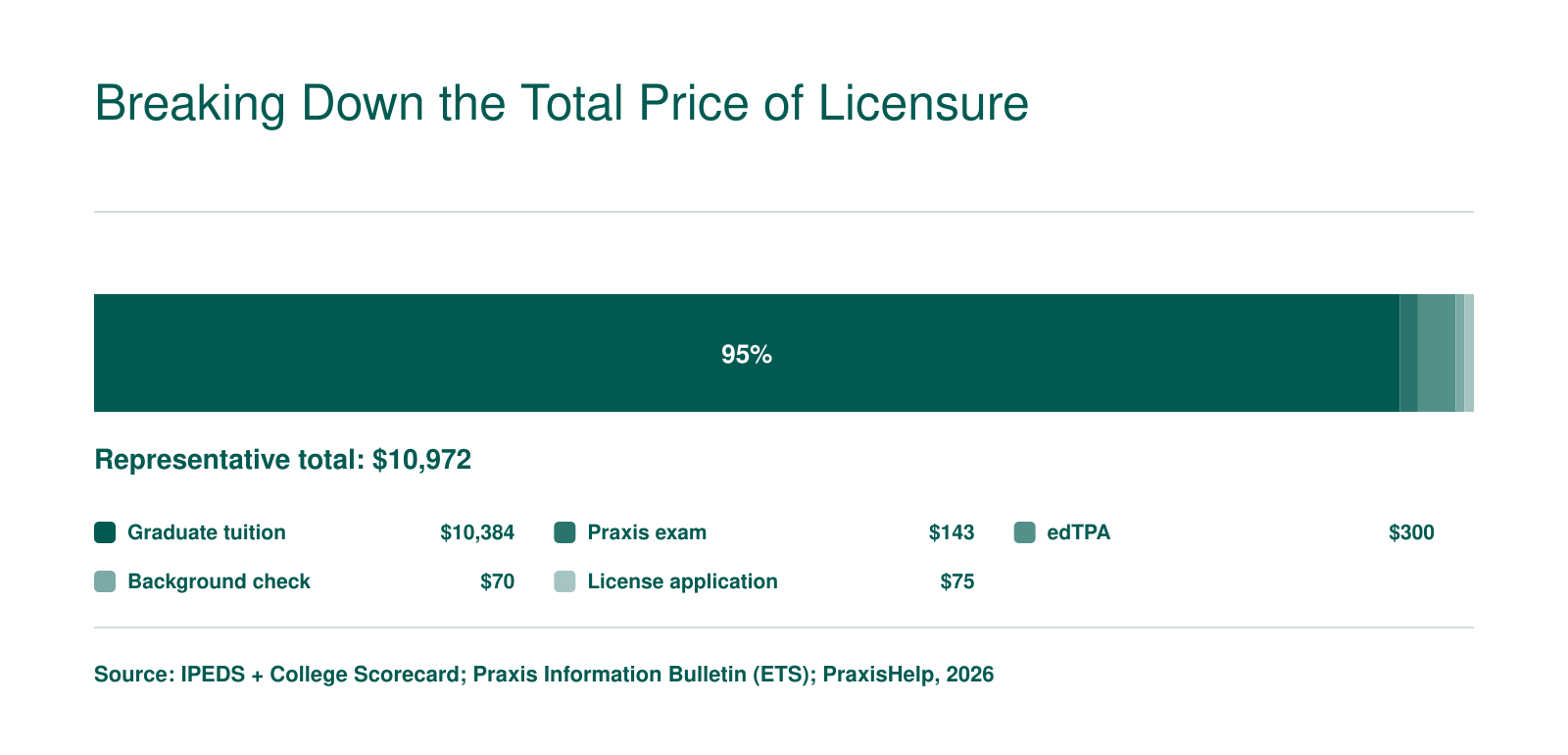
Breaking Down the Total Price of Licensure
This representative budget pairs the median in-state graduate tuition across the 10 ranked programs ($10,384) with midpoint estimates for the four licensure add-ons. Exam, background check, and application fees vary by state, subject area, and testing cycle, so treat them as planning figures, not fixed rates. Tuition is the dominant share, and the add-ons together run roughly $500-$600.
Related Articles
Online vs. Campus: How Format Affects Scheduling and Student Teaching
Online delivery changes how you take classes, not where you student teach. Even in fully online programs, supervised classroom work happens in person at a school, and state authorization rules can limit where you can be placed and licensed. Our sources describe online formats in detail but do not give a campus comparison, so confirm on-campus schedules directly with any program you are considering.
| Topic | Coursework format | Student teaching and field experience |
|---|---|---|
| K-State Master of Arts in Teaching | Fully online and asynchronous, self-paced within each semester | Practicum and internship attendance are exceptions to online delivery |
| Point Park University MEd in Secondary Education | Fully asynchronous; instructors often hold optional virtual meetings | Placement details not covered in our sources; ask the program |
| Arizona State University MEd (Teacher Certification) and Clemson University MAT | Asynchronous, entirely online at both schools | Placement details not covered in our sources; ask each program |
| North Carolina State University online MAT, Social Studies | Mix of asynchronous and synchronous classes; live sessions start at 4 p.m. or later | Placement details not covered in our sources; ask the program |
| Typical online alternative certification and MAT programs | Coursework completed online | In person at a local school, typically in the state where you seek licensure |
| New York University Teacher Residency | Year-long supervised field experience paired with coursework | Within and outside New York State; authorized under SARA for SARA states and territories |
| Ohio State and Utah State state authorization guidance | Online programs may be authorized broadly (Utah State says all states) | Out-of-state placements may need licensure board approval; SARA allows up to ten students per program per facility; Utah State notes possible limits in non-SARA states |
| University of Tennessee Knoxville licensure programs | Federal rules since July 1, 2024 bar enrolling students whose state's licensure requirements the curriculum does not meet | Students outside Tennessee may enroll only if they intend to seek employment in Tennessee |
Will Your License Transfer? State Reciprocity Rules
The NASDTEC Interstate Agreement is not automatic reciprocity. It is not binding on any state and is not an interstate compact, so each state can add its own requirements. The table below covers eight states where we have agency-sourced details. Always confirm current steps with the state agency before you plan a move.
| State | Licensing Agency | Required Content Exam | Out-of-State Teacher Pathway |
|---|---|---|---|
| California | California Commission on Teacher Credentialing (CTC) | Not specified in our research | Hold a professional-level credential from another state or U.S. territory to qualify based on out-of-state preparation. |
| Texas | Texas Education Agency (TEA) | Not specified in our research | Texas does not have reciprocity with any other state and does not automatically issue a standard certificate for an out-of-state one. You must use its out-of-state certification process (full steps not detailed here). |
| Arkansas | Arkansas Division of Elementary and Secondary Education (ADE) | Content-area testing, if applicable; Foundations of Reading test, if required | Submit an online application with a $75.00 nonrefundable fee, official transcripts, and a current or expired out-of-state license in good standing covering your three most recent years of teaching. Also provide professional-development documentation. |
| Massachusetts | Massachusetts Department of Elementary and Secondary Education | Applicable testing requirements (specific exams not listed here) | Show a state-approved educator-preparation program or the equivalent of at least an Initial license from another jurisdiction. Degree, testing, and prerequisite requirements still apply. |
| Wyoming | Wyoming Professional Teaching Standards Board (PTSB) | Applicable test scores (specific exams not listed here) | Submit a complete application, institutional recommendation, transcripts, evidence of U.S. and Wyoming Constitution knowledge, and fingerprints. Wyoming participates in reciprocity with all states, but that does not mean your license simply transfers. |
| Virginia | Virginia Department of Education | Not specified in our research | Universal licensure by reciprocity is available for teachers with a valid out-of-state license, full credentials, and at least three years of non-virtual classroom teaching experience. |
| Vermont | Vermont Agency of Education | Not specified in our research | Vermont accepts professional teaching licenses from all U.S. jurisdictions, but its reciprocity rules determine which certificate types, titles, and fields are accepted. |
| Pennsylvania | Pennsylvania Department of Education | PECT or Praxis Subject, depending on certification area | Apply for Pennsylvania certification and meet basic-skills (PAPA or Praxis Core) and content requirements, plus background checks. An intern certificate is available while you complete common requirements. |
What You Need to Apply
Requirements vary by school and by whether the track leads to licensure, but most master's in secondary education and MAT programs ask for the same core materials. Confirm specifics with each program before you plan your timeline.
- Bachelor's degree and GPAAn accredited bachelor's degree is the baseline. A 3.0 is common, but many programs accept 2.75, including Texas State and Chicago State. Some admit conditionally lower: Arizona State takes 2.75–2.99 and Bridgeport 2.67–3.0. Online programs can go lower, such as University of Phoenix at 2.5 and Old Dominion at 2.80.
- Subject-area courseworkLicensure tracks often expect a degree or coursework in the subject you want to teach. Boston College asks for subject-area coursework. American College of Education accepts a subject-area degree or a content exam. Idaho State looks for teaching experience or certification.
- GRENone of the programs we reviewed list the GRE as required. Policies aren't stated for every school, so check each program's page rather than assuming a waiver.
- Background check and skills testsAdmission pages rarely list these, but expect a background check before field placement or licensure. Basic skills or content exams are typically tied to your state's licensure rules, so check those requirements.
- Application materialsPlan on official transcripts, a statement of purpose, and usually three recommendation letters. A resume is often requested. International applicants typically submit TOEFL or IELTS scores.
- Deadlines and start termsFall and spring starts are most common, and some programs add summer. Xavier admits on a rolling basis. Cal State Fullerton's Fall 2026 final deadline was June 1, and Bridgeport's is July 15 for fall and December 1 for spring.
Secondary Education programs by state
Frequently Asked Questions About Master's in Secondary Education
These answers cover the questions prospective students ask most about timelines, career-changer eligibility, license portability, and teaching while you study. Requirements vary by state and program, so confirm details with your state education agency and your chosen school.
How long does it take to complete a master's in secondary education full-time or part-time?
Which programs accept career changers without an undergraduate education degree?
Can I use a master's in secondary education license outside the university's home state?
Can I work as a teacher while earning my master's (intern or emergency certificate)?
Compare Secondary Education programs on the data that matters
Explore more Education & Teaching specializations or browse every graduate field.
All Education & Teaching programs