Best Master's in Secondary Education Programs in South Carolina
Compare 5 accredited Secondary Education programs in South Carolina, with graduate earnings, cost, debt, and completion data from IPEDS and the U.S. College Scorecard.

Which South Carolina master's actually puts you in front of a seventh-grade class, and which one only moves you up a district pay scale? The answer should shape what you are willing to pay.
In-state graduate tuition across the programs ranked here runs from roughly $10,800 to $20,250, with campus and online options on the same list.
Format matters as much as price. Any route to an initial South Carolina teaching certificate still requires supervised teaching in a real classroom, and no amount of asynchronous coursework substitutes for it.
Key Points
- Charleston Southern University is the online and hybrid option on this list.
- South Carolina State University waives the GRE for 2027 master's applicants.
- Every South Carolina certification path requires supervised teaching in real classrooms.
South Carolina's Top Secondary Education Master's Schools, Ranked
Each program below earned its spot on the strength of what it costs South Carolina residents, how often students at the school finish, and how flexibly it fits a working schedule. The five paths that follow put a career-ready teaching credential or a secondary school leadership edge within reach.
University of South Carolina
#1Columbia, SC · ~$14,000/yr (est.)
Best for: Career changers pursuing secondary certification
The University of South Carolina offers a Master of Teaching in Secondary Education through its College of Education. The degree leads to secondary certification and serves both current undergraduates and career changers through two distinct pathways. Students choose among English, math, natural sciences, and social studies concentrations.
- Offers four concentration areas: English, math, natural sciences, and social studies
- Runs on two pathways: current USC undergraduates and career changers
- Leads to secondary teacher certification for high school subjects
- Applications accepted in fall, spring, and summer with varying deadlines
- Requires resume, three recommendation letters, and a personal statement
Winthrop University
#2Rock Hill, SC · ~$16,000/yr (est.)
Best for: Classroom teachers advancing curriculum and instruction
Winthrop University offers a Master of Education in Curriculum and Instruction with a Secondary Education concentration. The program sits alongside two other Curriculum and Instruction tracks, and students work with advisors to manage degree checklists and course substitutions. Records and Registration audits coursework before graduation clearance.
- Offers three Curriculum and Instruction tracks, including Secondary Education
- Tracks degree requirements through Degree Works inside Wingspan
- Advisors approve course substitutions when scheduling conflicts arise
- Records and Registration audits coursework before graduation clearance
Coastal Carolina University
#3Conway, SC · $10,000 – $15,000/yr (est.)
Best for: Certified teachers adding subject area depth
Coastal Carolina University's Spadoni College of Education offers a Master of Education in Secondary Education with five subject-area tracks. Admission requires teacher certification and GRE or MAT scores, and the program emphasizes graduate-level coursework and a comprehensive exam. Students complete at least half their credits in courses numbered 700 or above.
- Five tracks: English, math, natural sciences, social studies, and Spanish
- Requires 36 credit hours, or 36-39 for natural sciences
- At least half of coursework must be numbered 700 or above
- Admission requires GRE or MAT scores and teacher certification
- Requires a 3.0 GPA and comprehensive examination to graduate
Charleston Southern University
#4Charleston, SC · ~$20,000/yr (est.)
Charleston Southern University offers a Master of Education with a concentration in Administration and Supervision for secondary school settings. The program prepares current educators for leadership roles in grades 6-12 and includes two administrative internships. Graduates are eligible to sit for the Praxis 5412 exam.
- Prepares for Praxis 5412 in educational leadership and administration
- Includes two administrative internships at elementary and secondary levels
- Requires three years of teaching experience
- Combines a 15-credit core with professional and specialty studies
- Focuses on grades 6-12 leadership roles, including principal
South Carolina State University
#5Orangeburg, SC · ~$11,000/yr (est.)
South Carolina State University offers a Master of Education in Secondary Education for teachers in grades 7 through 12. The program begins with research and learning foundations, moves through professional core courses, and allows students to specialize in one of nine content areas. It is designed for face-to-face completion in two years.
- Prepares teachers for grades 7-12 in nine concentration areas
- Covers data analysis, educational research, and learning theories
- Requires a research project and four professional core courses
- Face-to-face instruction designed to be completed in two years
- Concentrations include biology, business, chemistry, English, math, PE, science, and social studies
Cost & outcomes by school
Federal data for the highest-earning Secondary Education programs, independent of the ranking above. Earnings are this field's master's graduates four years after completing, where the Scorecard reports them.
| School | Earnings | Tuition / yr | Debt | Grads/yr | Format |
|---|---|---|---|---|---|
| University of South Carolina SC | $51,397 | $14,134 | $30,464 | 45 | Campus |
| Coastal Carolina University SC | $50,580 | $10,764 | $33,461 | 21 | Campus |
| Winthrop University SC | $47,645 | $16,306 | $28,976 | 31 | Campus |
| Charleston Southern University SC | — | $20,250 | — | — | Online |
| South Carolina State University SC | — | $11,460 | — | 3 | Campus |
Sources: U.S. Department of Education. Tuition and graduates: IPEDS. Earnings and debt: College Scorecard, this field's master's graduates; a dash means no figure is reported.
Cost, debt & payoff
Median earnings of this field's master's graduates (4 yrs after completing) vs. their median federal loan debt · U.S. College Scorecard
Across these programs the median graduate earns about $50,580 and finishes with roughly $30,464 in debt — a ratio that clears a common rule of thumb (keep debt below first-year salary). Tuition and debt vary widely school to school, so check the per-school figures in the table above before you shortlist.
Online and Hybrid Master's in Secondary Education Options in South Carolina
Delivery splits cleanly in the listings. The University of South Carolina, Winthrop University, Coastal Carolina University and South Carolina State University are listed as campus programs among the master's programs in South Carolina, and South Carolina State describes its master's as face-to-face. Charleston Southern University is the only online listing here, but that M.Ed. is an administration and supervision track, so it does not appear in the Best Online Master's in Secondary Education Programs ranking. It requires three years of teaching experience and two administrative internships, so it suits working teachers moving toward leadership, not career changers seeking an initial license.
Online coursework still means school-based hours
For initial certification, expect to be physically in a classroom. USC's Master of Teaching places students with coaching teachers in local schools. Its career-change pathway lists Internship A at 10 hours per week, followed by Internship B as full-time student teaching. The 33-credit fifth-year program includes 15 internship credit hours, though USC does not say how those convert to clock hours or weeks.
Questions to ask before applying
Neither USC nor South Carolina State publishes whether coursework meets live or runs self-paced, so ask admissions directly. Out-of-state applicants should ask about placement too. USC says only "local schools," and no school here publishes a rule on where placements may take place. Since the program arranges your placement, get written confirmation that you can complete it where you live.
Which South Carolina Master's Programs Make the GRE Optional
Graduate education admissions have drifted steadily away from standardized tests over the past several years, with more master's in secondary education no GRE options emerging, and South Carolina's teacher preparation programs reflect that shift unevenly rather than uniformly.
- Test requirement waived, at least for now: South Carolina State has waived GRE and GMAT requirements for applicants seeking Spring 2027 admission, effective October 15, 2026, across its master's, specialist and doctoral programs, including education master's degrees such as the grades 7-12 secondary education M.Ed., making it one of the No-GRE master's programs for Spring 2027. The announcement does not describe the waiver as permanent, so applicants targeting later terms should re-check.
- No stated test policy: The University of South Carolina's Secondary Education M.T. materials describe pathways for USC undergraduates and for career changers holding a bachelor's degree outside education, with an April 1 fall deadline and October 15 for spring, but they do not state a GRE or MAT requirement. USC sets testing rules program by program, so confirm with the College of Education.
- Unpublished: Winthrop, Coastal Carolina and Charleston Southern do not publish a clear secondary education test policy, so contact admissions rather than assuming.
Expect transcripts, a minimum GPA, recommendations, and content-area coursework in your certification field.
Related Articles
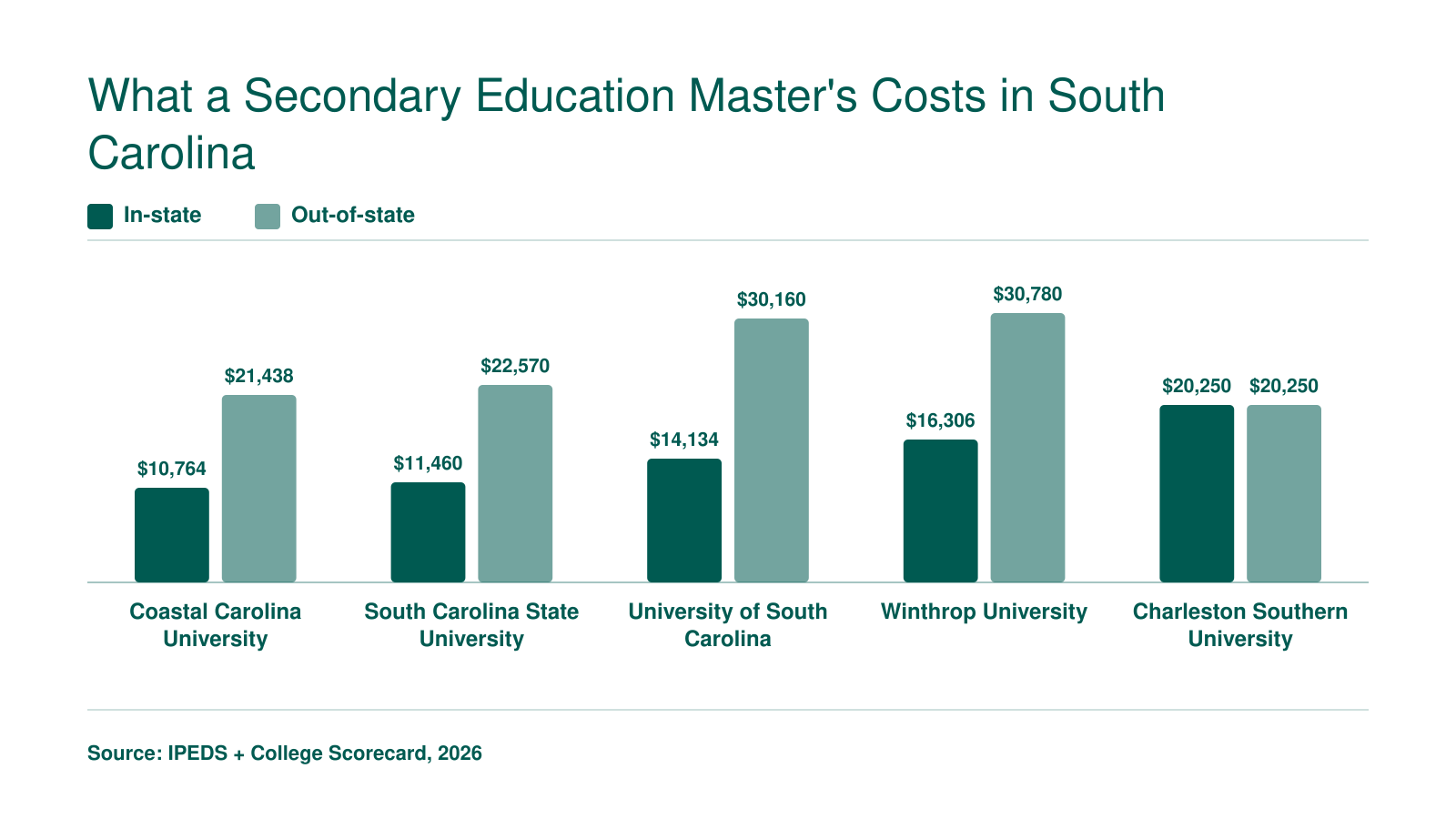
What a Secondary Education Master's Costs in South Carolina
Sticker price is only part of the cost picture. The chart below plots each program's published in-state and out-of-state graduate tuition, with the widest gap at the public universities. Private Charleston Southern charges one rate regardless of residency. Net price is an institution-wide average after aid, so treat it as approximate, and program-specific field or technology fees are not consistently published across these schools. Among the schools here, University of South Carolina's related M.Ed. in Teaching lists a Fall 2026 rate of $572.25 per credit and an estimated $18,863.50 total, though a secondary certification route may require 33-36 credits and separate fees.
The U.S. Department of Education's 2026-2027 Federal Student Aid handbook lets a graduate student receive up to $8,000 in TEACH Grants during a master's program, in exchange for four years of full-time teaching in a high-need field at a low-income school within eight years. Miss that obligation and the grant generally converts to a loan.
Getting Certified in South Carolina: Career-Changer and Licensed-Teacher Routes
A master's degree either advances your career or starts one, depending entirely on whether you already hold a license. Start there before choosing an affordable master's in secondary education program.
Career Changers Seeking Initial Certification
If you have never taught, a master's alone will not certify you in South Carolina. You need an approved educator-preparation program that recommends you in your subject field. From there, the South Carolina Department of Education requires passing the ETS Praxis Subject Assessment for your content area and the secondary-level Principles of Learning and Teaching (PLT) exam. A clinical internship or student teaching is part of the preparation, and you apply through the My SC Educator Portal with official transcripts, a College Recommendation Form, a cleared background check, and a $105 fee.
Already-Licensed Teachers
If you hold a valid license, an M.Ed. adds no new initial credential, but it can move you up the state salary schedule, which is the main reason many practicing teachers pursue a master's degree, such as a master's in curriculum and instruction South Carolina, for advancement rather than entry.
Alternative and Out-of-State Routes
Non-degree options exist. PACE is a three-year alternative route that lets you teach as teacher-of-record while completing a 10-day Institute, three approved college courses (graded B or better), and the Praxis Subject Assessment, provided a district employs you. Teachers moving from another state can seek reciprocity with a current, valid standard credential, which may waive South Carolina's assessments.
The decision line is simple: no license means an initial-certification MAT or M.T.; a current license means an M.Ed. for advancement.
Quick Answers on Secondary Education Master's Degrees in South Carolina
How long does a master's in secondary education take in South Carolina?
What separates an M.Ed., an M.T., and an MAT?
Do I need teaching experience to enroll?
When are application deadlines and cohort start dates?
Compare Secondary Education programs on the data that matters
Explore more Education & Teaching specializations or browse every graduate field.
All Education & Teaching programs