Master's in Secondary Education Programs With No GRE Required
Compare 430+ accredited no-gre Secondary Education programs at 290+ schools, with graduate earnings, cost, debt, and completion data from IPEDS and the U.S. College Scorecard.

The programs ranked here require 30 to 42 credits. Adding months of GRE prep is a hard sell for teachers already juggling lesson plans and grading.
Many secondary education master's programs, including accelerated secondary education master's programs, have dropped the test, but policies vary. Xavier University waives the GRE only for applicants who already hold a teaching license, while Lehigh University lists it as optional.
Cost and licensure matter more than admissions. A no-GRE online degree pays off only if its credential is recognized in the state where you teach.
Key Points
- Most secondary education master's programs waive the GRE in 2027.
- Ranking weighs retention, completion, institutional quality, cost, and earnings.
- Your licensure status determines whether you choose an initial certification MAT.
Top No-GRE Master's in Secondary Education Programs
These master's in secondary education programs are selected for their no-GRE or test-optional admission paths, then ordered by a composite of retention, completion, and institutional quality, with moderate weight on cost and earnings. Delivery formats vary from fully online and hybrid to campus-based, and some programs require licensure-specific exams such as Praxis or MTEL even when the GRE is waived. Because policies can differ by concentration or applicant status, check each program's admissions page before applying.
The University of Texas at Austin
#1Austin, TX · ~$12,000/yr (est.)
Best for: Texas certification seekers wanting urban placements
The University of Texas at Austin offers campus-based secondary education master's programs that lead to Texas teacher certification, with concentrations in English language arts and social studies. The programs are set in urban schools and include ESL endorsement options and extensive field experience. The school's graduation rate is 89%.
- 42 total credit hours in a two-year full-time campus program
- Leads to Texas teaching certificate and ESL endorsement
- No GRE required for admission
- Focused on grades 7-12 in diverse urban schools
- Includes student teaching and electives outside the department
- 36 total credit hours in a one-year full-time calendar-year format
- Prepares for Texas teacher certification and social studies secondary endorsement
- Test-optional admission; no GRE required
- Summer start with priority deadline December 15
- Extensive urban field experience
University of Central Florida
#2Orlando, FL · ~$9,000/yr (est.)
Best for: Certified science teachers advancing online
The University of Central Florida offers an online MEd in Secondary Education with a science education concentration designed for certified teachers who want to move into coaching or district leadership. The program uses a cohort model and offers three start dates per year, with no GRE required. The school's graduation rate is 78%.
- Fully online program with three start dates per year
- 33-36 credit hours tailored to certified teachers
- No GRE required; test-optional admission
- Cohort-based structure with UCF Online Success Coaching
- Focus on space and physical science, data-driven decision-making, and teacher leadership
Lehigh University
#3Bethlehem, PA · ~$29,000/yr (est.)
Best for: Lehigh undergraduates accelerating into secondary teaching
Lehigh University's 4+1 accelerated master's in secondary education lets undergraduate students earn a bachelor's and MEd in five years while completing Pennsylvania teacher certification for grades 7-12. Students can choose from eight concentration options and complete the graduate portion in one additional year. The school's graduation rate is 88%.
- 30 total credit hours in one additional year
- No GRE required; test-optional admission
- Pennsylvania teacher certification for grades 7-12
- Eight concentration options available
- 3.0 GPA minimum; conditional admission with 2.75
- Fieldwork in local classrooms culminating in student teaching semester
- Transfer up to 6 undergraduate credits
Colorado State University-Fort Collins
#4Fort Collins, CO · ~$14,000/yr (est.)
Colorado State University offers a campus-based MEd with secondary teacher licensure concentration that uses a Professional Development School model, placing students in local classrooms from day one. The one-year, 41-credit program prepares career changers and recent graduates for Colorado licensure, with no GRE required and rolling admissions. The school's graduation rate is 67%.
- 41 total credit hours; complete in as little as 12 months
- $650 per credit with rolling admissions
- No GRE required for admission
- Professional Development School model with 15 weeks of student teaching internships
- Prepares for Colorado teacher licensure and Praxis
- Cohort-based structure; enter with a bachelor's degree in a content area
University of Colorado Boulder
#5Boulder, CO · $15,000 – $20,000/yr (est.)
The University of Colorado Boulder offers an intensive one-year MA plus teacher licensure program for secondary English, social studies, mathematics, science, or music. The campus-based program grounds coursework in equity and justice, includes student teaching, and leads to Colorado secondary licensure. The school's graduation rate is 74%.
- 33 total credit hours in a one-year immersive sequence
- Test-optional admission
- Equity and justice focused curriculum
- Small group faculty interview required
- Prepares for Praxis Subject Assessment and Colorado secondary licensure
- Summer start; 3.0 GPA and three recommendation letters
- Math or science concentration with summer start
- 33 total credit hours in a one-year program
- No GRE required for admission
- Prepares for Praxis and Colorado secondary licensure
- Content area coursework required; student teaching in spring
- 3.0 GPA minimum and three letters of recommendation
University of Massachusetts-Boston
#6Boston, MA · ~$20,000/yr (est.)
UMass Boston offers a Middle/Secondary Education MEd that prepares candidates for initial licensure in grades 5-12 through immersive placements in Boston Public Schools. The 37-credit program can be completed full-time in about one year plus a summer, or part-time over two to three years. The school's graduation rate is 49%.
- 37 total credit hours; full-time in one year plus summer, or part-time over 2-3 years
- No entrance exam required; test-optional admission
- Prepares for initial licensure in middle and high school classrooms
- Hands-on placements in Boston Public Schools with job search support
- Teach Next Year residency and COSMIC STEM teaching options
- Second license in special education or ESL available
- Starts fall, spring, and summer
Merrimack College
#7North Andover, MA · ~$37,000/yr (est.)
Merrimack College offers an MEd in Middle School (5-8) and High School (8-12) Education with online, hybrid, and campus course options and six start dates per year. The 36-credit program includes a 450-hour student teaching practicum and prepares candidates for Massachusetts initial licensure. Applicants are not required to submit GRE or GMAT scores. The school's graduation rate is 70%.
- 36 total credit hours; complete in as few as 13 months full-time or 2-3 years part-time
- No GRE or GMAT required; test-optional admission
- 450-hour student teaching practicum plus three pre-practicum observation experiences
- Online or on-campus course options with six start dates per year
- Prepares for Massachusetts Initial licensure and MTEL
- $620 per credit; employer tuition reimbursement supported
- Biology (8-12) concentration for Massachusetts licensure
- 450-hour student teaching practicum in biology classrooms
- DESE accredited program path
- Test-optional admission; no GRE or GMAT required
- MTEL prep support built in
Xavier University
#8Cincinnati, OH · ~$19,000/yr (est.)
Xavier University's Master of Education in Secondary Education includes a multi-age PreK-12 concentration and blends online coursework with in-person experiences. The 30-credit program offers rolling admissions with summer, fall, and spring starts, and includes a full semester of supervised student teaching in over 50 partner schools. GRE or other test scores may be waived for licensed teachers and several other candidate categories. The school's graduation rate is 69%.
- 30 total credit hours with rolling admissions
- $674 per credit
- No GRE required for licensed teachers; test waiver categories available
- Blended online and in-person coursework
- 99% licensure exam pass rate
- Six multi-age concentration fields available
- Full-semester supervised student teaching in 50+ partner schools
University of Phoenix-Arizona
#9Phoenix, AZ · $15,000 – $20,000/yr (est.)
University of Phoenix offers a Master of Arts in Education with a Secondary Teacher Education concentration for adults who hold a bachelor's degree but have no prior teaching background. The hybrid program includes asynchronous online classes along with clinical field experience and student teaching, and is designed to prepare candidates for initial secondary licensure. Admission is open, with no GRE or GMAT required and a minimum 2.5 GPA. The school's graduation rate is 21%.
- 39 total credit hours; asynchronous online classes with in-person clinicals
- No GRE or GMAT required; open-admissions policy
- 2.5 cumulative GPA minimum; no essay required
- 100 clinical hours plus field experience and student teaching
- Fully online or hybrid options with locked tuition rate
- $540 per credit; military benefits and employer reimbursement supported
None of the ranked Secondary Education programs match the no-gre lens yet. The full ranking is at the link above.
Cost, debt & payoff
Median earnings of this field's master's graduates (4 yrs after completing) vs. their median federal loan debt · U.S. College Scorecard
Across these programs the median graduate earns about $58,845 and finishes with roughly $30,750 in debt — a ratio that clears a common rule of thumb (keep debt below first-year salary). Tuition and debt vary widely school to school, so check the per-school figures in the table above before you shortlist.
Does a Master's in Secondary Education Require the GRE?
Skipping the GRE saves time and money for No-GRE master's programs, but it shifts the weight onto your transcript and your classroom record. Most secondary education master's programs no longer ask for the test, especially MAT and M.Ed. With No GRE Required degrees built for working teachers.
Admissions offices typically look at:
- GPA: Minimums often fall around 2.75 to 3.0 for your undergraduate degree.
- Experience: A teaching license or classroom time can carry real weight.
- Content coursework: Prior credits in the subject you plan to teach.
- Writing and references: A statement of purpose and recommendation letters.
Watch for conditional waivers. Some schools are fully no-GRE, while others require scores only if your GPA falls below their cutoff. Read the fine print before assuming you're exempt.
State licensure exams such as the Praxis are a separate matter. Even with no GRE, you may still need those tests to earn certification in your state.
How We Ranked These No-GRE Secondary Education Programs
What makes one no-GRE secondary education program rank above another? Each school receives a composite score. Programs that waive or don't require the GRE earn an eligibility bonus. The rest of the score rests on student retention, completion, and overall institutional quality. Cost and graduate earnings count with moderate weight, so a cheap program with weak outcomes can't climb on master's in secondary education cost alone.
The inputs come from IPEDS and College Scorecard institution- and program-level data.
One limit matters. Graduation rates and net price are institution-wide averages, not program-specific figures. They cover many degrees and typical students, so they are not a quote for this master's. Confirm tuition, fees, and GRE-waiver terms with each admissions office before you apply.
Licensure vs. Non-Licensure Secondary Education Master's: Which Track Fits You
Your current licensure status should drive the choice. If you need an initial teaching credential, choose a state approved initial certification MAT, not a non-licensure degree. CAEP or AAQEP accreditation can support program quality, but it does not replace state educator preparation program approval.
| Track | Best for | Leads to a teaching license | Student teaching | Typical length |
|---|---|---|---|---|
| Initial certification MAT | Career changers with a bachelor's degree, often outside education, who want an initial teaching credential | Yes, in a state approved program; one example allows graduates to apply for an initial Kansas license, subject to required exams | Required; full time in a classroom setting | 12 to 24 months |
| Advanced licensure MEd | Already licensed teachers or those who completed teacher preparation and want an additional or advanced state licensure pathway | Potentially, only when the specific licensure program has final state recognition; state boards determine recognition | Varies by state and licensure pathway; no uniform requirement is established | No single typical length is established |
| Non-licensure secondary education master's | Students who want graduate study in secondary education without relying on the degree as a licensure pathway | No; it does not by itself satisfy state approval requirements for licensure leading programs | Typically not required as a licensure component | No single typical length is established |
Related Articles
Graduate Tuition at the Most Affordable No-GRE Programs
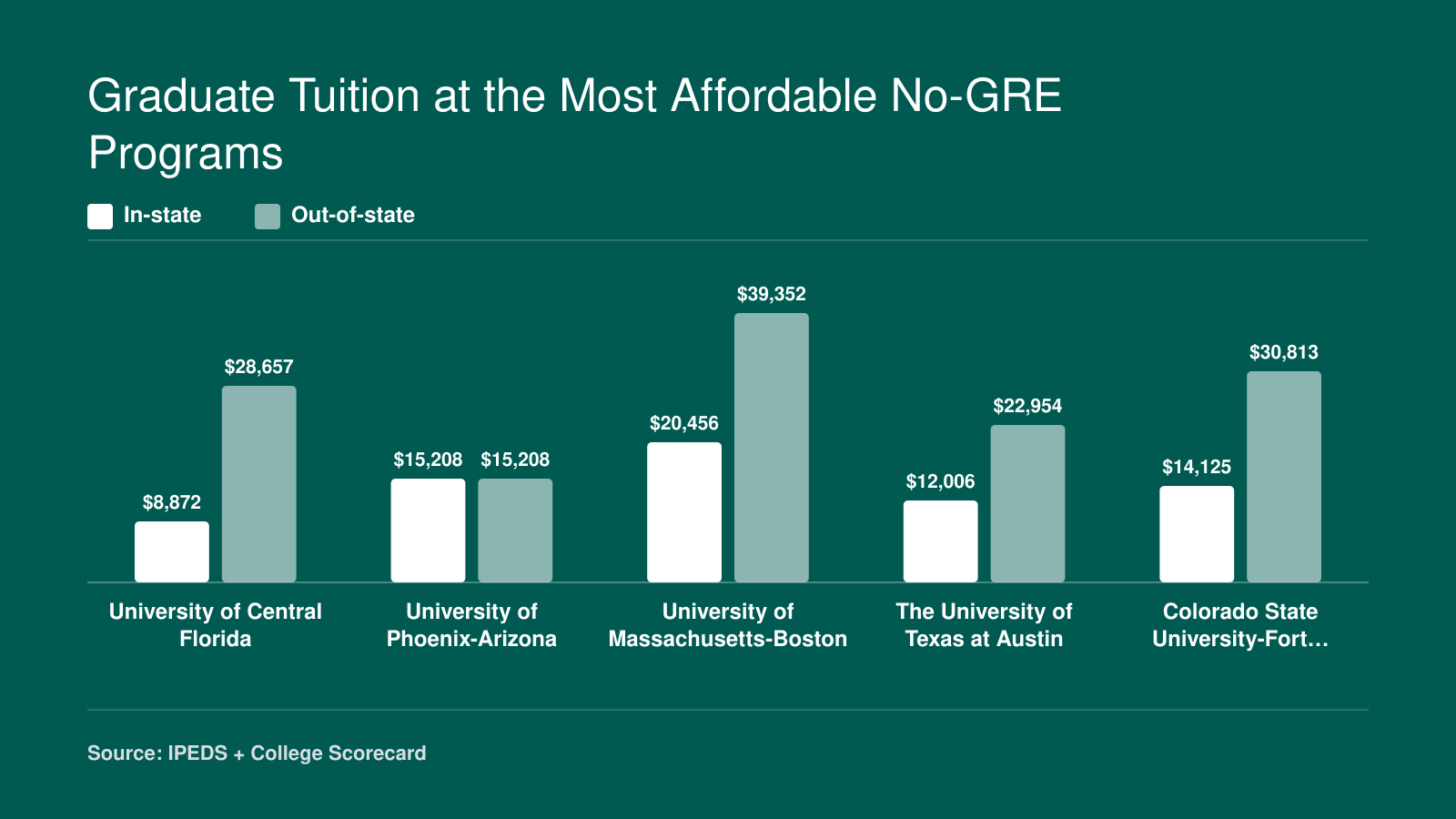
Tuition varies widely even among programs that do not require the GRE. The chart below compares published in-state and out-of-state graduate tuition at the lowest-cost schools on this list. These are sticker tuition figures, not personal costs: each school's net price is an institution-wide average after grants and scholarships, not a quote for this program. Graduate students can also pursue the federal TEACH Grant (up to $4,000 per year and $8,000 total in exchange for four years of full-time teaching in a high-need field at a qualifying school) and teacher loan forgiveness programs such as Teacher Loan Forgiveness and Public Service Loan Forgiveness.
In 2019-20, 90.6 percent of teacher-preparation program completers nationally passed their teaching-credential assessments, according to the U.S. Department of Education's Title II report. That strong pass rate underscores why secondary teaching remains a viable path for career-focused graduate students.
Secondary Education programs by state
FAQs About No-GRE Master's in Secondary Education Programs
Can I get a master's in secondary education online without the GRE?
How long does a master's in secondary education take without a GRE?
Which states accept a no-GRE secondary education master's for teacher certification?
What jobs can you get with a master's in secondary education beyond classroom teaching?
Compare Secondary Education programs on the data that matters
Explore more Education & Teaching specializations or browse every graduate field.
All Education & Teaching programs