Best Master's in Secondary Education Programs in Ohio
Compare 14 accredited Secondary Education programs in Ohio at 7 schools, with graduate earnings, cost, debt, and completion data from IPEDS and the U.S. College Scorecard.

Program length in Ohio swings from 30 credit hours at Xavier University to 54 at the University of Cincinnati, and the gap partly reflects whether the degree must also deliver a teaching license. Career changers in Master of Arts in Teaching Programs in Ohio need that initial 7-12 license, with its coursework and student teaching. Already-licensed teachers can skip it and aim at the salary schedule.
The programs here span campus, online, and hybrid formats, from Cleveland State and Toledo to Wright State. Total cost and time to completion follow from which path you're on, not from sticker tuition.
Key Points
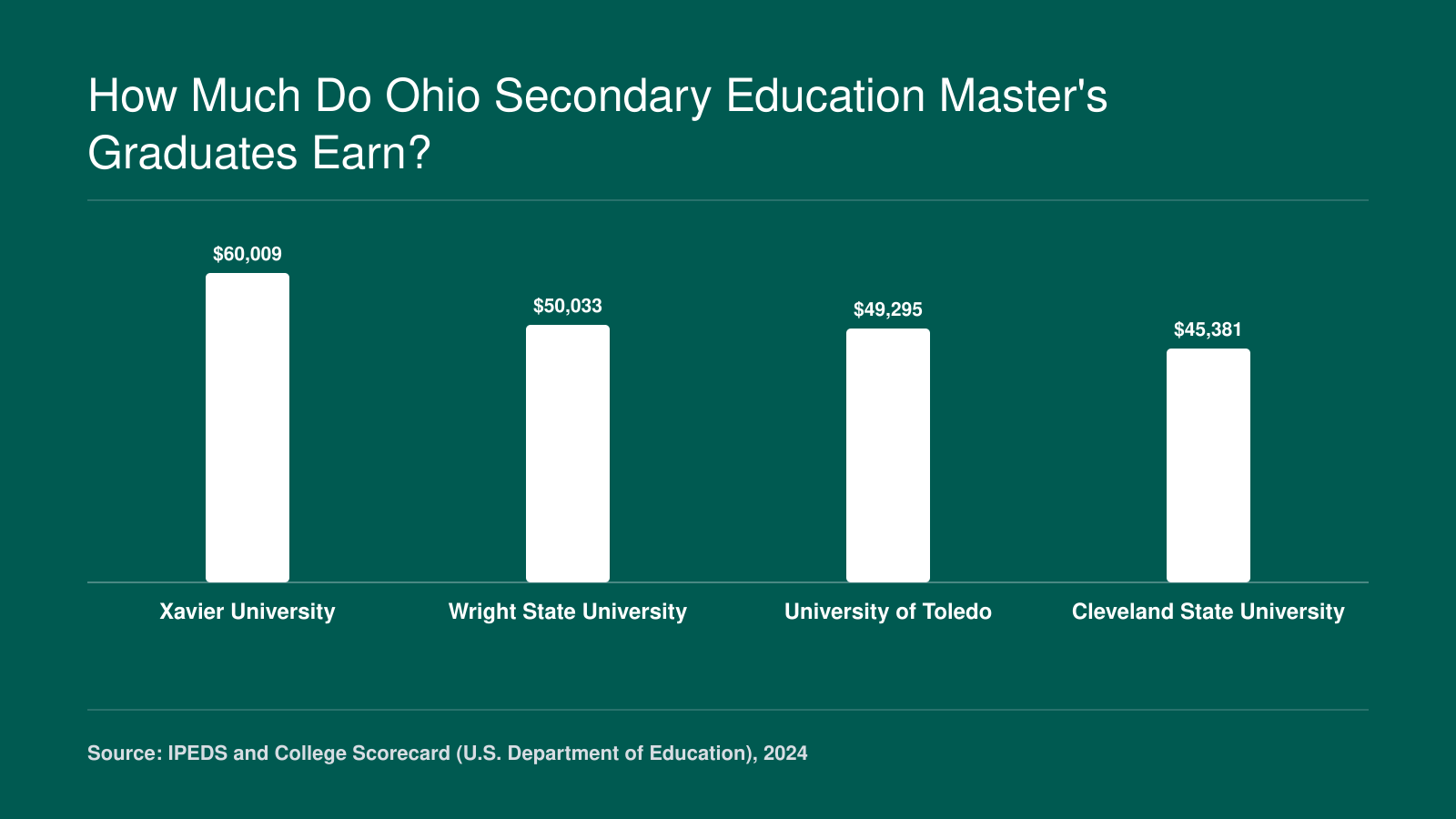
- Five-year program earnings vary by about $14,600 across these Ohio schools.
- Median program debt starts at $25,500 at Wright State University.
- Cincinnati, Toledo, and Xavier document CAEP accreditation; confirm it for the others.
Best Master's in Secondary Education Programs in Ohio: Top 10 Picks
Five Ohio universities make up this list, and together they offer 12 distinct secondary education master's listings. Several schools appear with more than one concentration, so each program is named separately below. Graduation rates cited are the university's overall rates, not program-level results.
University of Cincinnati
#1Cincinnati, OH · ~$15,000/yr (est.)
Best for: Full-time students wanting on-campus cohorts
The University of Cincinnati offers a full-time, on-campus cohort route to Ohio initial licensure for grades 7-12 through its Master of Education in Curriculum and Instruction. Students choose a secondary education concentration or a specific content track such as English language arts or integrated mathematics. Coordinators arrange clinical placements in partner schools, so students do not have to find their own. Graduate assistantships and scholarships are listed for eligible students.
- Four-semester, 54-credit cohort program on the main campus
- Leads to Ohio initial teaching license for grades 7-12
- Four concentration options across content areas
- GRE listed as required, with a condensed three-semester option for Math and Science
- 2.8 GPA minimum and three recommendation letters
- Graduate assistantships and scholarships available
- Four-semester, 54-credit program with a fall start
- Ohio teaching license in grades 7-12
- Two-step admissions with a December 15 fall deadline
- GRE required if undergraduate GPA is below 3.0
- Content prerequisite coursework required
- Clinical field experiences in Ohio schools
- Four-semester, 54-credit program starting fall or summer
- Clinical placements arranged by program coordinators
- Background checks and good moral standing required
- Graduate assistantships and a University Graduate Scholarship listed
- Two-step admissions process
- 2.8 GPA minimum and prerequisite courses
Xavier University
#2Cincinnati, OH · ~$19,000/yr (est.)
Best for: Working teachers needing blended flexibility
Xavier University's 30-credit Master of Education in Secondary Education blends online coursework with in-person classes and supports full-time or part-time study. Three pathways serve career changers, licensure seekers and practicing teachers, and a full semester of supervised student teaching runs through more than 50 partner schools. Rolling admissions with summer, fall and spring starts suit working professionals.
- 30 credits at $674 per credit
- Licensure concentrations in 13 fields
- Blended online and in-person format
- Rolling admissions with three start terms a year
- GRE listed, but optional for licensed teachers
- Full semester of supervised student teaching
- 99% licensure pass rate reported by the program
- Seven concentration options within the grades 7-12 track
- X-Alt pathway for career changers
- Test waiver option for qualified applicants
- Non-licensure option for practicing teachers
- Catholic school tuition rate available
- Full-time and part-time study
- Licensure concentrations in six Multi-Age fields
- No GRE required for licensed teachers
- Starts summer, fall or spring
- Blended online and in-person courses
- Partnerships with over 50 local schools
Cleveland State University
#3Cleveland, OH · ~$11,000/yr (est.)
Best for: Aspiring urban teachers earning while training
Cleveland State University's Master of Urban Secondary Teaching (MUST) Residency Program is an accelerated hybrid route to a master's degree and a teaching license, built around work in urban schools. A nine-month school residency and a 16-week student teaching placement anchor the cohort model. A paid residency option lets participants earn income while training.
- 12-month hybrid program with a single summer start
- Concentrations in math, science, social studies, English and world languages
- Nine-month school-based residency plus 16-week student teaching
- Paid residency option through Teach, Earn, and Learn
- Reports a 93% job placement rate
- Focus on urban education in a cohort learning community
- Special education track within the same 12-month residency model
- Rolling admissions with one summer start a year
- Prerequisite courses required
- Mentor teacher guidance, seminars and coaching
- Paid residency available through the TEL option
University of Toledo
#4Toledo, OH · $18,000 – $29,000/yr (est.)
The University of Toledo pairs a Master of Education in Secondary Education with an initial Ohio license for grades 7-12. Courses combine on-campus, online and field-based formats, and the university reports relationships with more than 180 Toledo-area partner schools. Concentrations cover foreign language, language arts, math, science and social studies, and a dual intervention specialist license is possible.
- 31 credit hours with a capstone seminar
- Initial Ohio license for grades 7-12
- World language licensure for PreK-12 available
- Dual intervention specialist license option
- Practicum and internship in PK-12 schools
- OAE tests and edTPA required for licensure
- Selective admissions, one recommendation and a 2.7 GPA preferred
Wright State University
#5Dayton, OH · ~$16,000/yr (est.)
Wright State University in Dayton offers a campus-based Master of Education and Licensure in Adolescent to Young Adult Education for grades 7-12. Its defining feature is a year-long student teaching internship alongside a mentor teacher, with placements across nine local school districts. The program reports a 97% licensure exam pass rate and lists CAEP accreditation.
- Prepares for the Ohio Resident Educator license
- Year-long student teaching internship
- Four licensure areas offered
- 2.7 GPA minimum and prerequisite courses
- Lists CAEP accreditation
- 97% licensure pass rate reported by the program
- Field placements in urban, rural and suburban schools
- Year-long student teaching internship
- Partnership with nine local school districts
- Clinical faculty provide feedback
- 2.7 GPA minimum
- Prepares candidates for Ohio licensure exams
- Year-long internship in diverse school settings
- Collaboration with nine local school districts
- Prerequisite courses required
- Eligible for the Ohio Resident Educator license
Cost & outcomes by school
Federal data for the highest-earning Secondary Education programs, independent of the ranking above. Earnings are this field's master's graduates four years after completing, where the Scorecard reports them.
| School | Earnings | Tuition / yr | Debt | Grads/yr | Format |
|---|---|---|---|---|---|
| Xavier University OH | $57,072 | $19,218 | $27,220 | 57 | Campus |
| Cleveland State University OH | $51,198 | $11,297 | $43,024 | 22 | Hybrid |
| John Carroll University OH | $50,614 | $15,782 | — | 19 | Hybrid |
| University of Toledo OH | $50,005 | $17,605 | $30,451 | 15 | Hybrid |
| Wright State University OH | $48,735 | $15,771 | $25,500 | 4 | Campus |
| Ohio State University OH | — | $13,901 | — | — | Campus |
| University of Cincinnati OH | — | $14,902 | — | — | Campus |
Sources: U.S. Department of Education. Tuition and graduates: IPEDS. Earnings and debt: College Scorecard, this field's master's graduates; a dash means no figure is reported.
Cost, debt & payoff
Median earnings of this field's master's graduates (4 yrs after completing) vs. their median federal loan debt · U.S. College Scorecard
Across these programs the median graduate earns about $50,906 and finishes with roughly $27,220 in debt — a ratio that clears a common rule of thumb (keep debt below first-year salary). Tuition and debt vary widely school to school, so check the per-school figures in the table above before you shortlist.
Our Scoring Approach for Ohio Secondary Education Master's Programs
Every master's in secondary education program on this list earned its spot on outcomes and affordability, not brand name. The inputs come from public data: graduate tuition and fees, average net price, institution-wide graduation rate, and College Scorecard program-level earnings and debt where those figures are published.
Two cautions apply. The graduation rate and the net price are university-wide, not program-specific, so read them as context rather than a guarantee. We also avoid inventing precise weights, since the inputs are not equally available for every school.
Campus, hybrid, and online Master's Programs in Ohio are scored together on one list. Format works as a filter you can apply later, not a penalty in the score.
Online and Hybrid Master's in Secondary Education Options in Ohio
Can you finish a master's in secondary education in Ohio entirely online? Based on the program pages, not really. University of Cincinnati and Wright State University are listed as campus programs, and Cincinnati calls its licensure track onsite. Xavier University blends online and in-person courses, University of Toledo lists on-campus, online, and field-based courses, and Cleveland State University's urban teaching residency is labeled hybrid.
The pages generally do not say whether online sessions meet live or on your own schedule, or whether campus visits are required, so ask admissions before you apply. Student teaching is always in person. Cincinnati's field placement runs three semesters in a local school, Cleveland State pairs a nine-month school residency with 16 weeks of student teaching, and Xavier cites partnerships with more than 50 local schools.
Subject areas vary by school. Xavier offers chemistry, English language arts, integrated mathematics, integrated science, integrated social studies, life science, and physics, areas often compared in the best Master's in STEM Education Programs in Ohio, plus multi-age French, German, Spanish, music, theater, and visual art. Toledo covers English, math, science, social studies, and Chinese, French, German, or Spanish. The pages do not flag which concentrations are available online.
If you live outside Ohio, confirm that the program can arrange a placement in your state and that it supports Ohio licensure.
Related Articles
Which Ohio Master's in Secondary Education Programs Waive the GRE?
Most Ohio education master's programs now operate as No-GRE master's programs, screening applicants by reviewing academic records rather than requiring an entrance exam. The exam has largely fallen out of favor, with admissions instead weighing an undergraduate GPA (commonly 3.0 or higher), a statement of purpose, letters of reference, and a background check. Many programs also expect progress toward the relevant Ohio content exam for licensure.
Because published policies vary by school, here is what we can and cannot confirm for the programs ranked here:
- University of Cincinnati: No published policy. Check the current admissions page before applying.
- Xavier University: No published policy.
- Cleveland State University: No published policy.
- University of Toledo: No published policy.
- Wright State University: No published policy.
Where a school lists no exam requirement, confirm directly with the program, since policies change by term and track. Do not assume a waiver until you see it in writing.
Ohio Teaching License and CAEP Accreditation Basics
How Much Do Ohio Secondary Education Master's Graduates Earn?
These figures are median earnings for graduates of each school's own secondary education master's program, measured five years after finishing. The gap between the top and bottom schools is about $14,600. Median program debt runs from $25,500 at Wright State University to $43,024 at Cleveland State University, so the lowest earnings figure here sits alongside the highest debt.
For career changers, total cost and timeline depend less on sticker tuition than on whether the program builds in the licensure coursework and clinical placement you still need.
Compare Secondary Education programs on the data that matters
Explore more Education & Teaching specializations or browse every graduate field.
All Education & Teaching programs