Best Master's in Secondary Education Programs in Texas
Compare 14 accredited Secondary Education programs in Texas at 13 schools, with graduate earnings, cost, debt, and completion data from IPEDS and the U.S. College Scorecard.
A career changer walking in with a biology degree and no classroom experience needs a different Texas master's than a third-year algebra teacher chasing a pay bump. The first path bundles initial certification and clinical teaching into the degree; the second treats the master's as a skills-and-salary step for someone already licensed.
In-state graduate tuition across the programs ranked here runs from $7,179 at Texas A&M University-Corpus Christi to $25,862 at Dallas Baptist University, a wide enough spread to reshape the math on any degree. Texas sets the floor either way: a TEA-approved preparation program plus passing TExES scores.
Key Points
- Texas A&M University-Corpus Christi has the lowest in-state graduate tuition and fees, at $7,179.
- Texas State University's online M.Ed. in Secondary Education lists total program tuition of $15,060.
- Texas certification still requires TExES content and PPR exams, whatever master's program you choose.
Top-Ranked Texas Master's in Secondary Education Programs for 2027
Each program below earned its spot on what Texas students actually pay, what graduates go on to earn, and how many finish. The roster mixes campus, online, and hybrid options, and several programs lead to Texas teacher certification as part of the degree. We could not verify current CAEP or TEA approval status for every school listed here, so confirm each program's standing on the TEA approved educator preparation list before you apply.
The University of Texas at Austin
#1Austin, TX · ~$12,000/yr (est.)
Best for: Aspiring English teachers in urban schools
UT Austin pairs a high institution-wide graduation rate (about 89% of students graduate) with two secondary tracks built around urban school placements. Both lead to Texas teacher certification and include an ESL endorsement. The university also appears on the state's approved teacher-residency provider list. We could not confirm its CAEP or TEA status from the sources reviewed, so check the TEA approved program list.
- Two-year, full-time on-campus program, fall start only
- 42 credit hours covering grades 7-12 English and reading
- Earns a Texas teaching certificate and ESL endorsement
- No GRE required
- Urban school teaching focus with student teaching
- One-year, calendar-year program with a summer start
- 36 credit hours, full-time schedule
- Prepares for Texas teacher certification with ESL endorsement
- GRE test optional
- Priority deadline December 15, final deadline May 1
University of North Texas
#2Denton, TX · $9,000 – $16,000/yr (est.)
Best for: Non-education graduates choosing campus or online
UNT's Master of Education in Secondary Teaching is built for people whose bachelor's degrees are not in education. The 30-credit program is described as available on campus and online. About 61% of UNT students graduate institution-wide. UNT is also an approved Texas teacher-residency provider, though we could not verify its CAEP or TEA status from the sources reviewed.
- 30 credit hours, typically 1.5+ years
- Designed for holders of non-education bachelor's degrees
- Prepares for teaching in grades K-12, 6-12, or 4-12 by subject
- Covers classroom management, literacy, and diverse-learner curriculum
- Blends content expertise with secondary pedagogy
Houston Christian University
#3Houston, TX · ~$12,000/yr (est.)
Best for: Faith-based learners wanting 7-12 certification
Houston Christian University offers a private, on-campus route to 7-12 certification inside a Master of Education in Curriculum and Instruction. Field-based clinical teaching is built into the 36-credit plan. Graduates can also pursue curriculum specialist or community college teaching roles. About 49% of students graduate institution-wide, and we could not verify the program's CAEP or TEA status from the sources reviewed.
- 36 credit hours, on-campus format
- 7-12 teacher certification included
- Field-based clinical teaching in secondary schools
- Covers instructional design, technology integration, and curriculum evaluation
- Comprehensive exams required
Texas State University
#4San Marcos, TX · ~$9,000/yr (est.)
Texas State's online Master of Education in Secondary Education is aimed at working teachers who want to keep teaching full time. It is a 30-credit degree in eight-week terms, with a published total tuition of $15,060 ($502 per credit). About 55% of students graduate institution-wide. Texas State is also on the state's approved teacher-residency list, but we could not verify its CAEP or TEA status from the sources reviewed.
- 100% online, eight-week terms, as few as 12 months
- 30 credit hours: 21 core and 9 elective
- $15,060 total tuition at $502 per credit
- No GRE; minimum GPA listed at 2.75 to 2.8
- Electives in educational technology and gifted education
- Next deadline January 4, 2027, classes start January 19, 2027
Dallas Baptist University
#5Dallas, TX · ~$26,000/yr (est.)
Dallas Baptist University's Master of Education in Teaching offers 14 concentration options, with a 37-hour Secondary 7-12 Certification plan that includes clinical teaching or an internship. Applicants need 24 undergraduate content hours (12 upper-level) or a passing PACT score, and an entrance exam is listed. About 57% of students graduate institution-wide. We could not verify CAEP or TEA status from the sources reviewed.
- 37 credit hours, non-thesis professional degree
- Clinical teaching or internship counts as six graduate hours
- Prepares for TExES certification exams
- PACT can substitute for 24 content hours
- Admission to the Educator Preparation Program required first
- Defense of degree through a lesson plan presentation
East Texas A&M University
#6Commerce, TX · ~$7,000/yr (est.)
East Texas A&M in Commerce is the most affordable public option in this group on published in-state tuition. Its listing centers on dual-credit teacher credentialing, letting teachers apply 18 graduate hours in their teaching discipline toward the degree. About 43% of students graduate institution-wide. The sources reviewed give few program details, so confirm requirements and CAEP or TEA status with the university.
- Choice of M.Ed. or M.S. in Secondary Education
- 18 graduate content hours can count toward the degree
- Tied to the dual-credit teacher credentialing process
- Campus-based listing; confirm delivery options with the university
Texas A & M University-Corpus Christi
#7Corpus Christi, TX · ~$7,000/yr (est.)
Texas A&M University-Corpus Christi combines a master's degree with initial Texas teacher certification, with required courses offered online and evening in-person options. Students can go fully online or hybrid. About 40% of students graduate institution-wide. We could not verify CAEP or TEA status from the sources reviewed.
- 36 to 42 credit hours, about two years
- Earns initial Texas certification for grades 7-12
- Fully online or hybrid, with evening in-person classes
- Two-semester, often-paid internship or one-semester clinical teaching
- Any bachelor's subject accepted; PACT scores required
- No prior teaching experience needed
Wayland Baptist University
#8Plainview, TX · ~$17,000/yr (est.)
Wayland Baptist University in Plainview offers a 36-hour Master of Education with an initial teacher certification track in secondary education. Its published institution-wide graduation rate is about 19%, the lowest in this group, so look closely at completion support before committing. We could not verify CAEP or TEA status from the sources reviewed.
- 36 credit hours: professional core plus 18-hour specialization
- Secondary is one of three certification tracks
- 3.0 GPA in education courses; no grade below C counts
- Up to 12 certification-only credits may apply, with approval
- Pass/fail comprehensive exam in the final term
Cost & outcomes by school
Federal data for the highest-earning Secondary Education programs, independent of the ranking above. Earnings are this field's master's graduates four years after completing, where the Scorecard reports them.
| School | Earnings | Tuition / yr | Debt | Grads/yr | Format |
|---|---|---|---|---|---|
| East Texas A&M University TX | $66,508 | $7,338 | $27,346 | 11 | Campus |
| Texas State University TX | $54,565 | $8,997 | $30,824 | 76 | Online |
| Texas Southern University TX | — | $8,328 | — | — | Campus |
| Houston Christian University TX | — | $11,870 | — | — | Campus |
| Texas A & M University-Corpus Christi TX | — | $7,179 | $30,581 | 9 | Hybrid |
| Texas A&M University-Texarkana TX | — | $6,036 | — | 4 | Online |
| Texas A & M International University TX | — | $6,650 | — | — | Campus |
| Texas A&M University-Victoria TX | — | $8,315 | — | 14 | Campus |
| University of North Texas TX | — | $9,091 | — | 7 | Campus |
| Texas Christian University TX | — | $38,658 | — | — | Campus |
| The University of Texas at Austin TX | — | $12,006 | — | 5 | Campus |
| Wayland Baptist University TX | — | $16,580 | — | — | Campus |
Sources: U.S. Department of Education. Tuition and graduates: IPEDS. Earnings and debt: College Scorecard, this field's master's graduates; a dash means no figure is reported.
Online and Hybrid Master's in Secondary Education Options Across Texas
Distance delivery in Texas stops at the classroom door. Texas State University offers its M.Ed. in Secondary Education fully online, and Texas A&M University-Corpus Christi runs a hybrid format with evening in-person classes and an online option; the other master's programs in Texas ranked here are campus-based.
Wherever the coursework happens, field experience must be completed in person in a PreK-12 school under state rules. The preparation program arranges or approves the placement, typically in a Texas public district, an authorized charter, a DoDEA school, or an accredited private school, often in your own district or one the university partners with.
Clinical teaching under 19 Tex. Admin. Code § 228.63 requires at least 490 clock hours, with a minimum of 280 in the subject and grade band you are seeking, under a trained cooperating teacher. Many programs schedule that as roughly 14 weeks or a full semester. Candidates on an alternative route may instead complete a paid internship of at least one full school year.
Before enrolling, ask whether the program places candidates outside its home region.
Related Articles
Which Ranked Texas Master's Programs Drop or Waive the GRE
Texas State University's M.Ed. in Secondary Education, one of the Education & Teaching master's programs, does not require the GRE and is among the master's programs with no GRE required; the published minimum is a 2.75 overall GPA or 2.75 in the last 60 hours. UT Austin's Curriculum and Instruction applicants no longer submit GRE scores; minimum GPA is 3.0.1 UT Arlington leaves the exam to individual programs; a waiver may be available for UT Arlington graduates with a 3.0 GPA, while the general graduate standard is a 3.5 GPA.2 Texas A&M University-San Antonio's published policy lists the GRE as required (minimum 146 current scale), with a 2.6 overall or 3.0 last-60-hours GPA.3 For University of North Texas, Houston Christian University, Dallas Baptist University, East Texas A&M University, Texas A&M University-Corpus Christi, and Wayland Baptist University, the admissions pages reviewed do not publish a clear GRE policy, so confirm directly.
In-State Graduate Tuition vs. Net Price at Ranked Texas Schools
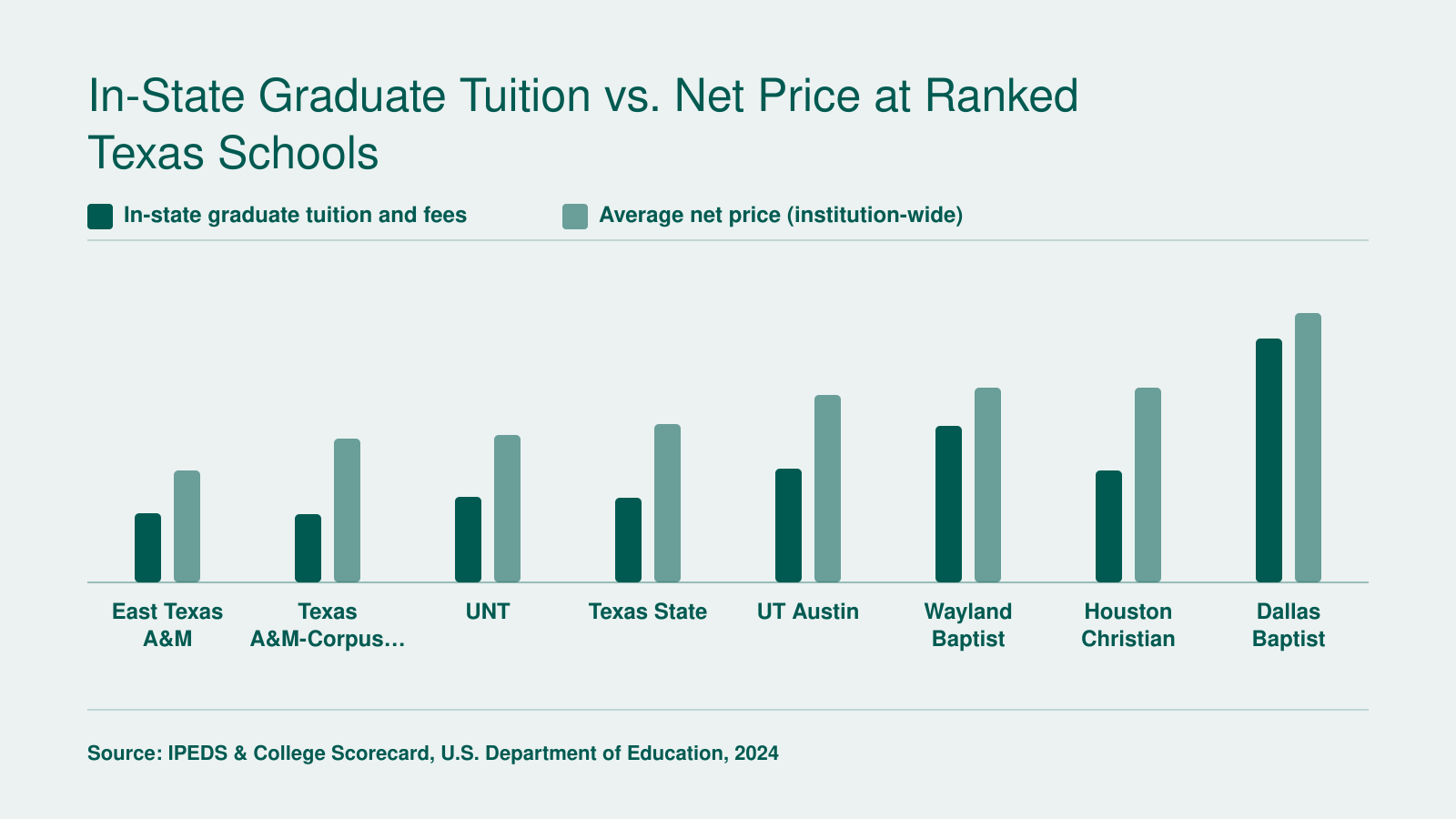
Texas A&M University-Corpus Christi has the lowest in-state graduate tuition and fees at $7,179, while Dallas Baptist University is the highest at $25,862, a spread of $18,683. East Texas A&M has the lowest net price at $11,841. Net price is an institution-wide average after aid and is not a quote for this specific degree.
Paying for a Master's in Secondary Education in Texas
The federal TEACH Grant is in transition: its award amount is tied to a sequestration reduction that applies to grants first paid before October 1, 2026. Confirm the current figure with your financial aid office.
Texas State University's online M.Ed. in Secondary Education lists $502 per credit, or $15,060 for 30 credits, paid by the course. The published schedule does not break out a campus rate or a full fee total, so ask for both before comparing it with campus programs.
The TEACH Grant offers up to $4,000 a year, or $3,772 after the reduction for grants first paid from October 2020 through September 2026.1 It requires four years of full-time teaching in a high-need field at a school serving low-income students.2 Confirm that your subject area qualifies. Teacher Loan Forgiveness is a separate federal option for eligible teachers.
Budget for certification too. Most TExES exams run $116, and content pedagogy exams run $120 to $140.3 The TEA application fee is $783, and fingerprinting is extra. Some UTRGV certification students also pay a $35 technology fee and $45 per semester. HB 2 fee waivers apply only to certain special education and bilingual candidates.
Graduate Earnings and Debt: Which Texas Programs Pay Off
Texas State University lists total program tuition of $15,060 for its online Master of Education in Secondary Education, and that is the most concrete money figure available for any program here. Program-level graduate earnings, median program debt, and estimated 10-year monthly payments are not yet published for the secondary education master's programs on this page. That means no school can honestly be crowned the earnings leader today, and we won't borrow institution-wide numbers to fill the gap. Those figures blend every graduate field and say little about what a classroom teacher takes home.
Until program-level data appears, price is the best predictor of how manageable your debt will be. Teacher salaries in Texas are set by district schedules, and a master's degree usually adds a modest bump. That makes a low-cost route the safer bet. Texas State's per-credit, pay-as-you-go online format lets you keep teaching full time while you borrow little or nothing. Public universities like UT Austin, UNT, and East Texas A&M are the other places to start, so compare each one's total program cost against your district's pay scale before you commit.
Texas Licensing at a Glance
Initial Certification or Career Advancement: Matching the Texas Program to Your Starting Point
Your starting point, not a school's reputation, decides which Texas master's track fits you.
- Career changers: This track fits people with a bachelor's degree who are not yet certified. Clinical teaching is required, at least 490 hours, with an assignment for each subject area you want certified. You must be admitted to an approved educator preparation program and receive its approval before registering for TExES exams. The outcome is a master's degree plus initial Texas certification. Texas State University, Texas A&M University-Corpus Christi (EC-12 or 7-12 options), and East Texas A&M University (post-baccalaureate alternative-certification route) all offer this.1
- Certified teachers seeking advancement: This track fits teachers who already hold a license. Clinical teaching would not apply, since you are already certified, and the outcome is a degree only. The program pages for Texas State and Texas A&M University-Corpus Christi describe certification routes and do not establish a separate advanced track, so confirm with admissions.
Stipend or salary-supplement potential is not published in the program materials, so ask each school directly.
Quick Answers on Texas Secondary Education Master's Degrees
Is a master's in secondary education required to teach in Texas?
Is a CAEP-accredited secondary education master's degree worth it?
Can a 1-year online master's in education lead to Texas teacher certification?
Compare Secondary Education programs on the data that matters
Explore more Education & Teaching specializations or browse every graduate field.
All Education & Teaching programs