Best Master's in Secondary Education Programs in Wisconsin
Compare 6 accredited Secondary Education programs in Wisconsin at 5 schools, with graduate earnings, cost, debt, and completion data from IPEDS and the U.S. College Scorecard.

A Wisconsin master's in secondary education serves two different people. The first has a bachelor's degree but no teaching license and needs an approved program that leads to initial middle or high school certification from the Department of Public Instruction. The second already teaches and wants a graduate degree, often a curriculum and instruction master's in Wisconsin, to deepen content knowledge and move up the salary schedule.
That split shapes everything, because an initial-license track requires a full student teaching semester that no amount of online coursework replaces. In-state graduate tuition across the campus and hybrid programs ranked here runs from roughly $9,000 to near $20,000 in the federal data, with the private schools carrying higher net prices than the public option.
Licensure testing and transcript review, not the GRE, now gate most admissions decisions.
Key Points
- Concordia University-Wisconsin offers a hybrid M.S. in Teaching and Learning with a secondary track.
- None of the schools here lists a GRE requirement on its program pages.
- UW-River Falls posts the lowest public tuition, while Edgewood and Concordia are private.
Wisconsin's Top-Ranked Master's in Secondary Education Programs
Each card below shows the city, delivery format, listed tuition and fees, and the share of students the school graduates overall. That graduation rate describes the whole institution, not this program. Net price figures are rough institution-wide averages after aid, so treat them as a starting point and confirm costs with each admissions office.
Concordia University-Wisconsin
#1Mequon, WI · ~$13,000/yr (est.)
Best for: Career changers needing mostly online licensure
Concordia University Wisconsin in Mequon delivers its secondary licensure master's through CAPTL, an accelerated, cohort-based format with three starts a year. Coursework is about 90% online with the remainder over Zoom, and a full-time student teaching semester is required. The school graduates about 68% of its students, and listed tuition and fees are $35,470 for in-state and out-of-state students alike. Average net price after aid is roughly $36,200, and the one-year employment share for program graduates is about 96%.
- Hybrid: about 90% online coursework, 10% via Zoom
- 34 credits including methods, disciplinary literacy and a capstone
- Full-time student teaching semester required
- Three start dates per year in a cohort model
- 3.0 cumulative GPA required, plus 3.0 in certification areas
- Some content areas require the Praxis II
- Leads to a Wisconsin license for grades 4-12
- Two other licensure tracks are offered: elementary and special education
University of Wisconsin-River Falls
#2River Falls, WI · $10,000 – $15,000/yr (est.)
Best for: Practicing math teachers deepening content expertise
UW-River Falls offers a math-focused secondary master's built for practicing teachers rather than career changers. Applicants are expected to hold math teacher certification and have teaching experience. The school graduates about 57% of its students. Listed tuition and fees are $9,008 in-state and $17,470 out-of-state, and Minnesota residents may qualify for reciprocity rates. Average net price after aid is roughly $14,100, the lowest of the three schools here. Program-level data show a median debt of about $31,300 and a one-year earnings median of about $47,000.
- On campus, with summer and Saturday or spring scheduling
- Research option (31 credits) or capstone option (34 credits)
- Prior teaching experience and a 2.8 GPA minimum required
- Coursework spans geometry, statistics, discrete math and calculus for educators
- Prepares teachers to lead AP courses and transcripted college courses
- Final oral exam with a faculty graduate committee
- Designed to be completed in about three years
- Minnesota reciprocity rates apply to this program
Edgewood University
#3Madison, WI · $15,000 – $20,000/yr (est.)
Best for: District employees seeking discounted licensure
Edgewood University in Madison pairs a Wisconsin teaching license with a Master of Arts in Education, and Secondary Education is one of eight licensing concentrations. Graduate study is described as available on campus or online. The school graduates about 60% of its students, listed tuition and fees are $35,860, and average net price after aid is roughly $26,100. Edgewood also publishes a reduced per-credit rate for employees of partner school districts, so check whether your employer participates. Program-level earnings and debt figures are not reported for this concentration.
- Secondary Education is one of eight licensing concentrations
- Combines a Wisconsin license and a master's degree
- Secondary licensure option covers grades 4-12
- On-campus or online graduate study is available
- Reduced per-credit rate for employees of partner districts
- Credit totals and entrance exams are not published on the program page
Cost & outcomes by school
Federal data for the highest-earning Secondary Education programs, independent of the ranking above. Earnings are this field's master's graduates four years after completing, where the Scorecard reports them.
| School | Earnings | Tuition / yr | Debt | Grads/yr | Format |
|---|---|---|---|---|---|
| Alverno College WI | $57,606 | $12,018 | $38,500 | 8 | Campus |
| University of Wisconsin-River Falls WI | $54,263 | $10,357 | $31,343 | 27 | Campus |
| University of Wisconsin-Madison WI | — | $12,325 | — | — | Campus |
| Concordia University-Wisconsin WI | — | $13,260 | $27,383 | — | Hybrid |
| Edgewood University WI | — | $19,656 | — | — | Campus |
Sources: U.S. Department of Education. Tuition and graduates: IPEDS. Earnings and debt: College Scorecard, this field's master's graduates; a dash means no figure is reported.
Cost, debt & payoff
Median earnings of this field's master's graduates (4 yrs after completing) vs. their median federal loan debt · U.S. College Scorecard
Across these programs the median graduate earns about $54,263 and finishes with roughly $31,343 in debt — a ratio that clears a common rule of thumb (keep debt below first-year salary). Tuition and debt vary widely school to school, so check the per-school figures in the table above before you shortlist.
Can You Earn a Master's in Secondary Education Online in Wisconsin?
Coursework for an online master's in secondary education can move online in Wisconsin, but the classroom part of becoming a secondary teacher cannot. Concordia University-Wisconsin comes closest to a remote option among online master's programs in Wisconsin. Its M.S. in Teaching and Learning (Secondary Education) is a hybrid program that runs about 90 percent online, with the rest delivered over Zoom, in 8-week courses totaling 34 credits. Plan on roughly two years for licensure alone and about six more months to finish the master's. Cohorts start three times a year, which helps career changers time their entry.
Even so, Concordia requires at least two pre-student-teaching field experiences and a full-time student teaching semester in a real school. A licensed cooperating teacher with at least three years of experience supervises it, and a background check comes first.
University of Wisconsin-River Falls runs its M.S.Ed. in Mathematics Education on campus. It is built for practicing math teachers with at least two years in the classroom, with summer and spring classes and a three-year path to completion.
Edgewood University is listed as a campus program, though its graduate admissions page also mentions online study. Confirm the format of the secondary concentration before applying.
Which Wisconsin Master's Programs Waive or Skip the GRE?
Admission to a master's in secondary education program in Wisconsin now turns more on your transcript and licensure testing than on the GRE. None of the programs we reviewed lists a GRE requirement on its admissions page, and none states a formal waiver policy, a common pattern for master's in secondary education programs with no GRE required.
- Concordia University-Wisconsin: No GRE policy is published. The licensure track requires a bachelor's degree, a 3.0 minimum GPA and an entrance exam, with Praxis testing built in. CUW staff evaluate your transcripts. The program has three start dates a year instead of one deadline.
- University of Wisconsin-River Falls: No GRE requirement is listed. The mathematics M.S.Ed. expects a 2.75 overall GPA or a 2.90 across your last 64 semester credits. You also need a current mathematics teaching certification, two years of teaching experience and a $56 application fee. No deadline is posted.1
- Edgewood University: The graduate admissions pages publish no GRE policy, GPA minimum or deadline for the licensing concentrations.
If you need an initial license, Concordia also requires field experience and a full-time student teaching semester. Before you apply, confirm the testing policy with each admissions office, because these rules can change from one cycle to the next.
Master's in Secondary Education Tuition in Wisconsin and the DPI License Each Program Leads To
Public tuition at UW-River Falls is the lowest of the three in the federal data, while Edgewood University and Concordia University-Wisconsin are private and carry higher average net prices. Federal tuition figures may not equal full program cost, so use the per-credit totals where a school publishes them. New completers of a state-approved program generally receive the Tier II provisional educator license. The main secondary band is middle/high school, grades 4-12 (early adolescence through adolescence, ages 10-21). Sources do not show separate online per-credit rates for these schools, so confirm any online pricing with admissions.
| School and program | Format | In-state graduate tuition | Out-of-state graduate tuition | Average net price | Per-credit rate and estimated program cost | DPI license outcome |
|---|---|---|---|---|---|---|
| University of Wisconsin-River Falls, Mathematics Secondary Education (MSE) | Campus | $10,357 | $20,312 | $14,054 | Not published in sources | Secondary math focus; license outcome not confirmed in sources |
| Edgewood University, MA in Education with Licensing Concentrations (Secondary Education) | Campus, with online graduate study available | $19,656 | $19,656 | $26,113 | Not published in sources | Licensing concentration in secondary education; subject area and grade range not stated |
| Concordia University-Wisconsin, MS in Teaching and Learning, Secondary (Grades 4-12) | Hybrid | $13,260 | $13,260 | $36,201 | $655 per credit, 34 credits, about $22,270 tuition only | Initial license for grades 4-12 (Tier II provisional route) |
What Wisconsin Secondary Education Master's Graduates Earn
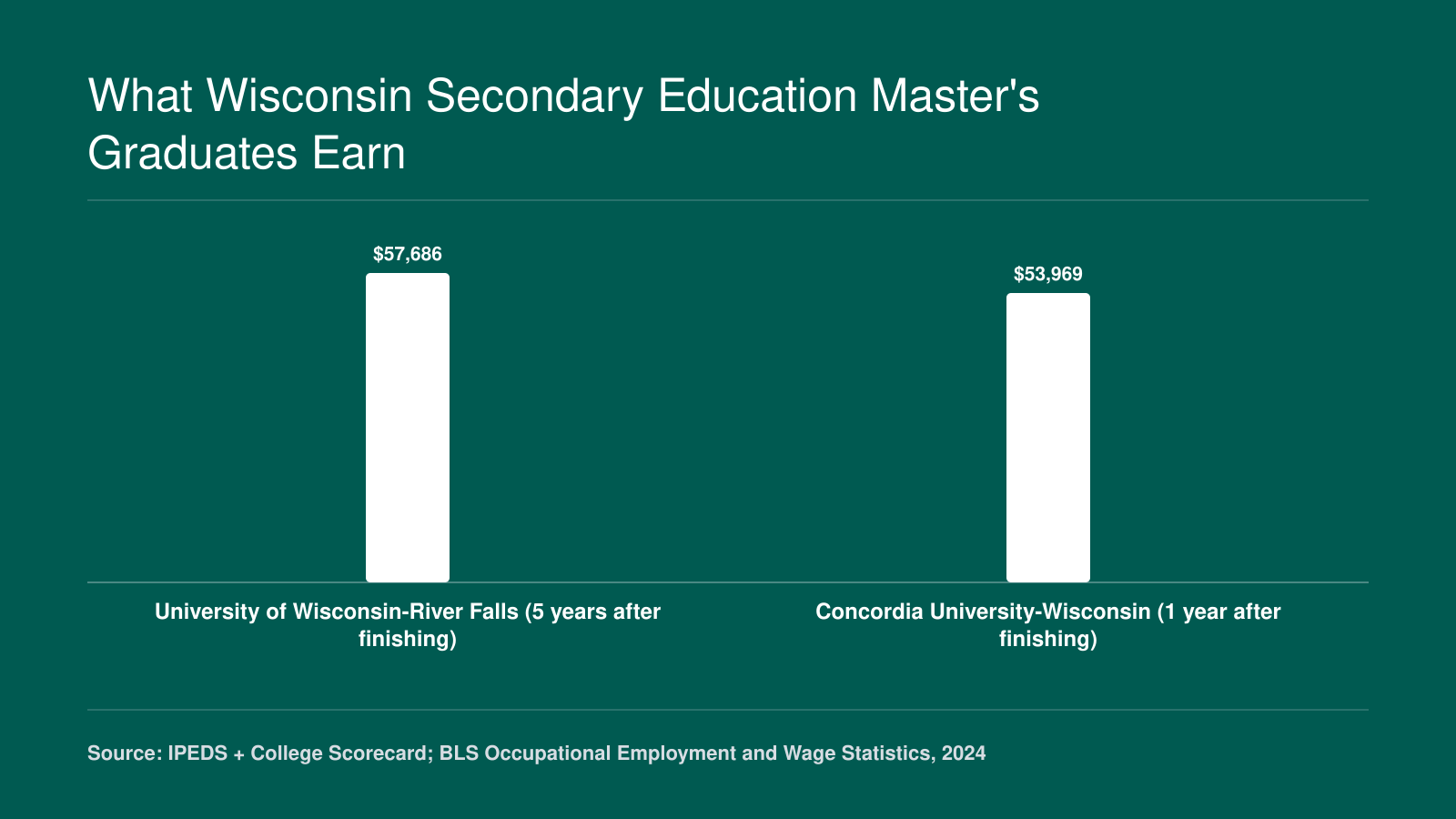
These bars show median earnings for completers of each school's secondary education master's program, and the measurement window differs by school, so read them as separate snapshots rather than a head-to-head. For context, the most recent BLS figure for all Wisconsin secondary school teachers (SOC 25-2031) is a median of $62,930 (May 2023). That number covers the whole occupation, including experienced teachers, not recent program completers. Median program debt was $31,343 at the University of Wisconsin-River Falls (about $357 a month over 10 years) and $27,383 at Concordia University-Wisconsin (about $311 a month). Concordia's figure rests on a very small group of completers.
Related Articles
How to Pick the Right Master's in Secondary Education Program in Wisconsin
The real decision here is not campus versus online, it is whether you need a license or already hold one. That single fact rules most of these programs in or out.
Start with your pathway
Career changers need a DPI-approved initial licensure route, often through Wisconsin DPI approved MAT programs. Concordia University-Wisconsin's Master of Science in Teaching & Learning grants initial secondary licensure and has staff evaluate your transcript to see how prior coursework maps on. Practicing teachers should look at advanced or content-focused degrees instead: Edgewood University's Master of Arts in Education with licensing concentrations requires a current Wisconsin DPI license to enroll.1 and the Mathematics Secondary Education master's at UW-River Falls expects teaching experience and deepens AP calculus and statistics content.
Match your subject and grade band
Grade range follows the specialization, not the degree title. At Concordia, English/language arts (#2300), science (#2600), and social studies (#2700) lead to grades 4-12, while mathematics (#1400) covers 6-12. Edgewood's secondary concentration sits at 4-12 and admits teachers licensed in a secondary content area, ESL, or a world language.1 Confirm the exact band before applying.
Weigh format, placement, and cost
Concordia runs most coursework online but still requires a full-time student teaching semester plus earlier field experience, so ask how placements near you are arranged. Then compare total cost against the earnings and debt figures above and the Most Affordable Master's in Secondary Education Programs, and request a transcript review first.
Quick Answers for Future Wisconsin Secondary Teachers
These answers cover the licensure, pay, and mobility questions that come up most for people planning a Wisconsin secondary teaching career. Rules and salary schedules change, so confirm details with the Department of Public Instruction (DPI) and your target district.
Which Wisconsin master's program fits career changers who need a first teaching license?
Does finishing a master's degree raise a Wisconsin teacher's pay?
Can I teach in a Wisconsin classroom while I finish my master's degree?
Will a Wisconsin secondary teaching license transfer to another state?
Compare Secondary Education programs on the data that matters
Explore more Education & Teaching specializations or browse every graduate field.
All Education & Teaching programs