Best Online Master's in Secondary Education Programs
Compare 210+ accredited online Secondary Education programs, with graduate earnings, cost, debt, and completion data from IPEDS and the U.S. College Scorecard.

Median earnings five years after finishing these online programs run from about $50,400 at the University of North Florida to $78,500 at Cal State Fullerton. That spread reflects two different students: career changers need a licensure track with local student teaching, while licensed teachers want a shorter degree for a salary bump. Every program here is fully online, with no hybrid or residency requirements; student teaching is the only in-person piece, done locally. The practical test is whether a program's licensure track matches your state's rules before enrolling.
Key Points
- Online tuition ranges from about $6,246 to roughly $29,774.
- In 2027, teaching licenses still issue state by state.
- Licensure-track programs add full-time classroom placements and take longer.
The 10 Best Fully Online Master's in Secondary Education Programs
All 10 programs below are fully online, and hybrid or in-person options were excluded from consideration. Each entry highlights the program's structure, concentrations, licensure pathways, and support features so you can compare the practical fit for your teaching career.
University of Georgia
#1Athens, GA · ~$11,000/yr (est.)
Best for: Certified math and science teachers
University of Georgia offers two fully online Master of Education tracks for certified secondary teachers: one in mathematics education and one in science education. Both emphasize research-based instruction and advanced content knowledge, with cohort and flexible scheduling options. Graduates can upgrade Georgia teaching certification to T5.
- 2-year program with 33 total credit hours
- Part-time scheduling available
- Summer and fall cohort start dates
- Designed for certified secondary math teachers
- Leads to Georgia T5 certification upgrade
- Capstone research project required
- $15,372 total program tuition
- 36 total credit hours, full-time or part-time
- Three start dates per year, no fixed cohort
- Designed for certified secondary science teachers
- Focus on Next Generation Science Standards
- All graduate coursework available online
University of Central Florida
#2Orlando, FL · ~$9,000/yr (est.)
Best for: Certified science teachers seeking leadership
University of Central Florida's online Master of Education in Secondary Education focuses on science education for certified teachers. The program uses a cohort model, requires no GRE, and offers three start dates per year. UCF Online provides success coaching and prepares graduates for roles as district science leads or high school teachers.
- Science Education concentration
- No entrance exam required, test optional
- Three start dates per year
- 33-36 credit hours, cohort-based structure
- Designed for certified teachers
- Online Success Coaching team support
California State University-Fullerton
#3Fullerton, CA · $9,000 – $19,000/yr (est.)
Best for: Practicing grade 6-12 classroom teachers
California State University, Fullerton offers a 21-month fully online Master of Science in Transformative Teaching in Secondary Education. The program is designed for practicing grade 6-12 teachers who already hold a credential, with coursework, electives, and a project seminar. It has been recognized among the best online graduate programs by U.S. News.
- 30-unit fully online program
- Designed for practicing grade 6-12 teachers with credential
- Two concentration options including Foundational-Level Mathematics
- 3.0 GPA and two letters of recommendation required
- Project seminar capstone EDSC 594 required
- WASC accredited
University of North Carolina at Charlotte
#4Charlotte, NC · $5,000 – $10,000/yr (est.)
UNC Charlotte's fully online Master of Education in Curriculum and Instruction includes a Secondary Education concentration for licensed teachers. The 30-credit program is asynchronous and leads to advanced instructional licensure. It is accredited by NCDPI and CAEP.
- Secondary Education concentration
- 30 total credit hours, asynchronous online classes
- 100% online format
- Requires initial teaching license
- Leads to advanced instructional license
- NCDPI and CAEP accredited
Saint Joseph's University - Philadelphia
#5Philadelphia, PA · ~$20,000/yr (est.)
Saint Joseph's University offers a Master of Science in Secondary Education for grades 7-12, with concentrations in English, math, sciences, social studies, and more. The online program pairs coursework with required field experiences and student teaching. Students receive field-placement support, academic advising, and career services.
- $879 per credit, 30 total credit hours
- Complete in 1.5-2.5 years
- Rolling admissions with fall, spring, summer starts
- Fieldwork and student teaching required in local schools
- 20% tuition discount for K-12 teachers
- Eight concentration options
University of North Florida
#6Jacksonville, FL · $10,000 – $15,000/yr (est.)
University of North Florida offers an online, non-licensure Master of Education in Curriculum and Instruction with an Advanced Secondary Education concentration. The 30-credit program emphasizes instructional coaching, teacher inquiry, and curriculum design, culminating in an action research project. It suits current educators seeking lead teacher or department chair roles.
- Advanced Secondary Education concentration
- 30 total credit hours
- Fully online option available
- 3.0 GPA in last 60 undergraduate credits required
- Action research capstone project
- Focus on instructional coaching and teacher inquiry
American Public University System
#7Charles Town, WV · $5,000 – $10,000/yr (est.)
American Public University System offers a non-licensure Master of Education in Teaching with a Secondary Social Studies concentration. The 45-credit program is built for degree holders who want graduate-level training without pursuing certification. Candidates need proximity to a school district for classroom observations.
- Secondary Social Studies concentration
- 45 total credit hours
- Capstone action research project required
- Aligned with West Virginia teaching standards
- Non-licensure track, no teaching certification
- Requires proximity to a school district for observations
- Background check fees are student's responsibility
University of Mary
#8Bismarck, ND · ~$12,000/yr (est.)
University of Mary's online Master of Education in Curriculum, Instruction, and Assessment includes a Licensure Track for secondary teaching licensure in North Dakota. The program combines online coursework with brief summer on-campus sessions in Bismarck. It is accredited by ESPB and meets CAEP advanced standards.
- Licensure Track for secondary education
- $595 per credit
- Complete in as little as 1.5 years
- Online with brief summer campus sessions
- ESPB and CAEP advanced standards accredited
- 2.8 GPA minimum
Indiana Wesleyan University
#9Marion, IN · ~$11,000/yr (est.)
Indiana Wesleyan University offers an online Master of Science in Secondary Teaching. The faith-based program uses tech-driven tools like virtual reality and video discussions, and features a locked tuition rate. It emphasizes self-reflection, data analysis, and collaborative leadership.
- $525 per credit, locked tuition rate
- 18 total credit hours
- 3.0 GPA minimum and work experience required
- Faith-based online program
- Tech-driven coursework delivery
- Employer reimbursement supported
University of Arizona
#10Tucson, AZ · ~$15,000/yr (est.)
University of Arizona's Humanizing & Culturally Affirming Teacher (HCAT) Program is a two-year Master of Education in Secondary Education. The alternative certification path lets you work as a paid full-time teacher in grades 7-12 while completing coursework. Graduates earn a Standard Professional Secondary Certificate and Structured English Immersion endorsement.
- 2-year program, 51 total credit hours
- Earn salary while teaching on alternative certification path
- Arizona secondary certification included
- Structured English Immersion endorsement
- Focus on culturally affirming and equity-minded teaching
- 3.0 GPA and two letters of recommendation required
Cost & outcomes by school
Federal data for the highest-earning Secondary Education programs, independent of the ranking above. Earnings are this field's master's graduates four years after completing, where the Scorecard reports them.
| School | Earnings | Tuition / yr | Debt | Grads/yr | Format |
|---|---|---|---|---|---|
| University of Washington-Tacoma Campus WA | $80,738 | $18,987 | $30,990 | 20 | Hybrid |
| Seattle University WA | $79,881 | $24,216 | $33,325 | 24 | Hybrid |
| Molloy University NY | $79,134 | $27,520 | $41,000 | 24 | Hybrid |
| California State University-Fullerton CA | $77,214 | $8,994 | $20,500 | 71 | Online |
| College of Staten Island CUNY NY | $71,468 | $11,650 | $20,950 | 23 | Hybrid |
| Grand Canyon University AZ | $56,764 | $10,015 | $31,340 | 1,662 | Online |
| Fort Hays State University KS | — | $4,949 | — | — | Online |
| Eastern New Mexico University NM | — | $5,706 | — | — | Online |
| New Mexico State University NM | — | $6,605 | — | — | Hybrid |
| Northern State University SD | — | $6,736 | — | — | Online or campus |
| Augusta University GA | — | $6,992 | — | — | Online |
| Vermont State University VT | — | $7,932 | — | — | Online |
Sources: U.S. Department of Education. Tuition and graduates: IPEDS. Earnings and debt: College Scorecard, this field's master's graduates; a dash means no figure is reported.
Cost, debt & payoff
Median earnings of this field's master's graduates (4 yrs after completing) vs. their median federal loan debt · U.S. College Scorecard
Across these programs the median graduate earns about $58,845 and finishes with roughly $30,750 in debt — a ratio that clears a common rule of thumb (keep debt below first-year salary). Tuition and debt vary widely school to school, so check the per-school figures in the table above before you shortlist.
Online Master's in Secondary Education Tuition Cost: What You'll Actually Pay
Paying in-state tuition can feel like the default savings route, but online graduate pricing often flattens that divide. Across the secondary education master's degree programs below, published annual tuition ranges from about $6,246 at Fitchburg State University to roughly $29,774 at the University of Georgia for out-of-state students. Several schools keep one rate for all online learners: Fitchburg State charges $6,246, and American Public University System charges $8,700, so out-of-state residents may not pay extra.
Total master's in secondary education cost depends on per-credit rates and required credits. Texas State's 30-credit M.Ed. in Secondary Education is $502 per credit, or $15,060 before fees. Auburn University at Montgomery's 30-credit program runs $13,950 for in-state and $15,330 for out-of-state. At the University of Georgia, $645 per credit would put a 33-credit M.Ed. near $21,285 before fees; a $411 online fee per semester adds to that. Old Dominion's 37-credit MAT is $672 per credit for Virginia residents and $662 out-of-state, excluding a mandatory $162 per-credit auxiliary tuition; a degree can therefore exceed $24,000 before any books or fees. Federal TEACH Grants can reduce costs for future teachers committing to high-need subjects, and many districts reimburse tuition for current teachers pursuing certification.
Related Articles
State Licensure Requirements: Will Your Online Degree Lead to Certification?
Studying online from anywhere is convenient, but teaching licenses are issued state by state, and finishing a degree does not guarantee you one.
Know Which Track You're On
Licensure-track MAT and M.Ed. programs are built for career changers and include the coursework and student teaching a state requires. Advanced-practice M.Ed. programs assume you already hold a license and won't certify you. Confirm which track you're enrolling in.
Check Your State Before Applying
Programs typically lead to licensure in the school's home state first. Federally aided schools must disclose, state by state, whether a program meets educational requirements (usually based on where you live while enrolled) and notify you directly if it doesn't or hasn't been determined. Read the university's professional licensure disclosure page before you apply.
Reciprocity Has Limits
The NASDTEC Interstate Agreement helps states recognize each other's approved programs, but it issues no license and guarantees nothing automatic. Massachusetts says it exempts no one from degree or testing requirements. Most receiving states still require their own subject-content exams, such as Praxis Subject Assessments in Tennessee and West Virginia, and some add coursework.
The core building blocks rarely change:
- A bachelor's degree
- Subject-area content knowledge
- A passing content exam score
- Student teaching
- A background check
How Long Does an Online Master's in Secondary Education Take?
Licensure-track master's programs and advanced-practice degrees for already licensed teachers move on different clocks. The licensure path adds a full-time classroom placement, while experienced teachers often skip that requirement and finish faster.
Credit loads here commonly run 30 to 36 semester credits. Accelerated timelines do exist: Texas State and Mayville State list 12 months, Clemson's MAT in Secondary Education around 14 months, Shenandoah about 16 months with eight week courses1, and Campbellsville estimates 12 to 18 months2. Kansas State's online MAT in secondary education reports 12 to 24 months, with license seeking students sometimes taking longer. A one-year online master's in education is possible, but initial licensure programs rarely finish in under a year because student teaching is a full-time final requirement. Part-time study often stretches the total closer to two years or more.
Student teaching is usually a full-time placement near your home. Drexel requires 14 to 16 weeks, Saint Joseph's 14 weeks3, Campbellsville 16 weeks2, and University of Phoenix at least 12 weeks plus 100 clinical hours, though some states require more. Schools such as Kansas State, Drexel, and Phoenix arrange local placements and provide coaching or placement specialists, but a local placement is not guaranteed everywhere. Advanced-practice programs for licensed teachers frequently waive student teaching, letting a 30 credit degree finish in about a year.
What Graduates Earn After Finishing
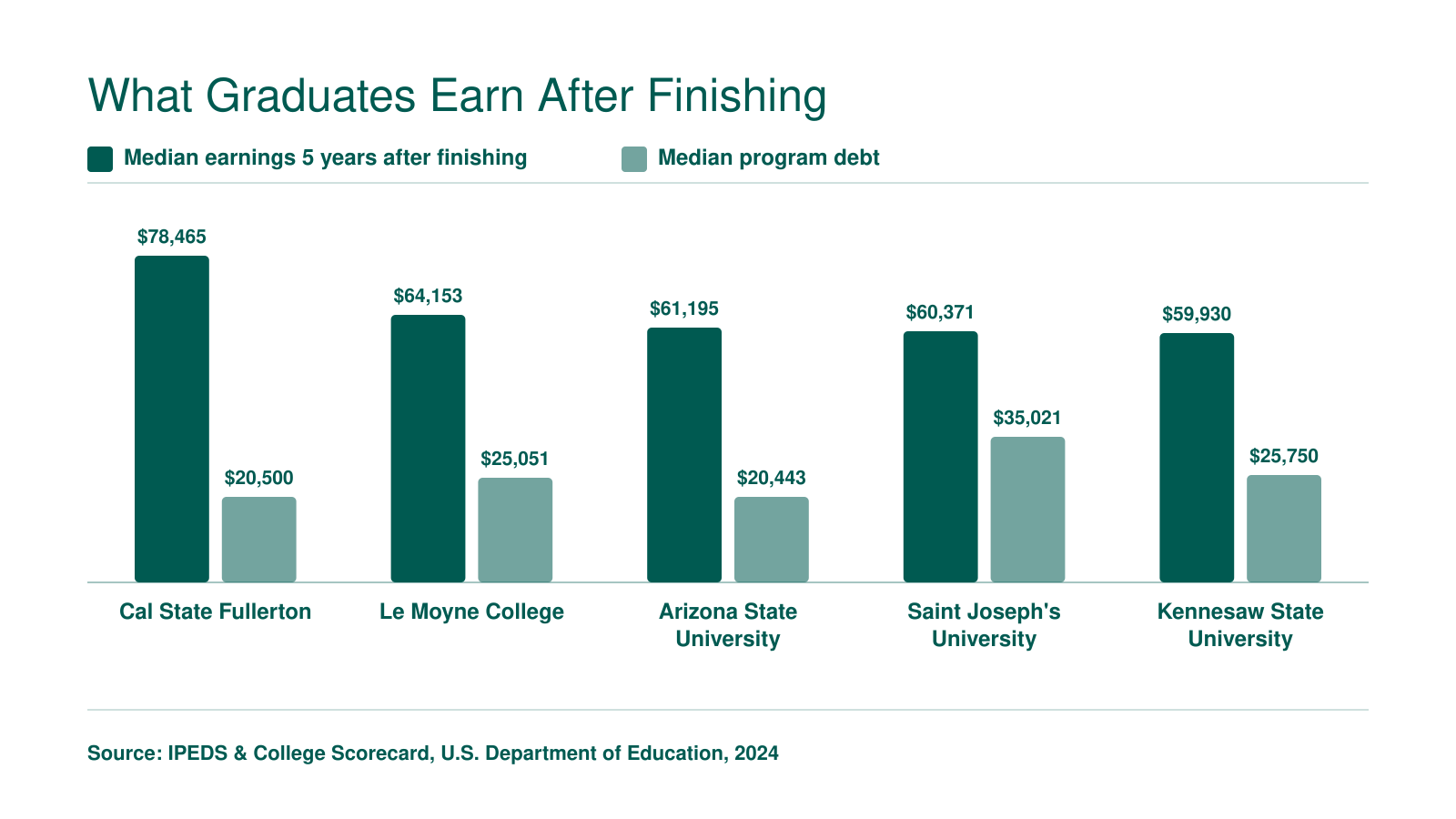
Graduate earnings in secondary education vary by program, but median earnings five years after finishing show the return on your tuition. The chart pairs each program's median earnings with its median program debt, so you can see how much graduates typically earn relative to what they borrow.
Secondary Education programs by state
Frequently Asked Questions About Online Secondary Education Master's Programs
Are GRE or other standardized tests required for an online master's in secondary education?
What subject areas can I teach with a master's in secondary education?
Can I transfer graduate credits into an online secondary education master's?
Can I keep working full time while earning the degree?
Compare Secondary Education programs on the data that matters
Explore more Education & Teaching specializations or browse every graduate field.
All Education & Teaching programs