Best Master's in Secondary Education Programs in Massachusetts
Compare 36 accredited Secondary Education programs in Massachusetts at 15 schools, with graduate earnings, cost, debt, and completion data from IPEDS and the U.S. College Scorecard.

A master's in secondary education in Massachusetts is a graduate degree and, in many programs, the route to an Initial license for grades 5 to 12, which requires MTEL passes and a supervised practicum. Program tuition here runs from $6,246 at Fitchburg State to $37,520 at Boston College, across campus, online, and hybrid formats.
The lowest price belongs to a non-licensure program, so it suits current teachers more than career changers.
Key Points
- Worcester State has the lowest average net price here, at $13,381.
- Merrimack College lists its middle and high school M.Ed. as test optional.
- Fitchburg State and Merrimack list fully online tracks, but online options may be non-licensure.
The 10 Best Master's in Secondary Education Schools in Massachusetts
These Massachusetts schools offer a master's in secondary education, from licensure-track programs for career changers to non-licensure degrees for working teachers. Graduation rates cited below are each school's institution-wide rates, not rates for the education program itself. Always confirm current tuition, admissions tests, and licensure details on the program page before you apply.
Boston College
#1Chestnut Hill, MA · ~$38,000/yr (est.)
Best for: Career changers seeking urban practicum experience
Boston College's Lynch School of Education prepares licensed teachers through a Massachusetts DESE-approved program, with STEM pathways for grades 8-12 or humanities pathways for grades 5-12. The semester-long, five-day-a-week practicum in Greater Boston schools is guided by both a school mentor and a university supervisor. Its institution-wide graduation rate is about 91 percent, the highest on this list, though as a private school its net price is among the higher ones here.
- 37 credit hours with a capstone
- Full-time in one academic year plus two summer sessions
- Part-time option and three start dates per year
- Licensure in Biology, Chemistry, English, History, Math, or Physics
- Optional Teaching English Language Learners (TELL) Certificate
- Donovan Urban Scholars track focused on urban education
- Licensure in Biology
- Part-time completion in 2 to 3 years
- Prepares for Massachusetts English licensure
- Includes pre-practicum and full practicum with school and university mentors
University of Massachusetts-Amherst
#2Amherst, MA · $15,000 – $20,000/yr (est.)
Best for: Undergraduates on a five-year accelerated path
UMass Amherst's 4+1 Accelerated MEd lets undergraduates earn a bachelor's and a master's in five years, with a full-year teaching residency in the 180 Days pathway. Springfield placements carry a $3,000 stipend. The school's institution-wide graduation rate is about 83 percent, and its public pricing keeps net price well below the private schools above. It suits current UMass undergraduates rather than students who already hold a bachelor's degree.
- Prepares you to teach middle or high school math
- Application begins in junior year
- Transfer up to 12 undergraduate credits
- Option to earn a license in a second subject
- Biology, Chemistry, General Science, or Physics
- Full-time teaching for the academic year, or part-time in fall and full-time in spring
- $3,000 stipend for Springfield district placement
- Part-time or full-time teaching pathways
- Second subject license available
- Apply in the fall of junior year
University of Massachusetts-Lowell
#3Lowell, MA · ~$16,000/yr (est.)
Best for: Hybrid learners pursuing initial licensure
UMass Lowell offers a hybrid Master of Education in Curriculum & Instruction with an initial-licensure track in secondary education. Licensure candidates study alongside in-service teachers, and the curriculum centers on culturally sustaining pedagogy and field-based experiences. At 30 credits, it is shorter than several peers. Its institution-wide graduation rate is about 65 percent, and its net price is low for a public school.
- 30 credit hours with a 3.0 GPA minimum
- Hybrid format designed for Massachusetts initial licensure
- Fast Track to Secondary Teaching option
- Accelerated bachelor's-to-master's option
- Requires a bachelor's degree in English
- Requires MTEL Communication and Literacy and content tests
- Includes internship and field practicum
- SEI Endorsement available
- Offers grades 5-12 licensure in History
- Requires a bachelor's degree in the content area
- Focus on equity and inclusion
- Fast Track to Secondary Teaching available
- Field-based experiences throughout
- Science Education option
- Designed for experienced practitioners
- Complete within five years
University of Massachusetts-Boston
#4Boston, MA · ~$20,000/yr (est.)
UMass Boston prepares teachers for urban, diverse classrooms, with immersive placements in Boston Public Schools and job search support. Options include the Teach Next Year residency and a second license in special education or ESL. Program graduates show median earnings of about $76,298 four years after finishing, per federal data. The school's institution-wide graduation rate is about 49 percent, the lowest on this list, so look closely at program-level support.
- 37 credits, one year plus a summer full-time or 2 to 3 years part-time
- Teaches grades 5-12 in English, history, math, science, and world languages
- COSMIC initiative for STEM teaching
- Listing says test optional, so confirm current admissions policy
- 37 credits in 12 courses with a 3.0 GPA minimum
- 100-hour pre-practicum and 14-week full-time student teaching
- Listing notes an entrance exam, so confirm requirements
- Five-year completion window
- 36 credits with 450 clinical hours
- Residency-based track with a practicum portfolio capstone
- Concentration options in ESL, Special Education, or Digital Literacy
- Pre-practicum fieldwork with English language learners
Worcester State University
#5Worcester, MA · ~$7,000/yr (est.)
Worcester State's M.Ed. in Secondary School Education is built for already-licensed teachers who want deeper content knowledge for grades 8-12. Courses run in person, online, or hybrid, and students finish with a thesis or capstone on a real classroom challenge. It has the lowest net price on this list. Its institution-wide graduation rate is about 61 percent. It is a strong fit for working teachers, not for career changers who still need initial licensure.
- 36 to 37 credits with a thesis or capstone option
- Concentrations in biology, English, history, math, or Spanish
- Requires an initial teaching license and 2.8 GPA minimum
- Two letters of recommendation
- In-person, online, or hybrid courses
- Transfer up to 4 post-baccalaureate courses
Merrimack College
#6North Andover, MA · ~$37,000/yr (est.)
Merrimack College's M.Ed. in Middle School (5-8) and High School (8-12) Education leads to initial Massachusetts licensure in as few as 13 months. Students choose online or on-campus courses and complete a 450-hour practicum. The listed program tuition is $22,320, and no GRE or GMAT is required. Its institution-wide graduation rate is about 70 percent. Merrimack is a private school with a higher net price than the public options, so compare aid offers.
- 36 credits at $620 per credit, 13-month full-time pace
- Online or hybrid delivery with six start dates per year
- 450 clinical hours plus MTEL preparation support
- Test optional, $0 application fee
- Employer reimbursement and district partnership discounts
- Biology concentration for grades 8-12
- One of eight content concentrations
Fitchburg State University
#7Fitchburg, MA · ~$6,000/yr (est.)
Fitchburg State offers a fully online M.Ed. in Education 5-12 that is non-licensure, so it fits teachers who already hold a license or do not need one. It skips methods courses and practicum, letting working teachers tailor electives. Pricing is low among public options. Its institution-wide graduation rate is about 55 percent. Anyone needing initial licensure should look elsewhere on this list.
- 36 credits, 100 percent online
- Complete in as little as 2.5 years
- Rolling admissions
- Three letters of recommendation
- Focus on curriculum, assessment, inclusive teaching, and family engagement
Massachusetts College of Liberal Arts
#8North Adams, MA · $5,000 – $10,000/yr (est.)
MCLA offers a fully online M.Ed. with secondary concentrations in English (5-12) and Mathematics (8-12), at about $466 per credit. It provides free MTEL vouchers, evening courses, and a licensure fast-track for waiver holders, and the math listing is designed for career changers and paraprofessionals. Its institution-wide graduation rate is about 56 percent. A professional-licensure pathway is available for educators who already hold an initial license.
- $466 per credit, 18 to 24 months
- Synchronous and asynchronous online options
- 3.0 GPA minimum and three recommendation letters
- Free MTEL vouchers and capstone seminar
- Designed for career changers and paraprofessionals
- Fast-track licensure for working teachers
- Fully online evening courses
- 14 licensure pathways across the M.Ed.
Endicott College
#9Beverly, MA · $15,000 – $20,000/yr (est.)
Endicott College's 36-credit M.Ed. in Secondary Education leads to a Massachusetts initial license, with a 300-hour practicum and personal advising. The program page describes coursework as fully online. Approved subject areas include English, history, and sciences, and military benefits are accepted. Its institution-wide graduation rate is about 76 percent. As a private school it carries a higher net price than the public options.
- 36 credit hours
- 300 clinical hours of field experience
- Eligible for Massachusetts initial teaching license
- Prepares for MTEL
- Two letters of recommendation, $50 application fee
- Military benefits accepted
Gordon College
#10Wenham, MA · ~$9,000/yr (est.)
Gordon College offers an accelerated pathway to a Master of Education in Middle/Secondary Education, with graduate coursework beginning during undergraduate years. It covers 16 licensure areas, with dual licensure options and online evening and weekend classes for working professionals. It is a Christian college, and its institution-wide graduation rate is about 69 percent. Data for graduate earnings was not available.
- 16 licensure areas including Biology, English, History, and Mathematics
- As little as one year to complete
- Online evening and weekend classes
- Dual licensure option
- Initial and professional licensure pathways
- Prepares for MTEL
Cost & outcomes by school
Federal data for the highest-earning Secondary Education programs, independent of the ranking above. Earnings are this field's master's graduates four years after completing, where the Scorecard reports them.
| School | Earnings | Tuition / yr | Debt | Grads/yr | Format |
|---|---|---|---|---|---|
| University of Massachusetts-Boston MA | $76,298 | $20,456 | $24,000 | 100 | Campus |
| Endicott College MA | $73,257 | $15,534 | — | 19 | Campus |
| Boston College MA | $68,576 | $37,520 | — | 23 | Campus |
| American International College MA | $67,175 | $13,314 | $20,500 | 57 | Campus |
| Worcester State University MA | $66,285 | $6,813 | — | 49 | Hybrid |
| Merrimack College MA | $61,055 | $36,800 | $25,588 | 109 | Online |
| Lesley University MA | $58,844 | $19,890 | $34,401 | 54 | Online |
| Westfield State University MA | $53,768 | $8,676 | — | 5 | Campus |
| Massachusetts College of Liberal Arts MA | — | $8,181 | — | — | Online |
| University of Massachusetts-Lowell MA | — | $16,434 | — | — | Hybrid |
| Springfield College-Regional, Online, and Continuing Education MA | — | $20,310 | — | — | Hybrid |
| Gordon College MA | — | $8,960 | — | 22 | Campus |
Sources: U.S. Department of Education. Tuition and graduates: IPEDS. Earnings and debt: College Scorecard, this field's master's graduates; a dash means no figure is reported.
Cost, debt & payoff
Median earnings of this field's master's graduates (4 yrs after completing) vs. their median federal loan debt · U.S. College Scorecard
Across these programs the median graduate earns about $67,876 and finishes with roughly $24,000 in debt — a ratio that clears a common rule of thumb (keep debt below first-year salary). Tuition and debt vary widely school to school, so check the per-school figures in the table above before you shortlist.
How We Rank Massachusetts Secondary Education Master's Programs
A famous name and a good financial return are not the same thing, so this independent, outcomes-first look at Master's Programs in Massachusetts starts with what a future teacher pays and what comes back. The inputs are graduate in-state and out-of-state tuition, the net price students actually pay after aid, institution-wide graduation rate, program-level earnings and debt from College Scorecard where published, and delivery format (campus, hybrid, or online).
One caution: graduation rate and net price measure the entire institution, not this master's in secondary education program alone. Treat them as context for a school's overall track record and affordability, then confirm program-specific costs directly.
No school paid for placement. Admissions and licensure details were checked against current program pages, but requirements change, so verify them with the admissions office before you apply.
Online and Hybrid Master's in Secondary Education Options in Massachusetts
Massachusetts secondary education master's programs no longer force a clean choice between campus and fully online coursework. Merrimack College, Fitchburg State, and Massachusetts College of Liberal Arts list fully online tracks; UMass Lowell and Worcester State blend online and in-person work; Boston College, UMass Amherst, and UMass Boston anchor campus cohorts.
Online and hybrid licensure tracks still keep student teaching in person. UMass Boston's middle and secondary M.Ed., for instance, requires pre-practicum hours and a full student-teaching placement, with some licensure students placed in Boston Public Schools.
Pacing varies by design. Boston College and UMass Boston offer full-time and part-time options, MCLA's online evening courses run about 18 to 24 months, and UMass Boston's Teach Next Year residency compresses training into one full-time year.
If you need to keep a job or commute, online or hybrid delivery is practical; if you want daily cohort support and in-person mentorship, a campus track likely fits better.
Which Massachusetts Master's in Secondary Education Programs Waive the GRE?
For students comparing no-GRE master's programs, Merrimack College lists its M.Ed. in Middle School and High School Education as test optional with no entrance exam required, and that is the clearest GRE-free signal among the schools here. UMass Boston's Middle & Secondary Education M.Ed. is also described as test optional, but its program page states no GRE rule,1 and the UMass Boston graduate program requirements page says some programs do require GRE or GMAT scores. An optional-GRE catalog statement we found dates from 2024-2025, so confirm the current policy before applying.
For Boston College, UMass Amherst, Framingham State, Fitchburg State, Westfield State and the other schools here, we found no published GRE requirement or waiver on the admissions pages we could retrieve. Treat that as unknown, not as a waiver.
Where tests are dropped, admissions usually rest on transcripts, a personal statement, and recommendations. Some programs also ask for a passing MTEL Communication and Literacy Skills score, which UMass Boston requires.1
Related Articles
Most Affordable Master's in Secondary Education Programs in Massachusetts
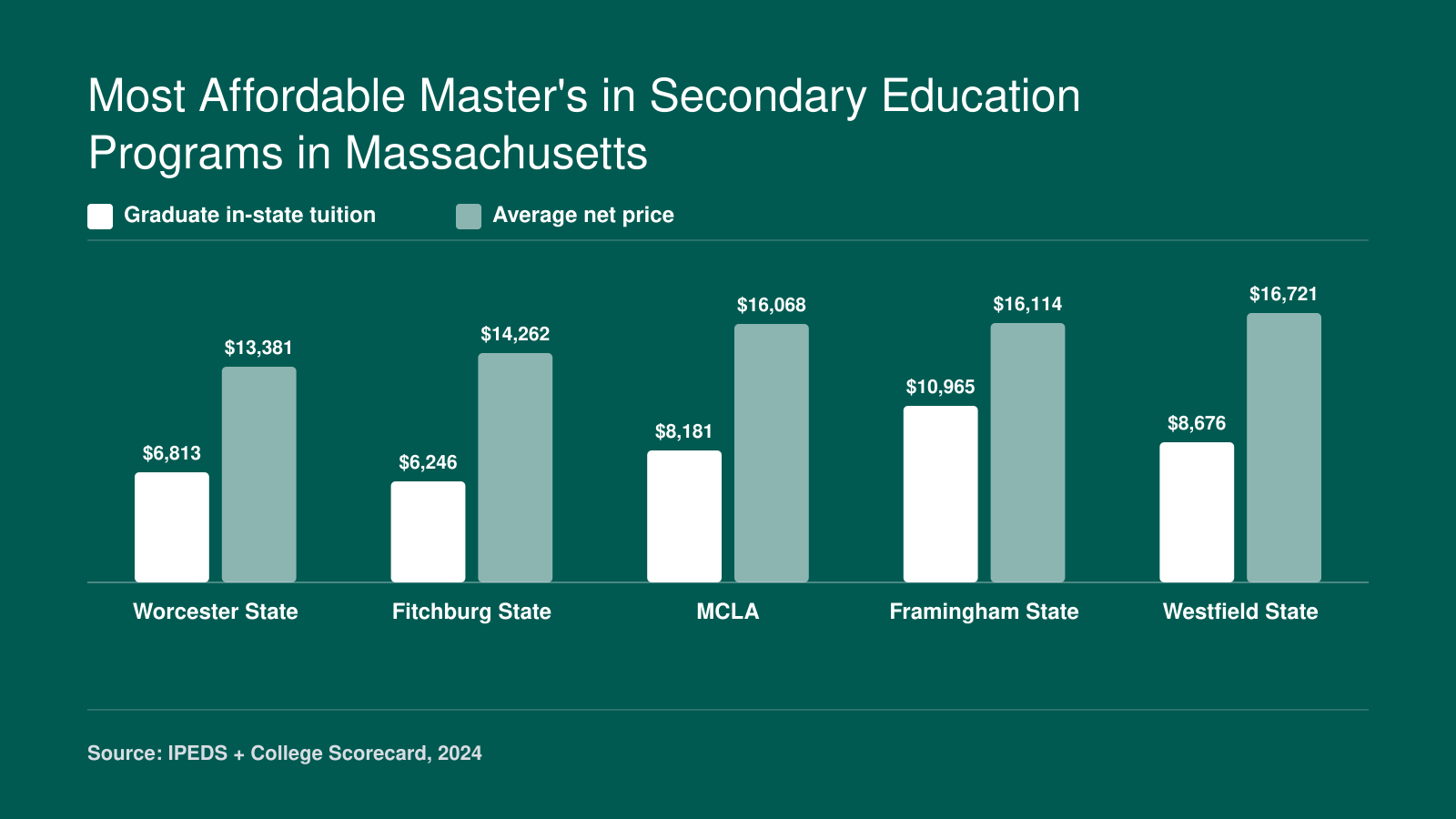
What is the cheapest master's in secondary education in Massachusetts? Worcester State University has the lowest average net price here at $13,381, while Fitchburg State University has the lowest graduate in-state tuition at $6,246 (its program is online and non-licensure). Net price is an institution-wide average after aid, not a guaranteed quote for your program, so confirm costs with each school's bursar.
Cost, Financial Aid, and Earning Your Massachusetts Teaching License
Public tuition in Massachusetts is far cheaper than private tuition, but the sticker price is not what you will pay. Worcester State lists in-state tuition near $6,813, and Fitchburg State is about $6,246. UMass Amherst runs $17,410 in-state, and Northeastern's program is $29,174. Net price falls below sticker once scholarships, employer discounts and fellowships apply, so compare award letters, not brochures.
Teaching candidates have extra aid options. Federal TEACH Grant eligibility depends on your program and a service commitment, so check it with each financial aid office. The state offers teacher scholarships and loan forgiveness1; its Massachusetts educator financial aid programs accept FAFSA or MASFA applications.
On licensure, a master's does not by itself grant a license. Initial-license programs, such as Merrimack's and Framingham State's, pair coursework with student teaching and MTEL exams; for MAT programs in Massachusetts, that combination is common. Non-licensure tracks, such as Fitchburg State's, do not lead to an Initial license. The Professional license requires an Initial license plus experience, induction and 12 graduate credits, so confirm any program is state-approved before enrolling.
Massachusetts Secondary Teacher Licensure at a Glance
Secondary Education Master's Salary in Massachusetts: Where Graduates Earn the Most
Figures come from U.S. Department of Education IPEDS and College Scorecard data (2024) and are program-level medians, each tied to its own measurement window. Windows differ by school, so compare with care. Where debt is published, the payback picture is favorable: at UMass Boston, median debt of $24,000 sits against $69,295 in earnings five years after finishing, and at American International College, $20,500 against $69,151. Monthly payments of $273 and $233 take roughly 4 to 5 percent of those earnings.
| School | Program | Median Earnings of Graduates | Median Debt | Monthly Payment (10-Year Plan) |
|---|---|---|---|---|
| Endicott College | M.Ed. in Secondary Education | $73,257 (four years after finishing) | N/A | N/A |
| Worcester State University | Master of Education in Secondary Education | $72,190 (five years after finishing) | N/A | N/A |
| University of Massachusetts-Boston | Education - Middle & Secondary MEd | $69,295 (five years after finishing) | $24,000 | $273 |
| American International College | Master of Education in Middle or Secondary Education | $69,151 (five years after finishing) | $20,500 | $233 |
| Boston College | Master of Education (M.Ed.) in Secondary Education | $68,576 (four years after finishing) | N/A | N/A |
Your Questions About Massachusetts Secondary Education Master's Programs
These answers draw on published program details from the schools ranked here. Policies change by term, so confirm deadlines, credit counts, and transfer rules on each program's admissions page before you apply.
Do I need a teaching license to apply to a secondary education master's in Massachusetts?
How long does a master's in secondary education take in Massachusetts?
What is the cheapest master's in secondary education in Massachusetts?
When are application deadlines and start dates for Massachusetts secondary education master's programs?
Can I transfer graduate credits into a Massachusetts secondary education master's program?
Which Massachusetts program is best for a working teacher seeking a Professional license?
Compare Secondary Education programs on the data that matters
Explore more Education & Teaching specializations or browse every graduate field.
All Education & Teaching programs