Best Master's in Secondary Education Programs in Tennessee
Compare 16 accredited Secondary Education programs in Tennessee at 12 schools, with graduate earnings, cost, debt, and completion data from IPEDS and the U.S. College Scorecard.

A licensure track for a career changer and an advanced M.Ed. for a teacher already in a 6-12 classroom are different degrees with different prerequisites. A master's in secondary education in Tennessee comes both ways, campus and online, and many are master's in secondary education programs with no GRE required; the cost spread is wide: in-state graduate tuition at the public universities sits near $8,600 to $11,900 a year, while Vanderbilt charges $57,868, a gap that makes the most affordable master's in secondary education programs worth comparing.
GRE policies, clinical placement rules, and which track your bachelor's degree actually qualifies you for matter as much as the sticker price.
Key Points
- The University of Tennessee-Chattanooga lists the lowest in-state graduate tuition here, at $11,110 a year.
- Vanderbilt University charges $57,868 a year to every student, in-state or not.
- Tennessee State University mentions the GRE only for conditionally admitted applicants, and no other school lists it as standard.
Ranked: Tennessee Secondary Education Master's Programs
Tennessee's master's options in secondary education split between licensure tracks for career changers and advanced programs for teachers already in the classroom, and the order below reflects what graduates earn, what the school costs after aid, and how many students finish. Vanderbilt appears with several cards because each subject concentration is listed separately. Graduation rates cited are institution-wide figures, not program completion rates, and earnings are stated with their time window after finishing.
Vanderbilt University
#1Nashville, TN · ~$58,000/yr (est.)
Best for: Aspiring English, math, science, or social studies teachers
Vanderbilt's Peabody College offers a campus-based Secondary Education M.Ed. with subject concentrations in English, mathematics, social studies, and science, each leading to grades 6-12 licensure. Students choose between a traditional student teaching model and a job-embedded pathway for those already teaching in Tennessee. Schools offering this program graduate about 94% of their students institution-wide, and program-level median earnings were $50,383 one year after finishing and $57,106 four years after. A guaranteed Teacher Pathway scholarship of at least 30% tuition and a close partnership with Metro Nashville Public Schools add practical value.
- 36 credit hours leading to English licensure for grades 6-12
- Courses include Adolescent Readers and Teaching Literature and Media
- Licensure requires two semesters of a foreign language
- Student teaching or job-embedded track
- 33 credit hours with Mathematics licensure
- Two-year program includes licensure
- Priority decision deadlines in January and February
- Job-embedded pathway available
- 33 credit hours with Social Studies licensure for grades 6-12
- Priority Decision 1 deadline of January 3
- Faculty research focused on social change
- Field-based practicum experience
- 33 credit hours with Science licensure
- Field-based practicum at middle and high school levels
- Collaborate with faculty on current research
- Placements in public, private, or charter schools
- Two-year program that starts in the fall
- Rolling admissions
- Eight clinical hours in secondary schools
- Licensure options also include Music and Multilingual Education
- Teacher Pathway scholarship of at least 30% tuition
Middle Tennessee State University
#2Murfreesboro, TN · ~$12,000/yr (est.)
Best for: Working adults needing hybrid flexibility
Middle Tennessee State University delivers its Secondary Education Licensure Path through a hybrid M.Ed. in Curriculum and Instruction that meets Tennessee's initial licensure requirements. Students pick a traditional teacher-training route or a job-embedded route, which suits people balancing work and coursework. Schools offering this program graduate about 54% of students institution-wide, and the curriculum emphasizes planning, assessment, instructional strategy, and classroom management.
- Available online and hybrid
- Meets Tennessee initial licensure requirements
- Traditional and job-embedded pathways
- Problem-based learning and professional learning communities
- Approved by the Tennessee Department of Education
East Tennessee State University
#3Johnson City, TN · ~$11,000/yr (est.)
Best for: Certified teachers building classroom technology skills
East Tennessee State University's M.Ed. in Secondary Education with a Classroom Technology concentration is aimed at certified secondary teachers who want stronger instructional technology skills, though career changers without a certificate can also apply. The program ends with a professional teaching portfolio and oral examination. Schools offering this program graduate about 53% of students institution-wide, and program-level median earnings were $45,685 one year after finishing.
- 37 total credit hours
- 24 credits in the classroom technology concentration
- 3.0 GPA minimum and three letters of recommendation
- Capstone with teaching portfolio and oral exam
- Open to non-certified career changers
- Option to add an endorsement
The University of Tennessee-Chattanooga
#4Chattanooga, TN · ~$11,000/yr (est.)
The University of Tennessee-Chattanooga offers a 36-credit M.Ed. in Secondary Education: Licensure built around a full 16-week student teaching semester. Dual placements in inner-city and suburban or rural schools broaden classroom exposure. Schools offering this program graduate about 50% of students institution-wide, and program-level median earnings were $50,277 one year after finishing.
- 36 total credit hours
- 16-week full-semester student teaching
- Dual placements in inner-city and suburban or rural schools
- Praxis exams required, with preparation for Praxis II
- Prerequisite bridging coursework required
- Student teaching deadlines: March 1 for fall, September 1 for spring
- Alternative option for employed teachers
- FBI and TBI fingerprinting required
The University of Tennessee-Martin
#5Martin, TN · ~$12,000/yr (est.)
The University of Tennessee-Martin's MSED in Teaching-Initial Licensure Secondary is built for people holding a non-teaching bachelor's degree who want to teach grades 6-12. The cohort model, small classes, and field placements are the main draws. Schools offering this program graduate about 53% of students institution-wide, and program-level median earnings were $45,434 one year after finishing.
- Requires a non-teaching bachelor's degree
- 2.5 GPA minimum and $40 application fee
- Two concentration options
- Prepares for Tennessee teaching licensure
- Develop, design, and evaluate curriculum
- Field placements, student teaching, and small class sizes
Tennessee State University
#6Nashville, TN · $11,000 – $24,000/yr (est.)
Tennessee State University, a Nashville HBCU, offers a campus-based M.Ed. in Curriculum and Instruction with a Secondary School Instruction concentration leading to initial certification for grades 7-12 or K-12. Candidates complete comprehensive exams, the Praxis subject test, and an edTPA portfolio. Schools offering this program graduate about 34% of students institution-wide, the lowest in this group, so applicants should ask about cohort completion and support.
- 33 credit hours: 15-credit core plus 18-credit concentration
- Initial teacher certification track
- edTPA portfolio required with a score of 42 or higher
- Comprehensive exams in general and secondary education
- Starts fall, spring, or summer
- Up to 12 graduate credits may transfer
- Conditional admission for lower GPAs requires GRE or MAT scores
Cost & outcomes by school
Federal data for the highest-earning Secondary Education programs, independent of the ranking above. Earnings are this field's master's graduates four years after completing, where the Scorecard reports them.
| School | Earnings | Tuition / yr | Debt | Grads/yr | Format |
|---|---|---|---|---|---|
| Lipscomb University TN | $65,590 | $17,334 | — | 2 | Campus |
| Vanderbilt University TN | $57,106 | $57,868 | $37,924 | 27 | Campus |
| The University of Tennessee-Chattanooga TN | $54,877 | $11,110 | — | 51 | Campus |
| East Tennessee State University TN | $51,479 | $11,366 | $28,500 | 38 | Campus |
| The University of Tennessee-Martin TN | $50,046 | $11,916 | $51,164 | 93 | Campus |
| Cumberland University TN | — | $8,280 | — | — | Hybrid |
| Austin Peay State University TN | — | $10,518 | — | — | Campus |
| King University TN | — | $16,073 | — | — | Online or campus |
| Tennessee State University TN | — | $11,188 | — | 2 | Campus |
| Middle Tennessee State University TN | — | $11,718 | — | — | Hybrid |
| Tennessee Tech TN | — | $12,386 | — | — | Hybrid |
| Lincoln Memorial University TN | — | $22,154 | — | — | Hybrid |
Sources: U.S. Department of Education. Tuition and graduates: IPEDS. Earnings and debt: College Scorecard, this field's master's graduates; a dash means no figure is reported.
Cost, debt & payoff
Median earnings of this field's master's graduates (4 yrs after completing) vs. their median federal loan debt · U.S. College Scorecard
Across these programs the median graduate earns about $57,106 and finishes with roughly $37,924 in debt — a ratio that clears a common rule of thumb (keep debt below first-year salary). Tuition and debt vary widely school to school, so check the per-school figures in the table above before you shortlist.
Online and Hybrid Master's in Secondary Education Options in Tennessee
Fully online secondary education master's degrees remain scarcer in Tennessee than the marketing around best online master's in secondary education programs suggests, and the distinction between online coursework and in-person clinical work is where most applicants get tripped up.
Who teaches where
Middle Tennessee State University's Curriculum and Instruction secondary licensure concentration is the only ranked program among master's programs in Tennessee offered in both online and hybrid formats. Vanderbilt's Secondary Education M.Ed., East Tennessee State's classroom technology track, UT Chattanooga's licensure M.Ed., UT Martin's initial licensure MSED, and Tennessee State's Curriculum and Instruction degree are structured as campus programs. UT Chattanooga defines fully online study as instruction delivered entirely at a distance, with asynchronous or scheduled live sessions and occasional in-person exceptions, according to its Online Programs, University of Tennessee at Chattanooga page, though its secondary education licensure M.Ed. is not listed that way.
Clinical hours still happen in a real classroom
No delivery format removes the field requirement. Vanderbilt students complete field-based hours and choose traditional student teaching or a job-embedded track, where second-year candidates must secure a placement in a Tennessee public middle or high school. UT Chattanooga runs a 16-week full-semester student teaching experience with dual placements in inner-city and suburban or rural schools.
Practical tip: if you are already a teacher of record, ask about job-embedded pathways first. They let your current classroom count as the placement rather than forcing an unpaid semester off.
Which Tennessee Schools Make the GRE Optional for a Master's in Secondary Education?
On the admissions pages we checked, none of these schools lists the GRE as a standard requirement for its secondary education master's. Tennessee State University is the only one that mentions it, and only for applicants admitted conditionally. Other schools here, including Vanderbilt University, Middle Tennessee State University, and The University of Tennessee-Martin, did not have a program-level policy we could confirm, so check their graduate admissions pages directly. Deadlines change by term, so verify the current date before you apply.
| School | GRE Policy | Minimum GPA | Other Prerequisites | Application Deadline |
|---|---|---|---|---|
| Tennessee State University (M.Ed. Curriculum and Instruction) | Not required for unconditional admission; conditionally admitted applicants must submit GRE or MAT scores to remove conditional status | 2.5 cumulative undergraduate GPA for unconditional admission; 2.75 on the last earned degree for graduate teacher-education admission | Bachelor's degree from an accredited four-year college or university | Fall: July 1; Spring: November 1 |
| The University of Tennessee-Chattanooga (Secondary Education M.Ed.) | No published policy | Not listed on program page | Graduate School application; official transcripts from every college attended; Praxis Core scores or proof of current teaching licensure; non-licensed applicants must also complete Teacher Education Program requirements | Rolling admission for fall, spring, and summer; submit at least 30 days before the applicable deadline |
| East Tennessee State University (MAT, Secondary Education 6-12) | No published policy | 2.75 overall GPA on a completed bachelor's or post-baccalaureate degree, or 3.0 in the most recent 60 credit hours | All Graduate School admission requirements; bachelor's degree from a regionally accredited institution | Not listed on the policy page; confirm with the Graduate School |
Related Articles
Master's in Secondary Education Costs and Tennessee Licensure Requirements
The University of Tennessee-Chattanooga lists the lowest in-state graduate tuition for a secondary education master's degree among the schools ranked here, at $11,110 a year. Vanderbilt University charges $57,868 to every student.
What the Programs Cost
In-state tuition at the public universities clusters tightly: Tennessee State at $11,188, East Tennessee State at $11,366, Middle Tennessee State at $11,718 and UT Martin at $11,916. Out-of-state students see wider gaps. UT Martin is the clear value at $12,978, compared with $29,700 at Middle Tennessee State. Average net price after aid is lowest at UT Martin ($10,701). That figure covers each institution as a whole, so treat it as a guide rather than a quote for this degree. Vanderbilt's guaranteed 30% tuition scholarship narrows its gap but does not close it.
Program length drives the total. Tennessee State requires 33 credit hours, Chattanooga and Vanderbilt 36, and East Tennessee State 37. Ask each bursar for the current per-credit rate and mandatory fees before you budget.
Tennessee's 6-12 Licensure Steps
- Approved program: Complete a State Board-approved educator preparation program.
- Content tests: Have ETS, NES or the Tennessee Language Center send qualifying scores for your endorsement directly to the state. Some candidates with a degree in their endorsement area have been exempt since 2023, so confirm your status with your program.
- Performance assessment: In-state programs have required edTPA. Since July 1, 2026, candidates in programs with Department-approved clinical practice are exempt. Tennessee State's track still lists an edTPA portfolio, so verify current expectations.
- Application: Apply through TNCompass. Your name and Social Security number must match your testing records.
Initial Licensure vs. Advanced Tracks
Initial-licensure Master of Arts in Teaching (MAT) in Tennessee programs include student teaching and lead to a license. Examples are UT Martin's MSED for holders of non-teaching bachelor's degrees and Middle Tennessee State's licensure path. Other M.Ed. programs assume you are already licensed. Those take less time but add no credential. Job-embedded options at Middle Tennessee State and Vanderbilt let you teach while you finish.
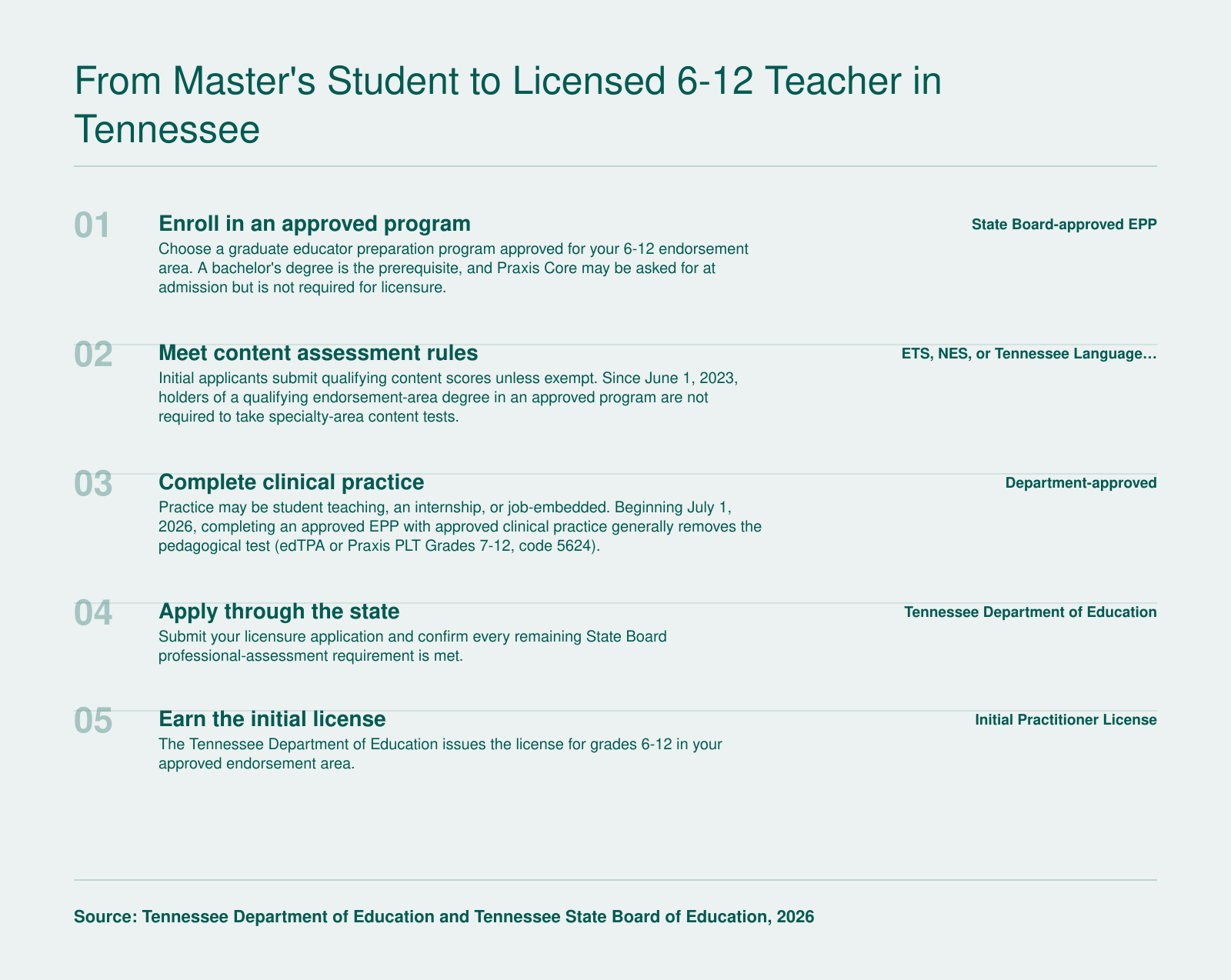
From Master's Student to Licensed 6-12 Teacher in Tennessee
Tennessee's graduate route to a 6-12 license follows a set order. Exact test requirements depend on your degree, endorsement area, and program, so treat this as the general sequence.
M.Ed. or MAT? Picking the Right Tennessee Track for Your Background
Tennessee's teacher shortage has pushed more career changers toward graduate pathways that lead to a classroom, which makes the choice between an MAT and a licensure-track M.Ed. more consequential than it once was. The two degrees serve different starting points, so match the track to where you stand today.
Side by Side
- Primary purpose: The MAT is built for initial licensure.1 The M.Ed. is typically advanced preparation, though some M.Ed. tracks (like UTC's Secondary Education Licensure option) also lead to an initial 6-12 license.
- Typical candidate: MAT suits bachelor's holders without a Tennessee license, including career changers.1 M.Ed. conventionally serves already licensed teachers.
- Credit hours: Examples here range from about 30-33 credits for an M.Ed. to 37 for ETSU's MAT, with clinical work of roughly 3-9 credits in the M.Ed. and around 10 in the MAT.2
- Student teaching and exams: Both require supervised student teaching and passing the relevant Tennessee state exams before licensure.1
How Long It Takes
Full-time students often finish in about two years; part-time schedules stretch longer, though a concentrated student-teaching semester usually must be completed full-time regardless of pace.
Rule of Thumb
Career changers without a license should pursue an initial-licensure MAT or a licensure-track M.Ed. Already-licensed teachers seeking salary-lane or leadership advancement usually want the standard M.Ed.
Compare Secondary Education programs on the data that matters
Explore more Education & Teaching specializations or browse every graduate field.
All Education & Teaching programs