Best Master's in Secondary Education Programs in Virginia
Compare 19 accredited Secondary Education programs in Virginia at 9 schools, with graduate earnings, cost, debt, and completion data from IPEDS and the U.S. College Scorecard.

In Virginia, a master's in secondary education is usually a licensure decision before it is a degree decision. Career changers need a program that ends in a grades 6-12 endorsement, with student teaching and a Praxis Subject Assessment built in. Licensed teachers need coursework that fits a school day.
Price spreads widely. Liberty University lists about $8,730 a year online, while Marymount University runs near $23,446.
Online format changes less than it seems: student teaching still happens in a real middle or high school classroom.
Key Points
- Sweet Briar lists about $12,750 a year in-state tuition, Old Dominion about $15,390.
- Credit loads run from 30 at Shenandoah to 51 at Averett.
- Liberty, Randolph, and Old Dominion offer online or hybrid paths, but student teaching stays in a school.
Best Master's in Secondary Education Schools in Virginia: 2027 Ranked List
These programs are ordered by what graduates earn and owe, what the schools charge, and how many students finish, not by reputation. Graduation rates below describe the whole institution, not any single program. Accreditation is noted only where we could confirm it.
William & Mary
#1Williamsburg, VA · $15,000 – $20,000/yr (est.)
Best for: Career changers wanting an immersive cohort year
William & Mary offers a full-time, 12-month M.A.Ed. in Curriculum & Instruction with secondary concentrations in English, Mathematics and Science. It pairs a fall clinical field experience with a spring student teaching internship, all in a cohort. Listed tuition and fees are $25,914 in state and $51,038 out of state, with a published net price near $19,096, and the school's graduation rate is about 89%. A Teacher in Residence pathway offers a $20,000 paid internship and a $9,000 tuition award in exchange for a three-year teaching commitment in New Kent County or Newport News.
- Concentration: Secondary English
- 44 credit hours over a 12-month, summer-start cohort
- Fall clinical field experience with 60 hours of observation
- Spring full-time student teaching internship
- Prepares for the Praxis Subject Assessment in English and the VCLA
- Designed for candidates without a teaching certificate
- Concentration: Secondary Mathematics
- 41 to 44 credit hours depending on the listing
- One-year, cohort-based, full-time on campus
- Fall field experience of 60+ hours and spring student teaching
- Subject area requirements in mathematics
- Scholarships available
- Concentration: Science, one of four secondary options
- 44 credit hours, full-time, summer start
- Fall clinical field experience of 60+ hours
- 15-week spring student teaching placement
- Eligible for Virginia 6-12 licensure
George Mason University
#2Fairfax, VA · $15,000 – $20,000/yr (est.)
Best for: Northern Virginia learners wanting hybrid flexibility
George Mason's 30-credit M.Ed. in Secondary Education is hybrid, blending online coursework with on-campus sessions at Fairfax, and offers concentrations including English, History and Social Science, and Mathematics. Candidates complete clinical work through a partner-school network across Northern Virginia and finish with an action research project. Listed tuition and fees are $14,220 in state and $38,688 out of state, with a published net price near $17,915, and the school's graduation rate is about 68%. Eligible Virginia PK-12 educators can use a 15% educator discount.
- 30 credit hours with five concentration options
- Hybrid format blending online and on-campus study
- Action research capstone
- Praxis testing, CPR and First Aid certification required
- Admissions interview and two recommendation letters required
- About $753 per credit before fees
- As few as four semesters, with fall, spring or summer starts
- 3.0 GPA minimum
- 6-credit internship included
- Clinical experiences across 18 partner schools
- Subject area advisors for each track
- About $752.50 per credit before fees
- Employer tuition reimbursement supported
- Action research methods and seminar courses
- Content area review for licensure
- Graduate new student fee of $60
- Prerequisite courses and content area review required
- On-campus courses at the Fairfax campus
- Three start dates per year
- Employer tuition reimbursement supported
- Action research project completes the program
University of Mary Washington
#3Fredericksburg, VA · ~$12,000/yr (est.)
Best for: Working adults needing evening courses
The University of Mary Washington's M.Ed. in Secondary Education is a post-baccalaureate route to a master's degree and initial grades 6-12 licensure at the same time. Evening, blended and online courses suit working adults and career changers, and candidates choose from eight licensure areas. Listed tuition and fees are $14,640 in state and $27,560 out of state, with a published net price near $20,667, and the school's graduation rate is about 66%.
- Earn the M.Ed. and a grades 6-12 license together
- Eight licensure area options
- Evening, blended or online course formats
- Semester-long student teaching internship
- Biology licensure area
- Designed for adult learners
- Courses available in evenings or online
- English licensure area for grades 6-12
- Field placements in local schools
- Evening and blended format for career changers
Sweet Briar College
#4Sweet Briar, VA · ~$13,000/yr (est.)
Sweet Briar College's Master of Arts in Teaching is a small, hands-on route to Virginia secondary licensure, finished in one to two years depending on the coursework you bring in. Licensure areas include biology, chemistry, English, history and social science, and mathematics. Listed tuition and fees are $26,160 with no in-state discount, the published net price is near $17,758, and the school's graduation rate is about 52%. A recent tuition initiative expands access for Virginia women, though eligibility details were not available to us.
- One to two years to complete
- Four concentration options for secondary licensure
- Candidates must major in the associated discipline
- Open to graduates of other institutions
- Add-on special education endorsement available
- Elementary and PreK-12 tracks also offered
Hollins University
#5Roanoke, VA · $15,000 – $20,000/yr (est.)
Hollins University's Master of Arts in Teaching leads to a Virginia license and a master's degree together, with secondary endorsements in English, history and social sciences, biology, chemistry, mathematics and physics. It is built for career changers, with full-time and part-time options and evening classes. Listed tuition and fees are $43,560, the published net price is near $20,896, and the school's graduation rate is about 65%. Per-credit tuition is $450, offset by a student teaching grant and TEACH Grant eligibility.
- 40 credit hours, $450 per credit
- One and a half to two years of full-time study
- Part-time option with five years to finish
- Hybrid and online class options plus evening classes
- Student teaching grant of $5,220
- Federal TEACH Grant up to $4,000
- Licensed teachers get a $100 course discount
Liberty University
#6Lynchburg, VA · ~$9,000/yr (est.)
Liberty University's online M.A.T. in Secondary Education prepares candidates for grades 6-12 licensure through asynchronous, 8-week courses with a semester of student teaching. The program is CAEP accredited and designed around Virginia licensure requirements, with reciprocity possible elsewhere. Listed tuition and fees are $22,465, the published net price is near $29,357, and the school's graduation rate is about 65%. Full-time graduate education tuition is $450 per credit, with a reduced military graduate rate.
- CAEP accredited initial licensure program
- 36 credit hours listed, with a 30-hour fifth-year option
- $450 per credit, with a lower military rate
- Asynchronous online classes with eight start dates a year
- No entrance exam required, 2.5 GPA minimum
- Transfer up to 50% of the degree
- Semester of student teaching and background check required
- Federal TEACH Grant eligible
Marymount University
#7Arlington, VA · ~$23,000/yr (est.)
Marymount University's hybrid Master of Education in Secondary Education combines online work with afternoon and evening classes in Arlington. Full-time students can finish in as little as one year, with licensure areas such as biology, chemistry, English and mathematics. Listed tuition and fees are $40,920, the published net price is near $29,137, and the school's graduation rate is about 54%. The program includes a 14-week student-teaching internship.
- 36 credit hours, as little as one year full time
- Part-time option, with fall, spring or summer starts
- Seven concentration options
- 14-week student-teaching internship
- 2.8 GPA minimum and two recommendation letters
- Prepares for the Praxis, with one licensure exam required
- Faculty-sponsored research and study abroad options
Randolph College
#8Lynchburg, VA · ~$18,000/yr (est.)
Randolph College offers an online Master of Education with a Middle School and Secondary concentration, aimed at working adults who want to specialize in adolescent learners. Published program details are limited, so confirm licensure pathway, credit hours and cost directly with the college. Listed tuition and fees are $30,310, the published net price is near $15,921, and the school's graduation rate is about 46%.
- Online format for working adults
- Concentration: Middle School and Secondary
- Elementary and special education concentrations also offered
Old Dominion University
#9Norfolk, VA · $15,000 – $36,000/yr (est.)
Old Dominion University's Master of Science in Education in Secondary Education (6-12) is an initial licensure program for people with a non-teaching bachelor's degree, offered on campus and online. Content areas include English, mathematics, science and social studies. Listed tuition and fees are $12,750 in state and $33,780 out of state, with a published net price near $14,638, and the school's graduation rate is about 46%. Virginia public-school educators may qualify for a 25% per-credit discount in the online program.
- Initial licensure for grades 6-12 with a master's degree
- Available on campus and online
- 2.8 GPA minimum and Praxis required for entry
- Prerequisite courses required
- Internship and student teaching included
- Teaching portfolio comprehensive exam
- Background check required
- Seven concentration options in the program
- Initial licensure in grades 6-12
- First Aid, AED and CPR certification required
- Dyslexia Awareness and Child Abuse and Neglect training required
Cost & outcomes by school
Federal data for the highest-earning Secondary Education programs, independent of the ranking above. Earnings are this field's master's graduates four years after completing, where the Scorecard reports them.
| School | Earnings | Tuition / yr | Debt | Grads/yr | Format |
|---|---|---|---|---|---|
| Marymount University VA | $62,324 | $23,446 | $37,779 | 3 | Hybrid |
| Old Dominion University VA | $58,916 | $15,390 | $27,000 | 54 | Online |
| University of Mary Washington VA | $57,480 | $12,462 | $20,500 | 12 | Hybrid |
| Virginia Wesleyan University VA | — | $8,982 | — | — | Campus |
| Sweet Briar College VA | — | $12,750 | — | — | Campus |
| Radford University VA | — | $13,762 | — | — | Campus |
| William & Mary VA | — | $17,666 | — | — | Campus |
| George Mason University VA | — | $17,964 | — | — | Campus |
| Randolph College VA | — | $18,310 | — | — | Online |
Sources: U.S. Department of Education. Tuition and graduates: IPEDS. Earnings and debt: College Scorecard, this field's master's graduates; a dash means no figure is reported.
Cost, debt & payoff
Median earnings of this field's master's graduates (4 yrs after completing) vs. their median federal loan debt · U.S. College Scorecard
Across these programs the median graduate earns about $58,916 and finishes with roughly $27,000 in debt — a ratio that clears a common rule of thumb (keep debt below first-year salary). Tuition and debt vary widely school to school, so check the per-school figures in the table above before you shortlist.
Online and Hybrid Master's in Secondary Education Options in Virginia
An online master's in secondary education or hybrid program moves coursework off campus, but student teaching still happens in a real middle or high school classroom. Among the programs on this page, Liberty University, Randolph College, and Old Dominion University are listed as online (ODU also offers an on-campus version). George Mason University, the University of Mary Washington, Hollins University, and Marymount University are hybrid. William & Mary and Sweet Briar College are campus-based.
Placement is where programs differ. George Mason places licensure candidates through its partner school network in Fairfax, Prince William, Loudoun, Alexandria, Manassas, and Falls Church, and a teacher on a provisional license may be able to use that job in place of the internship. Mary Washington places student teachers in schools local to the university. Fully online students cannot assume a school division near home will be arranged for them, and we could not confirm each program's policy.
Tip: before enrolling, ask who coordinates your placement, which divisions are eligible, and whether out-of-state students need to relocate or attend in-person sessions.
Which Ranked Virginia Programs Waive the GRE?
GRE policies vary across the schools here, and a few do not address the exam at all on their admissions pages. Check each program's current application page before you plan around a waiver.
| School | GRE Policy | Notes or Waiver Conditions |
|---|---|---|
| University of Virginia | Optional | The GRE is not required for any program at the School of Education and Human Development. Applicants may submit scores, and leaving them out does not hurt the application. |
| William & Mary (M.A.Ed. in Secondary Education) | Not required | Admission tests such as the GRE are not considered in application review. Any scores submitted should be no more than five years old at admission. |
| Virginia State University (Education graduate programs) | Required | The Education program is listed as requiring the GRE. Requirements vary by program. |
| Virginia State University (Master of Education) | Required for some programs, not others | Official scores must be no more than five or six years old, depending on the program. Most programs waived the GRE for Fall 2020, so confirm the current rule with the department. |
| Old Dominion University | No published policy | The admissions pages do not state a GRE rule. Only program directors can waive an application requirement, so contact the director if you think you qualify. |
| University of Mary Washington (M.Ed. in Secondary Education) | No published policy | The program page describes the degree and licensure pathway but lists no GRE requirement or waiver. |
Related Articles
Cost and Financial Aid for a Master's in Secondary Education in Virginia
The lowest annual tuition and the lowest total bill are not always the same program. For Virginia residents, Sweet Briar College lists about $12,750 a year and Old Dominion University about $15,390, according to the 2026-2027 Tuition and Fees Report. William & Mary sits near $17,666 and George Mason near $17,964. Non-residents pay much more at William & Mary and George Mason, roughly $36,000 to $40,000; ODU's online program charges out-of-state students $24,494 total. Private Sweet Briar and Randolph College charge everyone the same rate.
Per-credit pricing tells you more. ODU's online secondary education master's runs 37 credits at $672 per credit for Fall 2026, about $24,864 total. Virginia public-school educators may qualify for a 25% discount. George Mason charges residents $779 per credit plus $25 to $84 in course fees, and eligible Virginia educators can take 15% off.
Published net price figures are institution-wide averages, not quotes. Program-level median debt is not reported for these programs. The Virginia Teaching Scholarship Loan Program has offered up to $10,000 a year for critical-shortage subjects, with a two-year teaching commitment.1 Confirm the 2026 terms on the Virginia Department of Education's Financial Support for Teaching in Virginia page before you count on it.
Virginia Teacher Licensure After Your Master's
How Long Does a Master's in Secondary Education Take in Virginia?
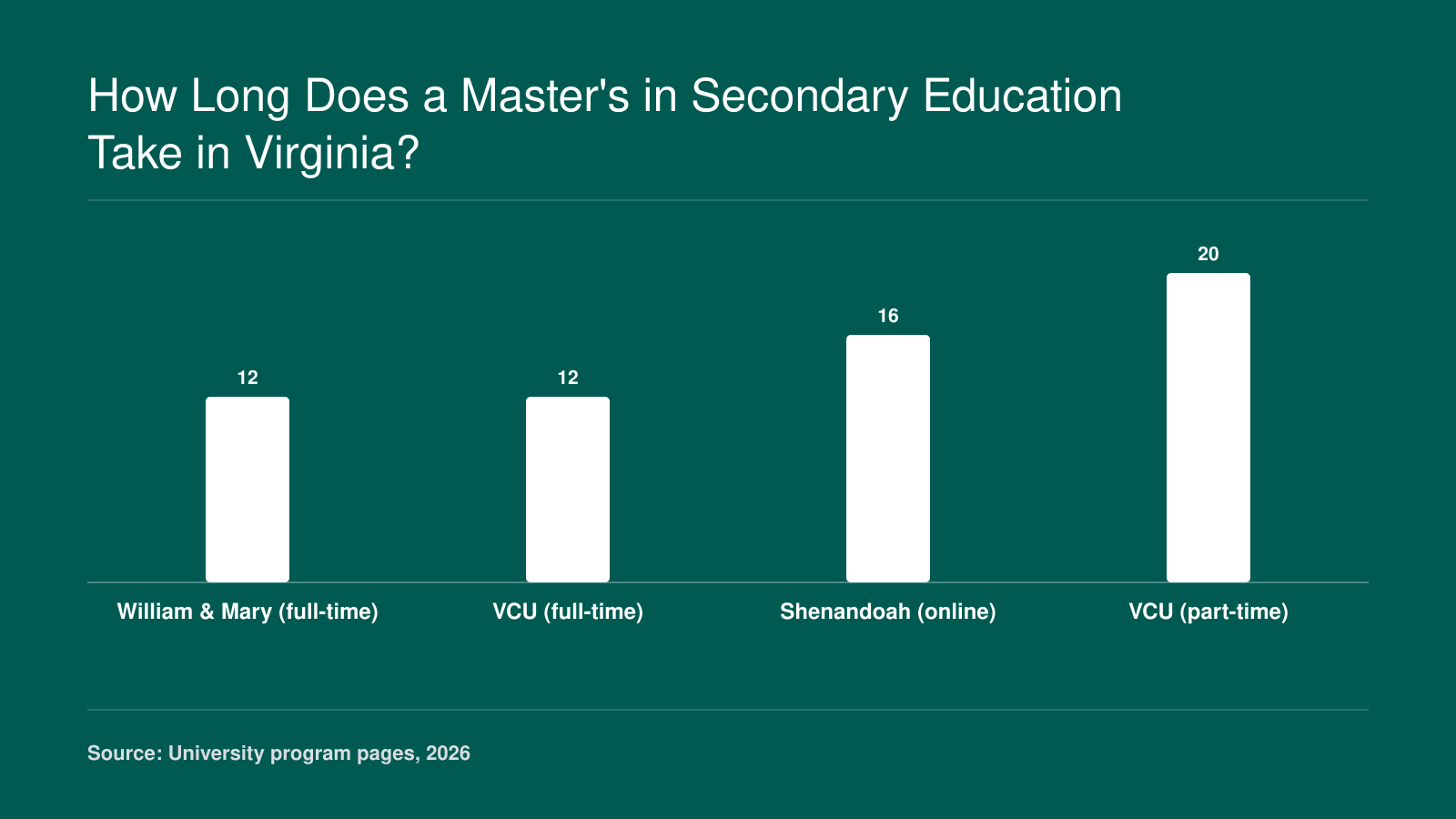
Credit loads run from 30 at Shenandoah to 37 at Old Dominion, 41-44 at William & Mary, and 42-51 at Averett. William & Mary's full-time cohort and VCU's full-time track both finish in about 12 months. Student teaching semesters and part-time enrollment stretch timelines: VCU's secondary student teaching is spring only, and its part-time students typically need about 20 months. Old Dominion and Averett do not state a typical completion time.
MAT vs. Med vs. M.A.Ed.: Initial Licensure or Licensed-Teacher Track?
The degree letters matter less than whether the program leads to an initial Virginia 6-12 license, and that split cleanly separates career changers from teachers already in the classroom.
Initial-licensure tracks for career changers
Master of Arts in Teaching (MAT), MEd, and M.A.Ed. programs built for initial licensure include student teaching and lead to a Virginia 6-12 credential. James Madison's M.A.T. in Secondary Education (2025-2026)1 and William & Mary's M.A.Ed. both fall here, as do George Mason's M.Ed. licensure pathway and Virginia Tech's M.A.Ed. initial-licensure track. These typically expect a bachelor's in an approved content area such as English, mathematics, social studies, or science rather than an unrelated non-education degree. George Mason's listed licensure pathway is the clearest in accepting any bachelor's toward the credential.
Advanced tracks for licensed teachers
Non-licensure degrees, like George Mason's M.Ed. Secondary Education (Non-licensure), serve applicants who already hold a license or want graduate study without clinical teaching; they accept any accredited bachelor's.
Bottom line: career changers need an initial-licensure MAT or MEd, while licensed teachers look at advanced MEd or M.A.Ed. tracks.
Questions Virginia Secondary Education Applicants Ask
Which Virginia master's in secondary education program is best for initial licensure?
What is the cheapest master's in secondary education program for Virginia residents?
Which programs can be completed in 12 months?
Can online students complete student teaching near their home in Virginia?
Which Virginia programs accept non-education bachelor's degrees?
When are application deadlines, and what prerequisites do ranked Virginia programs require?
Compare Secondary Education programs on the data that matters
Explore more Education & Teaching specializations or browse every graduate field.
All Education & Teaching programs