Best Master's in Physical Education Programs
Compare 80+ accredited Physical Education programs at 70+ schools, with graduate earnings, cost, debt, and completion data from IPEDS and the U.S. College Scorecard.

Physical education master's degrees now split sharply between programs that lead to a teaching license and programs that only add credits to one you already hold. Maryland's one-year M.Ed. includes mentored internships and an edTPA portfolio, while Arkansas and Cortland offer online degrees aimed at working teachers.
That split matters whether you want a salary-schedule bump or need initial certification as a career changer. Cost, format, and whether the program meets your state's licensure rules shape the decision as much as reputation does.
A degree that doesn't satisfy your state's licensing board can leave you with debt and no new credential.
Key Points
- Net price is an institution-wide average after grants, so it's not your actual bill.
- Program-level earnings and debt are not yet published, so compare cost and format first.
- State approval and accreditation, not the MEd, MS, or MAT label, decide licensure.
Best Master's in Physical Education Schools for 2027
The following ten programs stand out for their mix of teacher certification pathways, online flexibility, and affordability. We looked at federal net price, program-level earnings and debt where published, and institution-wide graduation rates, then highlighted the specific strengths each school brings to physical education. Use the cards to compare tuition and format side by side.
University of Maryland-College Park
#1College Park, MD · ~$18,000/yr (est.)
Best for: One-year campus licensure seekers
A public research university offering a one-year PreK-12 physical education M.Ed. that leads to teacher certification. The program combines elementary and secondary methods with intensive mentored internships in partner schools and requires edTPA and ISTE portfolios. Its cohort structure and supportive faculty make it a strong fit for students who want to become certified PE teachers in one year.
- 36 total credit hours
- Praxis exams required
- One-year completion timeline
- Mentored internships in partner schools
- Leads to Maryland teacher certification
- edTPA and ISTE portfolios required
- Research project and paper required
- Elementary and secondary PE methods focus
The University of Texas at Austin
#2Austin, TX · ~$12,000/yr (est.)
Best for: Research-oriented applicants wanting no GRE
A flagship program grounded in research and interdisciplinary study. Students complete 36 credit hours across kinesiology, health education, and cultural studies, with three degree pathways: MA thesis, MA report, or MEd. Graduates pursue roles as teachers, teacher educators, coaches, and policymakers, and the program does not require the GRE.
- No GRE or entrance exam required
- 36 total credit hours
- Fall start
- Three degree options: MA thesis, MA report, MEd
- Research-based curriculum with independent research project
- Interdisciplinary coursework in kinesiology and health
- Emphasis on cultural influences in physical activity
- On-campus in Austin, Texas
Boston University
#3Boston, MA · $65,000 – $70,000/yr (est.)
Best for: Evening hybrid learners balancing full-time work
A private research university with an EdM in Applied Human Development that lets students specialize in physical education and choose between licensure and non-licensure tracks. The curriculum blends motor development, lifespan health, and cultural diversity, with a student teaching practicum for licensure seekers. Flexible evening courses and part-time options serve working professionals.
- 36 total credit hours
- Licensure and non-licensure tracks
- Student teaching practicum included
- Full-time and part-time options
- Lifespan development perspective
- CPR/First Aid certification required
- Cultural and social diversity emphasis
George Mason University
#4Fairfax, VA · $15,000 – $20,000/yr (est.)
A practical MEd concentration designed for current teachers who want to advance without leaving the classroom. The 30-credit program can be completed in about two years and offers a 100 percent online or on-campus/blended format. It aligns with National Board standards and accepts up to 12 transfer graduate credits, with a Virginia educator discount.
- 30 total credit hours
- Approximately two years to complete
- 100% online or on-campus/blended options
- Designed for current working teachers
- Aligned with National Board for Professional Teaching Standards
- Virginia educator discount available
- Transfer up to 12 graduate credits
- Professional Development Portfolio capstone
State University of New York at Cortland
#5Cortland, NY · $10,000 – $15,000/yr (est.)
An online M.S.Ed. in Physical Education Leadership built for experienced physical educators seeking department or district leadership roles. The program offers two tracks: Physical Education Leadership and Adapted Physical Education. It requires initial PE teacher certification and a 3.0 GPA, and includes curriculum design, program evaluation, and advocacy coursework.
- Fully online M.S.Ed. in Physical Education Leadership
- Leadership track for department and district roles
- Requires initial PE teacher certification
- 3.0 GPA minimum
- Curriculum design and program evaluation focus
- One-page application letter required
- Three references required
- Prepares for school leadership positions
- Adapted Physical Education specialization
- Fully online coursework
- Resume with three references required
- Application letter required
- Contact program coordinator Emily Gilbert
- Prepares educators for adapted PE settings
CUNY Queens College
#6Queens, NY · ~$12,000/yr (est.)
A New York City public college with an affordable MS in Education in Physical Education housed in the Department of Family, Nutrition and Exercise Sciences. The curriculum emphasizes exercise science, motor development, and inclusive teaching strategies. Graduates prepare for leadership roles in schools and community settings while meeting New York State professional preparation standards.
- Curriculum and Teaching in Physical Education concentration
- Housed in Family, Nutrition and Exercise Sciences
- Emphasizes exercise science and motor development
- Inclusive teaching strategies across populations
- Meets New York State professional preparation standards
CUNY Brooklyn College
#7Brooklyn, NY · $10,000 – $15,000/yr (est.)
A New York City public college where the Physical Education Teacher M.S.Ed. offers three certification tracks: Initial, Professional, and Transitional B. Coursework covers pedagogy, curriculum design, motor development, and social-emotional learning, with internships in New York City schools. Graduates are prepared to teach elementary through high school across NYC, supported by faculty mentoring.
- Three certification tracks: Initial, Professional, Transitional B
- GRE or TOEFL exam required
- Rolling admissions with fall/spring starts
- Internships in New York City schools
- Prepares for New York State teacher certification
- Faculty mentoring and NYC alumni network
- Minimum 3.0 GPA and two recommendations
University of North Carolina Wilmington
#8Wilmington, NC · $8,000 – $24,000/yr (est.)
An online MEd specialization in Physical Education and Health for current K-12 teachers. The 34-credit program combines research methods, adapted physical activity, curriculum development, and analysis of teaching, culminating in an action research project and teaching portfolio. A required 15-hour field experience with a licensed adapted physical educator adds hands-on practice.
- 34 total credit hours
- Online format for working K-12 teachers
- 15-hour field experience with licensed adapted physical educator
- Action research project and teaching portfolio capstone
- Focus on diverse student populations
- Prepares for leadership roles in schools
University of Arkansas
#9Fayetteville, AR · ~$12,000/yr (est.)
An online Master of Education in Physical Education designed for practicing professionals who want career advancement. The 30-credit, two-year program covers kinesiology, motor learning, and curriculum design, with three start terms per year and no GRE requirement. Graduates pursue roles as PE teachers, athletic directors, and curriculum specialists.
- 30 total credit hours at $459 per credit
- No GRE required
- 100% online with three start terms
- Focus on kinesiology, motor learning, and curriculum design
- Prepares for PE teacher, athletic director, curriculum specialist roles
- Arkansas Teacher Opportunity Program scholarship available
University of Mary
#10Bismarck, ND · ~$12,000/yr (est.)
A private university offering an online MEd in Physical Education and Athletic Administration grounded in servant leadership and Benedictine values. The program is designed for working professionals, with online coursework, optional blended summer sessions, and completion in as little as 1.5 years. Graduates prepare for roles such as athletic director, physical education department chair, and activities director.
- Concentration in Athletic Administration
- Online coursework with optional Bismarck summer sessions
- $595 per credit
- Complete in as little as 1.5 years
- Prepares for athletic director or department chair roles
- Accepts prior learning credits and military benefits
Cost & outcomes by school
Federal data for the highest-earning Physical Education programs, independent of the ranking above. Earnings are this field's master's graduates four years after completing, where the Scorecard reports them.
| School | Earnings | Tuition / yr | Debt | Grads/yr | Format |
|---|---|---|---|---|---|
| CUNY Brooklyn College NY | $88,100 | $11,524 | $20,500 | 108 | Campus |
| CUNY Queens College NY | $87,964 | $11,612 | $19,100 | 183 | Campus |
| CUNY Lehman College NY | $87,910 | $11,570 | $20,500 | 105 | Online |
| Utah State University UT | $78,061 | $7,828 | $12,000 | 20 | Online |
| Valdosta State University GA | $76,119 | $6,316 | $20,324 | 92 | Online |
| Salem State University MA | $72,560 | $9,360 | $16,500 | 46 | Campus |
| East Stroudsburg University of Pennsylvania PA | $68,345 | $11,790 | — | 32 | Campus |
| University of West Georgia GA | $65,853 | $6,046 | $19,037 | 33 | Online |
| Oregon State University OR | $65,430 | $16,206 | $20,500 | 15 | Campus |
| Old Dominion University VA | $65,354 | $15,390 | $20,500 | 18 | Campus |
| State University of New York at Cortland NY | $65,285 | $13,114 | $20,500 | 157 | Online |
| Emporia State University KS | $65,259 | $8,843 | $18,862 | 63 | Online |
Sources: U.S. Department of Education. Tuition and graduates: IPEDS. Earnings and debt: College Scorecard, this field's master's graduates; a dash means no figure is reported.
Cost, debt & payoff
Median earnings of this field's master's graduates (4 yrs after completing) vs. their median federal loan debt · U.S. College Scorecard
Across these programs the median graduate earns about $61,561 and finishes with roughly $21,380 in debt — a ratio that clears a common rule of thumb (keep debt below first-year salary). Tuition and debt vary widely school to school, so check the per-school figures in the table above before you shortlist.
What a PE Master's Really Costs: Tuition, Net Price, and Debt
Published tuition is what a program charges. Net price is the average amount students at the institution pay after grants and scholarships. Those two numbers can sit far apart, and neither is your bill.
Tuition vs. net price
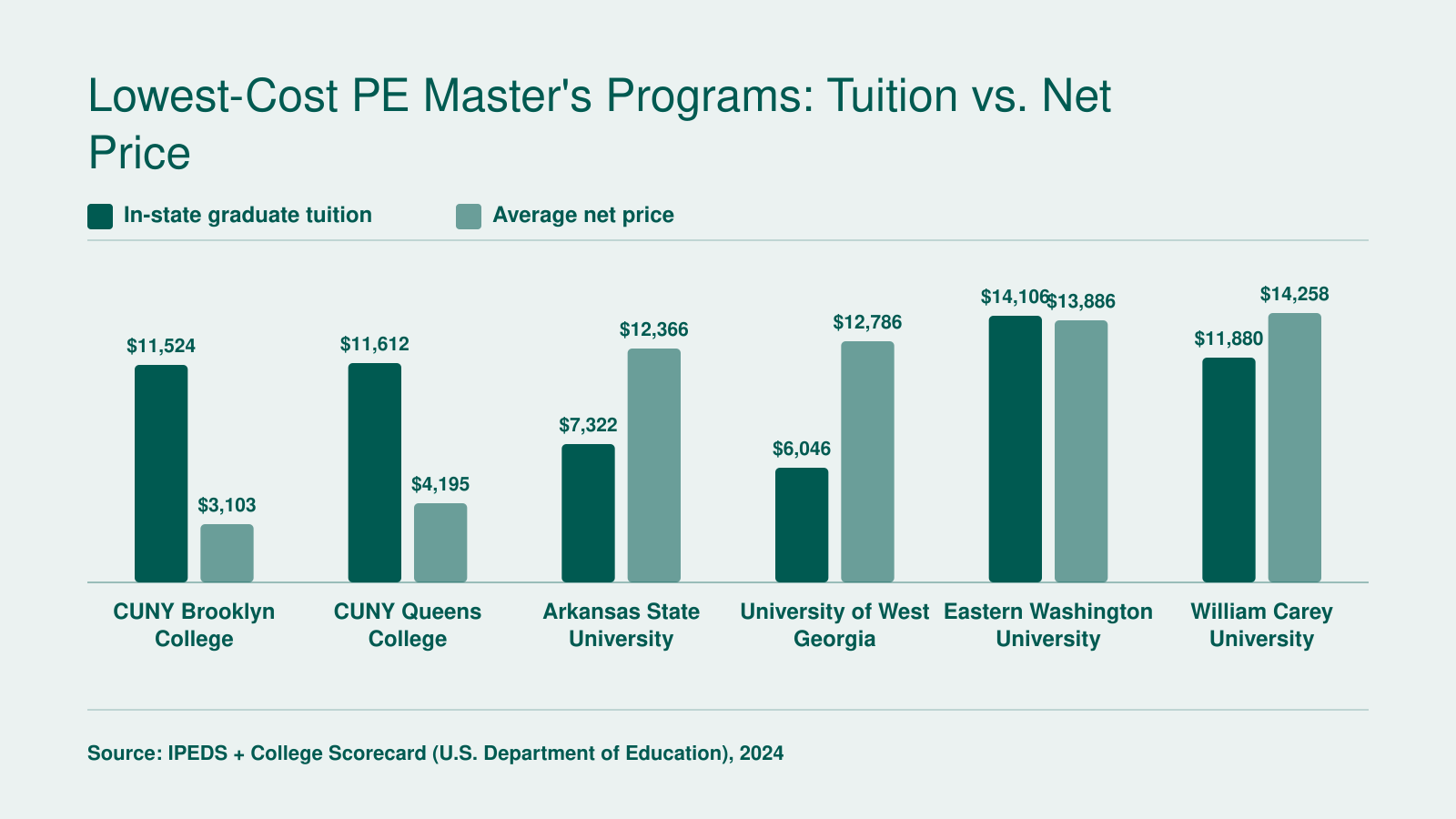
Net price is an institution-wide average, so treat it as a rough guide. It does not isolate graduate students. CUNY Queens College shows a net price of $4,195 and Brooklyn College $3,103, but those figures reflect a student body with heavy need-based aid. Tuition for the master's itself is $11,612 in-state at Queens and $11,524 at Brooklyn. Use net price to compare how generous an institution tends to be, then rely on the program's own tuition for budgeting.
Residency changes the math
Among public schools here, out-of-state tuition often runs well above in-state. Utah State lists $7,828 in-state against $24,773 out-of-state. UNCW lists $8,112 against $24,198. Arkansas State is the lowest in-state at $7,322, with $13,028 out-of-state. SUNY Brockport has the narrowest gap, $12,486 versus $14,746, and offers a fully online option. That is the only school here where the figures suggest residency matters little, so confirm its policy directly. Online delivery alone does not guarantee a flat rate. Eastern Washington's online program lists $335 per credit across 49 credits, or $16,415 total, but its published in-state and out-of-state figures still differ.
Debt and a teacher's budget
No program-level federal debt or monthly repayment figures are available for these programs, so a typical loan balance or payment cannot be quoted. Plan conservatively instead. A master's that adds a certification or salary step should be financed against a teacher's pay, not a future promise.
Questions to ask before you enroll
- Total cost: Ask for credits multiplied by the per-credit rate, plus all fees, for the full degree.
- Reimbursement: Check whether your district offers tuition reimbursement. George Mason, for example, notes employer reimbursement support.
- Salary schedule: Find out whether your district pays a bump for a master's, and how much, before comparing programs on price.
Lowest-Cost PE Master's Programs: Tuition vs. Net Price
Sticker tuition and net price can tell very different stories. The chart compares in-state graduate tuition with each school's average net price. Net price is an institution-wide average after grant aid and not an exact quote for a PE master's student, and it includes living costs, so it can run above tuition. Use it as a rough guide, then confirm your own cost with the school.
Med vs. MS vs. MAT: Which Physical Education Degree Fits Your Goal?
The degree initials matter less than what the program is built to do, and the central tradeoff is between advancing a career you already have and qualifying for one you don't. Program structure and state approval, not the label, decide whether you can teach.
How the Three Degrees Compare
- MEd: Built for licensed teachers who want to deepen their practice or move into leadership.3 A typical example runs about 34 credits, ends in a comprehensive exam rather than a thesis, and requires an existing license.12 It leads to professional licensure, not initial licensure.3
- MS: Leans toward exercise science, research, or doctoral preparation. One common structure pairs roughly 25 core credits with 6 elective credits and a 6-credit thesis.4 It generally does not lead to initial licensure.5
- MAT or PETE route: The most direct path to initial certification for career changers and new graduates.6 The University of Memphis MAT, for example, takes about 18 months, asks for a 3.0 GPA, and requires the Praxis II, with no thesis.
Thesis rules follow the individual program, not the degree title. Some MAT tracks use a portfolio or project, and some MS descriptions are unclear about whether a thesis and a capstone are alternatives. Ask the program directly.
Exceptions to Watch
An MEd can lead to initial licensure only if it is explicitly designed as an initial-certification program. Likewise, an MS is usually not a licensure route, yet West Virginia University offers an accelerated BS/MS pathway that does lead to state initial licensure.5 Even a Master of Arts in Teaching (MAT) is not automatic nationwide: it needs state approval, clinical teaching, exams, and performance assessments, so confirm the grade bands covered and your state's extra requirements.
What Districts Recognize
For K-12 teaching, the state license and physical-education endorsement are what count. Many districts credit a regionally accredited master's toward salary-schedule movement, but no nationwide rule exists. Treatment varies by state, union contract, and local policy, so check your target district's salary schedule before choosing. Outside schools, employers often read an MS as research-oriented, an MEd as applied leadership, and an MAT as classroom preparation, though that is a tendency, not a standard.
Online, Campus, or Hybrid: How PE Master's Formats Work
Which physical education master's format actually fits your schedule, and will an online degree still satisfy your practicum or licensure requirements? The answer depends less on the delivery label than on your status: a certified teacher seeking an advanced credential or a career changer pursuing initial certification.
What the formats look like
The programs below include fully online, campus-based, and hybrid or evening options. Credit totals cluster around 30, but the range is real. Several listed programs require 30 credits, including University of Nebraska at Kearney, Wayne State1, University of South Florida, Northwest Missouri State2, Arkansas3, and SUNY Brockport. University of West Alabama requires 33, Campbellsville ranges from 33 to 39 credits4, and Eastern Washington's online M.Ed. reaches 49 credits. Full-time students commonly finish in one to two years. University of Idaho advertises a 12-month online path for certified PE teachers, Campbellsville describes 12 to 18 months4, West Alabama lists 12 to 24 months, and Arkansas lists roughly 24 months3. Part-time timelines vary with course load, sequencing, and certification status.
The licensure catch: online does not remove field requirements
Online coursework may be asynchronous, but licensure-track and some M.Ed. programs still require in-person or school-based practice. Campbellsville's online MAT includes public school field experiences, and its traditional route ends with 16 weeks of student teaching; its Kentucky Option 6 may waive student teaching only for provisionally certified health and PE teachers who complete a full year of mentoring with the university and district. Eastern Washington's online M.Ed. includes an internship, and Wayne State's separate initial certification pathway requires a four-month full-time clinical. Ask early whether placements can be arranged near your home district.
Online vs campus fit
Fully online or hybrid programs favor working teachers. Asynchronous courses and summer-intensive schedules let certified PE teachers stay employed while completing a master's. A campus-based program may be the better fit for career changers who need supervised teaching hours, in-person coaching, and a stronger school-placement pipeline.
Related Articles
Only six states set minimum physical education participation times for high school students, according to a 2025 summary of findings from SHAPE America's Shape of the Nation report. That gap is one reason state policy, not a single national standard, shapes so much of a PE teacher's job.
Accreditation Checklist Before You Apply
Accreditation is checked in layers, and no single layer settles whether a program will lead to a teaching license. Work through each item below for any program you are considering, including those ranked on mastersprograms.com.
- Institutional accreditationConfirm the school is accredited by an agency recognized by the U.S. Department of Education or CHEA. Search the exact legal name in the Department's DAPIP database, then cross-check CHEA. DAPIP is reported by accrediting and state agencies and is not audited, so confirm status with the accreditor directly.
- Educator preparation accreditationFor licensure-track programs, look for CAEP (successor to NCATE and TEAC, merged in September 2014) or AAQEP accreditation, and verify it on the accreditor's own directory. This is programmatic accreditation. It does not replace institutional accreditation and does not itself grant a license.
- State program approvalCheck your state education department's approved-program list. States differ in what they accept. New York, for example, has partnership agreements with CAEP and AAQEP, but you should not assume every state works the same way.
- Professional licensure disclosureFor online programs, find the disclosure on whether the program meets requirements in the state where you live or plan to teach. Also ask how student teaching is arranged in your state, since online programs still require clinical experience and state authorization.
- SHAPE America alignmentA claim of alignment means the curriculum is built around SHAPE America's professional standards. It is not accreditation, state approval, or a guarantee of licensure eligibility, so treat it as a curriculum signal and verify the items above separately.
Physical Education programs by state
Physical Education Master's FAQ
These answers cover the questions applicants ask most after reading the program comparisons. Requirements differ by school and state, so confirm specifics with each admissions office before you apply.
How long does it take to complete a master's in physical education?
Can I earn a master's in physical education without a teaching license?
Do PE master's programs require the GRE?
Does a master's in physical education raise a teacher's salary automatically?
Compare Physical Education programs on the data that matters
Explore more Education & Teaching specializations or browse every graduate field.
All Education & Teaching programs