Accelerated Master's in Physical Education Programs
Compare 80+ accredited fastest Physical Education programs at 70+ schools, with graduate earnings, cost, debt, and completion data from IPEDS and the U.S. College Scorecard.

An accelerated master's in physical education finishes the degree in as little as 12 months, or trims a year off a combined path by counting graduate credits toward the bachelor's. Northwest Missouri State runs 30 credits in 12 months; Nebraska Kearney's 4+1 option takes five years total.
The payoff is usually a higher pay step or a coaching or leadership role sooner. The schools ranked here put the shortest paths first.
Speed doesn't guarantee a license, though: some one-year tracks assume you already hold teaching certification.
Key Points
- The fastest pathway here finishes in four years via shared graduate credit.
- The lowest in-state tuition here is $6,868 at West Alabama.
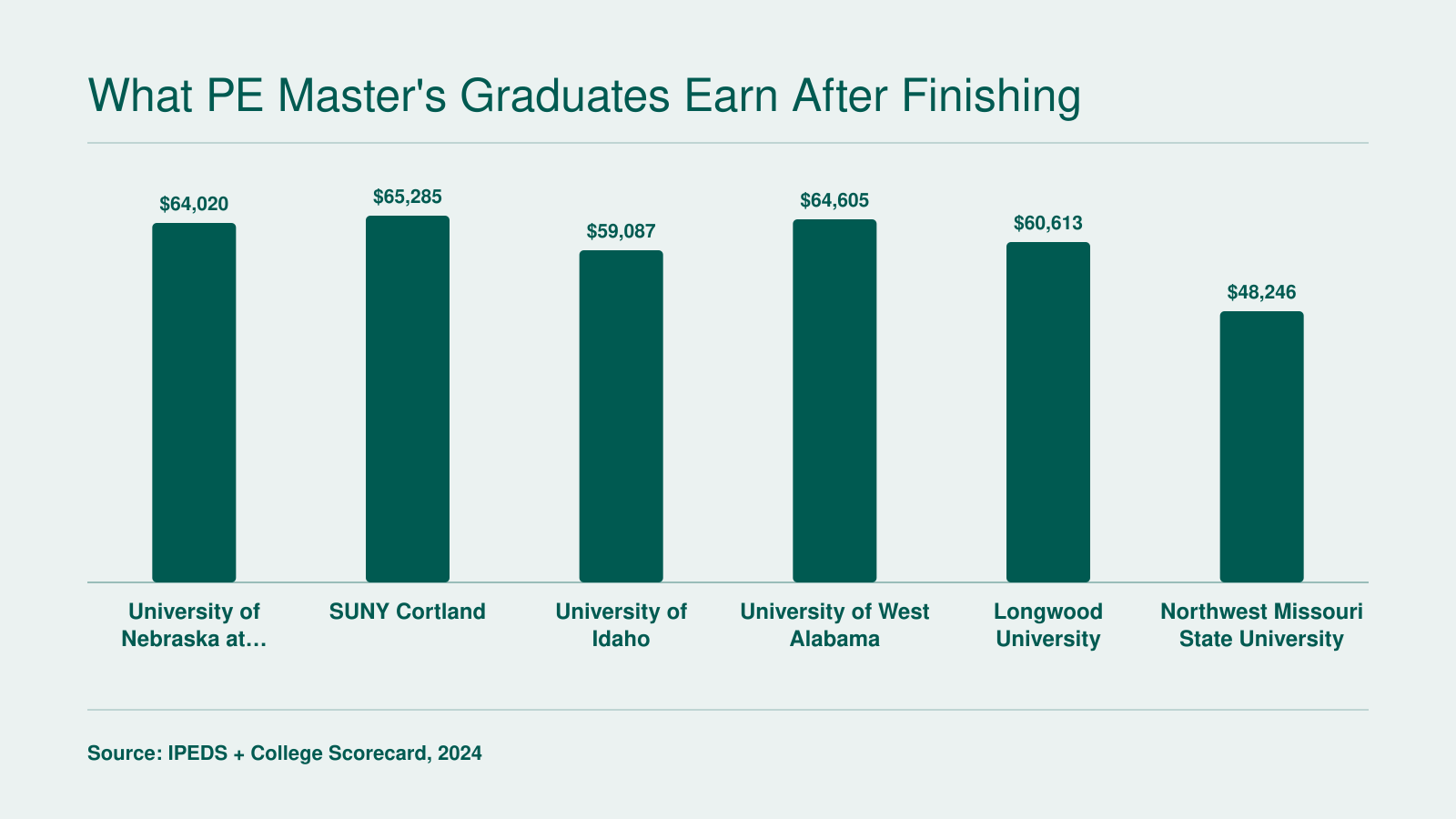
- Four years after finishing, median earnings range from $48,246 to $65,285.
Best Accelerated Physical Education Schools: 2027 Ranking
These accelerated physical education master's programs are ordered first by the shortest route to the degree, then by graduate outcomes and cost. The list includes campus, online, and hybrid formats, with several one-year options for licensed teachers and aspiring educators.
University of Maryland-College Park
#1College Park, MD · ~$18,000/yr (est.)
Best for: Aspiring PreK-12 PE teachers
The University of Maryland's PreK-12 Physical Education M.Ed. pairs initial teacher certification with a one-year, 36-credit graduate degree. Mentored internships in partner schools, edTPA and ISTE portfolios, and a research project give candidates direct classroom experience. The cohort structure and faculty support make it a strong fit for aspiring public school PE teachers.
- Leads to Maryland teacher certification and M.Ed.
- 36 total credit hours, one-year cohort
- Intensive mentored internships in partner schools
- Requires Praxis exams and edTPA teaching portfolio
- Includes ISTE technology portfolio and research project
- Focuses on elementary and secondary PE methods
- Entrance exam required
State University of New York at Cortland
#2Cortland, NY · $10,000 – $15,000/yr (est.)
Best for: Working PE teachers pursuing leadership
SUNY Cortland's online M.S.Ed. in Physical Education Leadership is built for certified physical educators who want to move into school and district leadership. Two tracks in Physical Education Leadership and Adapted Physical Education let students specialize in curriculum design or inclusive programming. A sample one-year timeline and asynchronous online format support working teachers.
- Fully online M.S.Ed. for working teachers
- Two tracks: PE Leadership or Adapted PE
- Requires initial PE teaching certification
- Minimum 3.0 GPA and three references
- Sample one-year program timeline available
- Prepares for school leadership positions
- Includes letter of intent requirement
Longwood University
#3Farmville, VA · ~$8,000/yr (est.)
Best for: Licensed teachers needing flexible online pacing
Longwood University's M.S. in Education with a Health and Physical Education concentration is a fully online program for licensed teachers. Full-time students can finish in one year, while part-time pacing spans two to five years, and there are no on-campus requirements. The curriculum includes adapted PE, community health, and a school or community internship.
- $14,850 total program tuition, $450 per credit
- 33 credit hours, one-year full-time option
- Fully online with no on-campus requirements
- Three start dates: fall, spring, summer
- Internship in school or community setting
- Meets Virginia postgraduate licensure requirements
- Transfer up to nine credits
- Grant proposal project required
University of Nebraska at Kearney
#4Kearney, NE · ~$8,000/yr (est.)
The University of Nebraska at Kearney offers a 30-credit M.A.Ed. in Physical Education fully online with asynchronous courses. Two emphases in Pedagogy and Adapted PE allow specialization, and an accelerated 4+1 option lets undergraduates begin graduate coursework early. The school graduates 58% of students institution-wide.
- 30 credit hours, fully online asynchronous
- Two concentrations: Pedagogy or Adapted PE
- Accelerated 4+1 option for undergraduates
- $369 per credit in state, $591 out of state
- Adapted PE adds Nebraska endorsement
- Thesis or comprehensive project options
- Prepares for National Board Certification
- In-state estimate $12,833.50 total
Northwest Missouri State University
#5Maryville, MO · $5,000 – $10,000/yr (est.)
Northwest Missouri State University's online M.S.Ed. in Health and Physical Education uses accelerated seven-week courses and a 12-month, 30-credit structure. Curriculum covers adaptive PE, risk management, and contemporary teaching approaches, with faculty including former SHAPE America board members. The school graduates 54% of students institution-wide.
- $12,210 total program tuition, $407 per credit
- 30 credit hours, 12-month accelerated format
- Fully online seven-week courses
- Four start dates per year
- Taught by former SHAPE America board members
- No teaching license required for admission
- Focus on adaptive physical education
- Pay-by-the-course tuition
University of Idaho
#6Moscow, ID · $10,000 – $15,000/yr (est.)
The University of Idaho's M.Ed. in Physical Education offers a one-year online option for certified teachers and a three-semester on-campus pathway for those seeking initial certification. The 27-to-35-credit program covers curriculum design, assessment, and whole-school physical activity. The school graduates 57% of students institution-wide.
- 27 to 35 credits, non-thesis
- One-year online option for certified teachers
- On-campus pathway includes teacher certification
- No GRE required, $50 application fee
- Three start dates: fall, spring, summer
- Full-time tuition $11,796 in state, $31,272 out
- Out-of-state tuition waiver through WRGP
- Program interview and three references required
University of West Alabama
#7Livingston, AL · $7,000 – $14,000/yr (est.)
The University of West Alabama's online M.Ed. in Physical Education P-12 is designed for certified teachers seeking Alabama Class A certification. Eight-week courses, a one-year timeline, and a personal success coach support working educators. The school graduates 35% of students institution-wide.
- 33 credit hours, one-year program
- Fully online eight-week courses
- Leads to Alabama Class A certification
- $429 per credit
- Personal success coach assigned
- Up to nine transfer credits accepted
- Flexible self-paced learning
- Financial aid and scholarships available
Cost & outcomes by school
Federal data for the highest-earning Physical Education programs, independent of the ranking above. Earnings are this field's master's graduates four years after completing, where the Scorecard reports them.
| School | Earnings | Tuition / yr | Debt | Grads/yr | Format |
|---|---|---|---|---|---|
| University of West Alabama AL | $64,605 | $6,868 | $27,333 | 42 | Online |
| Longwood University VA | $60,613 | $7,758 | — | 63 | Campus |
| Northwest Missouri State University MO | $48,246 | $8,096 | $17,000 | 171 | Online |
Sources: U.S. Department of Education. Tuition and graduates: IPEDS. Earnings and debt: College Scorecard, this field's master's graduates; a dash means no figure is reported.
Cost, debt & payoff
Median earnings of this field's master's graduates (4 yrs after completing) vs. their median federal loan debt · U.S. College Scorecard
Across these programs the median graduate earns about $61,561 and finishes with roughly $21,380 in debt — a ratio that clears a common rule of thumb (keep debt below first-year salary). Tuition and debt vary widely school to school, so check the per-school figures in the table above before you shortlist.
How Long Does an Accelerated Physical Education Master's Take?
Most accelerated physical education master's pathways land at five years, but the fastest advertised route finishes in four years and a standalone option takes about 12 months.
Shared graduate credit is what shortens the combined path. University of Nebraska at Kearney's 4+1 Physical Education M.A.Ed. lets students count up to 6 graduate credits toward both the bachelor's and the master's, finishing in five years. Wayne State University's AGRADE option in Health and Physical Education Teaching is more generous, allowing up to 16 master's credits during the bachelor's and advertising both degrees in five years. West Virginia University advertises both degrees in four years, the fastest timeline in these descriptions; no summer term is specified.
A one-year master's is a different route. The University of Texas Rio Grande Valley's M.S. in Kinesiology, Physical Education concentration is a 36-credit program designed for about 12 months1, more compressed than a traditional two-year, 30-36 credit master's in physical education.
What Does an Accelerated Physical Education Master's Cost?
Accelerated pathways are changing how students pay for a master's, because the savings now come as much from billing structure as from speed. Across the ranked schools, in-state graduate tuition runs from $6,868 at the University of West Alabama to $18,276 at the University of Maryland-College Park. Out-of-state tuition runs from $8,096 at Northwest Missouri State to $38,207 at Maryland. Net price is only an approximate institution-wide average, so treat it as a rough guide rather than a physical education master's program cost figure.
Savings come from two places. Shared credits may be billed at undergraduate rates: Wayne State says its undergraduate tuition is less than half of graduate tuition and allows up to 16 master's credits during the bachelor's, though it doesn't publish exact rates. You also skip a semester of living costs. As a standard-master's benchmark, Eastern Washington's online master's in physical education runs $345 per credit and $16,905 in total.1
Where program-level median debt is published, it ranges from $17,000 at Northwest Missouri State to $27,333 at West Alabama. Estimated 10-year payments run about $193 to $311 a month.
Also ask about graduate assistantships (Idaho lists teaching assistantships in Movement Sciences) and TEACH Grant eligibility, which carries a teaching service obligation.
According to ETS, the Praxis Physical Education: Content and Design exam (test code 5095) packs 90 selected-response questions and 2 constructed-response questions into a single 2-hour sitting, and the 2026 fee is $156. Passing scores aren't set by ETS. Each state sets its own.
Can You Earn an Accelerated Physical Education Master's Online?
Yes, and most of the schools here offer online master's programs. Cortland, Nebraska Kearney, Northwest Missouri State and West Alabama are online, Idaho is hybrid, and Longwood's Health and Physical Education Graduate Program is fully online and asynchronous. Maryland is the campus-based option.
Speed comes from short terms. Northwest Missouri State runs 7-week courses, West Alabama uses 8-week terms1, and Eastern Washington's Online M.Ed. in Health and Physical Education uses six-week sessions. These programs generally do not publish weekly study hours, so ask admissions how many hours a typical course demands before you enroll.
Online does not always mean no in-person work. Programs that lead to licensure usually expect supervised field experience. Wayne State, for example, requires 200 clinical hours, and Maryland builds in mentored internships in partner schools.
Working teachers usually do best in online formats, since they can keep their jobs and often already hold a license. Career-starters who still need supervised teaching are better served by a campus or hybrid format with placements arranged for them.
Related Articles
Admission Requirements for Accelerated PE Pathways
Minimums vary by school, but accelerated PE and kinesiology pathways share common checkpoints.
- GPAPlan for at least a 3.0. Purdue's 4+1 requires a 3.0, and Humboldt's kinesiology pathway asks for a 3.25 in kinesiology coursework.
- Credits and prerequisitesApply as a junior with most undergraduate requirements complete, about 90 credits at Purdue or 96–108 credits at Humboldt, including roughly 24 kinesiology credits there. Purdue also requires C+ or better in prerequisites such as anatomy and physiology, chemistry, physics, psychology, statistics, exercise physiology, and biomechanics or kinesiology.
- Tests and recommendationsHumboldt's pathway lists a GRE requirement and three recommendation letters, with at least two from kinesiology faculty. UMass Amherst and Purdue do not publish a GRE requirement in their pathway guidance.
- TimingHumboldt opens applications October 1 for fall admission and lists a February 2 deadline; UMass Amherst lists February 1, 2027.
Do Accelerated PE Programs Lead to Teacher Licensure?
First, determine who the program serves: new teachers seeking a first credential or certified teachers deepening expertise. Both exist under the accelerated banner, and they lead to different places.
Initial vs. Advanced Programs
Initial-licensure programs prepare candidates to be recommended for a state teaching certificate, usually in a P-12 physical education grade range. Advanced programs serve teachers who are already certified and want to strengthen their practice or add an endorsement, not earn a first license.
Accreditation and State Approval
Two signals matter. CAEP accredits educator preparation providers at both initial and advanced levels1, but CAEP itself issues no teaching license2. State approval is separate: a state board (South Dakota's, for example) authorizes a program to recommend candidates and makes the final call. Some states accept either CAEP review or their own state accreditation review3.
Moving Between States
Licenses are state-issued and not automatically portable. The NASDTEC Interstate Agreement lets participating states consider an out-of-state certificate, but receiving states may still require their own exams, coursework, or verified experience. Most initial programs also build in supervised student-teaching or practicum hours.
What PE Master's Graduates Earn After Finishing
Four years after finishing, median earnings for these physical education master's programs range from $48,246 at Northwest Missouri State University to $65,285 at SUNY Cortland. The other ranked schools fall in between, and the share of graduates employed one year after finishing is 97% or higher at each school that reports it.
How We Rank Accelerated Physical Education Schools
This ranking sorts physical education master's programs first by how quickly you can finish, since speed is the main reason to choose an accelerated path. Among programs with similar timelines, we then weigh cost (published graduate tuition and the average net price students actually pay) and outcomes (program-level earnings and debt reported by the College Scorecard).
One caveat: graduation rates and net price describe the whole university, not the PE program alone. Read them as context, not as a direct measure of your department.
Prestige plays no role. A famous name earns nothing unless its graduates' earnings and debt support it. A smaller school that gets you finished faster and for less can rank above it.
Physical Education programs by state
Accelerated Physical Education Master's FAQ
Quick answers to common questions about accelerated physical education master's programs, based on published program details.
What is the fastest accelerated physical education master's program?
Can I start teaching while finishing an accelerated PE master's?
Is a health education master's a good alternative to a PE master's?
Compare Physical Education programs on the data that matters
Explore more Education & Teaching specializations or browse every graduate field.
All Education & Teaching programs