Best Master's in Secondary Education Programs in Oregon
Compare 4 accredited Secondary Education programs in Oregon, with graduate earnings, cost, debt, and completion data from IPEDS and the U.S. College Scorecard.

Which Oregon master's leads to a middle or high school teaching license without outrunning early teaching pay? In-state graduate tuition runs from $11,679 at Portland State University to $16,137 at the University of Oregon; Western Oregon University sits at $11,879.
The spread is modest, but the credential outcome is not. Oregon's TSPC licenses only completers of approved programs, so a MAT aimed at initial licensure differs from an MEd for already-licensed teachers. Early secondary pay leaves little room for a degree that adds cost without the credential.
Key Points
- Rankings weigh graduate earnings, net price, and completion rates from federal data.
- Oregon licensure requires a TSPC-approved teacher preparation program and content exam.
- Most ranked programs no longer require GRE scores for 2027 admission.
Oregon's Top-Ranked Master's in Secondary Education Programs
The three programs below earned their spots on what graduates pay, how often students finish, and what completers earn afterward, all drawn from federal IPEDS and College Scorecard records. Each card highlights the licensure track, accreditation or approval status, and campus or hybrid format that matter most for Oregon secondary educators.
University of Oregon
#1Eugene, OR · ~$19,000/yr (est.)
Best for: Future subject specialists wanting embedded ESOL
University of Oregon's UOTeach Curriculum and Teaching MEd is a one-year, full-time or part-time pathway to a master's and Oregon secondary teaching license, with subject endorsements in math, science, English, social studies, and world languages. The program embeds an ESOL endorsement and uses a cohort model with equity-focused pedagogy and hands-on student teaching in local classrooms. UO's AAQEP accreditation runs through June 30, 2028, it is TSPC-approved, and the university's institution-wide graduation rate is 72%.
- One-year full-time or part-time pathway
- Middle and high school subject endorsements
- Math, science, English, social studies, and world languages
- Embedded ESOL endorsement
- Cohort-based with equity-focused pedagogy
- Hands-on student teaching in local classrooms
- Starts summer
Portland State University
#2Portland, OR · ~$18,000/yr (est.)
Best for: Working adults needing hybrid scheduling
Portland State University's Graduate Teacher Education Program offers a master's in secondary education for grades 6 through 12 in one-year full-time or two-year hybrid formats. The cohort-based curriculum emphasizes equity and social justice, with field placements throughout Portland-area schools and a progression from practicum to full-time student teaching. PSU is TSPC-approved, and the university reports a 53% institution-wide graduation rate.
- 63 total credit hours
- One-year full-time or two-year hybrid formats
- Cohort-based structure
- Field placements throughout Portland-area schools
- Half-time then full-time student teaching
- Mix of in-person and online coursework
- Daytime and evening scheduling
Western Oregon University
#3Monmouth, OR · ~$19,000/yr (est.)
Best for: Second-career candidates seeking licensure
Western Oregon University's Master of Arts in Teaching with an Initial Secondary Licensure track is designed for second-career and nontraditional students seeking both a graduate degree and initial Oregon licensure. The program emphasizes planning instruction, classroom climate, and edTPA performance assessment, with placements determined by participating schools across Oregon. WOU is TSPC-approved, and the university reports a 47% institution-wide graduation rate.
- Initial secondary and elementary licensure tracks
- Aligned with Oregon TSPC standards
- Leads to partial preliminary teaching license
- Uses edTPA performance assessment
- Plan instruction for student progress
- Establish classroom climate for learning
Cost & outcomes by school
Federal data for the highest-earning Secondary Education programs, independent of the ranking above. Earnings are this field's master's graduates four years after completing, where the Scorecard reports them.
| School | Earnings | Tuition / yr | Debt | Grads/yr | Format |
|---|---|---|---|---|---|
| Portland State University OR | $62,874 | $17,745 | $40,495 | 39 | Campus |
| Western Oregon University OR | $60,465 | $19,452 | $34,166 | 34 | Hybrid |
| University of Oregon OR | $60,111 | $19,474 | $29,591 | 84 | Campus |
| University of Portland OR | — | $27,000 | — | — | Campus |
Sources: U.S. Department of Education. Tuition and graduates: IPEDS. Earnings and debt: College Scorecard, this field's master's graduates; a dash means no figure is reported.
Cost, debt & payoff
Median earnings of this field's master's graduates (4 yrs after completing) vs. their median federal loan debt · U.S. College Scorecard
Across these programs the median graduate earns about $60,465 and finishes with roughly $34,166 in debt — a ratio that clears a common rule of thumb (keep debt below first-year salary). Tuition and debt vary widely school to school, so check the per-school figures in the table above before you shortlist.
How Oregon's TSPC Licenses Secondary Teachers
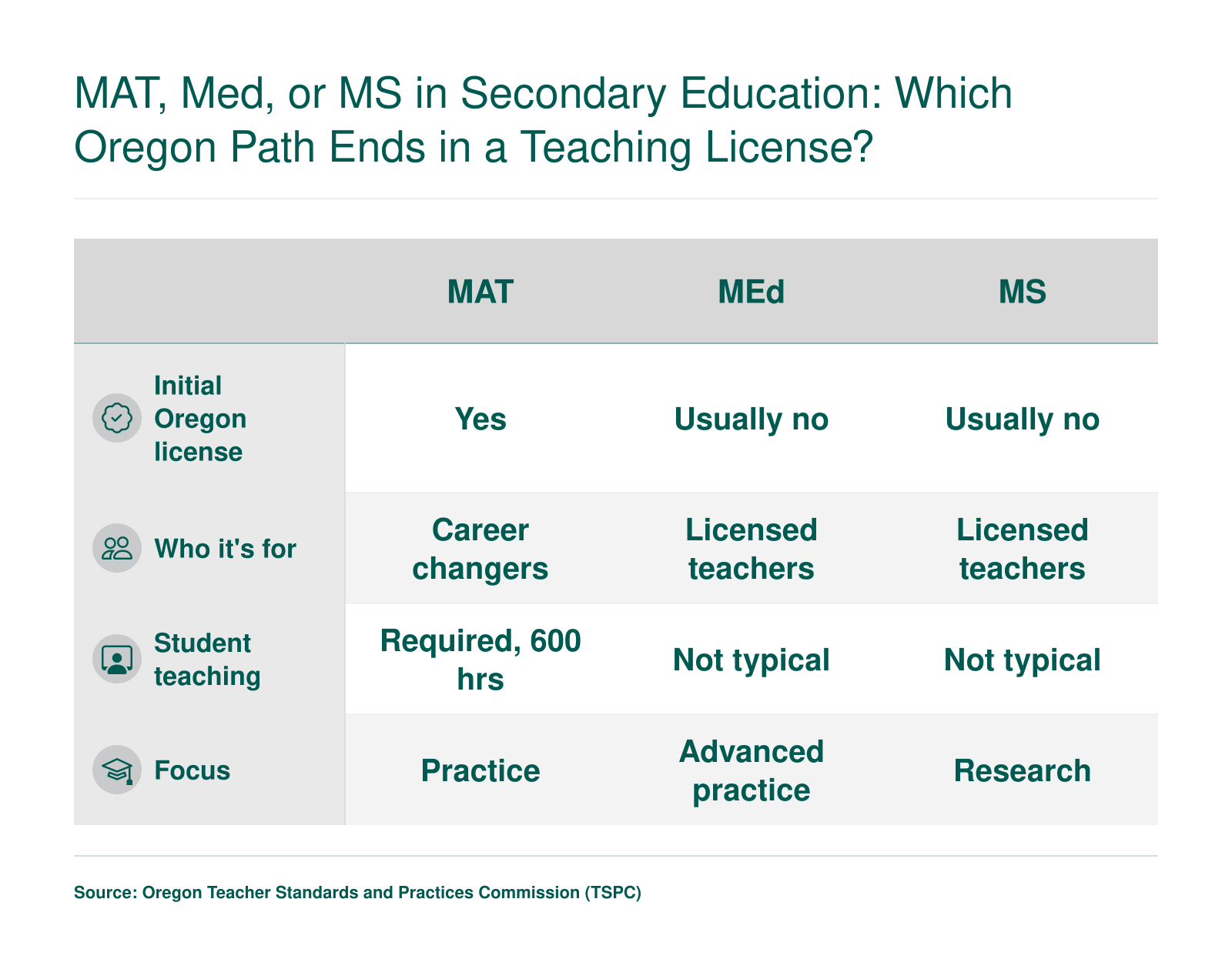
MAT, Med, or MS in Secondary Education: Which Oregon Path Ends in a Teaching License?
Oregon's secondary education master's degrees do not all mean the same thing. Most MAT programs are built for people who still need an initial Preliminary teaching license, while MEd and MS programs usually serve teachers who already hold a license and want advanced study. If you already hold a license, you generally want an advanced MEd or MS, not an initial-licensure program. Degree titles are not consistent, so verify TSPC approval for any program before applying.
Related Articles
Online and Hybrid Master's in Secondary Education Options in Oregon
Among the ranked programs, the master's in secondary education options concentrate on campus study. The University of Oregon's UOTeach MEd and Western Oregon University's M.A.T. both run as campus programs, as does Portland State University's Graduate Teacher Education Program, which is in person and offers daytime and evening scheduling across its quarter-based terms.
In-Person Student Teaching Is Non-Negotiable
Even the most flexible formats require supervised student teaching in an Oregon middle or high school; a license cannot be earned remotely. Expect a substantial clinical commitment. Programs structure this differently, often beginning with part-time field work before moving to a full-time takeover of a classroom. Placements are typically arranged through partner districts, and schools commonly bar placing you where you have personal relationships.1
Working Adults and Out-of-State Students
PSU's cohort model offers both daytime and evening scheduling, and some programs split student teaching into a lighter fall and full-time spring1 to ease the transition for those still working.
If you are enrolling online from outside Oregon, confirm two things before you pay a deposit: that the program is approved for an Oregon teaching license, and that it can secure a supervised placement near where you actually live.
For 2024-25, Oregon designated mathematics, science (notably physics and chemistry), special education, bilingual/ELL education, Spanish, and speech-language pathology as teacher shortage areas. Earning an endorsement in one of these subjects can open eligibility for federal loan forgiveness and service scholarships, which changes the math on your tuition bill.
Which Oregon Secondary Education Master's Programs Waive the GRE?
Most Oregon teacher-prep master's programs no longer require the GRE. The table below lists the published policy for each program in the ranking; where a program does not publish a GRE policy, that is shown as no published policy.
| Program | GRE Policy | Application Deadline(s) | Minimum GPA | Other Requirements |
|---|---|---|---|---|
| University of Oregon | No published policy | Not stated | Not stated | Not stated |
| Portland State University | No published policy | Not stated | Not stated | Not stated |
| Western Oregon University | No published policy | Not stated | Not stated | Not stated |
What a Master's in Secondary Education Costs in Oregon, Including Licensure Fees
Graduate tuition, the main driver of master's in secondary education cost, spans a wide range, and the sticker price is only part of what you will pay to stand in front of a classroom.
Tuition and What Comes After Aid
For residents, published graduate tuition is about $11,679 per year at Portland State University, $11,879 at Western Oregon University, and $16,137 at the University of Oregon. Those figures climb sharply for nonresidents (UO reaches $44,598). Institution-wide net price, the approximate average students actually pay after grants and scholarships, tends to land lower than list tuition: roughly $9,552 at Portland State and $17,237 at Western Oregon.
Adding the Licensure Costs
Tuition is not the whole bill. For example, among OSU graduate programs, the online Teaching M.A.T. charges $609 per quarter credit for 2026-27, and at 52 credits that works out to about $31,668, plus a one-time $380 matriculation fee. On top of program tuition, budget for:
- Testing: NES/ORELA content exams carry per-test fees.
- TSPC licensing: The Preliminary teaching license costs $1871, and recent application and eLicensing fees add roughly $182 plus $10, before fingerprinting.2
All in, expect several hundred dollars beyond tuition to finish licensure.
One Money Tip
Ask each program about TEACH Grant eligibility; it can offset tuition if you commit to teaching in a high-need field.
Oregon Secondary Education Master's: Your Questions Answered
Answers to common questions about Oregon secondary education master's degrees, endorsement rules, testing, and licensure transfer, based on TSPC guidance and University of Oregon licensure information.
Which Oregon master's in secondary education program is best for a math or science endorsement?
What are the licensure test pass rates for Oregon teacher preparation programs?
Which Oregon secondary education master's programs lead to an initial teaching license?
Can I add a second subject endorsement during or after my master's?
Do I have to pass a content test before student teaching in Oregon?
Can I keep working full time while earning a secondary teaching master's?
Will an Oregon teaching license transfer to Washington or another state?
How many months do Oregon secondary MAT programs usually take?
Compare Secondary Education programs on the data that matters
Explore more Education & Teaching specializations or browse every graduate field.
All Education & Teaching programs