Best Master's in STEM Education Programs in Oregon
Compare accredited Stem Science Technology Engineering Math master's programs by earnings, cost, and outcomes.
Sample layout — live rankings and program data appear here once the data source is connected.
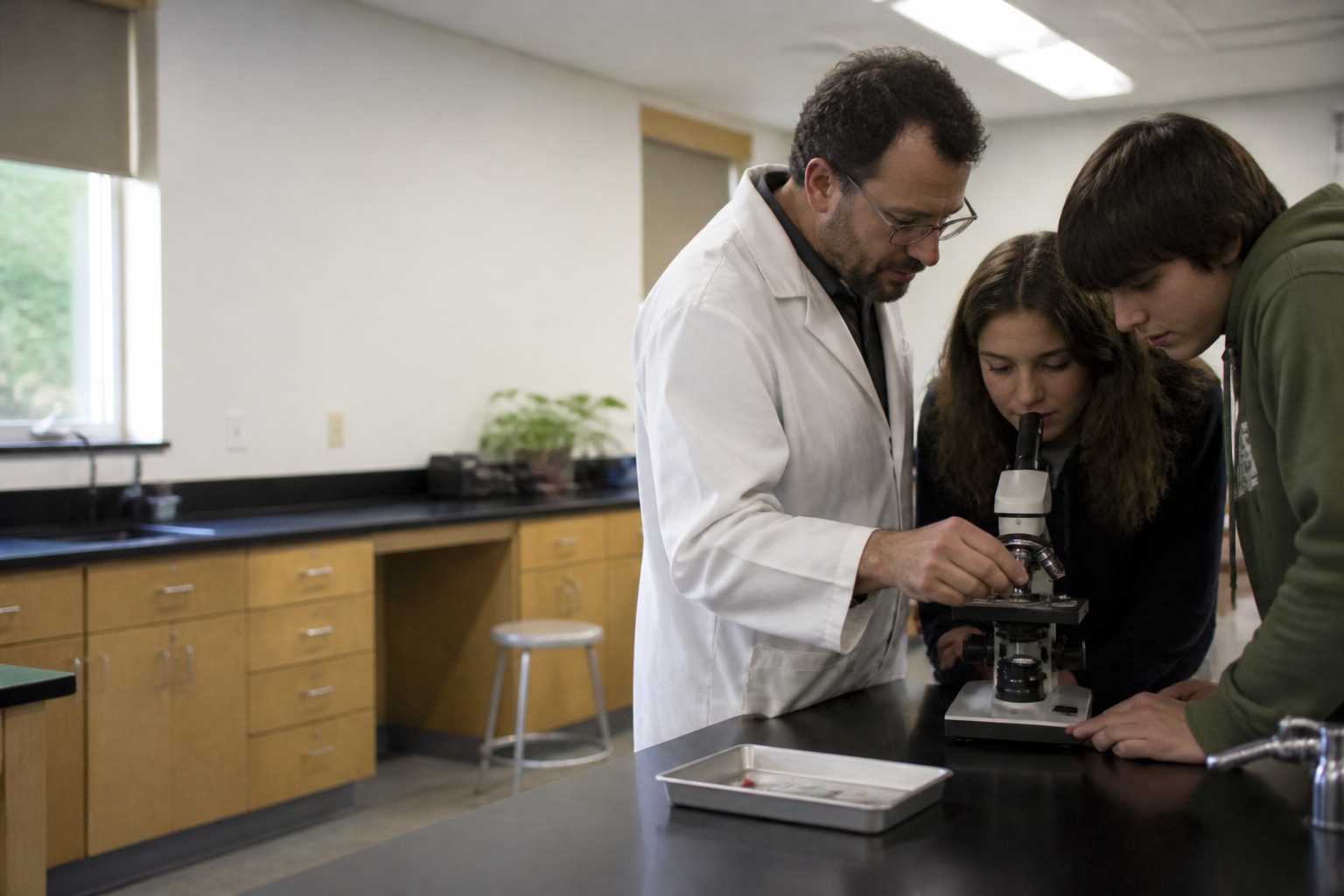
A master's in STEM education in Oregon usually means one of two things: an initial licensure route that turns a scientist or engineer into a licensed math or science teacher, or an advanced degree for someone already licensed.
In-state graduate tuition at the schools ranked here runs from about $16,200 to $30,500, a range worth comparing against the Most Affordable Master's in STEM Education Programs.
Key Points
- Oregon State University lists its STEM education master's as hybrid in 2027.
- OSU and OSU-Cascades list 2026-2027 graduate tuition at $518 per credit.
- Licensure tracks separate new teachers from already licensed educators.
Best Master's in STEM Education Programs in Oregon, Ranked
This ranking highlights Oregon master's programs that can lead to STEM education careers, with an emphasis on licensure pathways, classroom experience, and research-backed teaching preparation. We compare tuition, delivery formats, and program structure so you can weigh cost against long-term career value.
Oregon State University
#1Corvallis, OR · $15,000 – $20,000/yr (est.)
Best for: Licensure-focused STEM teacher candidates
This hybrid M.S. in Education is the ranking's strongest STEM education fit, preparing secondary math and science teachers through a cohort model with asynchronous online coursework and in-person Saturdays in Corvallis. Students complete two professional internships and a full-time student teaching placement in spring, totaling more than 700 hours of classroom experience, and graduate with a K-12 Oregon Teaching License plus subject matter endorsements. Oregon State's STEM Research Center, established in 2012 and directed by Martin Storksdieck of the College of Education, works on learning ecosystems and equity-focused STEM teaching. The school reports an institution-wide graduation rate of about 70%.
- Two professional internships
- Full-time student teaching in spring
- More than 700 student teaching hours
- Hybrid national student cohort with asynchronous online classes and in-person Saturdays on Corvallis campus
- Full-time one-year or part-time two-year cohort options
- K-12 Oregon teaching license with math or science endorsements
- $609 per credit
- 47 to 53 quarter credits required
- ESOL endorsement optional
- Concentrations in mathematics education and science education
University of Portland
#2Portland, OR · ~$27,000/yr (est.)
Best for: Working professionals in operations management
This private university in Portland offers a STEM-designated Master of Science in Operations and Technology Management rather than a dedicated STEM education degree. The program emphasizes analytics, quality, project management, and leadership, with four concentration options and case-study work with local companies. AACSB accreditation and a two-year timeline are notable features. The school has an institution-wide graduation rate of about 80%.
- STEM-designated degree program
- Four concentration options, including IT management and supply chain management
- 3.2 GPA minimum
- 2 letters of recommendation (minimum)
- Prerequisite courses required
- AACSB accredited
- Financial aid available
- Coursework covers analytics, quality, project management
- Work with local companies on case studies
- Ethics-focused Holy Cross tradition
University of Oregon
#3Eugene, OR · ~$19,000/yr (est.)
Best for: Analytically minded computer science and economics students
The University of Oregon contributes STEM education research through the Oregon Education and Science Laboratory, which studies STEM+C teaching and learning with a focus on equity and inclusion, and STEM CORE, a consortium of science, mathematics, education faculty and K-12 partners. Its ranked programs include a Master of Science in Computer Science and a STEM-designated Master's in Economics, both on campus in Eugene. The school has an institution-wide graduation rate of about 72%.
- 54 total credit hours
- 3.0 GPA minimum
- Thesis or project track
- Public thesis presentation required
- Electives in linguistics, math, physics, psychology
- Scholarships available
- No entrance exam required; test optional, reports GRE
- 1-year program, 48 total credit hours, 12 courses
- Apply by 2027-05-01
- Full-time and part-time options; starts fall
- 3.0 GPA minimum; prerequisite courses required
- STEM-designated economics degree
- More than 20 electives each year; optional thesis or research paper
- Three-course econometrics sequence
Portland State University
#4Portland, OR · ~$18,000/yr (est.)
Portland State University offers campus-based STEM master's programs in computer science and systems science. The computer science program features 45 credits, part-time options, internships for credit, and access to Portland's Silicon Forest employer network. The systems science program emphasizes integrative problem solving with thesis or capstone options and test-optional admission. The school's overall graduation rate is about 53%.
- 45 total credit hours
- Part-time available; fall, winter, spring starts
- Internships count toward degree credits
- Dedicated staff advisor for master's students
- Located in Portland's Silicon Forest; top employers Google, Amazon, Intel
- Courses include cybersecurity and quantum computing
- Offered by Maseeh College of Engineering
- No entrance exam required; test optional, reports GRE/GMAT
- 45 total credit hours; starts fall
- 3.0 GPA minimum
- 2 letters of recommendation (minimum)
- Thesis or capstone option
- Three degree completion options; adviser assigned upon admission
Oregon Health & Science University
#5Portland, OR · $30,000 – $35,000/yr (est.)
Oregon Health & Science University offers health-focused STEM master's programs in biomedical informatics and bioinformatics. The online biomedical informatics master's features concentrations in health and clinical informatics, three start dates per year, and part-time completion options. The campus-based bioinformatics program is offered at the M.S., Ph.D., and M.D.-Ph.D. levels.
- 2 concentration options
- 2-year full-time program; part-time completion in 6 years
- 3 start dates per year: fall, winter, spring
- 10-15 hours per week per course
- Up to 16 transfer credits
- Financial aid available
- Delivered online
- Includes lectures, quizzes, exams
- Offered as M.S., Ph.D., M.D.-Ph.D.
- Financial aid and scholarships available
Online and Hybrid Master's in STEM Education Options in Oregon
None of the math or science teaching license routes at the schools ranked here runs entirely online, though advanced coursework for teachers who already hold a license can come close. Oregon State University lists its STEM education master's as online and hybrid, Oregon Health & Science University lists its program as online, and University of Portland, University of Oregon and Portland State University list theirs as campus-based.
Oregon State is where format matters most. Its 2025-26 program guide places the M.S. in Math or Science Education under both online and hybrid delivery, and the program is aimed at licensed K-12 math and science teachers. Its program listing also mentions in-person Saturdays on the Corvallis campus, so confirm which sessions apply to your cohort before assuming you can study from anywhere.
Initial licensure works differently. The MAT in Mathematics or Science, one of the MAT programs in Oregon, is taught at OSU-Cascades in Bend, with in-person coursework plus internships and practica that include classroom observation and teaching practice.1 Oregon State's Ecampus does not list a math or science MAT.
Can you finish a STEM education master's entirely online in Oregon, or should you compare the best online master's in STEM education programs? If you already teach, one of the online master's programs in Oregon or a hybrid advanced degree may get you most of the way. If you need your first license, plan on in-person classroom placements in an Oregon school.
Master's in STEM Education Cost and Financial Aid in Oregon
The table orders the programs by net price, which is an institution-wide average after grant and scholarship aid and is not a quote for any single degree. Oregon State University and OSU-Cascades list 2026-2027 graduate tuition at $518 per credit for Oregon residents and $1,204 for nonresidents, with a flat range from 9 to 16 credits. Portland State University has the lowest net price after aid here at $9,552, while Oregon State shows the lowest in-state graduate tuition at $16,206; aid routes for Oregon STEM teachers include the federal TEACH Grant, up to $4,000 per year with a four-year service commitment, and the Oregon Teacher Scholars Program, up to $12,000 per year for licensure fields, though the 2026-2027 application is closed.
| School | In-State Graduate Tuition | Out-of-State Graduate Tuition | Net Price After Aid (Institution Average) |
|---|---|---|---|
| Portland State University | $17,745 | $23,334 | $9,552 |
| Oregon State University | $16,206 | $33,351 | $19,604 |
| University of Oregon | $19,474 | $33,379 | $22,182 |
| University of Portland | $27,000 | $27,000 | $28,210 |
Related Articles
Which Oregon STEM Education Master's Programs Lead to Teacher Licensure?
Oregon STEM education master's programs fall into two groups, and the distinction matters before you apply. The first prepares career changers and new teachers for an Oregon Preliminary Teaching License.1 The second serves people who already hold a license and want advanced study or an added endorsement.
Programs for initial licensure
The Master of Arts in Teaching is the path if you do not yet hold a license. The OSU-Cascades MAT offers elementary and secondary options and leads to the Preliminary Teaching License.1 For secondary STEM candidates, an Oregon secondary education master's program that builds on a bachelor's degree in your subject is the most direct route, pairing roughly a year of coursework with supervised student teaching.2
Programs for already-licensed teachers
Some online STEM-focused master's programs are built for teachers who already hold a license and want deeper content or an additional endorsement rather than first-time licensure. If your goal is your initial license, confirm with the program's admissions office that completing it actually certifies you through TSPC; an advanced degree alone does not.
The core TSPC steps
- Approved program: Complete a TSPC-approved educator-preparation program.1
- Content tests: Pass the subject-matter and pedagogy exams TSPC requires for your endorsement.1
- Background check: Clear fingerprint-based screening before licensure.1
Check each program's current endorsement list directly, since available subjects change.3
Oregon's Teacher Licensing Board: TSPC
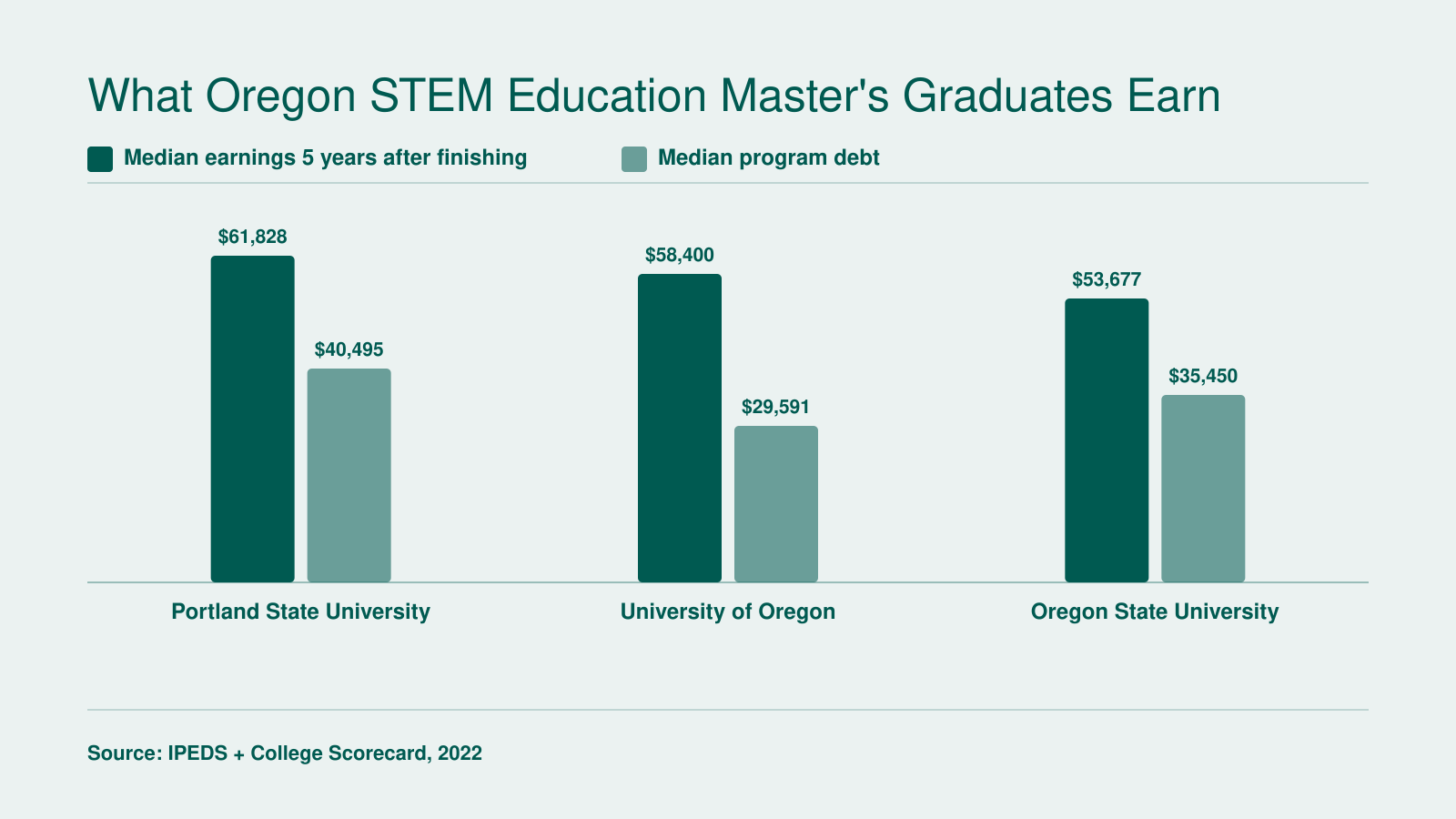
What Oregon STEM Education Master's Graduates Earn
Five-year outcomes show how these programs pay off. The chart pairs median earnings five years after finishing with median program debt, so you can weigh salary against the cost of borrowing.
Frequently Asked Questions About Master's in STEM Education Programs in Oregon
Here are answers to common questions about completing a master's in STEM education in Oregon. Because licensure and deadlines vary, confirm details directly with each program before applying.
Does an online STEM concentration lead to an Oregon teaching license?
What STEM subjects can you specialize in beyond mathematics and science?
When do Oregon STEM education master's programs start, and what are the application deadlines?
Which Oregon STEM education master's programs are designed for already licensed teachers?
Compare Stem Science Technology Engineering Math programs on the data that matters
Explore more Education & Teaching specializations or browse every graduate field.
All Education & Teaching programs