Best Online Master's in STEM Education Programs
Compare accredited Stem Science Technology Engineering Math master's programs by earnings, cost, and outcomes.
Sample layout — live rankings and program data appear here once the data source is connected.

Schools keep struggling to staff science, math, and technology classrooms, and a master's in STEM education is one way for working teachers to move into lead and curriculum roles without leaving the classroom.
Every program here is 100% online. Hybrid formats are excluded.
The main caveat comes first: most of these degrees are built for current teachers, and only some lead to initial licensure. Citadel's interdisciplinary STEM M.Ed., for example, states plainly that it does not lead to certification. Confirm that before comparing tuition.
Key Points
- The 2027 fully online rankings weigh cost, graduation rate, and earnings outcomes.
- Accreditation alone does not guarantee teaching authorization in your state.
- STEM education master's graduates earn $70,550 to $101,786 five years later.
Top 10 Fully Online Master's in STEM Education Programs for 2027
These 10 fully online STEM education master's programs were selected and ordered using a composite of cost, each institution's graduation rate, and federal College Scorecard outcomes. In-person or hybrid components are not part of this ranking. Because the list is built from IPEDS and Scorecard data rather than prestige, prospective students can compare schools on the tradeoffs that actually affect their finances and careers.
Citadel Military College of South Carolina
#1Charleston, SC · $13,000 – $19,000/yr (est.)
Best for: Working educators seeking STEM leadership
The Citadel's Master of Education in Interdisciplinary STEM Education is a fully online, asynchronous 30-credit program for current teachers, informal educators, and STEM professionals. Core work covers educational technology, project-based learning, and STEM literacy, while electives span robotics, forensic science, and app development. Graduate tuition is about $12,600 in-state and $38,500 out-of-state, with an institution-wide average net price near $20,700. The school's graduation rate is 75%.
- 30-credit asynchronous online degree
- 15 core credits plus 15 elective credits
- Electives include robotics, forensic science, and app development
- Does not lead to teacher certification
- Optional computer science endorsement pathways for licensed teachers
- Open to formal and informal educators
North Carolina State University at Raleigh
#2Raleigh, NC · $12,000 – $33,000/yr (est.)
Best for: Science teachers pursuing advanced licensure
NC State's online M.Ed. in STEM Education with a Science Education concentration is a 30-credit degree for practicing science teachers. Elective options include biology, chemistry, forestry, and climate science, and the program meets North Carolina's advanced licensure requirements. Graduate tuition is about $8,800 in-state and $32,800 out-of-state, with an institution-wide average net price near $17,300. The school's graduation rate is approximately 85%.
- 30-credit online program for practicing science educators
- Electives in biology, chemistry, forestry, and climate science
- No entrance exam required
- Meets North Carolina advanced licensure requirements
- Supports National Board Certification
- Full-time finish in two years; part-time three to four
Texas A&M University-College Station
#3College Station, TX · ~$12,000/yr (est.)
Best for: Teachers needing asynchronous cohort structure
Texas A&M's asynchronous, cohort-based M.Ed. in Curriculum and Instruction with a STEM emphasis is a 36-credit program built for working teachers. It includes an integrated 12-credit graduate STEM certificate and focuses on action research across curriculum, instruction, and assessment. Graduate tuition is about $13,200 in-state and $40,100 out-of-state, with an institution-wide average net price near $21,300. The school reports an 84% graduation rate, and four-year earnings data shows a median of about $78,300.
- 36-credit asynchronous, cohort-based program
- Includes integrated 12-credit graduate STEM certificate
- No thesis or capstone required
- Designed for working educators
- Starts in summer; financial aid available
California State University-Northridge
#4Northridge, CA · ~$9,000/yr (est.)
CSUN's Master of Arts in Secondary Mathematics Education is a two-year, online, cohorted 30-unit program for California secondary math teachers. Core classes meet Tuesday evenings, and students finish with an applied classroom-based research project. Graduate tuition is about $7,500 in-state and $20,100 out-of-state, with an institution-wide average net price near $7,000. The school's graduation rate is 57%.
- Two-year, online, cohorted 30-unit degree
- Tuesday evening core classes, four semesters
- Applicants must reside in California
- CSUN credential coursework may satisfy electives
- Applied classroom-based research project
Michigan State University
#5East Lansing, MI · $22,000 – $42,000/yr (est.)
MSU's fully online Master of Arts in Education with a Science and Mathematics Education concentration is a 30-credit degree that includes a capstone and online portfolio. At $933 per credit, tuition is about $16,500 in-state and $43,800 out-of-state, with an institution-wide average net price near $19,700. The program does not provide Michigan endorsement or initial certification. The school reports an 81% graduation rate.
- Fully online option available
- 30 credits, minimum 1.5 years
- $933 per credit
- Requires work experience, 3.0 GPA, goal statement, three recommendations
- No Michigan teacher certification
- Capstone and online portfolio required
Saint Joseph's University - Philadelphia
#6Philadelphia, PA · ~$20,000/yr (est.)
Saint Joseph's offers a fully online 30-credit Master's in Curriculum and Instruction with a STEM Education concentration through its School of Education. The program serves K-12 teachers, curriculum specialists, and STEM professionals, with additional literacy and ESL options. Graduate tuition is about $53,300 for both in-state and out-of-state students, with an institution-wide average net price near $29,700. The school's graduation rate is approximately 79%.
- 30-credit fully online program
- STEM Education concentration; literacy and ESL options
- Serves K-12 teachers and curriculum specialists
- Housed in School of Education and Human Development
- No campus attendance required
University of Maryland-Baltimore County
#7Baltimore, MD · $15,000 – $20,000/yr (est.)
UMBC's professionally focused Data Science M.S. can be taken in hybrid and online formats and emphasizes practical data analysis, problem-solving, and management. The program is built for working professionals aiming at data science and analytics leadership roles. Graduate tuition is about $13,300 in-state and $31,300 out-of-state, with an institution-wide average net price near $16,500. The school's graduation rate is 70%.
- Hybrid and online format options
- Courses taught by industry practitioners
- Focus on practical data analysis and management
- Scholarships and financial aid available
- Multiple campus locations available
University of Connecticut
#8Storrs, CT · ~$23,000/yr (est.)
UConn's MBA includes two STEM-designated tracks in business analytics and supply chain management, with online, in-person, and hybrid formats. The 42-credit program takes about two years and includes career coaching and alumni access. Graduate tuition is about $21,000 in-state and $43,700 out-of-state, with an institution-wide average net price near $25,100. The school's graduation rate is 83%.
- 42-credit program, about two years to complete
- Business Analytics or Supply Chain Management tracks
- Online, in-person, or hybrid formats
- STEM designation supports extended OPT for international graduates
- Customized career coaching and alumni access
Grove City College
#9Grove City, PA · ~$9,000/yr (est.)
Grove City College's Master of Engineering in Systems Engineering and Technology Management is a 30-credit program for engineers and computer scientists moving into technical leadership. It can be completed in as little as one year, with full- or part-time pacing. Graduate tuition is about $21,700 regardless of residency, and the school reports an 83% graduation rate.
- 30-credit degree for engineers and computer scientists
- Complete in as little as one year
- Full-time and part-time options available
- Tuition below state and national averages
- Prepares for technical leadership roles
University of California-Davis
#10Davis, CA · $15,000 – $20,000/yr (est.)
UC Davis's 15-month Online Master of Management is a STEM-designated, 36-unit degree for early-career professionals and career changers. No work experience is required, and GMAT/GRE scores are optional. Graduate tuition is about $16,800 in-state and $51,000 out-of-state, with an institution-wide average net price near $14,700. The school's graduation rate is about 86%.
- 15-month, 36-unit STEM-designated curriculum
- Live online classes plus flexible study
- No entrance exam, GMAT/GRE optional
- Rolling admissions with spring and fall starts
- Personalized career plan and alumni network
None of the ranked Stem Science Technology Engineering Math programs match the online lens yet. The full ranking is at the link above.
Accreditation and State Licensure: Will an Online STEM Education Master's Get You Certified?
Regional accreditation vouches for the university. Educator-preparation accreditation vouches for the teaching program itself. Districts and state boards often want both. Regional accreditation is institution-wide and may not satisfy a board that requires an approved or programmatically accredited preparation provider. CAEP and AAQEP review STEM education master's programs, not whole campuses, and neither replaces institutional accreditation. Whether a given program needs one depends on your licensure goal and your state's approval rules.
Know Which Degree You Are Buying
- Initial licensure: Built for career changers who do not yet hold a teaching license. These carry the heaviest accreditation and state-approval scrutiny.
- Add-on endorsement: For licensed teachers adding a STEM, math, or science endorsement to an existing credential.
- Professional development: For licensed teachers who want curriculum and instruction depth or a pay-scale credit, with no new license attached.
Check Your State Before You Enroll
Online delivery adds state authorization, which is separate from accreditation. SARA participation does not decide whether a program leads to a license. Federal rules (34 CFR 668.43) require schools to publicly identify states where a program does and does not meet licensure requirements. For distance students, the relevant state is generally where you live at initial enrollment.
Some programs align to one state. New York City College, for example, aligns its licensure pathway to New York. States may also add exams, background checks, and student teaching. Find the school's state-by-state disclosure page and get the answer for your state in writing.
Most Affordable Fully Online STEM Education Master's Programs
Cost is often the deciding factor for working teachers, so this table puts net price front and center. College Scorecard's net price figure is an institution-wide average after grants and scholarships for students receiving federal aid, not an exact quote for every student. Some public schools charge online students a flat rate regardless of residency, so confirm the per-credit price on each program's tuition page before applying. Teachers typically combine federal graduate loans, district tuition reimbursement, and the TEACH Grant to cover costs.
| School | In-State Graduate Tuition | Out-of-State Graduate Tuition | Net Price After Aid (Institution-Wide Average) |
|---|---|---|---|
| California State University-Northridge | $8,982 | $19,062 | $7,021 |
| Oakland University | $21,960 | $24,648 | $9,120 |
| The University of Texas at El Paso | $7,166 | $16,621 | $9,403 |
Related Articles
Admission Requirements for Online STEM Education Master's Programs
- Bachelor's degreeAn accredited bachelor's degree and official transcripts are standard.
- GPAMinimums often fall between 2.5 and 3.0, with provisional options near 2.0 or last-60-credit alternatives.
- Teaching license or experienceNot universal: Drexel and Colorado State welcome unlicensed career changers in non-licensure or provisional paths, while William Paterson and CU Denver require a current license for endorsement tracks.
- GRE/GMATUsually waived; Grand Canyon offers a GMAT 500 or GRE 300 alternative for applicants below a 2.8 GPA.
- Recommendation lettersOften requested, sometimes alongside a résumé; some programs may not require them.
- Statement of purposeCommon but not universal; some programs use interviews instead.
- Transfer creditsLimits vary; Texas Tech accepts up to 6 transfer credits toward its 36-credit STEM M.Ed.
Before you enroll, confirm that the program leads to licensure in your state, because accreditation alone does not guarantee you can teach there.
Asynchronous Classes, Practicums, and Student Teaching: What 100% Online Really Means
Asynchronous coursework lets you watch lectures and post discussion work at midnight after grading papers; synchronous courses put you on video at a fixed hour. For a teacher already in a classroom, that distinction decides whether the degree fits your week. "Online" is not a guarantee of flexibility either: the University of Nebraska at Kearney runs its 30-credit program fully asynchronously over about two years, while Roger Williams University pairs asynchronous study with scheduled Saturday meetings, and the University of Kentucky mixes evening, online, and hybrid delivery in a 30-hour accelerated master's in STEM education program finishable in a calendar year.1
Where the in-person hours come in
Coursework can live entirely online while licensure still happens in a school building. Grand Canyon University's licensure track runs 41 credits with roughly 100 hours of observational and practice-based experience plus 15 weeks of full-time student teaching2; its non-licensure route is 33 credits and may exempt that placement.3 Colorado School of Mines embeds field experience, practicum, and student teaching inside 30 credits.4 Placements are typically arranged locally, sometimes in your own classroom.
Ask admissions these four questions
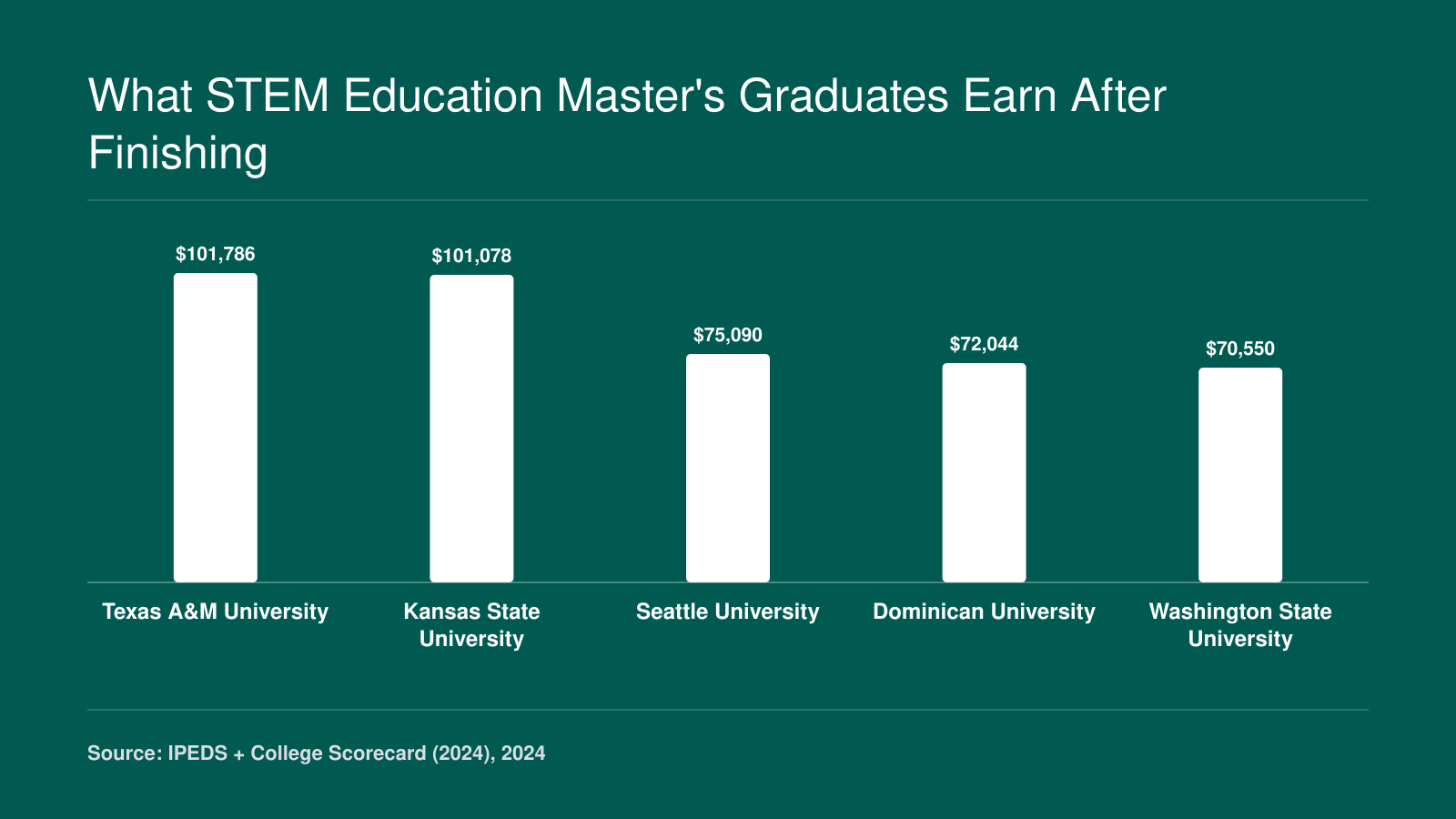
What STEM Education Master's Graduates Earn After Finishing
Five years after completing their degree, median earnings for STEM education master's graduates at the schools below range from $70,550-$101,786. Where reported, median program debt runs $23,050-$33,325, and many teachers also receive a salary step increase for holding a master's.
FAQs About Online Master's in STEM Education
What is the difference between a master's in STEM education and a master's in curriculum and instruction?
Can I get a STEM teaching certification online?
Is an online master's in STEM education worth it?
Compare Stem Science Technology Engineering Math programs on the data that matters
Explore more Education & Teaching specializations or browse every graduate field.
All Education & Teaching programs