Best Master's in STEM Education Programs
Compare accredited Stem Science Technology Engineering Math master's programs by earnings, cost, and outcomes.
Sample layout — live rankings and program data appear here once the data source is connected.

In-state tuition across the ranked programs runs from $6,381 to $68,686, and only one of the 10 is offered fully online. A STEM education master's can look identical on a school website but still differ sharply in total cost, synchronous class hours, and whether the credit leads to licensure or a pay bump in your district.
Those variables often decide the degree's real return before you enroll. The tradeoff is blunt: a low-tuition online program may fit a full-time teaching schedule, while a higher-cost campus program may not. Base your shortlist on net price and format fit, not on the most familiar name.
Key Points
- Out-of-state tuition adds $15,102 to $28,890 at five affordable programs.
- Confirm CAEP accreditation directly, since marketing claims don't guarantee licensure or a district pay bump.
- Program-level earnings data is limited, so weigh borrowing against your likely salary gain.
The 10 Best Master's in STEM Education Programs for 2027
The ranking below balances affordability, graduate outcomes, and delivery format so you can compare STEM education master's options side by side. Each card shows tuition, net price, location, and concentration where available, and we flag the format that best fits working teachers and career changers. The full methodology follows the ranked list.
University of California-Berkeley
#1Berkeley, CA · ~$16,000/yr (est.)
Best for: Aspiring California STEM teachers
UC Berkeley's teacher education program combines a master's degree with a teaching credential in a 15-month sequence, offering dedicated pathways in secondary math and science. Students enter in summer through the Berkeley Teacher Education Program, and the GRE is not required. The program is housed in the Department of Education and prepares candidates for classroom work in California.
- Five pathways including Secondary Math and Secondary Science
- 15-month MA plus teaching credential
- Apply by December 15, 2026
- Starts in summer
- No GRE required
- Berkeley Teacher Education Program (BTEP)
- Prepares for California classroom teaching
Vanderbilt University
#2Nashville, TN · ~$58,000/yr (est.)
Best for: STEM professionals pursuing Tennessee licensure
Vanderbilt's Peabody College offers a two-year M.Ed. in Secondary Education with science and mathematics concentrations, preparing students for grades 6-12 licensure. The 33-credit program includes a field-based practicum and a choice of traditional student teaching or a job-embedded placement in Tennessee public schools. Peabody reports 96% of job-seeking graduates were employed or attending graduate school within four months.
- Science and mathematics concentrations
- 33 credit hours for grades 6-12 licensure
- Traditional student teaching or job-embedded Tennessee placement
- Field-based practicum: eight hours
- Priority deadlines December 1 and January 3
- 96% of job-seeking graduates employed or in grad school within four months
- Teacher Pathway Scholarship minimum 30% scholarship
- Rolling admissions after priority deadlines
- Computer and network systems concentration
- No entrance exam required
- Spring or fall starts
- Online M.S. option available
- GRE scores waived indefinitely
- TOEFL 89, IELTS 7, Duolingo 130 minimums
- $0 application fee
- Medical image computing concentration
- Entrance exam required: TOEFL or IELTS
- Thesis or capstone option
- State-of-the-art research facilities
- Interdisciplinary research encouraged
- Transfer to Ph.D. possible
- No Day 1 CPT offered
Johns Hopkins University
#3Baltimore, MD · ~$65,000/yr (est.)
Best for: Future Maryland STEM teachers needing funding
Johns Hopkins' TeachingWell program is a full-time, in-person M.Ed. for teaching professionals that leads to Maryland certification in secondary mathematics and science fields. The 39-credit program combines four semesters of coursework with a paid residency year in partner schools. Students receive full-tuition support, health insurance, and a partial living stipend, and commit to four years at a JHU-approved Maryland district.
- STEM teacher preparation for Maryland certification
- 39 total credit hours
- 4 semesters coursework plus 1 year residency
- Full-tuition support, health insurance, partial living stipend
- Four-year teaching commitment at JHU-approved Maryland school
- $10,000 Noyce Scholarship stipend
- Cohort-based with instructional coaching
- Apply by April 29, 2027
Northwestern University
#4Evanston, IL · ~$55,000/yr (est.)
Northwestern's MSEd in Secondary Teaching prepares candidates for grades 5-12 math or science licensure. STEM majors can apply for the STEM+ Fellowship, which fully funds the second year and requires a two-year teaching commitment in a high-need school. The program emphasizes small cohorts, individualized advising, and Illinois math and science teacher shortage areas.
- Teacher licensure for grades 5-12 in math or science
- STEM+ Fellowship provides full second-year funding
- Two-year teaching commitment in high-need schools
- Partners with justice-oriented community organizations
- Small class sizes with individualized advising
- Works on OpenSciEd curriculum and NGSS implementation
- Targets Illinois math and science teacher shortage
- ESL and bilingual endorsements available
University of Pennsylvania
#5Philadelphia, PA · ~$48,000/yr (est.)
Penn offers research-driven engineering master's programs, including materials science and energy and sustainability, with interdisciplinary electives across Wharton and other schools. Students can choose thesis or non-thesis tracks and collaborate through the MSE Graduate Group. These are STEM-focused graduate degrees with strong industry and academic pathways.
- 10 graduate-level courses
- Thesis, non-thesis, or independent study tracks
- 2.7 GPA minimum
- Interdisciplinary electives across Wharton and Arts and Sciences
- Up to two transfer course units
- Required weekly MSE seminars
- Four concentration options in energy and sustainability
- Four-semester, cohort-based structure
- Rolling admissions
- Capstone required
- In-person at Penn's Philadelphia campus
- Opportunities to integrate internships
- Interdisciplinary access to Wharton, Arts and Sciences, Weitzman
University of Michigan
#6Ann Arbor, MI · $29,000 – $58,000/yr (est.)
Michigan's civil engineering master's offers a structural engineering focus and serves as an alternative to the discontinued MEng in Structural Engineering. Students take graduate courses in the Department of Civil and Environmental Engineering and can prepare for careers in structural engineering or pursue doctoral study.
- Structural engineering focus
- Same academic preparation as MEng in Structural Engineering
- Part of Department of Civil and Environmental Engineering
- Can serve as stepping stone to doctoral study
University of Notre Dame
#7Notre Dame, IN · ~$65,000/yr (est.)
Notre Dame's ESTEEM program is a one-year master's for students with technical or STEM backgrounds who want to blend science with business and innovation. The curriculum focuses on technology commercialization, market analysis, and entrepreneurship, with a one-semester campus residency. GRE or GMAT scores are optional.
- One-year master's for STEM and technical backgrounds
- Translate technologies into commercial ventures
- GRE or GMAT optional
- Three recommendation letters required
- One-semester minimum residency
- Focus on innovation, technology, and entrepreneurship
Grove City College
#8Grove City, PA · ~$9,000/yr (est.)
Grove City College offers a fully online Master of Engineering in Systems Engineering and Technology Management. The 30-credit program can be completed in as little as one year and is designed for engineers and computer scientists moving into technical leadership. Grove City notes tuition is below state and national averages for similar degrees.
- Fully online program
- 30 total credit hours
- Complete in as little as one year
- Full-time and part-time options
- Prepares for technical leadership positions
- Tuition below state and national averages
- Applications open December 1
- Accredited by Middle States
University of Florida
#9Gainesville, FL · ~$13,000/yr (est.)
Florida's Warrington College of Business offers a STEM-designated master's in information systems and operations management with concentrations in data science, IT, and supply chain management. The program is open to all undergraduate majors and includes optional internships and business analytics practicums. Completion typically takes 1.5 to 2 years.
- Data science concentration
- No entrance exam required
- 93% job placement rate
- Training in R, Python, Java, Tableau
- Optional summer internship and business analytics practicum
- Open to all undergraduate majors
- Five-course data science sequence
- 8-week course modules
- Information technology concentration
- Test optional for GRE/GMAT
- 3.0 GPA minimum
- 2 letters of recommendation minimum
- Prerequisite courses required
- $30 application fee
- Business Career Services support
- Holistic application review
- Supply chain management concentration
- STEM accredited program
- Ranked #7 among U.S. publics
- Recruiters from finance, technology, consulting
- Select scholarship and research assistantships
California Polytechnic State University-San Luis Obispo
#10San Luis Obispo, CA · ~$14,000/yr (est.)
Cal Poly San Luis Obispo's computer science master's is a research-focused, thesis-based program with no GRE requirement. Students can concentrate in areas like artificial intelligence, software engineering, computer networks, and database systems, and a blended BS+MS pathway accelerates progress.
- Research-focused, thesis-only program
- No GRE required
- Concentrations include AI, software engineering, networks, database systems, graphics
- Prerequisite CS coursework for non-CS applicants
- Blended BS+MS accelerated pathway
- Small classes and hands-on research
- Conditional admission for missing prerequisites
- Data science minor courses offered
How We Ranked These Programs and How to Verify Accreditation
How can you tell whether a master's in STEM education is likely to lead to licensure or a district pay bump, and how do you separate a real CAEP-approved program from a marketing claim? Use the outcome data and check the provider record yourself.
Outcome Data to Compare
When program-level outcomes are available, we compare median earnings and median debt for recent completers of that specific STEM education credential, using federal College Scorecard data. We place those numbers next to graduate tuition and the institution's net price, and we also note the overall graduation rate. Two boundaries matter: net price and graduation rate are institution-wide, not specific to the STEM education program, and earnings are medians for completers of that credential, so your individual result can differ.
Institutional vs. Programmatic Approval
Approval falls into two layers. A university should hold institutional accreditation recognized by the U.S. Department of Education, which you can check in DAPIP.1 For educator preparation, CAEP, the Council for the Accreditation of Educator Preparation, accredits the provider rather than every individual concentration or non-licensure track.2 That distinction matters because districts often look for a CAEP-accredited provider when granting licensure pathways or salary-schedule credit.
How to Check Status Yourself
- CAEP search: Use the CAEP accredited provider search.3 Match the exact name and state, and confirm the status reads accredited, not candidate, preaccredited, under review, or legacy. Check the decision, term, and expiration dates.
- DAPIP database: Use the U.S. Department of Education's DAPIP1 to confirm institutional accreditation, recognized agency, and any adverse actions.
- Licensure: CAEP accreditation does not guarantee state licensure. Verify separately with your state's educator licensing agency.
Confirmed CAEP Providers in the Rankings
Among programs reviewed, Rowan University, Slippery Rock University's M.Ed. in Secondary Math/Science STEM, and Southeastern Oklahoma State University's M.Ed. in Curriculum and Instruction appear under CAEP-accredited providers.3 Western Governors University lists both CAEP and AAQEP accreditation. For American College of Education's online M.Ed. in STEM Education, separate CAEP accreditation for that specific M.Ed. is not established; confirm the exact program record before relying on it. When a provider's marketing claim conflicts with the CAEP or DAPIP record, treat the live database as the controlling source.3
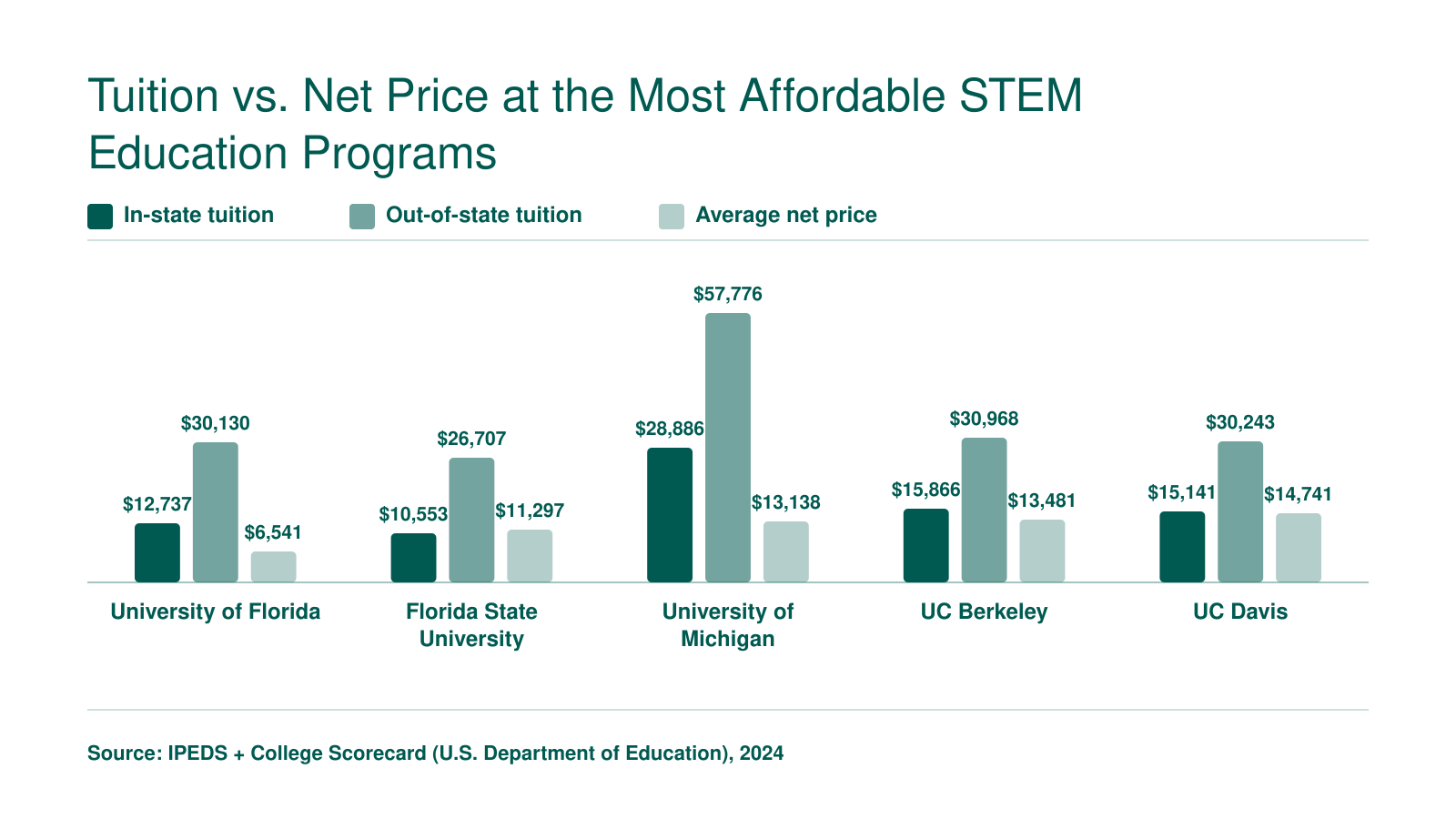
Tuition vs. Net Price at the Most Affordable STEM Education Programs
Out-of-state tuition runs $15,102 to $28,890 above the in-state rate at these five programs, so residency can matter more than the school you choose. Some online programs charge one flat rate regardless of residency, so check each program's tuition page. The programs here that list separate rates, including UC Davis's online option, do not charge a flat rate. Net price is an institution-wide average after grant aid, not a quote for any individual student, and your own cost will depend on your aid package. The programs shown are STEM master's programs from the cheapest-ranked slice of our data, in a range of fields.
Online vs. Campus STEM Education Master's: Synchronous Classes, Campus Visits, and Practicum Hours
Format is the first filter most working teachers apply, and it decides more about your week than any ranking does. A master's in STEM education can be fully online, campus-only, or a hybrid of the two, just like curriculum and instruction master's programs, and those labels mean different things from one school to the next.
Online, Campus, or Both
Among the programs covered here, Missouri State runs fully online, built explicitly for students who can't relocate or who work full time. Texas Tech delivers its coursework online in 8-week and 15-week blocks. Purdue is primarily online and mostly asynchronous, with no required campus visits. Drexel blends asynchronous courses with optional hybrid, field-based sessions. The University of Kentucky offers evening, online, and hybrid tracks so professionals can mix formats. Grand Canyon and Georgia State lean toward structured in-person fieldwork, and Rowan is campus-connected by design.
Synchronous vs. Asynchronous
Asynchronous means you complete coursework on your own schedule through assignments, discussion boards, and assessments, which is why Purdue and Drexel suit teachers juggling a full classroom load. Synchronous programs schedule live sessions you must attend at set times. If your district day ends at 3:30 and you teach an after-school club, a scheduled 4:00 p.m. live seminar can be a genuine conflict. Confirm the exact format before you enroll, not after.
Residencies and Fieldwork
Fully online does not always mean fully remote. Some programs require a short on-campus residency, typically one to two weeks, often in summer. Practicum and field experience requirements vary widely:
- Grand Canyon: roughly 100 hours of field experience plus a 15-week student teaching placement.
- Missouri State: two 3-credit practicum courses and an 8-credit internship, which may be completed at your workplace if approved by the university.
- Rowan: a 13-month structure with a yearlong clinical residency, with in-person school time Monday through Thursday.
- Georgia State: practicum placements in Metro Atlanta schools, supervised by a mentor teacher and faculty.
Many online programs let you complete supervised hours in your own K-12 school or a local community college, under a certified teacher and university supervisor, but placements must be pre-approved.
One Practical Step
Before applying, confirm the program is authorized to enroll students in your state, usually through state authorization or NC-SARA. An unauthorized program can leave your fieldwork, or your license, in limbo.
Related Articles
What STEM Education Master's Graduates Earn
The real question for most STEM education master's candidates is not whether a program advertises a high salary number, but whether the degree pays for itself once you account for what you borrow to earn it. For this group of programs, that answer depends almost entirely on how your district rewards the credential, not on prestige.
Program-Level Earnings Are Largely Unpublished Here
We hold a strict rule: we never pass off an institution's overall 10-year graduate earnings as a specific program's outcome. For the STEM education master's programs tracked on mastersprograms.com, program-level median earnings tied to this field are not yet reported, so we cannot responsibly name a single highest figure with a reliable window such as "four years after completing the degree." When that data publishes, we will state it plainly here, alongside the time window it reflects. Until then, treat any salary claim you see elsewhere that is not tied to this specific program with caution.
Where the Salary Gains Actually Come From
Most people who finish a STEM education master's are, or plan to be, classroom teachers, a role also emphasized in elementary education master's programs and special education master's programs. That shapes how the degree pays off. In public K-12 systems, your salary is set by a district schedule, and a master's typically moves you into a higher pay lane, often worth several thousand dollars a year, every year, for the rest of your career. Those raises compound in a way a one-time starting salary bump does not.
The degree also opens non-classroom roles that lift earnings further:
- STEM coordinator: oversees math and science curriculum across a school or district.
- Instructional coach: mentors other teachers, usually at a stipend above the base lane.
- Department or curriculum lead: combines teaching with supplemental administrative pay.
Weigh It Against What You Borrow
Because program-specific debt and the typical 10-year monthly payment are not published for these programs, the practical move is to compare each school's net price against your district's documented lane increase. If the annual raise clears your monthly loan payment within a few years, the math works in your favor.
Admission Requirements for STEM Education Master's Programs
Requirements vary by program and track, so confirm details with each school. Public sources for several programs don't list term-specific deadlines, so check directly before you plan a timeline.
- Bachelor's degree and GPAMost programs expect a bachelor's degree, and some accept any major. UT Austin, Drexel, and Rowan cite a 3.0 minimum GPA. Grand Canyon lists 2.8, and ACE University offers full admission at 2.50. Rowan weighs 2.75–3.0 against its cohort average, and UT Austin allows petitions for lower GPAs.
- STEM content prerequisitesUT Austin asks for an undergraduate STEM degree or substantial STEM coursework. Rowan requires a specific science or math major plus coursework in adolescent psychology, health and wellness, nutrition, and biology. Florida Tech's Ed.S. is a different case: it expects an earlier master's degree in STEM or a related education field.
- Teaching license or classroom accessLicensure-linked tracks, such as Rowan's, include milestones like the Praxis II and background checks. Programs aimed at working teachers may expect classroom access for coursework. Confirm this with the program before you apply.
- GRE policyMost programs no longer require it. UT Austin doesn't, and Roger Williams doesn't but encourages the GRE or MAT if your GPA is below 3.0. Grand Canyon accepts a GRE score of 300 or a GMAT score of 500 as one route for lower-GPA applicants.
- Recommendations, statement, and resumeRoger Williams asks for a letter of intent, two recommendations, and a $55 fee. Drexel wants two professional letters and a resume. Non-native English speakers typically submit TOEFL, IELTS, Duolingo, or Pearson scores.
- Deadlines and start termsDrexel's online program admits for fall only. Texas Tech uses rolling admissions. Many other programs don't publish term-specific deadlines, so confirm start terms and dates with admissions staff.
Frequently Asked Questions About STEM Education Master's Programs
These answers cover the questions applicants ask most about timing, prerequisites, and pay. Requirements vary by university, so confirm details with each program before you apply.
How long does it take to complete a master's in STEM education?
Do I need a teaching license to enroll in a STEM education master's program?
Can I earn a master's in STEM education if my bachelor's degree isn't in a STEM field?
Will a master's in STEM education move me up my district's salary schedule?
Compare Stem Science Technology Engineering Math programs on the data that matters
Explore more Education & Teaching specializations or browse every graduate field.
All Education & Teaching programs