Most Affordable Master's in STEM Education Programs
Compare accredited Stem Science Technology Engineering Math master's programs by earnings, cost, and outcomes.
Sample layout — live rankings and program data appear here once the data source is connected.

Listed tuition for the most affordable programs here runs from $5,376 at Salish Kootenai College to $11,570 at CUNY Lehman College, and the net price figures fall between $2,984 and $7,945.
Working teachers and career-changers want a STEM education master's without heavy debt. But the cheapest degree isn't always the right one: some programs lead to certification, while others are STEM-adjacent degrees with no classroom credential.
Public systems like CUNY and Cal State dominate the low end, so in-state residency often matters more than a school's name.
Key Points
- Compare total cost including per-credit tuition plus all added fees.
- TEACH Grant pays up to $3,772 yearly for STEM teaching, service required.
- Compare program-level median earnings against median federal loan debt.
Top 10 Most Affordable Master's in STEM Education Programs for 2027
Below are the ten most affordable master's in STEM education options for 2026. Each profile highlights what distinguishes the program, from credit load and concentrations to certification and career outcomes.
Texas A & M International University
#1Laredo, TX · ~$7,000/yr (est.)
Best for: Working math educators pursuing Texas graduate training
Texas A&M International University offers a 36-credit Master of Science in Mathematics with two concentrations: Applied Statistics and Mathematics Education. Students can choose a thesis or non-thesis route, and the curriculum emphasizes statistical analysis and mathematical modeling. The program serves both recent graduates and working professionals, with competitive assistantships and fellowships available.
- 36 total credit hours
- Choose thesis or non-thesis route
- Emphasizes statistical analysis and modeling
- Strong faculty research interaction
- Assistantships and fellowships available
- Two letters of recommendation
- 300-word personal statement required
- Prerequisite courses may be required
- 36-credit master's pathway
- Thesis or capstone option
- Prepares for careers in schools and universities
- Interdisciplinary research opportunities
- Research labs, library, and computers
- Two recommendation letters
- 300-word personal statement
CUNY Hunter College
#2New York, NY · ~$11,000/yr (est.)
Best for: Certified New York elementary teachers deepening STEM
CUNY Hunter College offers a pathway for certified elementary teachers that emphasizes STEM teaching for grades 1-6 through 33 credits of coursework. The curriculum focuses on making science, technology, engineering, and math accessible for young learners. The program deepens qualifications as an elementary STEM specialist and leads to professional certification in Childhood Education.
- 33 total credit hours
- Leads to Professional Certification in Childhood Education
- Requires current New York State teacher certification
- 3.0 GPA minimum
- Afternoon and evening courses
- For certified elementary teachers in grades 1-6
- Emphasizes inquiry, problem-solving, and discovery
- Two letters of recommendation
California State University-San Bernardino
#3San Bernardino, CA · ~$10,000/yr (est.)
Best for: California educators wanting a one-year STEM MA
California State University-San Bernardino's 30-credit Master of Arts in STEM Education prepares current and aspiring K-12 educators with hands-on, student-centered approaches. The program can be completed in as few as nine months and aligns with Common Core and Next Generation Science Standards. Graduates can lead STEM initiatives in schools and add teaching authorizations in math, science, or computer science.
- 30 total credit hours
- Can be completed in as few as nine months
- Aligned with Common Core and Next Generation Science Standards
- Transfer up to 12 credential units
- Thesis, project, or comprehensive exam option
- Integrates with teaching credential programs
- Prepares K-12 STEM educators and leaders
- 2 letters of recommendation
CUNY Lehman College
#4Bronx, NY · ~$12,000/yr (est.)
CUNY Lehman College offers several STEM teaching routes, including the scholarship-supported Noyce Focus-On-STEM program and a Science Education M.S.Ed. with five concentrations. The Noyce path emphasizes teaching mathematics or science in New York City public schools and preparing educators for English Language Learners. The Science Education degree includes 100 clinical hours and can lead to dual certification in science and special education.
- Scholarship-supported program
- Prepares teachers for New York City public schools
- Training for teaching English Language Learners
- Open to STEM graduates and professionals
- Focus on high-need middle and high schools
- Emphasizes culturally diverse classrooms
- Five concentration options
- 100 clinical hours
- Sequences range from 32 to 48 credits depending on track
- Dual certification in science and special education
- New York State teaching certification
- Teacher-of-record after half credits
- Prerequisite courses required
California State University-Fullerton
#5Fullerton, CA · $9,000 – $19,000/yr (est.)
Cal State Fullerton offers a STEM-designated Master of Science in Information Systems with a choice of a generalist track or business analytics concentration. The 30-unit curriculum blends core information systems knowledge with advanced 500-level coursework and prepares graduates for roles such as systems analyst, IT consultant, and IS manager. The program is designed for business administration graduates, though other majors may apply with prerequisites.
- STEM-designated program
- 30 total credit hours
- Choose between generalist and business analytics tracks
- At least 21 units at the 500 level
- Designed for business administration graduates
- GMAT or GRE exam may be required
- Prepares for systems analyst, IT consultant, and IS manager roles
California State University-Fresno
#6Fresno, CA · ~$9,000/yr (est.)
California State University-Fresno offers graduate mathematics and engineering paths that can lead into STEM teaching and leadership. The mathematics program includes pure, applied, and mathematics education emphases, with graduates prepared for community college teaching, doctoral study, and high school leadership. The electrical and computer engineering master's offers multiple concentrations for careers in industry and instruction.
- Mathematics education concentration
- Prepares for community college teaching
- Leadership roles in high school mathematics
- Pathway to doctoral study in mathematics education
- Industry work in mathematical modeling
- Employers include private firms and federal agencies
- Three concentration options
- Work areas include modeling, graphics, and cryptography
- Builds pathway to doctoral programs
- Advanced graduate-level mathematical study
- Computer Architecture and Embedded Systems concentration
- 10 concentration options
- 30 total credit hours
- 3.0 GPA minimum
- Thesis or capstone option
- Requires bachelor's in engineering or science
- Control Systems concentration
- Entrance exam required for international applicants
- Opportunity to blend research areas
- Electives in business, math, physics, and computer science
- Careers in industry, academia, and public instruction
California State University-Northridge
#7Northridge, CA · ~$9,000/yr (est.)
CSUN's 30-unit Master of Arts in Secondary Mathematics Education is a two-year, cohort-based program for secondary mathematics teachers. Students take eight core courses and two electives, with evening scheduling and an applied classroom research project. Graduates are prepared for department chair, math coach, and teacher-leader roles.
- 30 total credit hours
- 10 courses: 8 core and 2 electives
- Cohort-based two-year sequence
- Tuesday evening classes over four semesters
- Applied classroom-based research project
- Tracks toward department chair, math coach, or teacher-leader roles
- Applicants must reside in California
- CSUN credential courses may satisfy electives
Florida Atlantic University
#8Boca Raton, FL · $7,000 – $18,000/yr (est.)
Florida Atlantic University's Master of Education in Secondary Education offers certification-aligned concentrations in subjects including mathematics, biology, chemistry, physics, and English. Admission requires a 3.0 undergraduate GPA, resume, personal statement, and two recommendation letters, with fall, spring, and summer start dates. The program prepares graduates for secondary teaching roles in STEM and other fields.
- Concentrations include mathematics, science, and English
- Seven concentration options
- 3.0 GPA minimum
- Two letters of recommendation
- Resume and personal statement required
- Multiple start terms: fall, spring, and summer
The University of Texas at El Paso
#9El Paso, TX · $5,000 – $10,000/yr (est.)
The University of Texas at El Paso offers a 30-credit Master of Arts in Education with a concentration in STEM Education. The curriculum blends mathematics, science, and educational technology, with options in bilingual inquiry science and technology-rich pedagogy. Graduates pursue roles in PK-12 schools, community organizations, and research, with many continuing to doctoral study.
- 30 total credit hours
- 10 total courses
- Prepares STEM leaders for PK-12 schools
- Culturally sustaining STEM pedagogies
- Problem- and project-based learning
- Thesis or capstone option
- Includes graduate certificate in STEM education
- Prepares for Ph.D. or Ed.D.
Florida International University
#10Miami, FL · ~$11,000/yr (est.)
Florida International University offers a STEM-designated Master of Science in Information Systems with Business Analytics and Artificial Intelligence concentrations. The 12-to-16-month program prepares graduates for leadership roles such as CIO, CISO, IT director, and IT project manager. International students on F-1 visas can benefit from extended STEM OPT.
- STEM-designated program
- Complete in 12 to 16 months
- Choose between Business Analytics and Artificial Intelligence tracks
- Three-year OPT eligibility for F-1 students
- Spring and fall start dates
- Prepares for CIO, CISO, IT director, and project manager roles
- Financial aid and scholarships available
None of the ranked Stem Science Technology Engineering Math programs match the most affordable lens yet. The full ranking is at the link above.
What a STEM Education Master's Really Costs Once Fees Are Added
How far does a per-credit tuition rate actually stretch once online, technology, graduation, and assessment fees are added? Often less than students expect, so compare total cost of a master's degree, not the sticker price.
At American College of Education, the M.Ed. in STEM education lists $235 per credit for 31 credits, or $7,285 in tuition. Add a $54 per credit technology and library fee ($1,674), a $50 application fee, and a $100 conferral fee, and the realistic published total is about $9,109.
University of Nebraska at Kearney's online master's in STEM education program publishes a clearer figure: $369 per credit for 30 credits ($11,070 tuition), plus $1,763.50 in estimated mandatory fees, for about $12,833.50 before any course-specific charges.
Residency can change the math. University of Colorado Denver lists $496 per credit for resident or WRGP-eligible online students and $595 for nonresident online students, a roughly $3,000 difference over 30 credits. Roger Williams charges one flat online rate regardless of state, though semester fees vary with full-time or part-time enrollment.1
Rule of thumb: ask admissions for a total cost-of-attendance figure, including all mandatory fees, before comparing programs.
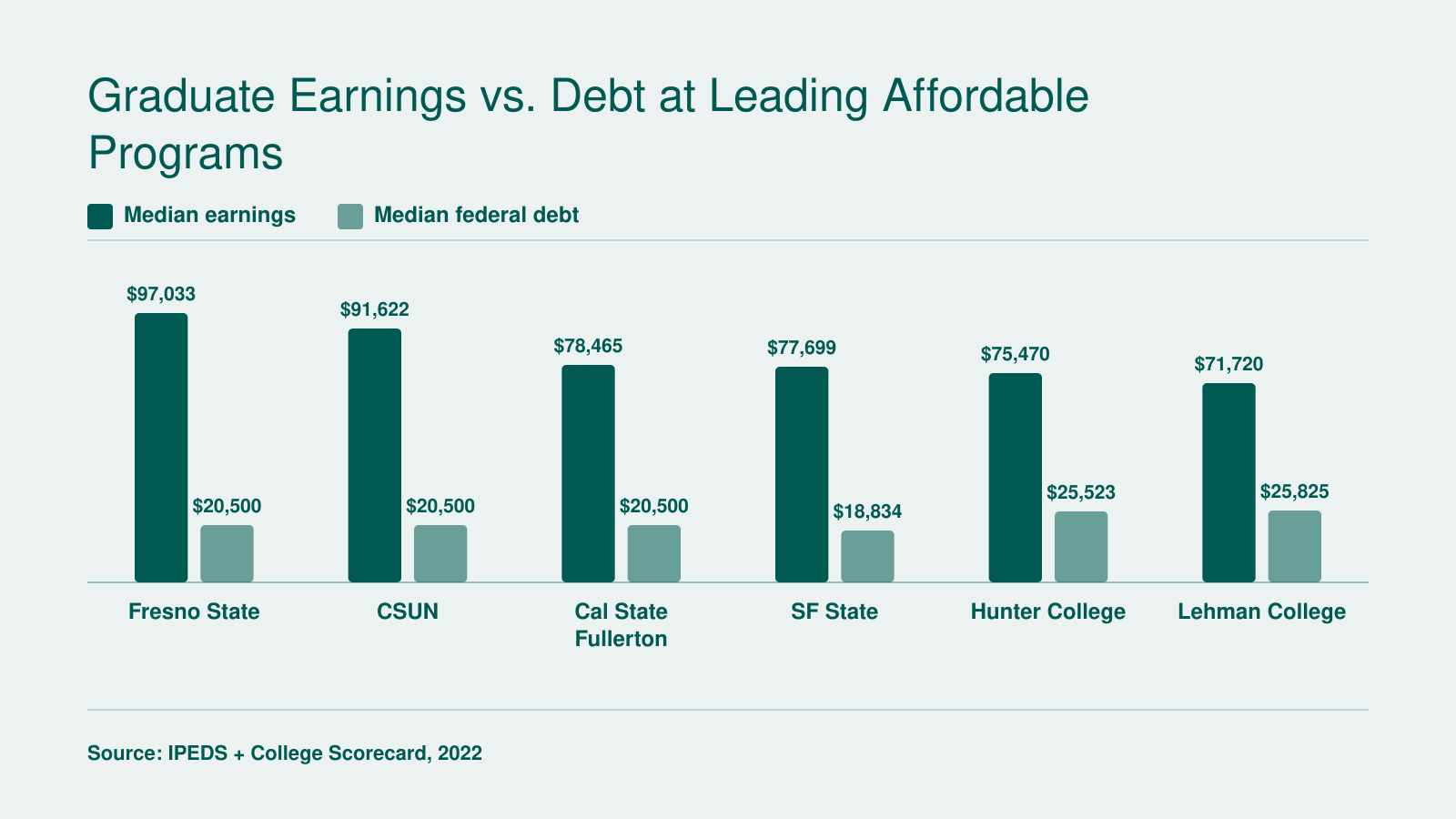
Graduate Earnings vs. Debt at Leading Affordable Programs
Earnings are program-level medians reported four or five years after finishing, depending on the program; debt is median federal loan debt. All figures are from 2022.
Related Articles
Licensure, Endorsement, or Non-Licensure: Know What You're Paying For
STEM education graduate programs that add a teaching license and those that add only a degree can cost the same per credit, yet they lead to different classrooms and paychecks. Match the pathway to your situation first.
- Initial licensure: For career-changers. Cal State San Bernardino's STEM Education M.A. integrates with its teaching credential programs, and Lehman College's Noyce track is open to STEM graduates and professionals who want to teach in NYC public schools.
- Add-on STEM endorsement: For current teachers. Hunter College's STEM specialization requires NYS teacher certification, so it suits teachers who are already certified.
- Non-licensure M.Ed.: For salary-step credit or curriculum roles. Fort Hays State's M.S.Ed. in STEM Education is one example. It does not lead to licensure, though it includes Praxis preparation.
Check before you enroll
Out-of-state online students should confirm with their own state education department that a program meets local licensure or endorsement rules. A credential recommended in one state is not automatically honored in another.
Regional accreditation determines federal aid eligibility. CAEP accreditation affects how easily a license transfers, and it can be narrower than it sounds: Fort Hays State's CAEP advanced-level accreditation excludes non-licensure programs. Verify each school's CAEP status in the CAEP directory instead of assuming it.
Online Format and How Fast You Can Finish
Speed and flexibility pull in different directions: the fastest programs compress coursework into fewer terms, while the most flexible spread it out so a full-time teacher can keep up. Fully online delivery is common here. Southeastern Oklahoma State (30 credits) and CU Denver (30 credits) are both fully online, though CU Denver's per-credit rate depends on residency, running $496 to $595. Check each course's schedule for required live sessions or campus visits, since the research does not confirm them.
American College of Education lists 31 credits in 12 to 15 months, which looks like its standard pace rather than a special accelerated track. Broader online STEM master's programs typically run 30 to 36 credits, taking 1.5 to 2 years full-time or 2 to 3 years part-time. Treat those as general ranges, not promises for each school.
Licensure-track programs usually add student teaching or field hours, which limits how quickly you can finish. Non-licensure degrees avoid that constraint. Shorter timelines also cut cost, because you pay fewer terms of fees.
The federal TEACH Grant can award graduate students up to $3,772 a year for preparing to teach high-need fields like math and science, but there's a catch: per studentaid.gov, you must teach full-time for at least four years in a low-income school, or the grant converts to a loan you repay with interest.
Frequently Asked Questions About Affordable STEM Education Master's Programs
These answers focus on cost, format, licensure, and transfer credit so you can compare affordable STEM education master's programs without surprises.
What is the cheapest master's in STEM education?
Can I complete a STEM education master's degree in one year online?
Are there affordable master's in STEM education programs that lead to teaching licensure?
Can transfer credits or prior graduate coursework lower the cost?
Compare Stem Science Technology Engineering Math programs on the data that matters
Explore more Education & Teaching specializations or browse every graduate field.
All Education & Teaching programs