Best Master's in Math Education Programs
Compare accredited Mathematics master's programs by earnings, cost, and outcomes.
Sample layout — live rankings and program data appear here once the data source is connected.

A math education master's forces a three-way tradeoff: the teaching level you want to serve, what the degree costs, and whether you can leave a classroom job to attend. Among the programs ranked here, tuition runs from under $10,000 to more than $67,000, and formats range from a 12-month cohort to a part-time online degree.
We evaluated 29 schools offering 37 program listings. The top 10 are ranked below, and the remaining programs appear in the directory.
Program-level earnings data is still thin, and licensure rules differ by state, so a degree's name and reputation often matter less than whether it meets the master's in secondary education licensure requirements where you plan to teach.
Key Points
- Only two of the 10 ranked programs are fully online: Florida and Purdue.
- Program-level earnings are not yet published, so compare net price and debt instead.
- Confirm state licensure approval before enrolling, since a master's alone doesn't replace certification.
10 Master's in Math Education Programs
This ranking spotlights math education master's programs that balance graduate earnings, net price, and flexible study formats. We looked beyond name recognition to identify programs where certification pathways, classroom experience, and online or evening options align with working teachers' schedules.
Columbia University in the City of New York
#1New York, NY · ~$58,000/yr (est.)
Best for: Aspiring teacher leaders seeking New York certification
Teachers College at Columbia offers a 60-credit Ed.M. in Mathematics Education with full-time, part-time, and three annual entry points, including spring, summer, and fall. The curriculum emphasizes professional education and teacher leadership, with about 42 credits in mathematics and math education and access to content courses through Columbia's Graduate School of Arts and Sciences. Graduates can pursue New York professional certification and roles such as teacher leader, curriculum specialist, or instructional coach. Graduate tuition and fees are $71,845, and the institution-wide average net price after aid is about $21,590.
- 60 total credit hours
- 42 credits in mathematics and math education
- Full-time and part-time campus options
- Spring, summer, or fall entry
- Prerequisite: 24 undergraduate math credits
- Recommendation: 6 credits in statistics
- Access to Columbia University content courses
- Supports New York professional certification
University of California-Los Angeles
#2Los Angeles, CA · ~$14,000/yr (est.)
Best for: California secondary teachers earning a credential
UCLA's M.Ed. in Mathematics Education pairs a single-subject teaching credential for grades 6-12 with master's-level study, linking sociocultural learning and critical race theory to classroom fieldwork. Students can choose pathways such as the two-year master's and credential program or a joint mathematics/education option for UCLA undergraduates. The program runs on campus and prepares graduates for diverse secondary classrooms. Graduate tuition and fees are $15,203 in-state and $49,403 out-of-state, with an institution-wide average net price around $12,548 after aid.
- Earns a single-subject teaching credential with the M.Ed.
- Prepares to teach grades 6-12 mathematics
- Focus on sociocultural learning and critical race theory
- Two-year master's and credential option
- Math residency pathways available
- Joint program for UCLA undergraduates
- Campus-based with classroom field work
- Application period mid-September to early December
University of Florida
#3Gainesville, FL · ~$13,000/yr (est.)
Best for: Working educators needing an online degree
Florida's online Master of Arts in Education in Mathematics Education is a 30-credit program built for practicing and aspiring teachers, with full-time or part-time pacing and fall, spring, and summer starts. Students create a personalized plan with a faculty advisor, choose from methods courses and math education specializations, and finish with a thesis or project in lieu of thesis. An optional EPI pathway supports Florida teacher professional certification. Graduate tuition and fees are $6,381 in-state and $28,659 out-of-state; the institution-wide average net price after aid is about $6,541.
- 30 total credit hours
- Fully online delivery
- Full-time and part-time pacing
- Fall, spring, and summer starts
- 2.7 GPA minimum
- Thesis or project in lieu of thesis
- Optional EPI pathway to Florida teacher certification
- Personalized plan with faculty advisor
University of California-San Diego
#4La Jolla, CA · $15,000 – $20,000/yr (est.)
UC San Diego's Elementary Mathematics Education Concentration is a campus-based track within the M.Ed./Multiple Subject Credential program for aspiring K-6 math teachers, though it is currently on hiatus. The curriculum includes a specialized seminar, a summer course in elementary math pedagogy, and student teaching with experienced mentors. Graduate tuition and fees are $16,758 in-state and $50,958 out-of-state, with an institution-wide average net price around $12,470 after aid.
- Focused K-6 elementary math teaching track
- Specialized seminar on advanced K-6 practices
- Summer course in elementary math content and pedagogy
- Student teaching with experienced mentors
- Guest speakers and professional development workshops
- Program currently on hiatus
Virginia Polytechnic Institute and State University
#5Blacksburg, VA · ~$19,000/yr (est.)
Virginia Tech's M.A.Ed. in Curriculum and Instruction with a Mathematics Education specialization is a teacher preparation program for aspiring secondary math teachers. Students complete advanced math content, pedagogy courses, and a classroom practicum that fulfills Virginia licensure requirements. An accelerated BA-M.A.Ed. option, a 25% tuition discount for in-state K-12 teachers, and no GRE requirement add flexibility. Graduate tuition and fees are $15,948 in-state and $37,764 out-of-state; the institution-wide average net price after aid is about $24,953.
- Teacher preparation for secondary mathematics
- Advanced math content and pedagogy courses
- Student teaching fulfills Virginia licensure
- Accelerated BA-M.A.Ed. option
- 25% tuition discount for in-state K-12 teachers
- No GRE requirement
- Graduate assistantships available
- Praxis II required for licensure
Purdue University
#6West Lafayette, IN · ~$10,000/yr (est.)
Purdue's online MSEd in Curriculum and Instruction with a Mathematics Education concentration is designed for working educators seeking advanced expertise in math pedagogy and curriculum development. The fully online format allows students to continue teaching while preparing for roles such as math coach or curriculum specialist. Purdue's College of Education reports a tie for the top spot among Indiana online MS education programs in 2026. Graduate tuition and fees are $9,992 in-state and $28,794 out-of-state; the institution-wide average net price after aid is about $14,600.
- Fully online MSEd program
- Concentration in mathematics education
- Prepares for math coach or curriculum specialist roles
- Tied No. 1 among Indiana online MS education programs in 2026
- Designed for working professionals
University of Minnesota-Twin Cities
#7Minneapolis, MN · ~$22,000/yr (est.)
Minnesota's M.Ed. in Mathematics Education with Teaching License is a 12-month, full-time, cohort-based program that prepares graduates for a grades 5-12 Minnesota math license. The curriculum combines mathematical knowledge with co-teaching and student teaching at both middle and high school levels. The program reports a 100% job placement rate, with five of six students finding teaching jobs within a year. Graduate tuition and fees are $17,214 in-state and $38,362 out-of-state; the institution-wide average net price after aid is about $16,778.
- 12-month full-time cohort
- 43 total credit hours
- Starts in summer
- Prepares for Minnesota grades 5-12 teaching license
- Co-teaching model with classroom experience
- Student teaching at middle and high school levels
- Reports 100% job placement rate
- TEACH grant up to $4,000 per year
William & Mary
#8Williamsburg, VA · $15,000 – $20,000/yr (est.)
William & Mary's M.A.Ed. in Curriculum and Instruction with a Secondary Mathematics Education concentration is a full-time 12-month cohort program leading to Virginia teaching licensure. The curriculum integrates educational foundations, mathematics methods, and field experiences in diverse school settings. Students complete 41 semester hours and student teaching, with a Noyce Scholarship opportunity for eligible candidates. Graduate tuition and fees are $25,914 in-state and $51,038 out-of-state; the institution-wide average net price after aid is about $19,096.
- 12-month full-time cohort program
- 41 total semester hours
- Starts in summer
- Leads to Virginia teaching licensure
- Field experiences in diverse school settings
- Noyce Scholarship opportunity
- Praxis Subject Assessment and VCLA preparation
Villanova University
#9Villanova, PA · $20,000 – $25,000/yr (est.)
Villanova's Master of Arts in Mathematics is a flexible evening program for students who have completed coursework through multivariate calculus and linear algebra. The 30-credit degree includes advanced electives in pure mathematics and can lead to secondary school teaching, PhD study, or careers in actuarial, pharmaceutical, and operations fields. Secondary school teachers may qualify for tuition discounts of 20% to 40%. Graduate tuition and fees are $67,776, and the institution-wide average net price after aid is about $43,756.
- 30 total credit hours
- Evening classes meet once weekly
- Full-time and part-time options
- 20% to 40% tuition discount for secondary school teachers
- Electives from MS in Applied Statistics
- Prepares for secondary school teaching or PhD study
- Requires undergraduate work through multivariate calculus and linear algebra
The University of Texas at Austin
#10Austin, TX · ~$12,000/yr (est.)
UT Austin's Master of Arts in Mathematics with an Actuarial Focus is a 33-credit professional program centered on actuarial exam preparation, including life contingencies, probability models, actuarial statistics, and interest theory. Students are automatically considered for teaching assistantships that can include tuition and a stipend, with employer connections for career fairs and internships. The program is an actuarial-focused mathematics master's rather than a K-12 math education credential, so it may appeal more to readers interested in quantitative careers than classroom teaching. Graduate tuition and fees are $11,688 in-state and $44,908 out-of-state; the institution-wide average net price after aid is about $19,857.
- 33 total credit hours
- Four-semester program
- Prepares for SOA and CAS actuarial exams
- Teaching assistantships include tuition and stipend
- Career fair and internship support
- Minimum GRE Quantitative score of 151
- Prerequisite courses required
- Funded by State of Texas and employer partners
Most Affordable Math Education Master's Programs
Net price is an institution-wide average, not a program quote, so use it as a starting point rather than a final bill. Actual cost depends on credit load, aid eligibility, and mandatory technology or distance-learning fees. Purdue University and Northwest Missouri State University publish a single flat per-credit online tuition rate, which can simplify out-of-state budgeting.
| Program | In-state tuition | Out-of-state tuition | Institution-wide net price | Per-credit tuition | Total required credits | Estimated total tuition |
|---|---|---|---|---|---|---|
| CUNY Brooklyn College, Middle Childhood Education (5-9) Mathematics, M.S.Ed. (campus) | $7,452 | $15,402 | $3,103 | N/A | N/A | N/A |
| CUNY Lehman College, M.S.Ed. Program in Mathematics Education (campus) | $7,410 | $15,360 | $3,148 | N/A | N/A | N/A |
| University of Florida, Master of Arts in Education, Mathematics Education (online) | $6,381 | $28,659 | $6,541 | N/A | 30 | N/A |
| Purdue University, MS in Education in Curriculum and Instruction, Mathematics Education (online) | N/A | N/A | N/A | $450 | 30 | $13,500 |
| Northwest Missouri State University, MSEd in Teaching Mathematics (online) | N/A | N/A | N/A | $432 | 30 | $12,960 |
| Northwest Missouri State University, M.S. in Mathematics (online) | N/A | N/A | N/A | $432 | 30 | $12,960 |
| Wayne State College, Math Education MSE | N/A | N/A | N/A | $389.40 | 36-42 | $14,018 to $16,355 |
| Shawnee State University, M.S. in Mathematics Education | N/A | N/A | N/A | In-state $538.69, out-of-state $576.40 | 36 | In-state $19,393, out-of-state $20,750 |
Online, Campus, and Hybrid Math Education Master's Formats
Among the 10 ranked programs, two are fully online (University of Florida and Purdue), and eight are currently campus-based based on current catalog listings. No top-10 program is listed as hybrid, but several strong hybrid options appear outside that top 10.
What Online Actually Means
Online is not one format. Boston University's EdM uses synchronous class sessions.1 Oregon State's MS is primarily asynchronous with limited synchronous work and two Saturday meetings per term, either in person or by Zoom.2 University of Northern Iowa's K-8 program is online but requires two weeks on campus each summer;3 its secondary track has a shorter summer campus component.4 University of Hawaii at Manoa runs a cohort model with a weeklong summer orientation, and its 2026-2027 cycle begins June 22-28, 2026.5 Some programs use fixed cohorts rather than self-paced schedules, so ask whether you must progress with a set group.
Initial Licensure vs. In-Service Students
Initial licensure programs usually require in-person student teaching in an approved school, often in the student's home district. Oregon State lists 700+ clinical hours in an approved school, and distance students should confirm how that placement is arranged near home.2 For licensed teachers, the picture is lighter: University of Missouri's online MEd lists no required campus residency, though some electives may require face-to-face.6 Some in-service tracks, such as master's in curriculum and instruction programs, do not advertise a separate field placement, but policies vary, so verify before enrolling.
What to Check Before Applying
Working teachers should confirm class meeting times and any summer intensives. East Carolina's Elementary Education cohort runs Fall 2026 to Summer 2028, and its high school track is hybrid unless you join a cohort.7 Marist begins with a three-day residency, usually in July.8 If your district calendar or coaching season conflicts, ask about attendance and recording policies.
Related Articles
M.A. vs. M.Ed. vs. M.S. in Math Education, Plus Elementary and Secondary Tracks
The degree title tells you less than you might expect. Schools define the M.A., M.Ed., and M.S. differently, and what matters most is whether the program leads to initial licensure, an add-on endorsement, or neither. Check each program's curriculum and state licensure language before comparing tuition or rankings.
| Option | Typical focus | Best suited for | Licensure and career notes |
|---|---|---|---|
| M.Ed. in Mathematics Education | Mathematics teaching and learning: instructional strategies, planning, research-based methods, and problem solving | Current teachers who want to specialize in math instruction or add math to an existing license | Some secondary pathways include classroom observation and full-time student teaching with state-specific licensure eligibility. Others are for practicing teachers only. Confirm by state. |
| M.S. in Mathematics Education | Often more mathematics content, though no single standard definition exists across schools | Teachers who want deeper subject knowledge, or those considering teaching at a two-year college | Not universally a licensure route. Many community colleges look for about 18 graduate credits in mathematics, which content-heavy M.S. programs are more likely to include. Verify the actual course list. |
| M.A. in Mathematics Education | Varies by school. Some are research or theory oriented, and some are MAT-style licensure paths | Career changers if the program is licensure-based. Otherwise, teachers who want a flexible credential | Not universally leading to initial licensure. Some states require a master's degree for license maintenance rather than entry. |
| Elementary (K-8) math specialist track | Elementary and middle-grades mathematics, with emphasis on how young learners build number sense and early concepts | Elementary teachers and aspiring math coaches or specialists | Offered under any of the three degree titles. About 49 percent of elementary teachers held a master's as their highest postbaccalaureate degree (2020-21). |
| Secondary (grades 6-12) content track | Advanced mathematics content paired with instruction for middle and high school courses | Secondary teachers, or bachelor's holders in math or a related field moving into teaching | Offered under any of the three degree titles. About 53 percent of secondary teachers held a master's as their highest postbaccalaureate degree (2020-21). |
Accreditation and License Portability: What to Verify Before You Enroll
A federal rule effective July 1, 2024 (34 CFR 668.14(b)(32)) requires any Title IV-eligible institution running a program that leads to professional licensure to tell you, before you enroll, whether that program meets, does not meet, or has not been determined to meet the educational requirements in your state.1 That single disclosure page is the most useful document you can read before paying a deposit.
Two Layers of Accreditation
Check both. Institutional accreditation (regional accreditation through bodies like SACS) signals that the university itself is legitimate and its credits transfer. Separately, the educator-preparation unit may hold specialized accreditation through CAEP or AAQEP. East Carolina University's MAEd in Mathematics Education, for example, carries SACS institutional accreditation plus CAEP accreditation and approval from the North Carolina Department of Public Instruction. North Carolina A&T's MAT and Ball State's MA in Mathematics Education are also CAEP-accredited. AAQEP, the newer accreditor, requires programs to meet all four of its standards.
Here is the catch: specialized accreditation alone does not grant you a license. The state where you want to teach decides whether your preparation, degree, tests, and clinical experience qualify.
State Approval Matters More Than a National Seal
For licensure, what counts is whether your program is approved by a state board, not just whether it holds CAEP or AAQEP accreditation. For online students, the relevant state is generally the one where you physically live when you first enroll.5 A nationally accredited online program may still not be authorized to lead to licensure in your state.
Portability Is Not Automatic
The NASDTEC Interstate Agreement lets preparation completed in one member state carry weight in another, but it is not automatic reciprocity. States routinely impose their own tests, continuing professional development, curriculum comparability checks, and delivery-mode requirements. Massachusetts, for instance, states in its Massachusetts NASDTEC Interstate Agreement guidance that NASDTEC participation does not exempt you from its degree, testing, and prerequisite rules.
Practical step: find the program's state authorization or professional licensure disclosure page, confirm your state's status, then contact that state's licensing board directly to verify what else you will owe.
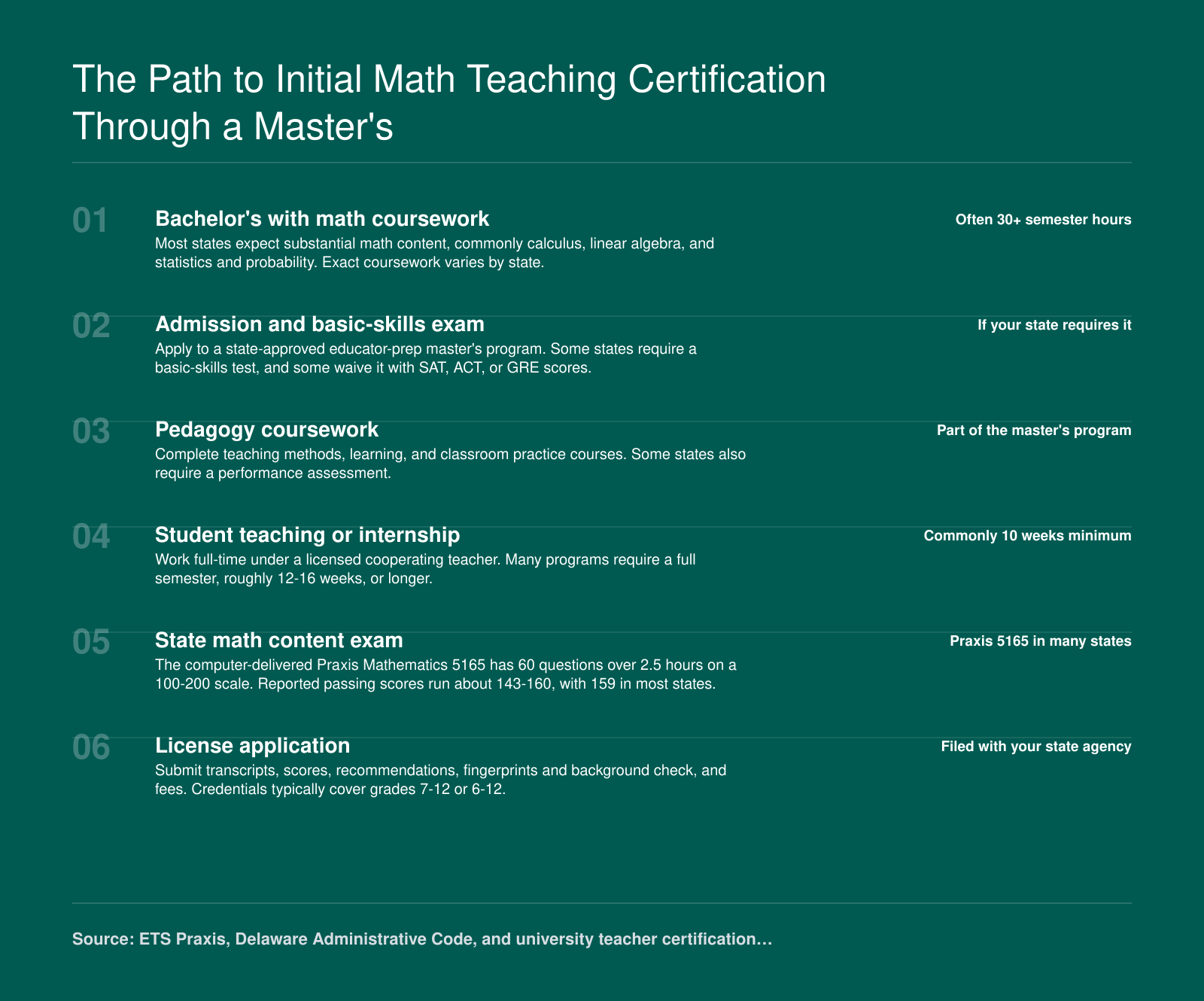
The Path to Initial Math Teaching Certification Through a Master's
Career changers with a non-education bachelor's degree can earn an initial secondary math license through a state-approved master's program. A master's alone does not replace state certification rules, so the program must be approved for licensure in the state where you plan to teach.
Admissions Checklist: GRE, Teaching Experience, and Transfer Credit
Requirements vary widely and change by admissions cycle, so confirm each item on the program's current admissions page before you apply.
- Bachelor's degree and GPAAn accredited bachelor's degree is the baseline. Indiana University of Pennsylvania asks for a 3.0 cumulative GPA, and Radford strongly prefers 3.0 but may consider lower GPAs alongside other materials. Illinois State looks at 2.8 over the last 60 undergraduate hours, Grand Canyon asks for 2.8, and Texas State for 2.75. UBC normally expects a B+ average (76%).
- GRE policyMost programs reviewed don't require it. Radford, Roger Williams, Stony Brook, and UBC don't. Illinois State doesn't require it for admission but does for department funding, such as assistantships. Grand Canyon is the exception: applicants below a 2.8 GPA can qualify with a 2.5 plus a GRE of 300 or GMAT of 500. Texas State lists GRE scores, so check whether they're mandatory.
- License or classroom experienceRequirements weren't established for most programs. Nearly all University of Georgia students teach full-time while enrolled. Stony Brook's secondary option leads to provisional certification for grades 7–12.
- Prerequisite mathContent-heavy tracks want a solid math base. Stony Brook expects two years of college math, including calculus and linear algebra. Columbia Teachers College and Grand Canyon expect 24 undergraduate math credits, and Grand Canyon includes Calculus 2. Radford expects math beyond calculus.
- Transfer credit and part-time optionsGeorgia accepts up to 6 transfer credits. Stony Brook accepts 12, but only 6 from outside Stony Brook. Grand Canyon allows 12 or one-third of the program, whichever is less. Columbia's sources conflict, so ask directly. Georgia, Stony Brook, and Roger Williams (37 credits) offer part-time study.
Master's in Math Education FAQ
These answers cover the questions prospective students ask most about timelines, certification, community college teaching, and employer funding. Requirements vary by institution, state, and district, so confirm specifics with each program and employer before you enroll.
How long does a master's in math education take to complete?
Can I get initial teaching certification through a math education master's program?
Can a master's in math education qualify me to teach at a community college?
Will my district pay for or reimburse a math education master's?
Compare Mathematics programs on the data that matters
Explore more Education & Teaching specializations or browse every graduate field.
All Education & Teaching programs