Best Online Master's in Math Education Programs
Compare accredited Mathematics master's programs by earnings, cost, and outcomes.
Sample layout — live rankings and program data appear here once the data source is connected.

UT Rio Grande Valley's online M.Ed. program in math education lists $13,750 in total tuition on a 10-month schedule. That appeals to working teachers chasing a pay-scale bump and to career changers who love math.
Every program ranked here is 100% online, with no hybrid or campus residency requirement. The rankings compare licensure fit, real cost, format, completion time, graduate earnings, and FAQs.
The sharper divide is licensure. The University of Missouri's MEd states it does not lead to certification, a dealbreaker for anyone without a teaching license.
Key Points
- The 2027 rankings include only fully online programs without required campus visits.
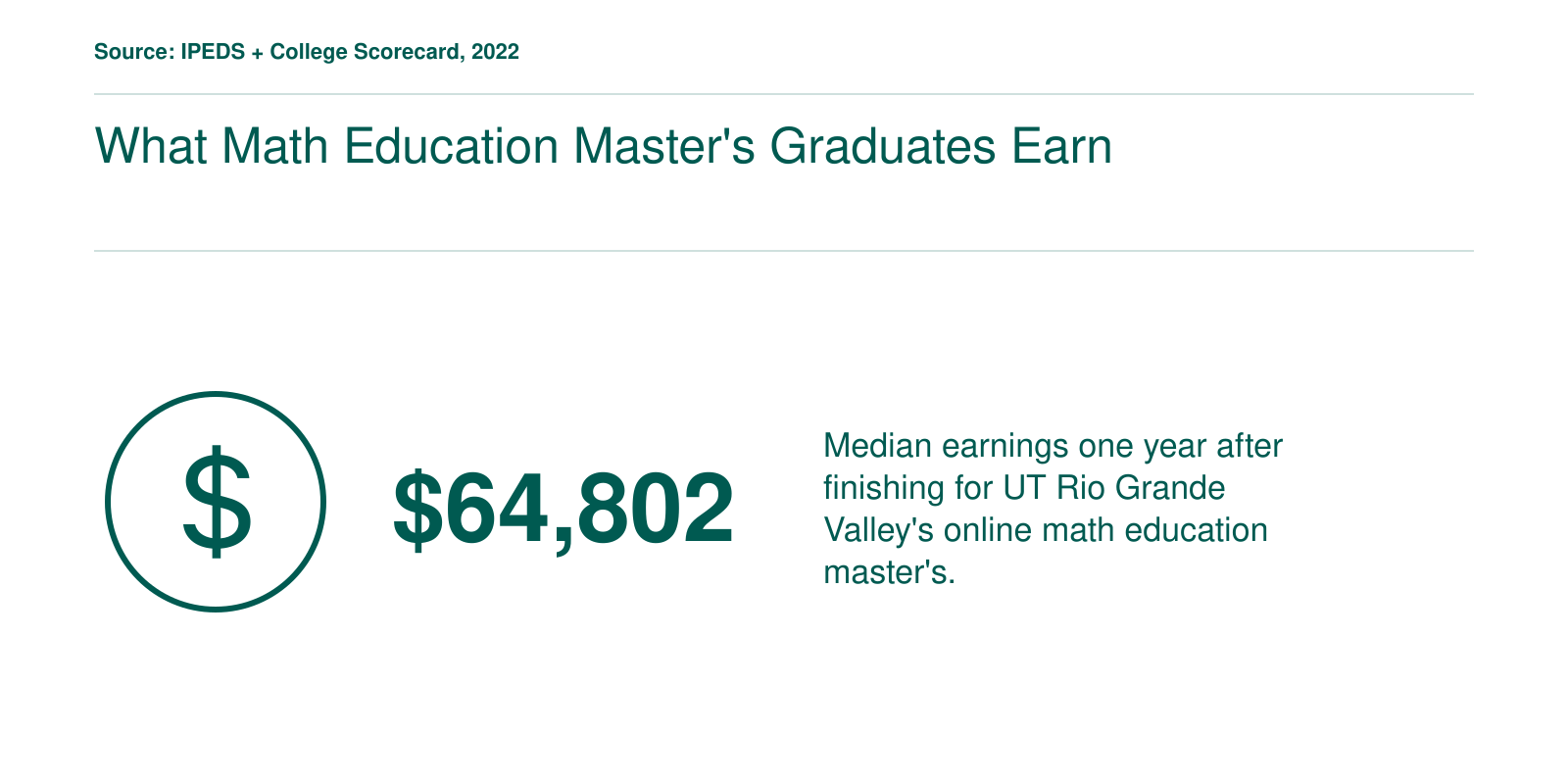
- UT Rio Grande Valley graduates earned a median $64,802 after one year.
- Most programs target teachers who already hold a license.
Best Fully Online Math Education Master's Programs: 2027 Rankings
These are the 10 best fully online math education master's programs for 2026. Hybrid programs are excluded; every option below can be completed without required campus visits, though some may require scheduled online sessions. The list is ordered on a blended look at graduate outcomes, graduation rates, affordability, and program-specific strengths, not a single metric.
University of Florida
#1Gainesville, FL · ~$13,000/yr (est.)
Best for: Florida teachers seeking professional certification
The University of Florida offers a flexible online Master of Arts in Education in Mathematics Education that lets working teachers build a personalized plan with a faculty advisor. The 30-credit program blends advanced math content with research-based pedagogy and ends in a thesis or project. An optional educator preparation pathway can support Florida professional teacher certification. With fall, spring, and summer starts and full- or part-time pacing, it fits practicing and aspiring math educators.
- 30-credit curriculum with thesis or project option
- Full-time and part-time pacing; about 2 to 3 years
- Fall, spring, and summer start dates
- Optional EPI path to Florida professional teacher certification
- 2.7 minimum GPA required for admission
- Tailored plan of study with a faculty advisor
- Two concentration options in mathematics education
Purdue University
#2West Lafayette, IN · ~$10,000/yr (est.)
Best for: Indiana educators wanting math curriculum leadership
Purdue University's online MSEd in Curriculum and Instruction with a Mathematics Education concentration is built for educators who want to specialize in math pedagogy and curriculum development. The fully online program is known for preparing graduates for leadership roles such as math coach or curriculum specialist. Purdue's College of Education is ranked #1 for online MS education programs in Indiana by U.S. News & World Report (2024).
- Online MSEd with Mathematics Education concentration
- Ranked #1 online MS Ed in Indiana by U.S. News & World Report (2024)
- Prepares for math coach or curriculum specialist roles
- Designed for working educators seeking specialization
University of Houston
#3Houston, TX · $10,000 – $19,000/yr (est.)
Best for: Working teachers needing dual-credit teaching path
University of Houston's online MEd in Curriculum and Instruction with an emphasis in Mathematics Education is designed for educators who want to examine how students learn math. The program offers a 30-hour capstone path and a 36-hour dual credit track for those interested in teaching college-level courses. Online courses include required synchronous evening sessions every other week, accommodating working professionals. The curriculum emphasizes equity, assessment, and mathematics learning from early childhood through college.
- Complete in as quickly as 14 months
- Synchronous and asynchronous options
- Thesis or capstone option
- 30-hour path with capstone
- 36-hour dual credit M.Ed. path
- Online with required synchronous evening sessions
- Emphasis on equity in mathematics education
- Prepares for teaching from early childhood to college
George Mason University
#4Fairfax, VA · $15,000 – $20,000/yr (est.)
George Mason University's online MEd in Curriculum and Instruction with a K-8 Mathematics Specialist Leader concentration prepares Virginia educators for state endorsement as mathematics specialists. The 30-credit program blends mathematics content with instructional leadership and can be completed in about two years. Virginia PK-12 educators receive a tuition discount, and the program supports employer tuition reimbursement.
- 30 credit hours, complete in about two years
- 100% online with synchronous online classes
- Prepares for Virginia Mathematics Specialist endorsement
- 15% tuition discount for Virginia PK-12 educators
- 3.0 GPA minimum and two recommendation letters
- Fall, spring, or summer start dates
- Transfer up to 12 credits
- Designed for K-8 mathematics leadership
The University of Texas Rio Grande Valley
#5Edinburg, TX · $5,000 – $10,000/yr (est.)
The University of Texas Rio Grande Valley's 100% online MEd in Curriculum and Instruction with a Mathematics Education specialization is an accelerated, affordable option for educators in diverse classrooms. The 30-credit program uses 7-week courses and can be completed in as few as 10 months, with no application fee. It emphasizes preparation for English-language learners and is connected to the Texas Regional Collaborative in Science and Math.
- 30-credit hour structure with capstone
- $13,750 total program tuition
- $458 per credit, no application fee
- Complete in as few as 10 months
- 7-week course terms
- 3.0 GPA minimum
- Part of Texas Regional Collaborative
- Prepares for curriculum specialist or coordinator roles
University of North Carolina at Charlotte
#6Charlotte, NC · $5,000 – $10,000/yr (est.)
UNC Charlotte's online MS in Mathematics with a Mathematics Education concentration is built for secondary math teachers who want to deepen both content knowledge and teaching practice. The 33-credit, part-time program typically takes two years and features synchronous online meetings, a research project or portfolio, and a comprehensive exam. Admission favors North Carolina A-licensed teachers with at least two years of full-time secondary math teaching experience.
- 33-credit curriculum with research project or portfolio
- Complete in two years part-time
- Synchronous online class meetings
- 3.0 minimum GPA and three recommendations
- Two years of full-time secondary mathematics teaching experience required
- Prepares for community college teaching
- Comprehensive exam and capstone project required
- 18 credit hours at the 6000 level
University of Missouri
#7Columbia, MO · ~$14,000/yr (est.)
The University of Missouri's online MEd in Mathematics Education is designed for certified, practicing K-12 teachers, not career changers seeking initial licensure. The 30-credit program allows an optional elementary or secondary focus and prepares graduates for leadership roles like department chair or professional learning facilitator. It is delivered fully online with no required campus visits.
- 30 total credit hours
- Optional focus on elementary or secondary education
- Designed for certified practicing teachers
- Fully online program
- Does not lead to additional certification
- Prepares for leadership roles like department chair
- 2 concentration options
The University of Texas at Arlington
#8Arlington, TX · ~$11,000/yr (est.)
The University of Texas at Arlington's MEd in Curriculum and Instruction with a Mathematics Education concentration is a 100% accelerated online program for educators seeking advanced expertise in mathematics instruction. The 30-credit, non-thesis program can be completed in as few as 18 months and is AAQEP-accredited. Its problem-based, inquiry-based curriculum prepares graduates for K-12 teaching, curriculum development, and district content roles.
- 30-credit, non-thesis curriculum
- Complete in as few as 18 months
- 100% accelerated online format
- AAQEP-accredited program
- Problem-based and inquiry-based teaching methods
- TEACH grant up to $3,772 per year
- Prepares for K-12 and informal settings
- No thesis or capstone required
University of Pittsburgh-Pittsburgh
#9Pittsburgh, PA · ~$28,000/yr (est.)
The University of Pittsburgh's online MEd in Instruction and Learning with a Mathematics Education concentration is designed for current and aspiring mathematics teachers who want a research-oriented foundation. The 36-credit program requires a comprehensive exam and allows up to 12 transfer credits. It emphasizes how people learn math and can serve as a pathway to doctoral study.
- 36 total credit hours
- Comprehensive examination required
- Up to 12 transfer credits accepted
- 3.0 GPA minimum
- Offered exclusively online
- Prepares students for doctoral study
- Designed for mathematics teachers
- Focus on how people learn math
University of North Carolina at Greensboro
#10Greensboro, NC · ~$9,000/yr (est.)
UNC Greensboro's fully online MEd in Teacher Education with an Elementary Mathematics Education concentration is designed for licensed practicing elementary teachers. The program focuses on students' mathematical thinking and covers algebraic reasoning, mathematical modeling, and data analysis. Graduates often pursue curriculum specialist, math coach, or elementary math teacher roles.
- 100% online program
- Designed for licensed practicing elementary teachers
- Curriculum covers algebraic reasoning and mathematical modeling
- Focus on students' mathematical thinking
- Prepares for curriculum specialist or math coach roles
- U.S. News top graduate school of education
- Scholarships available
None of the ranked Mathematics programs match the online lens yet. The full ranking is at the link above.
Licensed Teachers vs. Career Changers: Which Programs Lead to Certification?
Flexibility is easy to find online, but a license is not, and the degree title won't tell you which one you're getting. Many online math education master's programs are advanced degrees for teachers who already hold a license. Northwest Missouri State's online M.S.Ed. in Teaching Mathematics, for example, is framed as professional growth, not initial licensure. A smaller group, often MAT-style programs, builds in initial certification with student teaching.
State approval and portability
A program approved in its home state may not satisfy yours. Schools that take federal aid must publish state-by-state licensure disclosures (meets, does not meet, or not determined) and tell you before enrollment if your state isn't a match.1 Online delivery doesn't change that. Some schools, Ohio State among them, restrict enrollment in licensure programs by state.2
The NASDTEC Interstate Agreement helps less than it sounds. It is not reciprocity, it doesn't bind states, and it doesn't guarantee your license transfers.34 Out-of-state graduates may face extra coursework or exams.
What to do next
If you're already licensed, many districts pay a salary bump for a math education master's for licensed teachers regardless of track, so an advanced degree can pay off without a new license. Career changers should confirm two things before applying:
- Student teaching: Can you complete it locally, with a placement the program and your state accept?
- State approval: Is the program approved for licensure in the state where you plan to teach?
Admission Requirements: Do You Qualify?
Requirements vary by track and program, but most applications share these elements.
- Bachelor’s degree and GPAYou’ll need an accredited bachelor’s degree. Minimum GPAs vary, commonly from 2.5 to 3.0, with conditional pathways below that at some schools.
- Math courseworkSecondary-focused and advanced tracks often expect calculus and upper-level math courses, such as linear algebra, or a mathematics-related bachelor’s degree.
- GREPolicies vary widely: some programs don’t require the GRE, while others use it for regular admission or for lower-GPA conditional entry.
- Teaching license or experienceLicensed-teacher tracks may require a current certificate or 1–3 years of classroom experience; initial-licensure options generally accept unlicensed bachelor’s holders.
- Application materialsExpect official transcripts, a statement of purpose, and letters of recommendation. Published transfer limits are commonly 12 credits.
Related Articles
Most Affordable Online Master's in Math Education: True Cost Breakdown
These figures combine published graduate tuition and fees with institution-wide net price after aid, which is an average, not a personal cost quote. Per-credit and mandatory online fee disclosures are limited, so the table shows only what is reported. Online students should confirm whether the program charges a flat e-tuition rate or the out-of-state rate before budgeting.
| School | Program | In-state graduate tuition and fees | Out-of-state graduate tuition and fees | Net price (after aid) | Per-credit tuition | Total credits | Estimated program tuition | Mandatory online or technology fees |
|---|---|---|---|---|---|---|---|---|
| UT Rio Grande Valley | Master of Education in Curriculum & Instruction with a Specialization in Mathematics Education | $9,987 | $19,827 | $4,831 | $458 | 30 | $13,750 | N/A |
| University of Florida | Master of Arts in Education, Mathematics Education | $12,737 | $30,130 | $6,541 | N/A | 30 | N/A | N/A |
| Texas A&M University-Victoria | Curriculum and Instruction, Elementary Mathematics | $8,315 | $15,535 | $8,109 | N/A | 30 | N/A | N/A |
Asynchronous Classes, Capstones, and Completion Time
Can you finish an online math education master's without logging in at a set time each week? Mostly, but "online" and "fully asynchronous" are not the same thing, and the difference matters if you teach during school hours.
Delivery and Pace
Waterloo's Master of Mathematics for Teachers is delivered fully online, with almost all coursework asynchronous5, which suits teachers fitting study around a classroom day. The University of Georgia, East Carolina, and Florida run their programs online too, though whether they schedule live sessions is not always spelled out, so confirm with each school before you enroll.123
Credit loads for math education master's programs typically run 30 to 36 credits4. Florida's M.A.E. is 30 credits3; East Carolina's is 36 across 12 courses2. Part-time timelines commonly land around 12 to 24 months4: Georgia's two-courses-per-semester pace reaches completion in about 24 months1, and East Carolina allows full-time teachers two years2.
Culminating Work
Most programs end in a capstone project rather than a thesis. Georgia's EMAT 7100E1, East Carolina's capstone2, and Waterloo's MATH 6995 are all project-based; Florida lets you choose thesis or project3. The practical upside: teachers can often build an action-research capstone around their own students and classroom.
What Math Education Master's Graduates Earn
For graduates of UT Rio Grande Valley's online math education master's program, median earnings one year after finishing were $64,802.
Frequently Asked Questions About Online Math Education Master's Programs
Can I get an online master's in math education without a teaching license?
Which online math education master's programs are fully asynchronous?
What salary can I expect after earning a master's in math education?
Is WGU's online master's in math education worth it?
Compare Mathematics programs on the data that matters
Explore more Education & Teaching specializations or browse every graduate field.
All Education & Teaching programs