Best Master's in Secondary Education Programs in New Hampshire
Compare 4 accredited Secondary Education programs in New Hampshire, with graduate earnings, cost, debt, and completion data from IPEDS and the U.S. College Scorecard.

Credit requirements for a New Hampshire secondary education master's run from 32 at the University of New Hampshire to 42 at Franklin Pierce, a gap that shapes both cost and time to the classroom.
The state offers few graduate routes into middle and high school teaching, so each choice carries weight. Programs appear side by side regardless of delivery format, and the distinction that matters most is whether a program leads to initial licensure or serves teachers who already hold a certificate.
Early-career pay clusters near $48,000, which makes debt, not prestige, the deciding variable.
Key Points
- UNH M.Ed. is a fifth-year internship route; M.A.T. leads to initial licensure.
- Median debt: $20,500 at UNH, $29,634 at Southern New Hampshire University.
- New Hampshire licensure requires an approved prep program plus passing Praxis assessments.
Top New Hampshire Schools for a Master's in Secondary Education
Four New Hampshire schools made this list, and in-state graduate tuition across them spans about $15,500 to $41,800. The entries below combine program formats, licensure pathways, and institutional graduation data to help you compare value without relying on name recognition.
University of New Hampshire
#1Durham, NH · ~$17,000/yr (est.)
Best for: Career changers seeking initial licensure
University of New Hampshire offers a campus-based M.Ed. in Secondary Education built around a two-semester teaching internship in grades 5-12 and coursework in human development, inclusive teaching, content-area literacy, and classroom management. Candidates may prepare for licensure in areas such as English, math, science, social studies, and the arts, with full-time, part-time, and accelerated five-year options. Institution-wide, UNH graduates about 76% of students, giving a sense of its student success trajectory.
- 32 total credit hours
- Full-time and part-time options
- Three start dates per year: fall, spring, summer
- Two-semester teaching internship in grades 5-12
- Leads to New Hampshire teaching certification
- Accelerated five-year option for current UNH undergraduates
- Prepares for 10 licensure areas
Rivier University
#2Nashua, NH · ~$13,000/yr (est.)
Best for: Working professionals needing multiple start dates
Rivier University's Middle/Secondary Education master's tracks offer an on-campus route to New Hampshire licensure with concentrations in biology, English, mathematics, and social studies. Courses are structured in seven-week and fourteen-week terms, with rolling admissions and six start dates per year, which can help working professionals fit study around a job. Institution-wide, Rivier graduates about 52% of students, so the right fit depends on how you use the flexible schedule and local field placements.
- 39 total credit hours
- Four concentration options, including biology, English, math, and social studies
- Rolling admissions with six start dates per year
- Seven-week and fourteen-week course terms
- Internship and seminar included
- Biology track designed for biology baccalaureate holders
- Comprehensive examination required for biology track
- Two-year program
- Prerequisite courses required for biology candidates
- Hands-on field experience
- Internship for initial certification
Franklin Pierce University
#3Rindge, NH · ~$42,000/yr (est.)
Best for: Social studies and ELA teachers adding credentials
Franklin Pierce University runs a campus-based M.Ed. in Middle/Secondary Education with concentrations in Social Studies 5-12 and English Language Arts 5-8 or 5-12. The program includes field experiences, a student teaching capstone, and a path toward New Hampshire state-approved licensure, with the option to pursue dual certification in General Special Education. Institution-wide, Franklin Pierce graduates about 54% of students across all programs.
- 42 total credit hours
- Concentrations in Social Studies 5-12 and English Language Arts 5-8 or 5-12
- 2.8 minimum GPA for admission
- New Hampshire state-approved licensure program
- Field experiences and student teaching capstone required
- Dual certification with General Special Education available
- Four teacher licensure gates
- Partnership with local school districts
Southern New Hampshire University
#4Manchester, NH · ~$21,000/yr (est.)
Southern New Hampshire University offers a 13-month, full-time campus M.Ed. in Secondary Education that places students with mentor teachers in Manchester-area schools and includes a summer field experience. The program offers five certification content areas, CAEP-accredited initial licensure preparation, and an AmeriCorps partnership that may provide up to $29,360 in awards. Institution-wide, SNHU graduates about 43% of students, though the secondary education cohort itself is designed for full-time aspiring teachers.
- 36 total credit hours
- 13-month full-time campus program
- Five certification content areas
- Field-based learning with Manchester-area mentor teachers
- Summer cohort start
- AmeriCorps partnership may provide up to $29,360 in awards
- CAEP-accredited initial licensure program
Cost & outcomes by school
Federal data for the highest-earning Secondary Education programs, independent of the ranking above. Earnings are this field's master's graduates four years after completing, where the Scorecard reports them.
| School | Earnings | Tuition / yr | Debt | Grads/yr | Format |
|---|---|---|---|---|---|
| University of New Hampshire NH | $54,418 | $16,932 | $20,500 | 40 | Campus |
| Southern New Hampshire University NH | $51,153 | $21,387 | $29,634 | 170 | Campus |
| Rivier University NH | — | $13,375 | — | 4 | Campus |
| Franklin Pierce University NH | — | $41,600 | — | 3 | Online |
Sources: U.S. Department of Education. Tuition and graduates: IPEDS. Earnings and debt: College Scorecard, this field's master's graduates; a dash means no figure is reported.
What Earned a Spot on Our New Hampshire List
Every school below had to earn a place on our Master's Programs in New Hampshire list by showing its value in federal numbers, not brochure copy: graduate tuition, average net price, graduation rate and, where published, earnings of program graduates. Two caveats apply. Graduation rates cover the whole institution, not the secondary education program alone, and net price is an approximate average rather than a quote for your situation.
Approval status matters just as much. Southern New Hampshire University holds full CAEP accreditation at the initial-licensure level, earned in Fall 2023 with no areas for improvement. The University of New Hampshire's graduate catalog states its secondary education M.Ed. meets the educational requirements for New Hampshire licensure. At Rivier University and Franklin Pierce University, confirm current state approval directly with the school. Other states typically look for accreditation or state approval when you transfer a license, so ask before you enroll.
UNH's M.Ed. vs. M.A.T. in Secondary Education: Which Track Fits You?
UNH offers two secondary education master's tracks that share a 32-credit floor but serve different starting points. The M.Ed. is the fifth-year route with a full-year internship; the M.A.T. builds initial licensure with graduate content coursework. Career changers and new graduates seeking first-time certification should look first at the M.A.T., while students already on UNH's undergraduate path may fit the M.Ed.
| Feature | M.Ed. in Secondary Education | M.A.T. in Secondary Education |
|---|---|---|
| Primary audience / fit | Fifth-year route after a bachelor's; designed for students continuing UNH's undergraduate secondary education path | College graduates pursuing initial secondary licensure; accelerated option for qualified UNH undergraduates |
| Total credits | 32-credit minimum | 32-credit minimum; total may be adjusted with an adviser based on background and goals |
| Initial licensure | Yes, can lead to recommendation for NH initial secondary certification, not automatic | Yes, can lead to recommendation for NH initial secondary certification, not automatic |
| Internship / student teaching | Full-year, 12-credit internship (fall and spring) | Supervised two-semester internship; spring section listed as 3 or 6 credits, with total set by adviser |
| Subject-area / education coursework | 10 graduate UNH education credits beyond the internship | At least 9–12 graduate subject-matter credits in a concentration such as English, Mathematics, or Life Sciences |
| Admissions basics | Bachelor's degree; Graduate School and program application; GPA review; recommendations; Basic Academic Skills Assessment; background check; $65 fee | Same Graduate School and program materials; basic skills assessment; background check; accelerated pathway requires at least 90 undergraduate credits, two letters, with most tests and fee waived |
| Typical time | About 24 months | About 24 months; accelerated admission available for qualified UNH undergraduates |
Online and Hybrid Master's in Secondary Education Options in New Hampshire
An online master's in secondary education moves coursework onto a screen, but any version that leads to a teaching license still puts you in a real New Hampshire classroom. Among the schools here, the licensure programs at the University of New Hampshire, Rivier University, Franklin Pierce University and Southern New Hampshire University are listed as campus-based. SNHU's M.Ed. is a full-time, 13-month cohort that begins each June.
Does UNH offer an online master's in secondary education? Not that we could confirm. Its fully online graduate degree is the M.Ed. in Educational Studies, which does not lead to certification. That makes it a fit for teachers who are already licensed, not for career changers.
Placements are arranged through the program. UNH's M.A.T., one of the New Hampshire MAT programs, includes a practicum of at least 7 hours a week, then a supervised two-semester internship. Ask each admissions office about hybrid scheduling and placement rules before applying.
Related Articles
GRE Policies: Which New Hampshire Master's Programs Skip the Exam?
Paying for the GRE before you know whether a program appears among master's programs with no GRE required is an expensive gamble. The clearest published policy on this page is at the University of New Hampshire. Its Secondary Education M.A.T. admissions page does not mention the GRE, but it does require Praxis Core Reading, Writing, and Mathematics scores for master's programs leading to initial teacher certification. Rivier University, Franklin Pierce University, and Southern New Hampshire University do not publish a clear GRE policy on their admissions pages.1 Treat the absence as a prompt to call, since they are not listed among master's in secondary education no GRE programs. Keep the two tests separate: Praxis Core is often an admissions or program-entry requirement, while New Hampshire still requires relevant Praxis subject assessments for certification after you finish.1 Before you pay for any exam, confirm the current policy with the program's admissions office. A quick call can save you a registration fee and a test day.
New Hampshire Secondary Teacher Certification at a Glance
What a Master's in Secondary Education Costs in New Hampshire
The real question is not the sticker tuition but the total master's in secondary education cost before you earn your first teaching paycheck. Published graduate tuition across the schools ranked here ranges from roughly $17,200 to over $46,000 a year, so the structure matters as much as the number.
Per-credit rates tell a clearer story. University of New Hampshire charges about $820 per credit in-state and $1,430 out-of-state (2025-26), plus roughly $2,182 in mandatory fees, across its 32-credit M.Ed. Rivier University lists a flat $733 per credit (2026-27) for its 39-credit program, with a $175 graduation fee and no application fee.
Costs Readers Miss
- Fees and materials: Program, technology, and textbook costs (Rivier estimates about $1,470 a year for supplies) add up.
- Exams and licensure: Praxis tests run $90 to $270, and New Hampshire certification totals roughly $370 to $540 including the $120 application and $50 background check.
- Lost income: A full-time student-teaching semester usually means little or no earnings.
Remember that any net-price figure is an institution-wide average, not a personalized quote for your program.
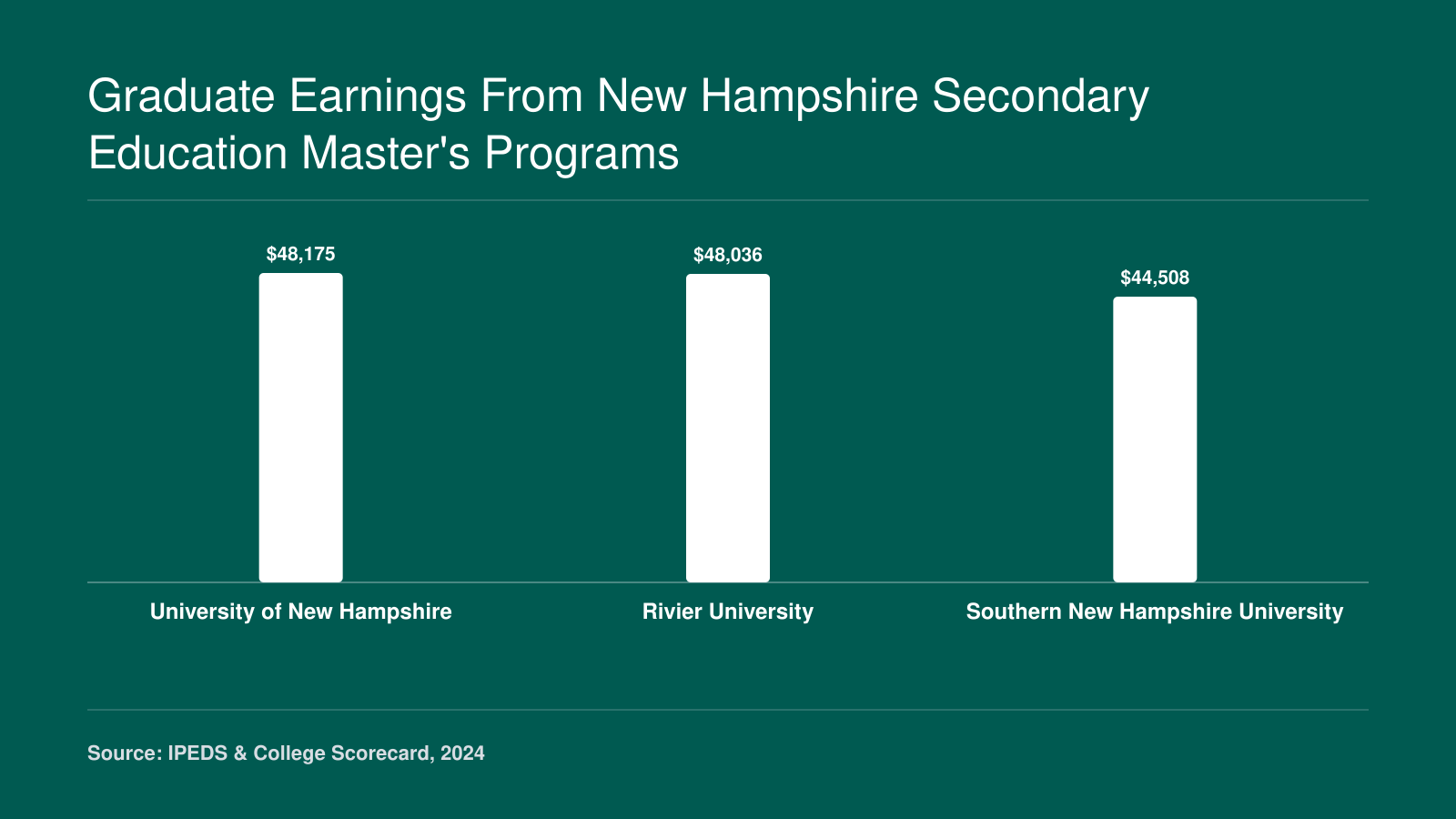
Graduate Earnings From New Hampshire Secondary Education Master's Programs
Median earnings one year after finishing show how New Hampshire programs compare on early-career pay. University of New Hampshire grads earn $48,175, Rivier University $48,036, and Southern New Hampshire University $44,508. Median program debt is $20,500 at UNH and $29,634 at SNHU, with 10-year monthly payments of $233 and $337.
Common Questions About Secondary Education Master's Degrees in NH
Here are concise answers to common questions about New Hampshire secondary education master's degrees, including licensure, online options, cost, and alternative pathways.
What is the difference between an M.Ed. and an M.A.T. in secondary education?
Does UNH offer an online master's in secondary education?
How much does a master's in secondary education cost in New Hampshire?
Do I need a GRE to apply to secondary education master's programs in New Hampshire?
Which New Hampshire master's programs lead to initial teacher licensure?
Can I teach on an intern or alternative certificate while finishing my master's in New Hampshire?
Will a New Hampshire secondary teaching license transfer to other states?
Which subject endorsements can I earn through an NH secondary education master's?
Compare Secondary Education programs on the data that matters
Explore more Education & Teaching specializations or browse every graduate field.
All Education & Teaching programs