Best Master's in Secondary Education Programs in Washington
Compare 6 accredited Secondary Education programs in Washington, with graduate earnings, cost, debt, and completion data from IPEDS and the U.S. College Scorecard.
Washington's first-level teaching credential, the Residency Teacher Certificate, requires a PESB-approved educator preparation program, and the master's degrees that satisfy that requirement range from $8,850 to $56,721 a year for in-state students.
Campus, hybrid, and online options sit on a single ranked list because the format decision often hinges on where a clinical placement can be completed. GRE policies are sparse and uneven across these programs, and endorsement exams ultimately determine the subjects you are legally able to teach.
Key Points
- Faith International University charges in-state and out-of-state graduate students the same $8,850.
- Washington has no fully online master's in teaching that certifies candidates.
- Whitworth University lists $715 per credit for its secondary education master's.
The Top Master's in Secondary Education Programs in Washington, Ranked
These Washington programs earned their place by balancing what students pay with what they can expect after graduation: completion odds, manageable debt, and early-career teaching salaries that hold up. The list mixes public and private options across campus, hybrid, and online formats, with each entry chosen for a specific licensing path in secondary education.
University of Washington-Tacoma Campus
#1Tacoma, WA · $19,000 – $33,000/yr (est.)
Best for: STEM-focused aspiring teachers needing evening classes
Tacoma's Master of Education in Secondary Education with certification in sciences or mathematics blends evening coursework with clinical practice in South Sound schools. The curriculum foregrounds anti-racist and decolonizing teaching methods, and the program can be completed in one year full-time or two years part-time. It fits STEM-focused aspiring teachers who want a residency certificate without a basic skills test score requirement.
- 5 science or mathematics concentration options
- 49 total credit hours; full-time or part-time
- Evening classes for working students
- Clinical placements in South Sound school districts
- No passing basic skills test score required
- Cohort model with personalized advising
- Residency Teacher Certificate awarded
- Anti-racist, decolonizing teaching practices
Seattle University
#2Seattle, WA · ~$24,000/yr (est.)
Best for: Equity-minded educators balancing work and study
Seattle University's hybrid Master of Education in Transformational Teaching and Learning pairs asynchronous online coursework with monthly in-person Saturday sessions. The second-year internship places candidates in a mentor teacher's classroom about 40 hours per week, and partial to full funding is available through grants and scholarships. It is a strong fit for equity-minded educators who need a flexible route to a Washington residency teaching certificate.
- 2 concentration options; 45 total credit hours
- Two-year hybrid with asynchronous online classes and monthly Saturday sessions
- First-year community-based field experiences and mentor teacher connection
- Second-year full-time internship in a mentor teacher's classroom
- Prepares for Washington State teaching certificate
- $0 application fee
- Full funding through grant programs; scholarships up to $12,000
- Focus on anti-racist pedagogies and equity
Washington State University
#3Pullman, WA · ~$15,000/yr (est.)
Best for: Career changers seeking immersive cohort training
Washington State University's 13-month Master in Teaching with a secondary concentration is built for career changers and offered on four campuses. The cohort model combines intensive pedagogy coursework with internships across Pullman, Spokane, Tri-Cities, and Vancouver. Applications close April 1, with earlier priority dates by campus; graduates earn a master's degree and Washington secondary teaching certificate.
- 13-month cohort-based program for career changers
- Offered on four Washington campuses: Pullman, Spokane, Tri-Cities, and Vancouver
- In-person internships across those campuses
- Coursework in literacy, social studies, science, math, and fine arts methods
- Culminating research project on teaching and learning
- 3.0 GPA minimum; basic skills and content exams required
- Competitive application through GradCAS
- Leads to Washington secondary teaching certificate and master's degree
Whitworth University
#4Spokane, WA · ~$14,000/yr (est.)
Whitworth University's Master in Teaching with a secondary cohort is a one-year, majority day program that includes a full academic year of student teaching. Tuition is $715 per credit, and secondary candidates cover core content areas such as English language arts, math, science, and social studies. Priority applications are due Feb. 17 and regular applications May 15 for a program that grants both a master's degree and Washington teaching certificate.
- 44-47 credit hours, one-year program
- $715 per credit
- Full academic year of student teaching included
- Secondary candidates cover ELA, math, science, social studies, health and fitness, languages, and arts
- Priority deadline Feb. 17; regular deadline May 15
- Earn master's and teaching certificate together
- Federal loans up to $20,500 yearly available
- Priority applicants may receive $250 scholarship
Faith International University
#5Tacoma, WA · ~$7,000/yr (est.)
Faith International University's Master of Arts in Education is an online program designed for church and marketplace leaders, with an optional Adolescent Education emphasis. The 56-hour curriculum frames educational psychology, learning theories, and curriculum design within a biblical worldview. It does not lead to Washington educator certification, so it suits students seeking ministry, leadership, or salary advancement rather than initial licensure.
- 56 quarter hours, online format
- Built for church and marketplace leaders
- Adolescent Education emphasis adds 16 quarter hours
- Framed by a biblical worldview
- Covers learning theories, curriculum design, and educational psychology
- Does not lead to educator certification
- 2.7 GPA minimum
Cost & outcomes by school
Federal data for the highest-earning Secondary Education programs, independent of the ranking above. Earnings are this field's master's graduates four years after completing, where the Scorecard reports them.
| School | Earnings | Tuition / yr | Debt | Grads/yr | Format |
|---|---|---|---|---|---|
| University of Washington-Tacoma Campus WA | $80,738 | $18,987 | $30,990 | 20 | Hybrid |
| Seattle University WA | $79,881 | $24,216 | $33,325 | 24 | Hybrid |
| Washington State University WA | $71,438 | $14,845 | $32,657 | 48 | Campus |
| Whitworth University WA | $67,773 | $14,146 | $41,000 | 29 | Campus |
| Central Washington University WA | — | $13,220 | — | — | Online |
| Eastern Washington University WA | — | $14,106 | — | — | Campus |
Sources: U.S. Department of Education. Tuition and graduates: IPEDS. Earnings and debt: College Scorecard, this field's master's graduates; a dash means no figure is reported.
Cost, debt & payoff
Median earnings of this field's master's graduates (4 yrs after completing) vs. their median federal loan debt · U.S. College Scorecard
Across these programs the median graduate earns about $75,660 and finishes with roughly $32,991 in debt — a ratio that clears a common rule of thumb (keep debt below first-year salary). Tuition and debt vary widely school to school, so check the per-school figures in the table above before you shortlist.
Online and Hybrid Master's in Teaching Options in Washington
A fully online master's in secondary education that also certifies you to teach in a Washington classroom does not really exist, and the clinical placement requirement is why. Instead, the available formats are a mix of hybrid coursework and campus cohorts, with the online-only option pointed at a different career.
How the formats differ
Seattle University's Transformational Teaching & Learning M.Ed. is the hybrid route: asynchronous online classes paired with monthly in-person sessions, structured as a two-year, 45-credit cohort. Washington State University's Master in Teaching is a campus cohort offered on four Washington campuses, starting in summer and finishing in 13 months.1 Whitworth's Master in Teaching is likewise campus-based, a one-year summer-start cohort of 44 to 47 credits at $715 per credit.2 Faith International University's Master of Arts in Education is delivered fully online across 56 credits, but it does not lead to educator certification, so treat it as a leadership degree rather than a licensure path.
Student teaching still happens in a school
Online or hybrid coursework does not shorten the classroom placement. Washington State University Vancouver requires a full academic year of student teaching: two days a week in the fall, then five days a week in the spring. Seattle University places candidates in a mentor teacher's classroom for an internship, alongside community-based field experiences.
Full-time and part-time timing
The certification cohorts are built for full-time study, and the compressed summer-start models at Washington State and Whitworth, common among accelerated secondary education master's programs, leave little room for full-time work. Seattle University's two-year schedule spreads the same load more gently.
Which Washington Master's Programs Waive the GRE, and What Else You Need to Apply
Washington teaching admissions have largely moved away from the GRE, with master's in secondary education no GRE programs now leaning on GPA, basic skills tests, and subject-area endorsements to make decisions.
GRE Policies at the Programs Here
University of Washington-Tacoma Campus does not consider GRE scores: if you submit them, they will not be reviewed. Washington State University does not state a GRE requirement in its published admissions materials.1 Seattle University, Whitworth University, and Faith International University do not list the GRE among their published requirements.
What Else You Need to Apply
- A bachelor's degree, typically with a 3.0 cumulative GPA. Some programs may review the most recent 60 semester credits if the overall GPA is lower.
- Basic skills in reading, writing, and math, commonly met by the WEST-B, SAT, or ACT.2
- A content area check such as the NES or WEST-E exam, or approved endorsement-area coursework.2
- Fingerprint and background checks before field placements and certification.
You do not need a bachelor's degree in education. Most MAT programs in Washington are built for career changers who hold a degree in the subject they want to teach.
MIT vs. M.Ed.
A Master in Teaching (MIT) typically leads to initial Washington teacher certification and is designed for people entering the classroom for the first time. A Master of Education (M.Ed.) is often aimed at educators who already hold a certificate and want to deepen their practice or move into leadership. For secondary certification, the MIT is the more common entry route among secondary education master's degree programs.
Related Articles
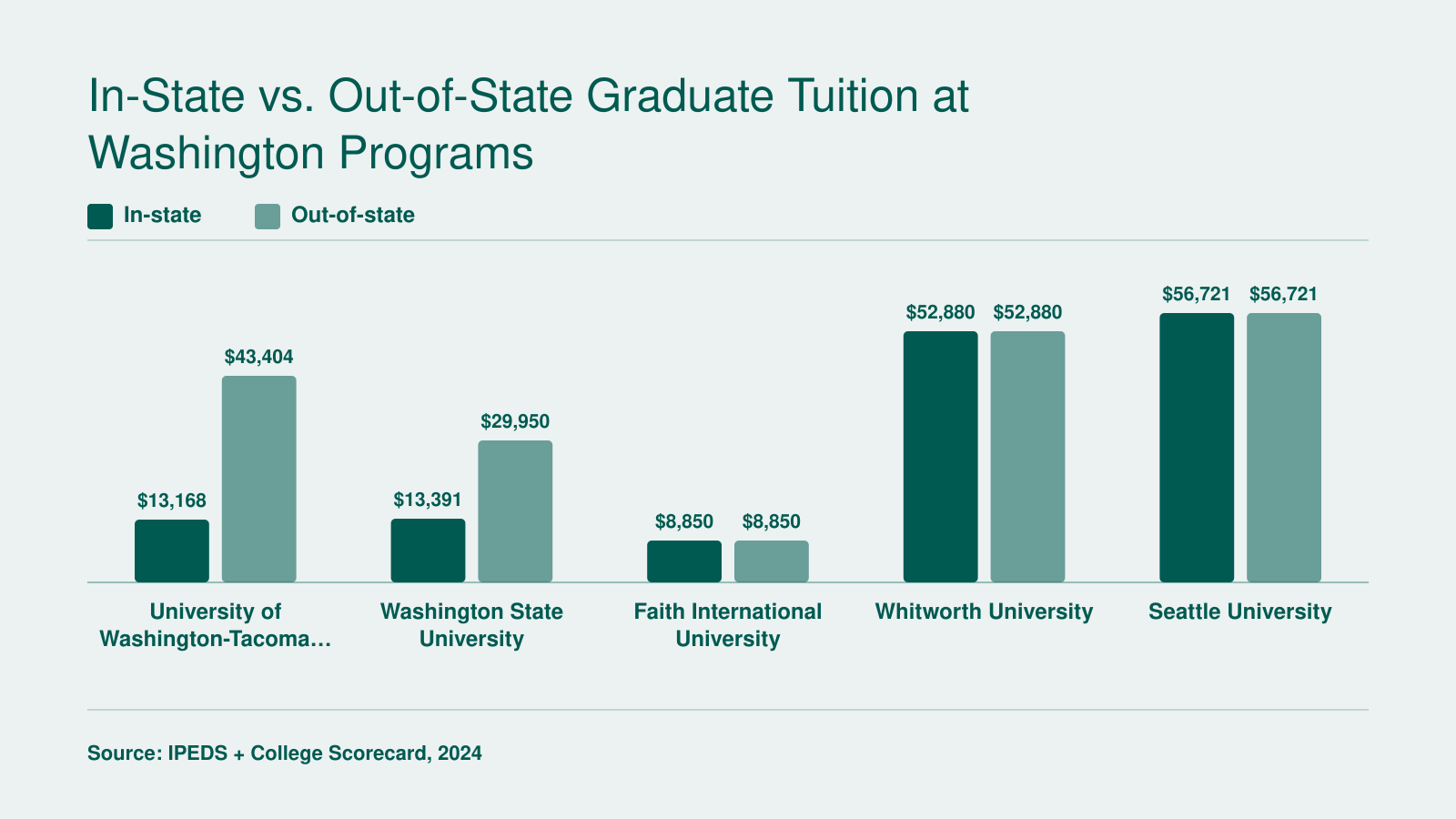
In-State vs. Out-of-State Graduate Tuition at Washington Programs
These figures are annual published graduate tuition and fees for 2024, not the total program cost. Faith International University has the lowest in-state rate at $8,850, and it charges nonresidents the same amount. At University of Washington-Tacoma Campus, the resident/nonresident gap is the largest in this comparison at $30,236.
What a Master's in Secondary Education Costs in Washington, Beyond Tuition
Washington has loosened some certification hurdles, but the bill still has more lines than the tuition page shows for master's programs in Washington.
Turning Tuition Into a Program Total
Multiply the per-credit rate by the credit count. Whitworth University lists $715 per credit, so confirm its credit total before multiplying. Seattle University's Transformational Teaching & Learning MEd runs 45 credits, and Eastern Washington University's online M.Ed. lists 49. Washington State University's Master in Teaching shows $12,298 in tuition plus $1,848 in fees over 50 credits on a third-party listing, so verify those figures with the program.
Costs Readers Forget
- Exams: Budget for the WEST-B and a content test (NES or WEST-E). Some programs provide full or partial vouchers.
- edTPA: Washington dropped it as a state requirement in 2021. If your program still uses it, expect roughly $300.
- Clearance and certificate: Fingerprinting and background checks, plus a $42 residency certificate (seven years at $6 per year).
- Program fees: Ask about student teaching and cohort fees.
Debt, Earnings and Aid
Median debt for program completers is $30,990 at UW-Tacoma, $32,657 at WSU, $33,325 at Seattle University, and $41,000 at Whitworth. One year after finishing, median earnings are $72,769 (UW-Tacoma), $62,589 (WSU), $72,295 (Seattle University), and $59,502 (Whitworth).
For an affordable master's in secondary education, net price is only an institution-wide average after aid: $34,662 at Seattle University and $26,534 at Whitworth. Ask each program about the TEACH Grant and Washington's Alternative Routes conditional scholarships.
Washington Teaching Certificate at a Glance
Secondary Endorsements and Accreditation Across Washington Master's Programs
Every Washington secondary endorsement, whether math, science, English language arts, social studies, or a world language, rests on two things: a passing WEST-E/NES score in that subject and coursework that matches it. A master's degree alone, even one of the Best M.Ed. Programs in Washington, does not add an endorsement to a certificate.
Where Each Program Points You
Washington State University's Master in Teaching, offered on four campuses, leads to a Residency Teacher Certificate with a secondary (5-12) endorsement and standardly supports biology, English language arts, history/social studies, and mathematics. At University of Washington-Tacoma, the 5-12 certification track is built around the sciences and mathematics, with middle level endorsement options available. Whitworth's secondary cohort covers core content areas, and Seattle University's transformational teaching program prepares candidates for Washington certification. Faith International University's adolescent education emphasis is the outlier here: it does not lead to educator certification. Endorsement lists live on each program's certification page and change, so verify before you commit.1 Math, science, and special education are widely cited as the hardest endorsements for districts to fill, a gap reflected in our Best Master's in Special Education Programs in Washington ranking.
PESB Approval Is the One That Counts
A Washington certificate requires completing a preparation program approved by the Professional Educator Standards Board. CAEP or AAQEP accreditation is a national quality signal, but it does not make you certifiable in Washington on its own. Check PESB's approved program list directly rather than relying on marketing copy.
Coming From Another State
Washington reviews applicants case by case instead of swapping certificates. Expect a bachelor's degree plus either an approved preparation program or three years of teaching under another state's certificate, subject-matter testing (every state's tests are accepted except Montana's), WEST-B or an ACT/SAT substitute, and fingerprinting. A one-year permit may cover testing gaps. Confirm the details with OSPI.
Compare Secondary Education programs on the data that matters
Explore more Education & Teaching specializations or browse every graduate field.
All Education & Teaching programs