Best Master's in Art Education Programs in Michigan
Compare 3 accredited Art Education programs in Michigan, with graduate earnings, cost, debt, and completion data from IPEDS and the U.S. College Scorecard.

Michigan's art education master's offerings have thinned in recent years, with tracks paused or folded into broader Michigan master of education programs, so older directory listings often point to programs that are not currently admitting students.
In-state graduate tuition runs from about $12,196 at Northern Michigan University to $20,103 at Western Michigan University. College for Creative Studies, a private school in Detroit, charges $58,440 regardless of residency.
Most of these degrees assume you already have the Visual Arts Education endorsement, which makes the practical question what the credential adds to a salary schedule rather than whether it gets you into a classroom.
Key Points
- Northern Michigan University is the cheapest ranked option, at about $12,196 in-state tuition.
- Western Michigan University art education graduates earned a median $54,295 one year after finishing.
- Confirm GRE rules, deadlines, and 2027 admissions status directly, since several schools publish no policy.
Ranked: Michigan's Master's in Art Education Programs for 2027
These three Michigan master's in art education programs are ordered by graduate outcomes and cost, and each card ends with a note on 2026 admissions status. Where an official catalog or department page did not confirm that a program is accepting applications, we say so. Confirm the current status with the department before you apply. The order reflects outcomes and cost, and the methodology section below explains how we weighed them.
Western Michigan University
#1Kalamazoo, MI · $20,000 – $25,000/yr (est.)
Best for: Studio-focused art teachers seeking advanced training
Western Michigan University in Kalamazoo offers a Master of Arts in Art Education through the Gwen Frostic School of Art, aimed at art educators who want advanced preparation in their discipline. Graduate study emphasizes individual studio and scholarly talents, professional studio competence, and the presentation of aesthetic ideas. The university graduates about 58% of its students, an institution-wide figure rather than a program completion rate. Admissions status: we could not confirm from the catalog pages reviewed whether the program is accepting 2026 applications, so check with the school directly.
- Administered by the Gwen Frostic School of Art
- Described as advanced preparation for working art educators
- Studio and scholarly focus with professional studio competence
- School of art is a National Association of Schools of Art and Design member
- Student-operated gallery and lectures by visiting artists
- Federal data shows median earnings of about $54,300 one year after completion
Northern Michigan University
#2Marquette, MI · $12,000 – $16,000/yr (est.)
Best for: Upper Peninsula students wanting a regional option
Northern Michigan University in Marquette lists a Master in Arts Education in its 2024-2025 Graduate Catalog, giving Upper Peninsula students an in-state option. The catalog entry is brief and does not state a credit total, course list, start term, admission requirements, or delivery format, so ask the department for specifics. The university graduates about 52% of its students, an institution-wide figure and not a program completion rate. Admissions status: we found no official page confirming that the program is accepting 2026 applications, so verify directly.
- Listed among graduate programs in the 2024-2025 Graduate Catalog
- Catalog gives no credit total or course list
- Start term, admission requirements and delivery format not published in the entry
- Federal data shows median earnings of about $54,100 one year after completion
- Small graduating group in the federal data, so treat outcomes cautiously
College for Creative Studies
#3Detroit, MI · ~$56,000/yr (est.)
College for Creative Studies is a private art and design college in Midtown Detroit, next to the Detroit Institute of Arts, and offers a Master of Arts in Art Education alongside several design graduate programs. Graduate enrollment is small, at 58 students, and the college reports that 98% of its students receive institutional, state, or federal aid. The college graduates about 71% of its students, an institution-wide figure and not a program completion rate. Admissions status: we could not confirm from official pages whether the art education program is accepting 2026 applications, so contact admissions before applying.
- Master of Arts offered among CCS graduate programs
- Campus in Midtown Detroit, next to the Detroit Institute of Arts
- Free admission to the Detroit Institute of Arts listed as a benefit
- 58 graduate students enrolled, mostly full-time
- Published 2026-27 graduate tuition of $1,948 per credit, plus fees
- Financial aid available; 98% of students receive some aid
Cost & outcomes by school
Federal data for the highest-earning Art Education programs, independent of the ranking above. Earnings are this field's master's graduates four years after completing, where the Scorecard reports them.
| School | Earnings | Tuition / yr | Debt | Grads/yr | Format |
|---|---|---|---|---|---|
| Western Michigan University MI | $62,562 | $20,103 | $35,733 | 34 | Campus |
| Northern Michigan University MI | $62,230 | $12,196 | — | 6 | Campus |
| College for Creative Studies MI | — | $55,670 | — | — | Campus |
Sources: U.S. Department of Education. Tuition and graduates: IPEDS. Earnings and debt: College Scorecard, this field's master's graduates; a dash means no figure is reported.
Online and Hybrid Master's in Art Education Options in Michigan
Fully online study and campus studio work pull in opposite directions, and in Michigan the split is fairly clean.
Fully online
Western Michigan University's M.A. in Art Education is delivered online and is included among the Best Online Master's in Art Education Programs; it is built around 18 required art education credits, with graduate studio art and art history electives that can be taken online, hybrid, or in person when program faculty approve the choice. The program is designed for part-time completion in about three years, which suits teachers staying in the classroom; WMU does not publish a separate full-time timeline. This degree is not a certification route. It does not lead to a Michigan art endorsement, so it is aimed at educators who already hold a license and want depth, not entry.
Campus-based
The College for Creative Studies offers its Master's in Art Education on campus in Detroit, with a listed full-time length of roughly two years. Part-time pacing is not published.
Neither school publicly lists a mandatory summer residency, so confirm current scheduling with each department before applying.
Which Michigan Art Education Master's Programs Waive the GRE?
We could not confirm a published GRE policy or a current application deadline for the schools ranked here, so the table says so instead of guessing. A missing policy on our end does not mean the school requires or waives the test.
| School | GRE Policy | Application Deadline | Notes |
|---|---|---|---|
| Western Michigan University | No published policy confirmed | Not confirmed | Check the graduate admissions page for the art education master's program. |
| Northern Michigan University | No published policy confirmed | Not confirmed | Ask graduate admissions whether the test is required, optional, or waived. |
| College for Creative Studies | No published policy confirmed | Not confirmed | Ask admissions whether deadlines are fixed or rolling, and about portfolio expectations. |
Michigan Art Teacher Certification at a Glance
Related Articles
Cost and Michigan Teaching Licensure for Art Educators
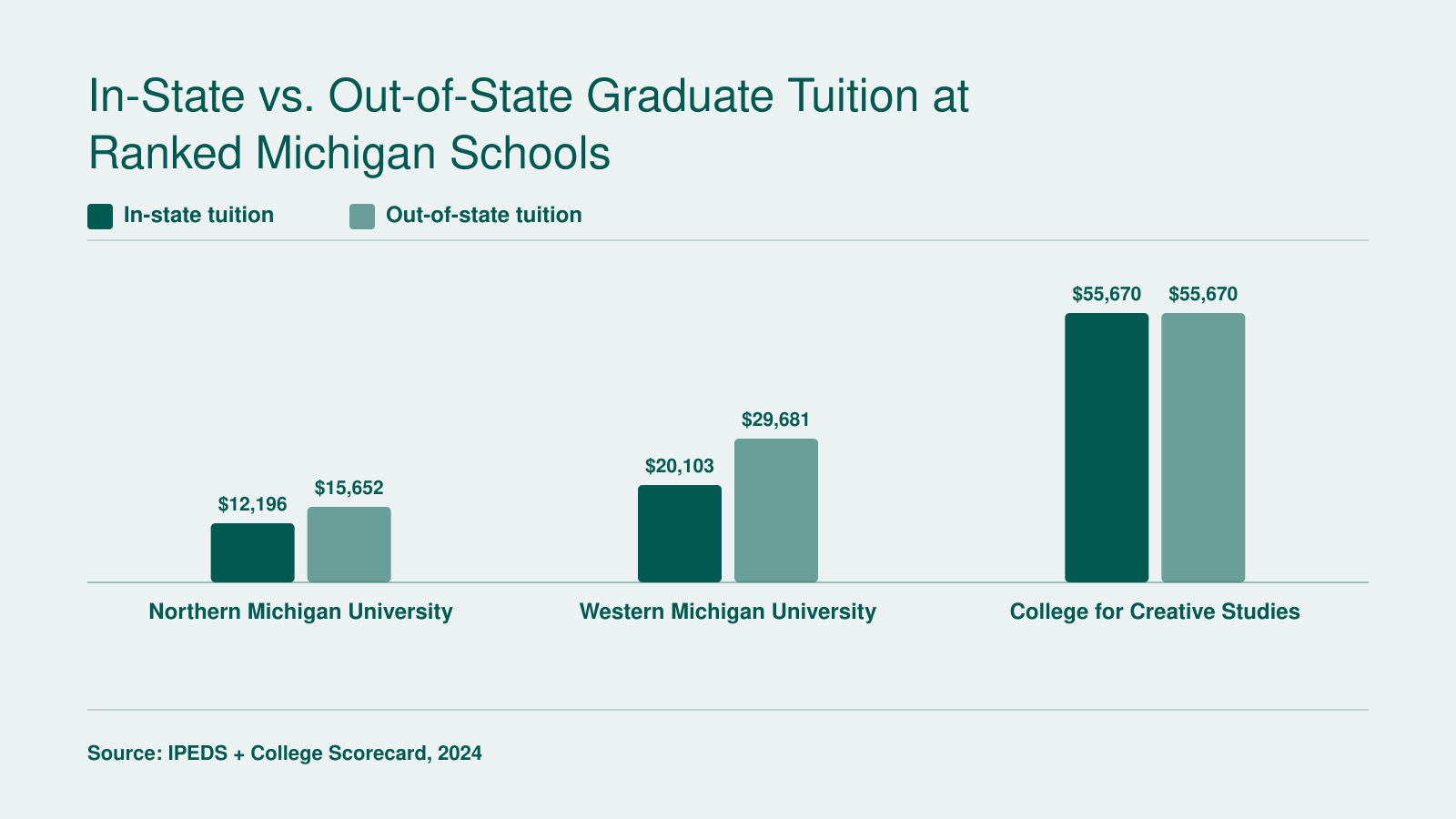
The real price of an art education master's is tuition plus what the credential does for your pay or your license. Listed tuition runs from about $12,196 in-state ($15,652 out-of-state) at Northern Michigan University, to $20,103 in-state ($29,681 out-of-state) at Western Michigan University. College for Creative Studies lists $58,440 for everyone. Per-credit rates and fees were not confirmed for 2026, so check each bursar page before you total the bill using the Michigan master's degree cost comparison.
Monthly payments
Western Michigan graduates show median debt of $35,733, which works out to roughly $406 a month on a 10-year plan. Debt figures for Northern Michigan and College for Creative Studies are not published, so we leave them out.
Licensure fit
Western Michigan's M.A. does not offer teacher certification or a visual arts endorsement; the Western Michigan's initial certification programs list the B.F.A. in Art Education as the certification route. That makes it best for licensed teachers. For Northern Michigan and College for Creative Studies, we found no confirmed certification pathway, so ask admissions whether the degree leads to initial licensure, an added endorsement, or only a pay-scale credential.
Offsetting the cost
Many Michigan districts pay more for a master's, so a licensed teacher can recoup part of the tuition through the salary schedule. Confirm the lane structure in your own district's contract.
In-State vs. Out-of-State Graduate Tuition at Ranked Michigan Schools
Residency matters at the public schools here. Michigan residents at Northern Michigan University pay $3,456 less than nonresidents, and at Western Michigan University the gap is $9,578. College for Creative Studies, a private school, charges the same $55,670 to everyone. Online programs at some schools may charge a flat rate regardless of residency, so confirm with the bursar before you budget.
Admissions Requirements and Portfolio Expectations
Requirements differ by school and track, so confirm each program's current admissions page before you apply.
- Bachelor's backgroundAn art, art education, or studio art degree is the usual route. Some tracks accept related majors if you have enough studio credits.
- GPAWestern Michigan University publishes a 2.75 minimum cumulative GPA for art education applicants.
- Certificate or experienceTracks that lead to teaching often ask for a Michigan teaching certificate. Art therapy-oriented tracks generally do not.
- PortfolioExpect a digital or slide portfolio of roughly ten works across media. Check each school's page, since some programs may not require one.
- Statements and lettersPlan on a statement of purpose and two recommendation letters. Some programs add an interview.
- ConcentrationsArt therapy tracks may add about 12 psychology credits and 18 studio credits.
How We Rank Michigan Master's in Art Education Schools
Our rankings favor what the most affordable master's in art education programs can actually cost you and pay back, not how selective or famous a school looks on paper. We weight graduate tuition, net price, and typical debt heavily, then fold in program-level earnings where the federal data reports them. Reputation surveys and prestige signals do not drive the order; they tell you little about whether a Michigan program is a good value for your career.
The comparison is not perfect. Graduation rate and net price are reported at the institution level, so they describe the whole university rather than only art education students. Earnings data covers the most recent Scorecard snapshot, a single year, and may be missing for smaller programs. Use the ranking as a starting point, then weigh fit, faculty, and licensure support yourself.
Career and Salary Outlook for Michigan Art Educators
Median earnings for Western Michigan University's Master of Arts in Art Education graduates were $54,295 one year after completion. About 99 percent of those graduates were employed in that first year, and roughly 94 percent were earning above the poverty threshold.
Northern Michigan University reports similar program-level earnings: $54,091 one year after completion. Its employment rate for that period is 100 percent, though the group is small (nine completers), so treat it as a loose signal.
These figures describe graduates as a whole. Many are already teaching when they enroll, so they don't show what the degree adds for any one person.
For licensed teachers, the payoff usually comes through the district salary schedule. Most Michigan districts pay more for a master's degree, in the form of a step or lane increase. Before you commit, get your district's current schedule, calculate the annual raise, and divide the program's total cost by that amount. The result is your break-even point in years.
Compare Art Education programs on the data that matters
Explore more Education & Teaching specializations or browse every graduate field.
All Education & Teaching programs