Best Master of Arts in Teaching (MAT) Programs in California
Compare 57 accredited Teaching programs in California at 44 schools, with graduate earnings, cost, debt, and completion data from IPEDS and the U.S. College Scorecard.

A California MAT can deliver a master's degree and a preliminary teaching credential in one program, and that bundling is the main reason to choose it over a standalone credential. The price spread is wide, though. Pepperdine lists $48,150 in total program tuition, while Stanislaus State's graduate tuition sits under $10,000.
Exam timing changes the math too: UC Irvine, for one, requires a CSET subtest at application, so some candidates must test before they are admitted.
Key Points
- UC Irvine does not require the GRE, and Pepperdine calls its MAT test optional.
- CalTPA data shows 94% of candidates passed both cycles in 2023-24.
- Tuition ranges widely, with Cal State San Bernardino and Stanislaus State at the affordable end.
The 10 Best MAT Programs in California for 2027
These ten schools combine credential-granting programs with master's degrees for working teachers, in campus, online, and hybrid formats. Graduation rates shown are institution-wide figures for the school, not the MAT program's own rate. Our research could not confirm each school's California Commission on Teacher Credentialing (CTC) approval or WSCUC accreditation, so check every credential program on the CTC Approved Institutions and Programs dashboard before you apply.
University of California-Berkeley
#1Berkeley, CA · ~$16,000/yr (est.)
Best for: Social justice-focused aspiring teachers
UC Berkeley's 15-month, cohort-based BTEP pairs a California teaching credential with a Master of Arts in Education, with a social justice focus and gradual immersion in Bay Area classrooms. The university's institution-wide graduation rate is about 93%. Berkeley appears on the CTC's list of approved blended or integrated programs, but that does not confirm this specific program's approval, and WSCUC status was not verified, so check the CTC dashboard.
- 15-month, campus-based cohort with a summer start
- Concentrations: Multiple Subject, English, History/Social Science, Math, Science
- Master's project researching your own teaching
- Gradual immersion, then lead teaching in Bay Area schools
- Three letters of recommendation minimum; no GRE required
- Financial aid and scholarships available
- Math concentration of the combined credential and MA
- Automatic fellowship consideration
- Teacher inquiry project is part of the MA
- Science concentration of the combined credential and MA
- CSET exams listed as required for this track
- Field supervisor support during student teaching
University of California-Irvine
#2Irvine, CA · ~$15,000/yr (est.)
Best for: Career changers wanting credential plus master's
UC Irvine awards the MAT and a California teaching credential in one course of study, with a summer-start cohort. The GRE, prerequisite coursework, and documented fieldwork hours are not required, but one passing CSET subtest must accompany the application. The university's institution-wide graduation rate is about 87%. CTC approval and WSCUC status were not confirmed in our research, so verify both before applying.
- MAT degree and California credential in one program
- 2027-28 cohort starts coursework in June 2027
- Application opens October 1, 2026; first deadline December 11, 2026
- 3.0 GPA minimum and three letters of recommendation
- One passing CSET subtest due with the application
- Remaining CSET scores or Subject Matter Verification due June 1, 2027
- Certificate of Clearance required; GRE not required
- Merit and need-based scholarships available
University of California-Davis
#3Davis, CA · $15,000 – $20,000/yr (est.)
Best for: Aspiring bilingual teachers
UC Davis combines a Master of Arts in Education with a Multiple Subject or Single Subject credential in about six quarters, with research built into classroom practice. Credential subjects include English, math, science, social science, and agriculture, and a bilingual authorization is available. The university's institution-wide graduation rate is about 86%. CTC approval and WSCUC status were not verified in our research, so confirm them on the CTC dashboard.
- Six-quarter program completed in under two years
- Multiple Subject or Single Subject credential with an MA in Education
- Subjects include English, math, science, social science, agriculture
- Bilingual authorization in Spanish or Mandarin available
- MA finished in two part-time quarters after the credential year
- 3.0 GPA minimum; prerequisite courses required
- Public school classroom immersion
Santa Clara University
#4Santa Clara, CA · ~$32,000/yr (est.)
Santa Clara University's MATTC offers the widest pathway menu here: one-year or two-year sequences, traditional student teaching or an intern route, and an in-person or online option with a three-day residency. It leads to a California preliminary multiple or single subject credential, though it is the most expensive public-versus-private comparison on this list, so weigh net price carefully. Institution-wide graduation rate is about 88%. CTC approval and WSCUC status were not confirmed in our research.
- Multiple Subject track: 59 units; Single Subject track: 53 units
- Single Subject areas: English, math, science, social science, Spanish
- One-year or two-year sequence
- Traditional student teaching or paid intern as teacher of record
- Online option with a three-day in-person residency
- Full-year practicum at placement sites
- Bilingual Authorization adds 9 units
San Jose State University
#5San Jose, CA · ~$10,000/yr (est.)
San Jose State's MAT is a master's degree for teachers who already finished SJSU's credential program and hold a preliminary credential, so it is not a route to initial licensure. A Critical Bilingual Education (Spanish) option is also listed. Institution-wide graduation rate is about 69%. Because this degree sits on top of a credential, confirm approval of SJSU's credential program on the CTC dashboard; WSCUC status was not verified in our research.
- For SJSU credential completers holding a preliminary credential
- Proof of teaching required
- One letter of recommendation plus a principal's letter
- Coursework valid for seven years
- 34 total credit hours
- 2.5 GPA minimum and two letters of recommendation
- Thesis or capstone option
- Bilingual authorization preparation
- Interview in Spanish required
- 45 observation hours recommended
San Diego State University
#6San Diego, CA · ~$10,000/yr (est.)
San Diego State stands out on format: an online, asynchronous MAT for working professionals that can be finished in one year, plus a Language Arts option completed over two summers. The listings describe inquiry-based master's study with an action research capstone, not an initial credential, so confirm your licensure route separately. Institution-wide graduation rate is about 76%. CTC and WSCUC status were not verified in our research.
- Fully online, asynchronous, one-year program
- 30 units across 10 courses; summer start
- Action research capstone in your own classroom
- Comprehensive exam required; no thesis
- Secondary Education concentration, online
- Course load reduction for recent credential holders
- Designed for K-12 master teachers
- Focus on culturally and linguistically diverse students
- Completed in two summers; 30 credit hours
- Mostly asynchronous with synchronous meetings
- Literacy theory and practice focus
- Transfer up to 6 units from a credential
- Annual literacy conference included
California State University-Sacramento
#7Sacramento, CA · $10,000 – $20,000/yr (est.)
Sacramento State is a low-cost master's option for teachers who already hold a Multiple Subject, Single Subject, or PK-3 credential from the school. Candidates complete a five-course MAT sequence in summer, fall, and spring, with up to seven years to finish. Institution-wide graduation rate is about 56%. This is a post-credential degree; CTC approval of the underlying credential program and WSCUC status were not verified in our research.
- Requires a Sacramento State teaching credential
- Five-course sequence across summer, fall, and spring
- Up to seven years to complete
- Separate application through Cal State Apply by March 1, 2027
- B or better required in MAT courses
- Inquiry-based, problem-based, social justice curriculum
Pepperdine University
#8Malibu, CA · $40,000 – $45,000/yr (est.)
Pepperdine's MAT is an 11-month hybrid with weekly live online classes and 600 clinical hours at over 200 partner sites, in Elementary (Multiple Subject) and Secondary (Single Subject) versions. Standardized tests are optional. The program page states CTC and WSCUC accreditation, though our data does not independently verify it, so confirm on the CTC dashboard. A recent listing suggests January and September 2027 starts and tuition near $48,900, so confirm both with the school. Institution-wide graduation rate is about 83%.
- 11 months, 30 credits, 600 clinical hours
- Listed tuition $48,150 ($1,630 per credit); confirm current figure
- Weekly live online classes with in-person student teaching
- 200+ student-teaching sites; annual career fair
- 3.0 GPA minimum and two letters of recommendation
- Test optional; application fee waivers available
- Single Subject preparation for Pre-K to 12 teaching
- Synchronous and asynchronous options
- No GRE or standardized tests required
California State University-Fresno
#9Fresno, CA · ~$9,000/yr (est.)
Fresno State's online MAT is built for credentialed practicing teachers, with a three-semester cohort (fall, spring, fall) emphasizing social justice, multiculturalism, and action research. It offers one of the lowest tuition levels on this list. Institution-wide graduation rate is about 57%. This is a post-credential degree; CTC and WSCUC status were not verified in our research.
- Fully online, three-semester cohort starting fall
- Designed for credentialed practicing teachers
- Work experience required
- Project, comprehensive exam, or thesis to finish
- Transfer up to 9 graduate units
- Action research methodology
California State University-Stanislaus
#10Turlock, CA · ~$10,000/yr (est.)
Stanislaus State offers an accelerated dual-objective MAT that earns a master's and prepares you for a preliminary California credential in one year, with tracks in Multiple Subject, Single Subject, and Education Specialist. Coursework is online with K-12 field experiences. Institution-wide graduation rate is about 53%. CTC approval and WSCUC status were not confirmed in our research, so verify both on the CTC dashboard.
- One year, or one and a half years with specialized studies
- Tracks: Multiple Subject, Single Subject, Education Specialist
- Online courses with K-12 field experiences
- 3.0 GPA and a B or higher in a writing-intensive course
- Equity and justice statement up to 1,000 words; faculty interview
- Fall 2027 applications: January 1 to March 1, 2027
- Capstone project on an education challenge
Cost & outcomes by school
Federal data for the highest-earning Teaching programs, independent of the ranking above. Earnings are this field's master's graduates four years after completing, where the Scorecard reports them.
| School | Earnings | Tuition / yr | Debt | Grads/yr | Format |
|---|---|---|---|---|---|
| California State University-Fresno CA | $97,033 | $8,865 | $20,500 | 18 | Online |
| California State University-Northridge CA | $89,925 | $8,982 | $20,500 | 7 | Campus |
| University of Massachusetts Global CA | $84,909 | $13,680 | — | 163 | Online |
| University of California-Irvine CA | $79,921 | $14,827 | $30,500 | 136 | Campus |
| Santa Clara University CA | $79,448 | $31,694 | $32,690 | 42 | Hybrid |
| San Francisco State University CA | $77,699 | $9,370 | $18,834 | — | Campus |
| University of Redlands CA | $76,286 | $25,172 | $30,750 | 168 | Hybrid |
| Saint Mary's College of California CA | $73,293 | $38,500 | $41,667 | 4 | Online |
| University of San Francisco CA | $71,273 | $29,960 | $34,375 | 2 | Campus |
| Chapman University CA | $69,818 | $39,868 | — | 35 | Campus |
| Loyola Marymount University CA | $69,328 | $23,172 | $43,095 | 6 | Hybrid |
| University of San Diego CA | $68,167 | $31,240 | — | — | Hybrid |
Sources: U.S. Department of Education. Tuition and graduates: IPEDS. Earnings and debt: College Scorecard, this field's master's graduates; a dash means no figure is reported.
Cost, debt & payoff
Median earnings of this field's master's graduates (4 yrs after completing) vs. their median federal loan debt · U.S. College Scorecard
Across these programs the median graduate earns about $72,283 and finishes with roughly $34,375 in debt — a ratio that clears a common rule of thumb (keep debt below first-year salary). Tuition and debt vary widely school to school, so check the per-school figures in the table above before you shortlist.
What Went Into These California MAT Rankings
California Master of Arts in Teaching programs are ranked by what shapes your finances: what the degree costs and what it pays back, with reputation left out of the equation. Each school earned its place on graduate tuition, average net price after aid, institution-wide graduation rate, and, where the College Scorecard publishes them, program-level earnings and debt.
Those figures have limits worth knowing. Net price is an average across all students at a school, not a quote for MAT candidates, and graduation rates describe the whole institution rather than the teaching program itself. Program-level earnings and debt are not yet available for every school here.
Campus programs, online masters programs in california, and hybrid programs were evaluated together on one list.
Online and Hybrid Master's in Teaching Options Among Ranked Schools
Across the Education & Teaching Master's Programs ranked here, online MAT options split between synchronous programs with live evening sessions and asynchronous formats you can move through on your own schedule. Claremont Graduate University's joint MA and preliminary credential program runs fully online with live Tuesday and Thursday evening classes from 5:00 to 8:00 pm, but every candidate completes a yearlong, in-person clinical residency in a partner California school, usually in Los Angeles, San Bernardino, Riverside, or Orange counties.1 Santa Clara University pairs mostly synchronous Zoom sessions with a required two-day in-person intensive at the start. Pepperdine University blends weekly live two-hour class sessions with asynchronous work and requires 600 hours of in-person student teaching.2 For several fully online programs, exact live times or on-campus residency policies are not published, so confirm directly with the school. Regardless of the online delivery, student teaching still happens in person at a California school.
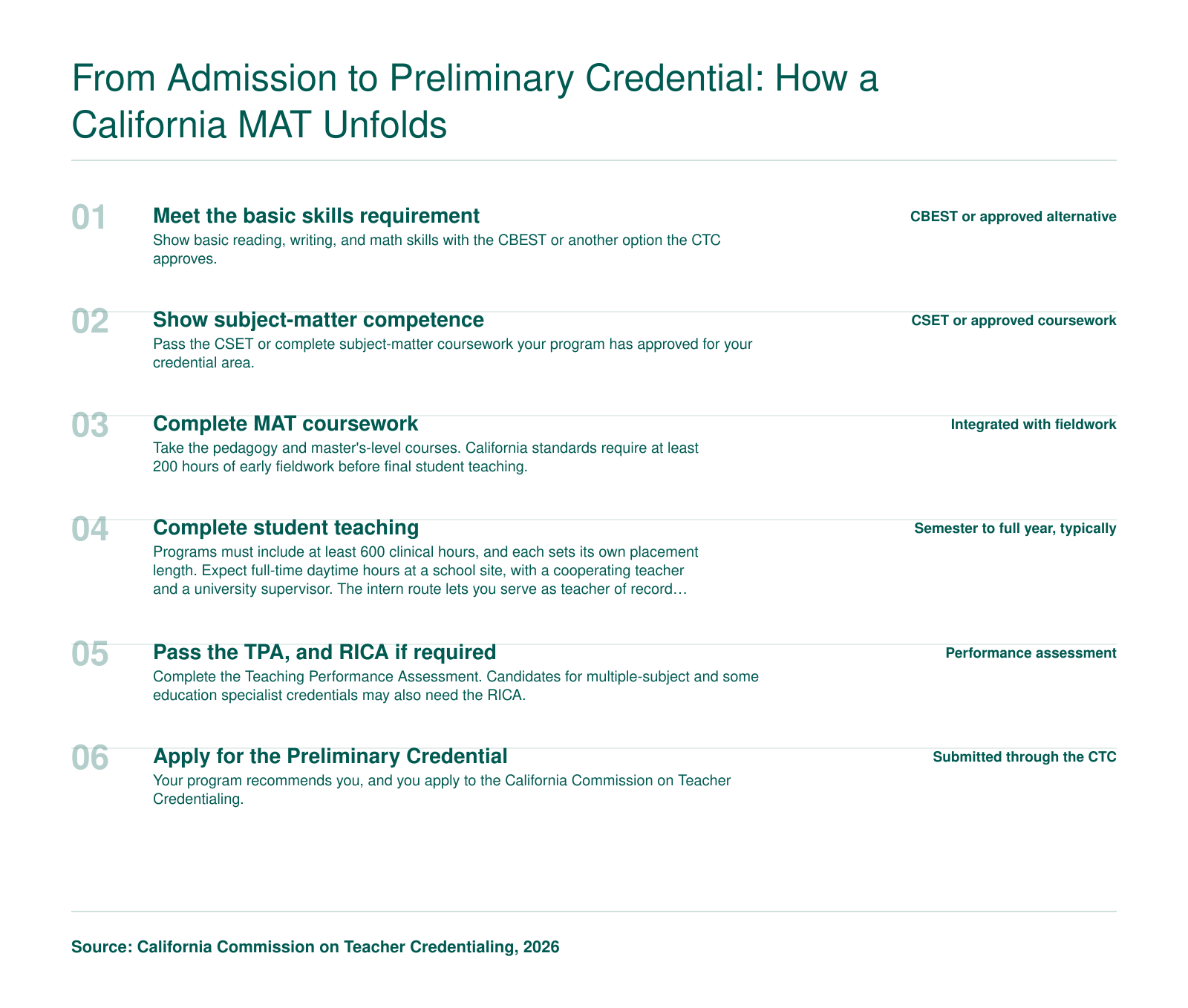
From Admission to Preliminary Credential: How a California MAT Unfolds
Most MAT-plus-credential paths take about 12-24 months, though each program sets its own schedule, so check its page for exact durations. The steps below show the usual order. Some candidates complete the exam steps before or alongside coursework.
Related Articles
Which Ranked California MAT Programs Drop the GRE, and When the CSET Is Due
GRE requirements are not uniform across the ranked programs, and some schools do not state a policy at all. UC Irvine explicitly does not require the GRE1, a stance that places it among master's programs with no GRE required. Pepperdine describes its MAT as test optional, and UC Berkeley notes no GRE requirement. For several other programs in this list, admissions pages publish no GRE requirement either way.
CSET timing is a separate admissions hurdle. At UC Irvine, applicants using the CSET must submit one passing subtest with the application.2 Admitted students must then submit passing CSET scores or a subject-matter verification by June 1 before summer enrollment.2 San Diego State allows applicants with a nonmatching degree to have CSET subtests in progress at application, but official passing scores were due February 15, 2026, and no offer is made until scores are verified. A matching degree can satisfy subject-matter competency at SDSU.
In the Commission on Teacher Credentialing's December 2024 CalTPA data, 94% of candidates who submitted both cycles in 2023-24 passed both. Across the first six program years, 2018-19 through 2023-24, the cumulative rate was 97%. These figures cover only candidates who submitted both cycles.
What a Master's in Teaching Costs in California and How Credentialing Works
How much does a California MAT actually cost, and what help exists for future teachers? The spread is wide. At the affordable end, public campuses like Cal State San Bernardino and Stanislaus State post graduate tuition in the mid-to-high four figures per year, while private universities run far higher. Azusa Pacific publishes a total program tuition of $30,375 (about $675 per credit for a 45-unit degree). At the top of the scale, Stanford's program carries tuition above $60,000.
Net price figures in our data are institution-wide averages across all students after grants, not MAT-specific sticker prices, so treat them as context rather than a quote for your program.
Aid Built for California Teachers
Several funding sources target credential candidates specifically:
- Golden State Teacher Grant: Up to $20,000 for students in a CTC-approved credential program. Applications are expected in July 2026, require the FAFSA or CADAA, and come with a service commitment of two to four years at a priority school.1 Awards go to the lowest Student Aid Index first, and funding is limited.2
- Federal TEACH Grant: Available to candidates who agree to teach in high-need fields; confirm current terms directly with the program.
- Paid residencies: California teacher residencies must offer candidates at least $20,000 in stipend or wages.2
Program-level debt and earnings are not yet published for every MAT program here.
Who Approves California Teacher Prep Programs
MAT Questions California Applicants Ask Most
These answers draw on the admissions pages of the schools ranked here. Deadlines and program lengths change by cohort and track, so confirm current dates with each program before you apply.
Which MAT programs in California lead directly to a teaching credential?
Do I need the CSET to apply to MAT programs in California?
What is the cheapest MAT program in California?
Can I complete a California MAT program online?
How long does a MAT with teaching credential take in California?
When are application deadlines and start dates for California MAT cohorts?
Compare Teaching programs on the data that matters
Explore more Education & Teaching specializations or browse every graduate field.
All Education & Teaching programs