Best Master's in Nutrition Programs
Compare 320+ accredited Nutrition programs at 180+ schools, with graduate earnings, cost, debt, and completion data from IPEDS and the U.S. College Scorecard.

Since January 2024, the Commission on Dietetic Registration has required a graduate degree to sit for the registered dietitian nutritionist exam. That single rule reshaped this field: a master's is no longer optional for clinical practice, and the degree you pick has to carry ACEND-accredited coursework and supervised practice, or it will not qualify you.
The ten programs ranked here run from fully online to campus-based, with published tuition stretching from roughly $12,800 at the University of North Carolina at Chapel Hill to about $71,500 at the University of Southern California.
Entry-level dietitian pay does not move that much across programs. The cost does.
Key Points
- Of 10 ranked programs, only the University of Southern California is online.
- Public CUNY campuses in New York City rank among the top three for return.
- An ACEND-accredited pathway, not the degree alone, qualifies you for the registered dietitian exam.
10 Master's in Nutrition Programs for 2027
These 10 master's in nutrition programs stand out for their mix of research depth, RDN preparation, and verifiable student outcomes. From fully online healthspan study to coordinated clinical tracks, the list spans the formats and concentrations that matter most to prospective nutrition graduate students.
University of Southern California
#1Los Angeles, CA · ~$72,000/yr (est.)
Best for: Aging and wellness-focused online learners
USC's Master of Science in Nutritional Science zeros in on healthspan and longevity for learners who already have a nutrition background, including future RDNs and current registered dietitian nutritionists. The 32-unit online program mixes didactic coursework with research and uses live streaming for real-time interaction. Full-time students can finish in as little as a year, and the degree carries STEM designation with merit scholarships available.
- 32 total credit hours
- Fully online with synchronous classes
- Full-time path in 12 to 18 months
- Emphasis on healthspan and longevity
- 24 units of didactic coursework and 8 units of research
- STEM Visa eligible
- 3.0 GPA minimum
- Scholarships available
Oregon Health & Science University
#2Portland, OR · $30,000 – $35,000/yr (est.)
Best for: Future registered dietitians needing clinical rotations
Oregon Health & Science University offers a science-based Master of Science in Human Nutrition with advanced nutrient metabolism, epidemiology, and biostatistics, plus an optional coordinated dietetic internship track that leads toward the RDN exam. Students can choose a thesis or capstone and pursue electives in sports nutrition or culinary medicine. As Oregon's only academic health center, OHSU places learners in clinical, research, and public health settings.
- $842 per credit
- 45 total credit hours
- 18-month program format
- Thesis or capstone option
- Electives in sports nutrition and culinary medicine
- 3.0 GPA minimum
- Oregon's only academic health center
- Prepares for doctoral studies
- 67 total credit hours
- 2-year program with 1,056 clinical hours
- 100% licensure pass rate
- Starts spring
- Rotations arranged by program, including OHSU Hospital
- Prepares for RDN exam
- 3 letters of recommendation minimum
University of Illinois Urbana-Champaign
#3Champaign, IL · ~$19,000/yr (est.)
Best for: Research-oriented students wanting flexible concentrations
Illinois offers an interdisciplinary nutritional sciences master's that draws on more than 60 faculty from 15 departments. Students choose thesis or non-thesis tracks and can coordinate the degree with MD, MPH, or RD pathways, including an accredited dietetic internship. Six research themes range from biochemical and molecular nutrition to community nutrition and food safety.
- 32 total credit hours
- 6 concentration options
- Interdisciplinary program with 60+ faculty
- Joint degrees with MD, MPH, or RD
- AND-accredited dietetic internship option
- 3.0 GPA minimum and GRE required
- Thesis or capstone option
- Starts fall, spring, and summer
Virginia Polytechnic Institute and State University
#4Blacksburg, VA · ~$19,000/yr (est.)
Virginia Tech's ACEND-accredited MS in Nutrition and Dietetics is built for RDN certification, with direct entry for students without a dietetics background and an accelerated BS/MS route for current HNFE majors. The compact 17-month curriculum integrates didactic coursework with supervised clinical and community experiences. Medical nutrition therapy, behavior-change counseling, and evidence-based practice anchor the program.
- 17-month accelerated format
- Two pathways: direct entry and accelerated BS/MS
- Clinical experience at Carilion Clinic
- Prepares for RDN registration exam
- Focus on nutrition counseling for behavior change
- Direct entry for non-dietetics backgrounds
- Prerequisite pathway available in summer
- 2 concentration options
University of North Carolina at Chapel Hill
#5Chapel Hill, NC · ~$13,000/yr (est.)
UNC Chapel Hill's nutrition programs sit inside the Gillings School of Global Public Health, the only U.S. nutrition department housed in both a school of public health and a school of medicine. Students can choose a research-focused MS with a thesis, an MPH in Nutrition, or an MPH in Nutrition and Dietetics that leads to the registered dietitian exam. The school pairs laboratory and population-based research with a public health lens.
- 39 total credit hours
- Thesis required
- Research skills in lab and population
- Prerequisites: anatomy, physiology, biochemistry, nutrition
- Dual degree with BSPH in Nutrition
- Only nutrition department in both public health and medicine
- 42 total credit hours
- 2-year program
- No entrance exam required
- Hybrid residential and online learning
- Apply to up to two concentrations
- Priority deadline for fellowship consideration
- Cohort-based structure of 40 students
- Prepares for CDR exam
- First ACEND Future Education Model program
- Two-year program with internship
- Residential at UNC Gillings
Case Western Reserve University
#6Cleveland, OH · ~$54,000/yr (est.)
Case Western Reserve offers a flexible MS in Nutrition for students with or without a nutrition background, including a post-baccalaureate premedical track approved by the AAMC. Learners can combine the degree with a dietetic internship focused on diabetes prevention, culinary medicine, and counseling. The 30-credit curriculum supports full-time or part-time study and progression toward clinical, research, or medical school goals.
- 30 total credit hours
- Complete in one to two years
- No undergraduate nutrition degree required
- Post-baccalaureate premedical track approved by AAMC
- Combine with dietetic internship
- Full-time and part-time options
- Integrated BS/MS option available
- 17-month combined program
- Concentrations in diabetes prevention and management, culinary medicine and counseling
- Clinical rotations at VA Medical Center
- DPD verification required
- $7,000 tuition assistance
- Capstone required
- 3.0 GPA minimum
Loma Linda University
#7Loma Linda, CA · ~$34,000/yr (est.)
Loma Linda's coordinated MS in Nutrition and Dietetics is structured for students whose bachelor's degree is outside nutrition, combining a year of foundation coursework with master's-level study and supervised practice. The university also offers an online MS in Plant-Based Nutrition for dietitians and health professionals, plus a general MS in Nutrition through its School of Public Health. The coordinated route prepares graduates for the RDN exam and careers in clinical, community, and food-service settings.
- Designed for non-nutrition bachelor's graduates
- Includes supervised professional practice
- One year of foundation coursework
- Admission requires an interview
- 3.0 GPA minimum
- Prepares for RDN exam
- Fully online MS in plant-based nutrition
- Designed for dietitians and health professionals
- Competency-based curriculum
- Can serve as prerequisite for PhD program
- Starts fall, spring, and summer
University of Minnesota-Twin Cities
#8Minneapolis, MN · ~$22,000/yr (est.)
Minnesota's MS in Nutrition is a research-focused program with thesis and project tracks covering vitamin and mineral biochemistry, nutritional genetics, physiology, and biostatistics. The small cohort, typically around nine students, supports personalized mentorship and immersive research. Graduates move into RDN credentialing, research, community health, corporate wellness, or nutrition education.
- Thesis-based Plan A or project-based Plan B tracks
- Average completion time of 2.3 years
- Small cohort of 9 current MS students
- Prepares for RDN credential
- Focus on nutritional genetics, physiology, and biostatistics
University of Connecticut
#9Storrs, CT · ~$23,000/yr (est.)
UConn's MS in Nutritional Sciences offers four emphasis areas: biochemical and molecular nutrition, human nutrition and metabolism, community/public health nutrition, and food science/nanotechnology. Students choose thesis or non-thesis plans and benefit from research collaborations with UConn Health. A fully online MS in Personalized Nutrition adds a nutrigenomics and clinical nutrition track for working professionals.
- 4 emphasis areas including community and food science
- 30 total credit hours
- Thesis Plan A or non-thesis Plan B
- 2-year program
- Accelerated 4+1 BS/MS option
- Laboratory-based research focus
- Comprehensive written exam required
- Collaborations with UConn Health
- Emphasis on human studies and metabolism trials
- Recommended prerequisites: nutrition, biochemistry, physiology
- Fully online, asynchronous format
- 30 credits and three start dates per year
- Focus on nutrigenomics and clinical nutrition
- Fulfills CNS academic requirements
Ohio State University
#10Columbus, OH · ~$14,000/yr (est.)
Ohio State offers a clinical Master of Dietetics and Nutrition built on the ACEND Future Education Model, with immersive experiences and a graduate project or case study. The separate MS in Human Nutrition provides a multidisciplinary research path with 13 concentration options. Ohio State's medical dietetics program, launched in 1961, was the first in the country.
- 2-year clinical master's program
- 80% licensure pass rate
- Competency-based ACEND Future Education Model
- First medical dietetics program in the US, founded in 1961
- Emphasis on applied medical nutrition therapy
- Graduate project or case study capstone
- Prepares for RDN exam
- 13 concentration options
- Thesis or capstone option
- Research project integrated into curriculum
Cost & outcomes by school
Federal data for the highest-earning Nutrition programs, independent of the ranking above. Earnings are this field's master's graduates four years after completing, where the Scorecard reports them.
| School | Earnings | Tuition / yr | Debt | Grads/yr | Format |
|---|---|---|---|---|---|
| Framingham State University MA | $83,433 | $10,965 | — | 12 | Campus |
| CUNY Lehman College NY | $81,872 | $11,570 | — | 6 | Campus |
| CUNY Hunter College NY | $75,480 | $11,398 | $33,795 | 5 | Campus |
| Saint Elizabeth University NJ | $75,352 | $19,178 | — | 20 | Hybrid |
| Simmons University MA | $74,038 | $28,561 | $41,000 | 31 | Online |
| Benedictine University IL | $72,603 | $19,584 | $40,312 | 17 | Online |
| Central Michigan University MI | $69,324 | $17,187 | $16,080 | 12 | Online |
| Indiana University of Pennsylvania PA | $68,605 | $12,672 | $31,856 | 8 | Online |
| Ohio University OH | $66,093 | $9,720 | — | — | Campus |
| Arizona State University AZ | $65,743 | $13,587 | $29,120 | — | Campus |
| Arizona State University AZ | $65,743 | $10,843 | $29,120 | 48 | Online |
| The University of Alabama AL | $64,913 | $11,980 | — | 123 | Online |
Sources: U.S. Department of Education. Tuition and graduates: IPEDS. Earnings and debt: College Scorecard, this field's master's graduates; a dash means no figure is reported.
Cost, debt & payoff
Median earnings of this field's master's graduates (4 yrs after completing) vs. their median federal loan debt · U.S. College Scorecard
Across these programs the median graduate earns about $65,918 and finishes with roughly $34,200 in debt — a ratio that clears a common rule of thumb (keep debt below first-year salary). Tuition and debt vary widely school to school, so check the per-school figures in the table above before you shortlist.
How We Ranked These Nutrition Graduate Programs
This ranking compares nutrition master's programs on a few concrete financial and outcome measures, not on reputation or advertising. The ranking is built for students who want to compare cost against real graduate outcomes.
What we count
We look first at what students actually pay, borrow, and earn after graduating. The comparison uses graduate tuition, net price after aid, program-level earnings and debt from federal IPEDS and College Scorecard, and institution-wide graduation rates. For earnings, we use figures for program completers measured one to five years after finishing, where Scorecard publishes them. We do not weigh prestige, faculty reputation, or marketing claims. The goal is to show which programs deliver stronger financial outcomes for the money.
What the data cannot tell you
Two numbers need context. Net price is an institution-wide average after financial aid, so your own cost may be higher or lower depending on your aid package, state residency, or enrollment intensity. Graduation rates cover the whole school, not the nutrition program specifically, so they signal overall student support rather than how well one department retains students. Program-level earnings are not available for every school; when they are missing, we say so instead of filling the gap with estimates.
What we leave out
ACEND accreditation status, curriculum content, and supervised practice hours are not scored here. Those require a separate review, and you should verify accreditation independently before applying. Check ACEND accreditation to confirm the program meets the standards you need for the registered dietitian path.
What a Master's in Nutrition Really Costs (And How to Pay Less)
Two pricing models dominate this field: public universities that charge by residency, and programs (mostly online) that quote a single per-credit rate to everyone. Which one you land in can swing your total bill by $20,000 or more.
The residency gap is the biggest variable
Among the campus programs ranked here, annual graduate tuition starts around $11,500 at CUNY Brooklyn College and CUNY Queens College and climbs to roughly $19,300 at the University of Illinois Urbana-Champaign for in-state students. Cross the state line and the math changes completely. Indiana University Bloomington runs about $11,800 in-state but roughly $33,500 for nonresidents. UNC Chapel Hill shows a similar spread, near $12,800 versus about $31,400. Wayne State University posts the highest nonresident figure in the group at roughly $36,500, though its online nutrition and food science master's advertises in-state tuition for out-of-state online students, which is exactly the kind of flat-rate structure worth hunting for.
Estimate by credit, not by year
Annual tuition tells you little when programs range from 30 to 53 credits. Most ranked programs sit in the 30 to 39 credit band: 30 at Arizona State, Indiana, and the University of Houston; 32 at Illinois and Wayne State; 33 at Brooklyn College; 39 at UNC. Tracks that build in supervised practice for the RDN credential run longer and cost more.
Per-credit rates published by several online programs make the arithmetic easy:
- Arkansas State University: about $350 per credit equivalent, working out to roughly $12,600 for the 36-credit non-RD track and $18,550 for the 53-credit RD track.1
- Institute for the Advancement of Dietetics and Nutrition Education (IDEA): $622 per credit for 2026-2027 across 32 credits.2
- Utah State University: $535 per credit for the 37-credit Master of Dietetics Administration.3
- St. Catherine University: $760 per credit for 2026-2027, listed at $36,480 for 48 credits before separate fees.4
Always ask whether mandatory fees, supervised practice costs, and health insurance sit outside that rate. They usually do.
Four ways to cut the bill
- Graduate assistantships: many departments pair a stipend with partial or full tuition remission. Terms vary widely by school, so ask the department directly rather than assuming.
- Academy of Nutrition and Dietetics Foundation scholarships: more than 300 awards from $500 to $25,000 through one universal application, with a 2026-2027 deadline of April 2, 2026.5 The Foundation distributed $996,250 to 317 recipients for 2025-2026.6
- Employer tuition benefits: hospitals and health systems frequently fund clinical nutrition coursework for current staff.
- Regional tuition exchanges: WICHE's Western Regional Graduate Program lets residents of participating Western states pay resident rates at approved out-of-state programs. Confirm your specific program is enrolled before counting on it.
Best Value: Nutrition Master's Programs With the Strongest Return
Nutrition graduates often start at moderate salaries, so keeping debt down can improve the return on a master's degree more than chasing the highest possible starting pay. The table below shows the strongest published debt and tuition profiles among the schools in this comparison.
| Program | Median debt at completion | Program tuition (in-state) | Program tuition (out-of-state) |
|---|---|---|---|
| CUNY Queens College, Nutrition and Exercise Sciences | $10,298 | $11,612 | $21,042 |
| Oregon Health & Science University, Master of Science in Human Nutrition | $16,625 | $30,468 | $30,468 |
| CUNY Brooklyn College, Nutrition, M.S. | $11,000 | $11,524 | $20,954 |
Related Articles
The Path From Master's Student to Registered Dietitian
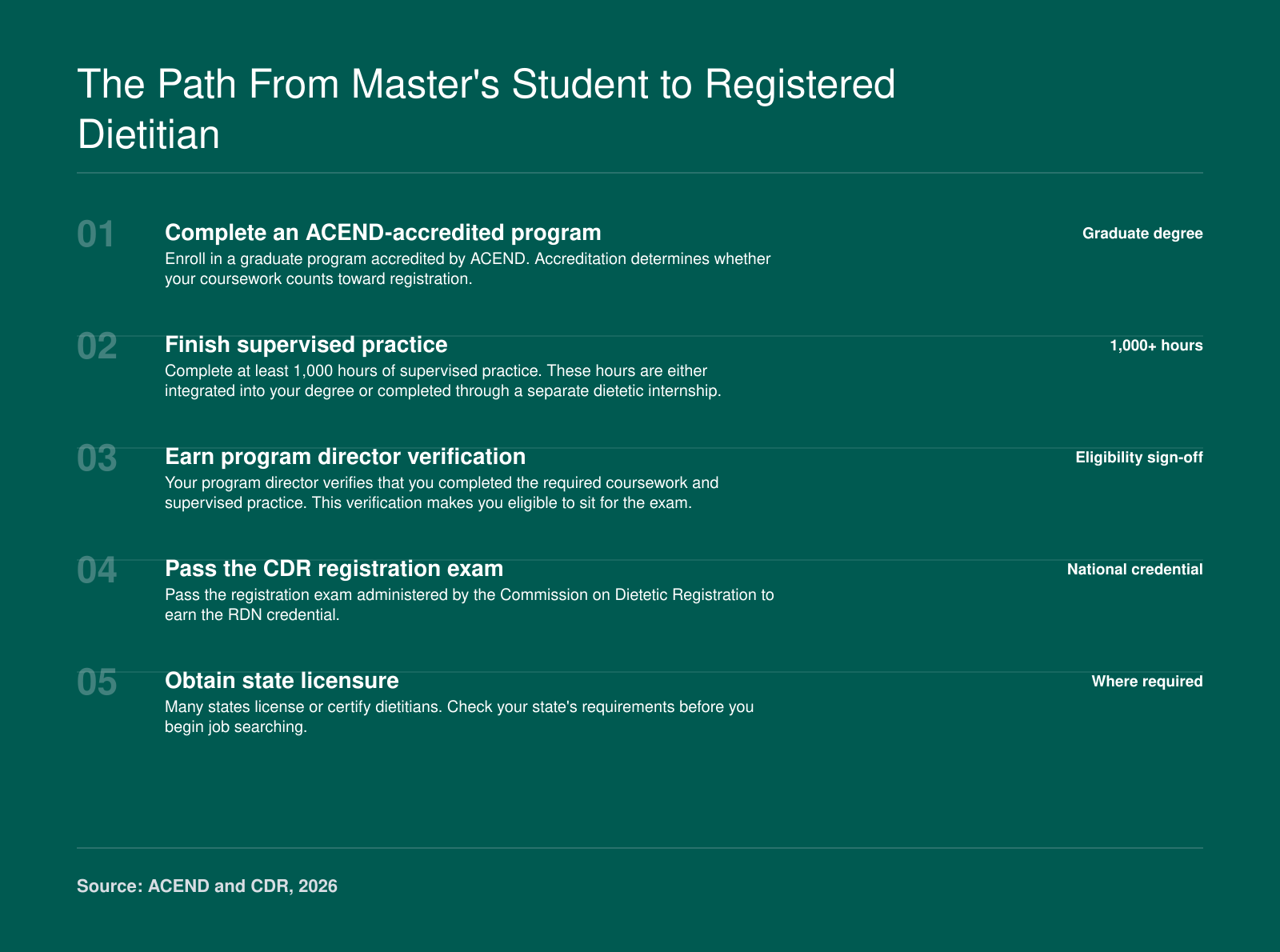
Becoming a registered dietitian nutritionist takes more than a degree. Coordinated and Future Education Model programs fold supervised practice into the master's itself, which shortens the overall timeline compared with finishing a degree and then applying separately for an internship.
Online vs. Campus Nutrition Master's Programs
Of the 10 programs in our ranking, one (University of Southern California) is listed as online and nine are listed as campus-based, so most top-ranked options still require you to relocate. Online does not mean one thing, though. Programs differ in how classes are delivered, where supervised practice happens, and who is responsible for finding placements. An online degree from an accredited university carries the same diploma as the campus version, and ACEND status attaches to the program, not the delivery format.
| Factor | Online | Campus |
|---|---|---|
| Flexibility | Part-time pacing and location freedom. Some programs, such as American University and University of New England, are asynchronous. | Fixed schedules and a set location. Full-time cohorts are common, such as Virginia Tech's 17-month program. |
| Class format | Ranges from asynchronous to required live sessions. USC lists synchronous online classes, and Saybrook is hybrid with required live sessions. | In-person lectures and labs on a set weekly schedule. |
| Supervised practice | Coursework can be remote while practice is not. Southern Mississippi and Nevada, Reno require at least 1,000 practice hours. | Placements are often built in. Tufts supplies all sites and requires at least 2,096 hours. |
| Preceptor workload | Often self-arranged. Samford, Houston, and Marshall distance interns find their own sites and preceptors, a real hidden workload. | Usually handled by the program, though this varies by school. |
| Lab and research access | Limited hands-on lab time. Research is usually remote or capstone-based. | Direct access to labs, faculty research, and thesis options, as at UNC Chapel Hill. |
| Cost and residency pricing | Some fully online programs charge the same tuition regardless of residence, such as Kentucky's. Confirm per program. | Public universities generally charge higher out-of-state rates, plus relocation and living costs. |
| State authorization | Programs may not enroll students in every state. Check authorization and licensure rules for your state. | Not an issue, since you attend in person. |
| RD eligibility | An online nutrition master's is not automatically RD-qualifying. Verify ACEND accreditation. | ACEND-accredited options include Virginia Tech and Ohio State. |
A nutrition degree alone does not make you eligible to become a registered dietitian. Completing an ACEND-accredited pathway is what qualifies you to sit for the credentialing exam.
Admissions Requirements and Prerequisites
Requirements differ by program and track, so treat this as a typical checklist and confirm details with each school.
- Bachelor's degree and GPAAn accredited bachelor's degree is the baseline. Minimum GPAs vary: Cal Poly Pomona lists 2.5, Nevada Reno 2.75, and Northern Colorado, Southern Utah, Oregon State and Illinois State 3.0. Texas Woman's asks for 3.25, while Boston University sets no minimum and reviews applications holistically.
- Science prerequisitesCommon coursework includes general and organic chemistry, biochemistry, anatomy and physiology, and introductory human nutrition. Metropolitan State University of Denver also lists medical nutrition therapy. Purdue expects a C or better in most prerequisites.
- DPD verification or extra courseworkRegistered dietitian (RD)-track programs may ask for a Didactic Program in Dietetics (DPD) Verification Statement. Applicants without a nutrition background may need extra prerequisites instead; NYU, for example, pairs an 18-course, 60-credit DPD with its clinical master's. This is not required by every program.
- GRE policyMany programs no longer require it. Boston University, Southern Utah and Metropolitan State University of Denver list no exam. Houston and Sam Houston State waive it for applicants with a 3.0 GPA or higher.
- Application materialsExpect transcripts, a statement of purpose, recommendation letters, and a resume. Some programs also weigh research or program-specific experience.
- TimingDeadlines are not uniform. Purdue's early decision date is October 1, and Oregon State's early admission deadline for a September 2027 start is September 15, 2026. Simmons uses a May 1 priority date and a July 15 final date. Rhode Island's Fall 2026 window has closed. Check each program's current cycle, since some online options offer rolling or multiple starts.
Dietitian and Nutritionist Pay at a Glance
Dietitians and nutritionists (SOC 29-1031) earn a national median wage that gives context for weighing master's tuition against likely pay.
Nutrition programs by state
Master's in Nutrition FAQs
These answers cover the questions prospective students ask most often about timelines, credibility, registered dietitian eligibility, and entry requirements. Details vary by program, so confirm specifics with each school before you apply.
How long does it take to complete a master's in nutrition?
Are online master's in nutrition programs credible?
Can I become a registered dietitian with a nutrition science master's that isn't ACEND-accredited?
Can I earn a master's in nutrition without a nutrition or science bachelor's degree?
Compare Nutrition programs on the data that matters
Explore more Healthcare specializations or browse every graduate field.
All Healthcare programs