Best Master's in Nutrition Programs in Virginia
Compare 8 accredited Nutrition programs in Virginia at 3 schools, with graduate earnings, cost, debt, and completion data from IPEDS and the U.S. College Scorecard.

Since January 2024, sitting for the Registered Dietitian Nutritionist exam requires a graduate degree, not just a bachelor's. That change reshapes how prospective students in Virginia weigh their options, because not every nutrition master's here is built for RDN eligibility.
The schools ranked below serve different goals. One lists an ACEND-accredited pathway with supervised practice at Carilion Clinic; others emphasize flexible online delivery aimed at credentials like the CNS. Tuition spans from Liberty's $8,730 to out-of-state rates near $40,000 at George Mason.
Virginia protects the titles "dietitian" and "nutritionist" but does not license them, so accreditation, not school name, determines which route your degree actually opens.
Key Points
- Virginia protects the title "dietitian" but does not license or certify dietitians.
- An ACEND-accredited master's is now required to sit the national RDN exam.
- Program-level graduate earnings are not yet published for these Virginia nutrition programs.
Best Master's in Nutrition Schools in Virginia: 2027 Ranking
Three Virginia schools make this list, and they serve different goals. Only one lists a master's program built around the Registered Dietitian Nutritionist (RDN) pathway, so check each card's accreditation note before you compare tuition. Graduation rates shown are institution-wide, not completion rates for a single program.
Virginia Polytechnic Institute and State University
#1Blacksburg, VA · ~$19,000/yr (est.)
Best for: Career changers pursuing RDN credentialing
Virginia Tech in Blacksburg offers the only master's on this list that is an ACEND-accredited graduate program in nutrition and dietetics. Graduates who complete it receive a verification statement and can apply to sit for the CDR RDN exam. It is not described as a coordinated program, and the sources do not label it a future-education-model program. Schools offering this program graduate 86% of students institution-wide, the highest rate among the three.
- ACEND-accredited graduate program on campus in Blacksburg
- Graduates are eligible to apply for the CDR RDN exam
- 17-month direct-entry track for non-dietetics backgrounds
- 22-month accelerated B.S./M.S. for current HNFE majors
- Supervised experiential learning includes clinical work with Carilion Clinic
- Prerequisite courses required; a summer prerequisite pathway is available
- Emphasis on nutrition counseling for behavior change and evidence-based practice
George Mason University
#2Fairfax, VA · $15,000 – $20,000/yr (est.)
Best for: Public health and performance nutrition seekers
George Mason University in Fairfax offers a nutrition science master's with three tracks: a general option, Community Nutrition, and Nutrition and Performance. Federal records list ACEND accreditation, but the sources do not describe the M.S. as a coordinated program or a future-education-model graduate program. Applicants who want to become an RDN should confirm directly whether it leads to exam eligibility and whether a separate internship is required. Schools offering this program graduate 68% of students institution-wide.
- Campus program in Fairfax with two concentration options
- Prerequisites include NUTR 295 and BIOL 124
- Choice of thesis or capstone
- Interprofessional education with a Nutrition Kitchen and Human Assessment Lab
- Program materials cite 89% of graduates working in fields related to their goals
- 39-45 total credits
- 200-hour practicum fieldwork option
- Thesis research with a three-member committee
- Accelerated bachelor's to master's option
- Focus on assessing and intervening in community nutrition issues
- Interdisciplinary approach to physical activity and nutrition
- Prepares for ISSN sports nutrition certification
- Career settings include fitness coaching and corporate wellness
Liberty University
#3Lynchburg, VA · ~$9,000/yr (est.)
Best for: Working adults needing asynchronous online study
Liberty University in Lynchburg delivers its nutrition-related master's mostly online, with asynchronous 8-week courses and eight start dates a year. None of its programs on this list shows ACEND accreditation, so they are not a route to RDN eligibility. The M.S. in Nutrition is positioned as a stepping stone toward the Certified Nutrition Specialist credential and non-licensed nutrition careers. Schools offering this program graduate 65% of students institution-wide.
- Not ACEND-accredited and not an RDN pathway
- 100% online, 36 credit hours at $580 per credit
- No GRE or other entrance exam required
- 3.0 GPA minimum for regular admission
- Prepares for the CNS credential
- Up to 50% of the degree may transfer
- Hybrid format with 2 residential intensives on the Lynchburg campus
- 35 credit hours
- Test optional admission
- Thesis or capstone option
- Not ACEND-accredited
- 100% online, 33 credit hours
- Prerequisite courses required
- Focus on diabetes, obesity, and chronic disease
- Leads toward wellness coach roles, not RDN licensure
- Not ACEND-accredited
Cost & outcomes by school
Federal data for the highest-earning Nutrition programs, independent of the ranking above. Earnings are this field's master's graduates four years after completing, where the Scorecard reports them.
| School | Earnings | Tuition / yr | Debt | Grads/yr | Format |
|---|---|---|---|---|---|
| Liberty University VA | — | $8,730 | — | — | Online |
| George Mason University VA | — | $17,964 | — | — | Campus |
| Virginia Polytechnic Institute and State University VA | — | $18,564 | — | 1 | Campus |
Sources: U.S. Department of Education. Tuition and graduates: IPEDS. Earnings and debt: College Scorecard, this field's master's graduates; a dash means no figure is reported.
Online and Hybrid Master's in Nutrition Options in Virginia
On-campus master's in nutrition and dietetics programs here build supervised practice into the degree, while the online option trades that structure for flexibility and a different credential path. If you want to become a registered dietitian nutritionist, that difference matters more than convenience.
- Liberty University (online): The M.S. in Nutrition is 36 credits of asynchronous, 8-week courses with no set login times. Liberty positions it for the CNS credential, not the RDN. Liberty describes a practicum in your local community, but its published materials do not state the hours or explain how sites are secured. Ask admissions whether you must find your own preceptor.
- Virginia Tech (campus): Plan to relocate to the Blacksburg and Roanoke area. Supervised learning is built into this ACEND-accredited degree through Carilion Clinic, so you are not hunting for placements on your own.
- George Mason (campus, Fairfax): Only the MS in Nutrition and Dietetics concentration includes supervised practice, at 1,155 or more hours. The other concentrations do not lead to RD eligibility.
- RDN reality check: Without accredited supervised practice, a flexible online degree will not qualify you for the RDN exam. Confirm accreditation and how hours are completed before you enroll.
Which Virginia Master's in Nutrition Programs Waive the GRE?
A GRE policy tells you whether a program requires the Graduate Record Examination, treats it as optional, drops it under certain conditions, or simply never asks for it. Among the Virginia nutrition programs ranked here, the availability of No-GRE master's programs varies.
- Liberty University: The online Master of Science in Nutrition requires no entrance exam. Applicants do need a minimum 3.0 GPA.
- Virginia Tech: The admissions materials for the Master of Science in Nutrition and Dietetics state that the GRE is neither required nor considered, though that language appears under the Track Two pathway, which also sets a minimum 3.4 overall GPA at the time of application. A separate policy for Track One is not published.
- George Mason University: The application requirements list a DICAS application, the university graduate application, transcripts, a statement of interest, two recommendation letters, and a resume. The GRE is not mentioned at all, so no required, optional, or waived status is published.
Before you pay a test registration fee, email the program coordinator and get the current policy in writing.
Related Articles
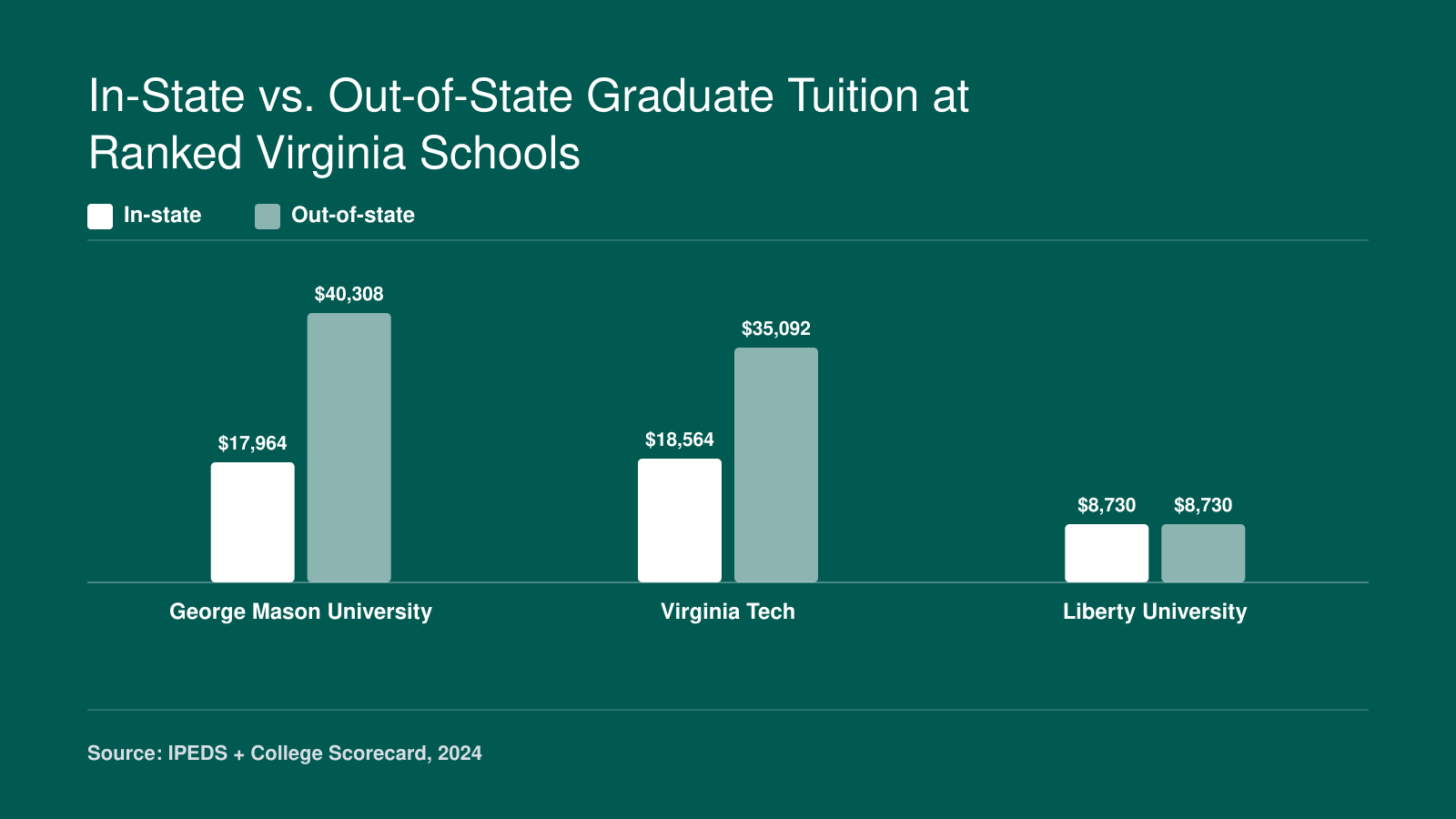
In-State vs. Out-of-State Graduate Tuition at Ranked Virginia Schools
Residency can change the price of a Virginia master's in nutrition more than the choice of school. The chart compares graduate tuition and fees for in-state and out-of-state students. At the public schools, the out-of-state premium is $22,344 at George Mason University and $16,528 at Virginia Tech. Liberty University, a private school, charges the same rate to everyone.
What a Master's in Nutrition Costs in Virginia and How It Leads to Licensure
Tuition for a Virginia nutrition master's is not one number; it depends on school, delivery format, and whether you qualify for in-state rates. James Madison's hybrid M.S. in Applied Nutrition lists $590 per credit and a $26,931 total for its 47-credit degree. Virginia Tech's hybrid program is $928 per credit for 51 credits, though no official all-in total is published. George Mason's dietetics concentration is $667 per credit for 45 credits, about $30,015 before fees. Old Dominion's online M.S. in Nutrition charges $672 per credit for Fall 2026, including a $162 mandatory auxiliary fee; the total is not stated because the required credit count is not published. Liberty lists $15,297 in annual tuition for its online program, but per-credit and total costs are not clearly stated. Shenandoah's 58-credit program does not publish current per-credit tuition.
Average net price is a rough benchmark for Virginia master's programs tuition comparison: about $17,915 at George Mason, $24,953 at Virginia Tech, and $29,357 at Liberty, but these are institution-wide, not program-level charges. Most programs do not publish nutrition-specific scholarships; Liberty advertises general scholarships and a military tuition discount, while others point to graduate assistantships and external Academy of Nutrition and Dietetics Foundation awards. The degree alone does not make you an RDN in Virginia; you still need ACEND-accredited supervised practice and the Commission on Dietetic Registration exam.
Virginia Dietitian Certification Requirements
Admission Requirements for Virginia Master's in Nutrition Programs
Requirements differ by school, so confirm each program's current page before applying.
- Bachelor's degreeRequired everywhere. ODU/EVMS describes a related degree. Applicants without a nutrition major can usually finish prerequisites first; Shenandoah suggests having half done before applying.
- Minimum GPAVirginia Tech, ODU and Shenandoah cite 3.0. ODU's admissions page also mentions 2.85, so confirm which applies. Virginia Tech's Track 2 for its own majors requires 3.4. George Mason states no minimum.
- Prerequisite sciencesVirginia Tech lists chemistry, biochemistry, anatomy and physiology, and nutrition courses. ODU requires anatomy, physiology and biochemistry at B- or better. Shenandoah requires C or better. Mason lists none for Dietetics.
- Letters of recommendationTwo at Virginia Tech, George Mason and ODU; three at Shenandoah. ODU rejects letters from friends or family.
- Statement of purposeVirginia Tech uses a seven-question essay. Shenandoah asks for two pages. Mason cites 500 words, though program guidance suggests longer.
- DeadlinesShenandoah is Aug. 15 and ODU Aug. 24. Virginia Tech's is Sept. 27, with Track 2 on Feb. 1. Mason lists Oct. 1 with rolling admission afterward, but a department page says Feb. 1.
What Virginia Master's in Nutrition Graduates Earn
Program-level earnings are the clearest way to judge whether a degree pays off, but no program-level earnings are published yet for the nutrition programs below. For Virginia Tech, George Mason, and Liberty, the federal outcomes data that would report graduate earnings one or two years after finishing has not been released at the program level, so we are not posting a number we cannot verify. We also do not substitute an institution-wide figure, since a university average mixes in fields that pay very differently from dietetics.
For context, George Mason's program materials cite an average salary above $69,000 for its 2020 graduates and note that most work in a field tied to their goals, though that is a self-reported figure rather than a verified outcome.
The practical takeaway
Until verified earnings arrive, weigh three things together: net price, whether the program makes you eligible for the RDN credential, and the salary range for dietitians in your area. A lower-cost, ACEND-accredited path to RDN eligibility is usually the stronger financial bet.
Compare Nutrition programs on the data that matters
Explore more Healthcare specializations or browse every graduate field.
All Healthcare programs