Best Master's in Clinical Research Programs
Compare 30+ accredited Clinical Research Management programs, with graduate earnings, cost, debt, and completion data from IPEDS and the U.S. College Scorecard.

Is a master's in clinical research worth the tuition? Drug, device, and academic trials all depend on coordinators, monitors, and managers who know Good Clinical Practice, and healthcare administration master's programs are one direct route into those roles.
The price spread is wide. Among the top ten, in-state tuition runs from about $13,900 at Ohio State to roughly $65,000 at Johns Hopkins, and programs last anywhere from nine months to two years. We ranked 28 programs using federal outcome data from IPEDS and College Scorecard, not reputation surveys.
Because federal earnings data for these degrees are not yet available, cost and format carry more weight than usual.
Key Points
- The cheapest ranked programs charge roughly $8,600 to $13,000 a year in tuition.
- Program-level graduate earnings are not yet published for any ranked school.
- Online programs often charge one flat rate, which can favor out-of-state students.
The 10 Best Master's in Clinical Research Programs
These ten clinical research master's programs stand out for combining practical trial skills with clear career pathways. We looked across online, hybrid, and on-campus formats so working clinicians and nonclinical professionals alike can find a fit. Each entry below pairs the program's distinctive strengths with cost and outcome details to help you weigh value.
Johns Hopkins University
#1Baltimore, MD · ~$65,000/yr (est.)
Best for: Clinicians moving into trial design and AI
Johns Hopkins pairs public health and medical school faculty to train clinicians in designing and running studies of new treatments and diagnostics. Students choose among clinical investigation/trials, disease-oriented studies, data science, and health services research pathways. The nine-month program includes data management, biostatistics, and research ethics, with no thesis required.
- Four pathways: investigation/trials, disease-oriented studies, data science, health services research
- Nine-month joint program from public health and medical schools
- Covers clinical trial design, biostatistics, data management, and research ethics
- No research thesis required
- Median earnings one year after finishing: $95,780
- Designed for clinicians and allied health professionals becoming clinical scientists
University of Virginia
#2Charlottesville, VA · ~$24,000/yr (est.)
Best for: Physicians completing research alongside clinical training
University of Virginia's clinical research MS is built for health and medical professionals who want to lead patient-oriented and translational studies. The 31-credit curriculum combines biostatistics, epidemiology, clinical trial design, informatics, and health services research. A final mentored research project is central, and the program has graduated more than 150 students, most of them physicians in training.
- 31-credit curriculum with core courses and specialized coursework
- Blends biostatistics, epidemiology, clinical trial design, informatics, and health services research
- Final independent research project co-mentored by faculty and a research advisor
- Designed for experienced professionals with a physician mentor
- More than 150 graduates since 1997
- Dual MD-MS-CR option available
Washington University in St Louis
#3St. Louis, MO · ~$65,000/yr (est.)
Best for: Experienced professionals leading clinical trial operations
Washington University in St. Louis offers an online or mostly online MS in Clinical Research Management for experienced research staff. The curriculum spans the science and business of trials, including regulatory requirements, ethics, product development, grant funding, study design, and data analysis. Coursework aligns with FDA and OHRP Good Clinical Practice guidelines, and the program enrolls in fall and spring.
- Mostly or fully online for working professionals
- Covers regulatory requirements, ethics, product development, grant funding, and data analysis
- Aligned with FDA and OHRP Good Clinical Practice guidelines
- Fall and spring entry options
- Designed for coordinators, nurses, project managers, monitors, and regulatory affairs staff
Rutgers University
#4New Brunswick, NJ · ~$23,000/yr (est.)
Rutgers trains clinical research professionals to manage drug and device trials end to end. The 36-credit hybrid MS offers three tracks: clinical research management, drug safety and pharmacovigilance, and academic clinical research management. Students complete mentored field training and a capstone, with mostly asynchronous courses for working adults.
- 36-credit hybrid program for working adults
- Three tracks: clinical research management, drug safety and pharmacovigilance, academic clinical research management
- Includes mentored field training and a capstone
- Mostly asynchronous online courses, full-time or part-time pacing
- New Jersey residents pay $1,009 per credit; nonresidents $1,050 per credit
- No GRE required; TOEFL required for some applicants
- Eligible toward CCRA/CCRC certification
- Fall admission only
Ohio State University
#5Columbus, OH · ~$14,000/yr (est.)
Ohio State's online Master of Clinical Research focuses on clinical research management and takes one year full-time or two years part-time. The 30-credit asynchronous curriculum covers study design, data management, project leadership, and regulatory compliance, aligned to industry competency standards. Graduates often work as clinical research coordinators, trial managers, or research compliance specialists.
- 30-credit online program, one year full-time or two years part-time
- Asynchronous classes through Carmen (Canvas), with fall, spring, and summer starts
- Aligns with Joint Task Force standards for clinical research competencies
- Eligible for ACRP and SOCRA certifications
- Open to any undergraduate field, with a 3.0 GPA minimum
- Median earnings one year after finishing: $73,440
Wake Forest University
#6Winston-Salem, NC · $35,000 – $40,000/yr (est.)
Wake Forest University's School of Medicine offers the MS in Clinical Research Management online. Courses are taught by basic science and clinical faculty from the medical school, and students can tap into the Innovation Quarter and Wake Forest Baptist Medical Center clinical research community. The flexible format supports remote learners seeking a biomedical research management credential.
- Fully online MS from the School of Medicine
- Taught by basic science and clinical faculty at the medical school
- Connects to Innovation Quarter laboratories and Wake Forest Baptist Medical Center
- Flexible online format for remote learners
University of Miami
#7Coral Gables, FL · ~$47,000/yr (est.)
University of Miami's MS in Clinical Research Management is a hybrid program for nurses and science professionals. The 30-credit curriculum builds skills in protocol development, regulatory compliance, study design, data collection, analysis, and scientific writing, with an immersion practicum. Students take two 10-week courses at a time, preparing for leadership roles in research hospitals, pharma, and academic medical centers.
- 30-credit hybrid curriculum with an immersion practicum
- 10-week course sessions, taking two courses at a time
- Prepares for clinical research certification
- Requires a nursing degree or related science background, 3.0 GPA, and one year of human subject research experience
- Median earnings one year after finishing: $154,482
Cabarrus College of Health Sciences
#8Concord, NC · $30,000 – $35,000/yr (est.)
Cabarrus College of Health Sciences offers an affordable online MS in Health Sciences with a clinical research concentration for nonclinical professionals. The asynchronous program includes applied statistics, healthcare business and finance, legal and ethical issues, and a hands-on practicum that can be completed anywhere in the country. Courses run in 7-week blocks, and the degree can take as little as one year.
- Online, asynchronous program for nonclinical professionals
- 7-week course blocks; can be completed in as little as one year
- Hands-on practicum can be completed anywhere in the country
- Core covers U.S. healthcare delivery, business and finance, applied statistics, and legal and ethical issues
- Competitive per-credit price
Pennsylvania State University
#9University Park, PA · ~$26,000/yr (est.)
Penn State's on-campus MS in Clinical Research is a 30-credit, two-year program for health-related research careers. Students complete a mentored research thesis with access to about 90 established investigators and can choose electives in data management and translational research. Weekday afternoon and evening courses make it possible to balance study with professional responsibilities.
- 30-credit, two-year on-campus program
- Mentored research thesis with access to 90 established investigators
- Weekday afternoon and evening courses between 3 and 9 p.m.
- Electives in data management and translational research methods
- Median earnings one year after finishing: $82,437
- Standard Penn State graduate tuition, with financial aid and scholarships available
Drexel University
#10Philadelphia, PA · ~$39,000/yr (est.)
Drexel's online MS in Clinical Research Organization and Management is designed for experienced research professionals who want to manage increasingly complex trials. The non-thesis curriculum covers study design, biostatistics, data integrity, GCP compliance, and regulatory pathways for medicines, devices, and biologics. Students receive close advising to tailor coursework, and recent alumni have advanced to director and chief operating officer roles.
- Online, non-thesis program for experienced research professionals
- Covers study design, biostatistics, data integrity, GCP compliance, and regulatory pathways
- Customizable course plans with advisor support
- No GRE, thesis, campus attendance, or residency requirement
- Requires at least two years of relevant professional experience
- Tuition $1,412 per credit plus $125 annual online program fee
- Median earnings one year after finishing: $88,637
- Rolling admissions with spring, summer, and fall entry
Cost & outcomes by school
Federal data for the highest-earning Clinical Research Management programs, independent of the ranking above. Earnings are this field's master's graduates four years after completing, where the Scorecard reports them.
| School | Earnings | Tuition / yr | Debt | Grads/yr | Format |
|---|---|---|---|---|---|
| University of Miami FL | $207,995 | $46,870 | $108,479 | 18 | Hybrid |
| Loyola University Chicago IL | $150,553 | $21,912 | — | 36 | Hybrid |
| University of Alabama at Birmingham AL | $136,395 | $8,640 | $41,000 | 74 | Online |
| Oregon Health & Science University OR | $128,912 | $30,468 | $51,343 | 60 | Campus |
| Johns Hopkins University MD | $118,011 | $64,730 | $55,801 | 219 | Campus |
| Pennsylvania State University PA | $111,065 | $26,034 | $44,873 | 14 | Campus |
| University of Cincinnati OH | $99,407 | $14,902 | $42,482 | 54 | Online |
| Drexel University PA | $98,899 | $39,261 | $44,416 | 89 | Online |
| Thomas Jefferson University PA | $98,597 | $24,528 | $55,062 | 5 | Campus |
| Rutgers University NJ | $95,935 | $23,241 | $35,792 | 16 | Hybrid |
| Rutgers University-Newark NJ | $95,935 | $23,221 | $35,792 | — | Hybrid |
| Ohio State University OH | $95,359 | $13,901 | $30,883 | 59 | Online |
Sources: U.S. Department of Education. Tuition and graduates: IPEDS. Earnings and debt: College Scorecard, this field's master's graduates; a dash means no figure is reported.
Cost, debt & payoff
Median earnings of this field's master's graduates (4 yrs after completing) vs. their median federal loan debt · U.S. College Scorecard
Across these programs the median graduate earns about $98,899 and finishes with roughly $41,741 in debt — a ratio that clears a common rule of thumb (keep debt below first-year salary). Tuition and debt vary widely school to school, so check the per-school figures in the table above before you shortlist.
How We Rank Clinical Research Master's Programs
Every program on this list is scored against five measures pulled from two federal sources: the Integrated Postsecondary Education Data System, which supplies graduate tuition and institutional figures, and the College Scorecard, which publishes program-level earnings and borrowing data for graduates of specific degrees.
What We Weigh
- Graduate tuition: Published in-state and out-of-state rates for the degree, not undergraduate sticker price.
- Net price: What students actually pay after grants and scholarships are applied.
- Program-level earnings: Median pay for graduates of clinical research and related health science master's programs, including health informatics master's programs, measured in the years after completion.
- Median debt: What a typical graduate of the program borrowed to finish.
- Graduation rate: How reliably the institution gets enrolled students to a credential.
Data Limits
We would rather name the limits than hide them. Net price is a schoolwide average shaped by undergraduate aid patterns, so read it as a rough affordability signal, not a personal estimate. Graduation rate reflects the whole university, not the clinical research department specifically.
Some smaller or newer programs have too few graduates for federal earnings and debt figures to be released, so those cards show no salary number. That absence is a reporting threshold, not a verdict on quality. Judge those programs on cost, format, and curriculum instead.
Most competing lists publish no criteria at all. If a ranking cannot tell you what it measured, it is measuring reputation.
Online vs. On-Campus Clinical Research Programs
Tuition: Flat Online Rates vs. Residency-Based Pricing
Online clinical research master's programs, like many other Healthcare Master's Programs, frequently charge a single per-credit rate regardless of state residency, which can make them cheaper for out-of-state students than on-campus programs with separate in-state and out-of-state tuition. For 2026-2027, Duke lists its Master of Health Sciences in Clinical Research at $896 per credit, though the published rate does not distinguish online from on-campus sections. Northeastern's published graduate rate is $2,125 per credit for 2026-2027, but the source does not confirm that rate applies specifically to the clinical research master's. George Washington has previously listed an online MSHS in Clinical and Translational Research at $681 per credit, but that pricing is from 2025 and should not be read as current 2026 tuition. The same school lists a $3 per-credit student government fee capped at $45 per semester for 2026-2027, a reminder that fees can shift the total cost.
Flexibility and Pace
Online formats tend to give working professionals more control over when and where they study. If you are already employed at a trial site, hospital, or contract research organization, an online program lets you apply coursework directly to your current work without pausing your income. Many online courses are asynchronous or offered in the evening, though pace still depends on the program's cohort structure and practicum schedule.
Practicum, Networking, and Format Tradeoffs
On-campus programs often have closer day-to-day access to hospital and CRO partners, which can simplify practicum placement and make networking with faculty, sponsors, and classmates more immediate. Online programs may still arrange a practicum near your location, but placement options vary by program and region. Hybrid or both-format programs can split the difference: you keep flexibility while still getting some face-to-face contact with clinical research employers. Before enrolling, confirm whether the online rate is truly flat, whether out-of-state students pay the same per-credit amount, and how the program handles practicum placement in your region.
Related Articles
What a Clinical Research Master's Costs
Tuition for a clinical research master's spans a wide range, and the gap between public in-state pricing and private sticker prices is now large enough to reshape where applicants apply. The cheapest ranked programs land near $8,600 to $13,000 a year for residents, while the most expensive private option on our list crosses $64,000 annually.
The public vs. private gap
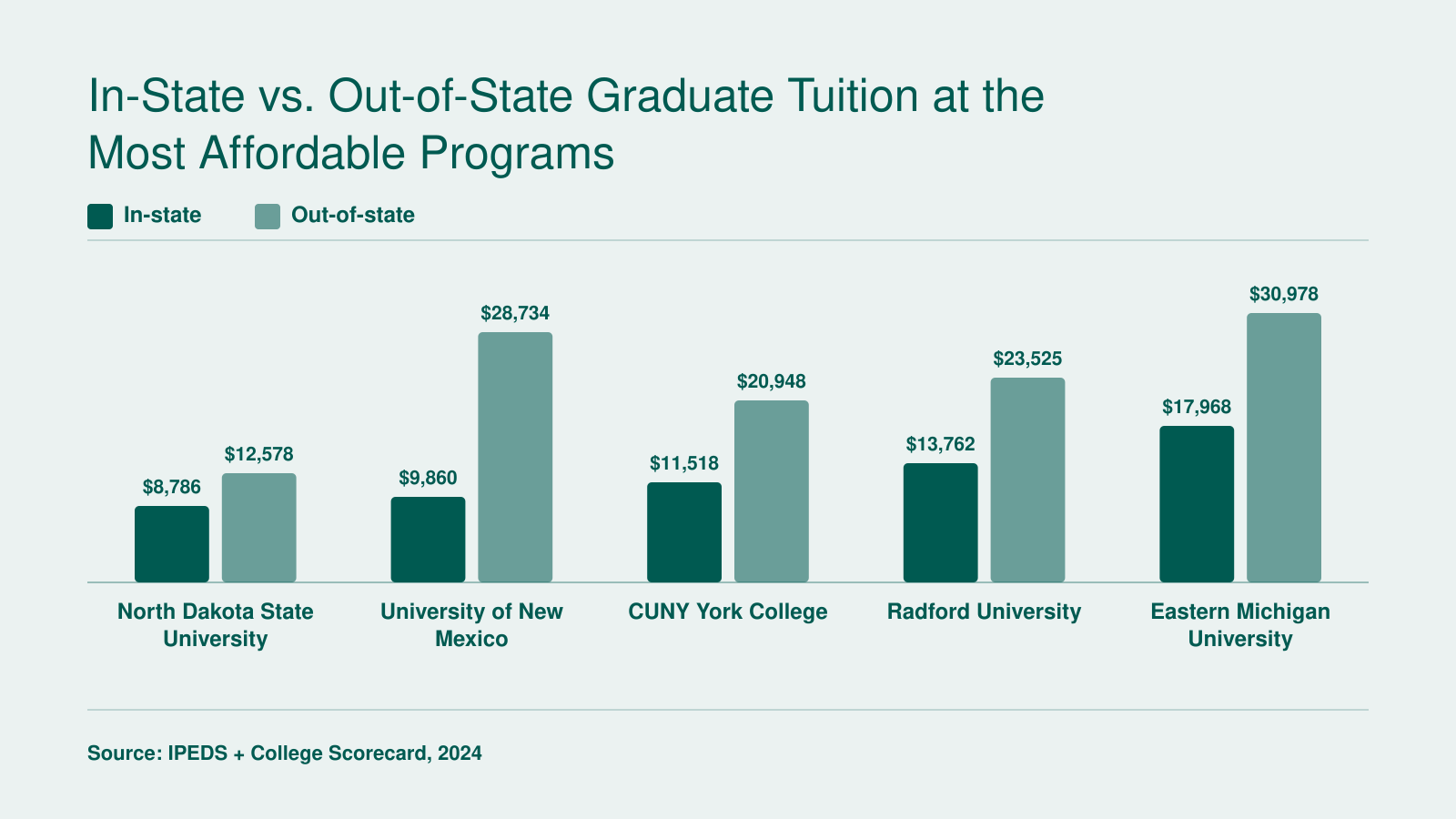
Among the most affordable ranked programs, North Dakota State University charges roughly $8,786 a year in-state and $12,578 out-of-state. The University of Alabama at Birmingham runs about $8,640 in-state against $21,168 for non-residents, and the University of New Mexico sits near $9,860 in-state versus $28,734 out-of-state. The in-state to out-of-state swing is real: at UNT Health, the same online clinical research management master's totals about $11,309 for Texas residents and $29,853 for non-residents.
Private programs tell a different story. Johns Hopkins lists $65,230 regardless of residency, and Drexel's MS in Clinical Research for Health Professionals carries a published cost near $38,690. Residency doesn't help at a private school, so your home state matters most when you're comparing public options.
Translating per-credit rates into total cost
Most of these degrees require 30 to 36 credits, so a per-credit figure is the honest way to estimate your bill. Rush University charges $1,657 per credit; Icahn School of Medicine at Mount Sinai lists $1,400 per credit across 27 credits for about $37,800 in tuition.2 Tulane's MSCR runs $1,173 per credit, and the National University of Natural Medicine comes in far lower at $538 per credit.1 Multiply the per-credit rate by your program's required credits for a realistic total before fees.
Fees and reimbursement to check
Published tuition rarely tells the whole story. Watch for technology and program fees (Drexel adds a $125 annual online fee), mandatory activity, health, and recreation charges (Tulane bills roughly $120 in student activity, $416 for the health center, and $247 for recreation), and Icahn's full cost of attendance reaches $70,745 once living expenses are included.2 Also budget for certification exam fees and travel tied to a practicum or internship.
Before you commit, ask your employer about tuition reimbursement. Hospitals and contract research organizations frequently cover part or all of a clinical research degree, which can erase much of the public-private gap.
In-State vs. Out-of-State Graduate Tuition at the Most Affordable Programs
Residency can change the price of a clinical research master's more than almost any other factor. The chart compares annual in-state and out-of-state graduate tuition and fees at the five lowest-cost ranked schools. None of the five charges the same rate to everyone. North Dakota State University has the narrowest gap, at $3,792, while the University of New Mexico has the widest, at $18,874. These are annual graduate tuition and fees, not total program cost. Multiply by the years your program takes, and add living costs, to estimate the full price.
Career Paths and Salary for Clinical Research Graduates
UNT Health Fort Worth's program materials cite a median annual wage of $100,590 for medical scientists, a related occupation that sits at the research-heavy end of this field. It is not a measured outcome for clinical research master's graduates, and it shouldn't be read as one.
Common Roles
Most graduates move into a handful of job families:
- Clinical research coordinator: Runs day-to-day trial operations at a hospital or academic site, from consent to data entry.
- Clinical research associate or monitor: Oversees sites for a sponsor or contract research organization and checks compliance with Good Clinical Practice.
- Regulatory affairs specialist: Prepares and tracks submissions to the FDA and other agencies.
- Clinical trial manager: Leads budgets, timelines, and cross-functional teams across a study.
- Data manager: Designs databases and keeps trial data clean and audit-ready.
Programs point to employers in pharma, hospitals, and academic medicine. Jefferson names all three. Rutgers draws faculty from pharma, CROs, and agencies, and says its coursework counts toward CCRA and CCRC certification eligibility.
What Earnings Data Is Available
For the ten ranked programs, the College Scorecard has not yet released median earnings for graduates one, two, four, or five years after completing the degree. Employment outcomes, such as the share of graduates working rather than still enrolled, are also not reported at the program level. We won't substitute institution-wide earnings figures, since those blend every degree and field at a school and say little about this master's.
Until program-level numbers appear, ask each admissions office for recent graduate outcomes directly: job titles, employers, and typical starting pay.
Why Your Starting Point Matters
Pay in this field tracks prior experience more than the diploma. Many students are already mid-career. Washington University and Drexel design their programs for experienced research professionals. Miami is built around working nurses, a population more typical of MSN programs. Virginia notes that most of its graduates were physicians in training, and Johns Hopkins aims to turn clinicians into clinical scientists. A coordinator moving into management or a physician adding trial design skills will land at a different salary than a career changer entering at the coordinator level.
When you weigh cost against payoff, compare each program to your own starting salary and target role, not to a generic average.
According to the Association of Clinical Research Professionals, resignations across the clinical research workforce in 2022 were 60 percent higher than in 2020, a shift the organization called a crisis point. Voluntary turnover peaked at 19.1 percent in fiscal year 2021 before easing.
Admissions Checklist: GRE Policies, Deadlines, and Prerequisites
Requirements vary by program, so confirm every detail on each school's current application page before you apply. Here is what the available 2026 admissions information shows.
- Bachelor's degree and GPAExpect to need a bachelor's degree, and a life science, nursing, or other health field is the usual preparation. Minimum GPA rules differ by school and the programs reviewed here did not publish one for clinical research, so check each program directly.
- GRE policyThe GRE is increasingly optional or absent. Duke's Clinical Research Training Program does not list it as required, and Johns Hopkins School of Medicine says many of its graduate programs don't require it and set no minimum score when one is needed. The Johns Hopkins Graduate Training Program in Clinical Investigation does require it for international applicants. Policies at Northeastern, George Washington, and Penn were not confirmed for this cycle.
- DeadlinesDuke's priority deadline was May 15, 2026, with priority decisions by June 30 and later applications considered on a space-available basis. Johns Hopkins' Clinical Investigation program lists March 1. George Washington applicants apply through SOPHAS or HAMPCAS and must submit by 11:59 PM Eastern on the posted date. Online programs often offer rolling admission or multiple start terms, so confirm dates with each school.
- Supporting materialsPlan on official transcripts and a CV or resume. Most programs also ask for a statement of purpose and recommendation letters. Duke lists a recommendation letter, and international applicants may need to submit TOEFL scores. Clinical or research experience, such as trial coordination or lab work, can strengthen an application, though requirements differ by school.
Clinical Research Management programs by state
Compare Clinical Research Management programs on the data that matters
Explore more Healthcare specializations or browse every graduate field.
All Healthcare programs