Accelerated Master's in Clinical Research Management Programs
Compare 30+ accredited fastest Clinical Research Management programs, with graduate earnings, cost, debt, and completion data from IPEDS and the U.S. College Scorecard.

Most clinical research management master's degrees run 30 to 48 credits, yet true one-year or compressed formats remain scarce in this field. That scarcity is the problem worth naming up front: the goal of finishing faster and spending less only works if the shorter path still delivers a real, aid-eligible degree.
Because genuine accelerated options are uncommon here, the useful skill is verification, not comparison shopping. Many programs advertise speed that depends on a 4+1 track you must enter as an undergraduate, or on transfer credits that cut tuition less than the marketing implies.
Speed rarely moves starting pay; experience and certification do.
Key Points
- Accelerated can mean 4+1 tracks, combined degrees, or standalone one-year programs.
- Drexel lists $1,412 per credit; fast tracks can cut a semester's tuition.
- Institutional accreditation controls federal aid eligibility; certification drives career advancement.
Accelerated Master's in Clinical Research Management Programs
-
#1
Saint Peter's University
Master of Science in Health Science
$16,035grad tuition / yr 18grads / yr15 monthsVisit program site →51score -
#2
Ohio State University
Master of Clinical Research
$95,359median earnings $13,901grad tuition / yr $30,883median federal debt 59grads / yr30 credits1 yearVisit program site →49score -
#3
Cabarrus College of Health Sciences
Master of Science in Health Sciences
$32,240grad tuition / yr1 yearVisit program site →43score
How we rank. Each program is scored on graduate figures only: the field's master's earnings and debt, graduate tuition and the number of master's graduates, normalized across all programs in this field. Data comes from the U.S. Department of Education's IPEDS and College Scorecard; no school pays for placement.
Compare the top programs
| Rank | School | Earnings | Tuition / yr | Debt | Grads/yr | Format |
|---|---|---|---|---|---|---|
| 1 | Saint Peter's University NJ | — | $16,035 | — | 18 | Online |
| 2 | Ohio State University OH | $95,359 | $13,901 | $30,883 | 59 | Online |
| 3 | Cabarrus College of Health Sciences NC | — | $32,240 | — | — | Online |
Sources: U.S. Department of Education. Tuition and graduates: IPEDS. Earnings and debt: College Scorecard, this field's master's graduates; a dash means no figure is reported.
Cost, debt & payoff
Median earnings of this field's master's graduates (4 yrs after completing) vs. their median federal loan debt · U.S. College Scorecard
Across these programs the median graduate earns about $98,899 and finishes with roughly $41,741 in debt — a ratio that clears a common rule of thumb (keep debt below first-year salary). Tuition and debt vary widely school to school, so sort the ranking by "Most affordable" or "Lowest debt" to weigh cost against outcomes.
What 'Accelerated' Really Means in Clinical Research Management
In clinical research master's programs, "accelerated" describes three distinct structures, and only one of them is a genuinely shorter standalone degree.
- Bachelor's-to-master's tracks: Undergraduates share a block of credits between the two degrees. Rutgers School of Health Professions runs a dual-enrollment pathway into its 36-credit M.S. in Clinical Research Management where nine credits transfer, leaving 27 after the bachelor's. The program is offered full-time over three to four semesters.
- Dual enrollment for current students: The same Rutgers route is restricted to students in, or entering, its BS in Health Sciences, with graduate coursework beginning in the junior or senior year. George Washington University's Clinical Research Administration Program likewise structures its accelerated option as an online dual-degree path built on its own bachelor's.1
- Compressed standalone master's: Ohio State's 36-credit Master of Clinical Research can be completed in three semesters rather than six.
If you already hold a bachelor's from elsewhere, the shared-credit routes are usually closed to you. Your realistic levers are a one-year full-time load where the program permits it, or transfer credit.
For an Online Master's in Clinical Research Management, treat "online" and "flexible" as delivery labels, not timelines. Drexel's 36-credit online program is fully online, which says nothing about finishing faster.2 Confirm the schedule on the program's own page.
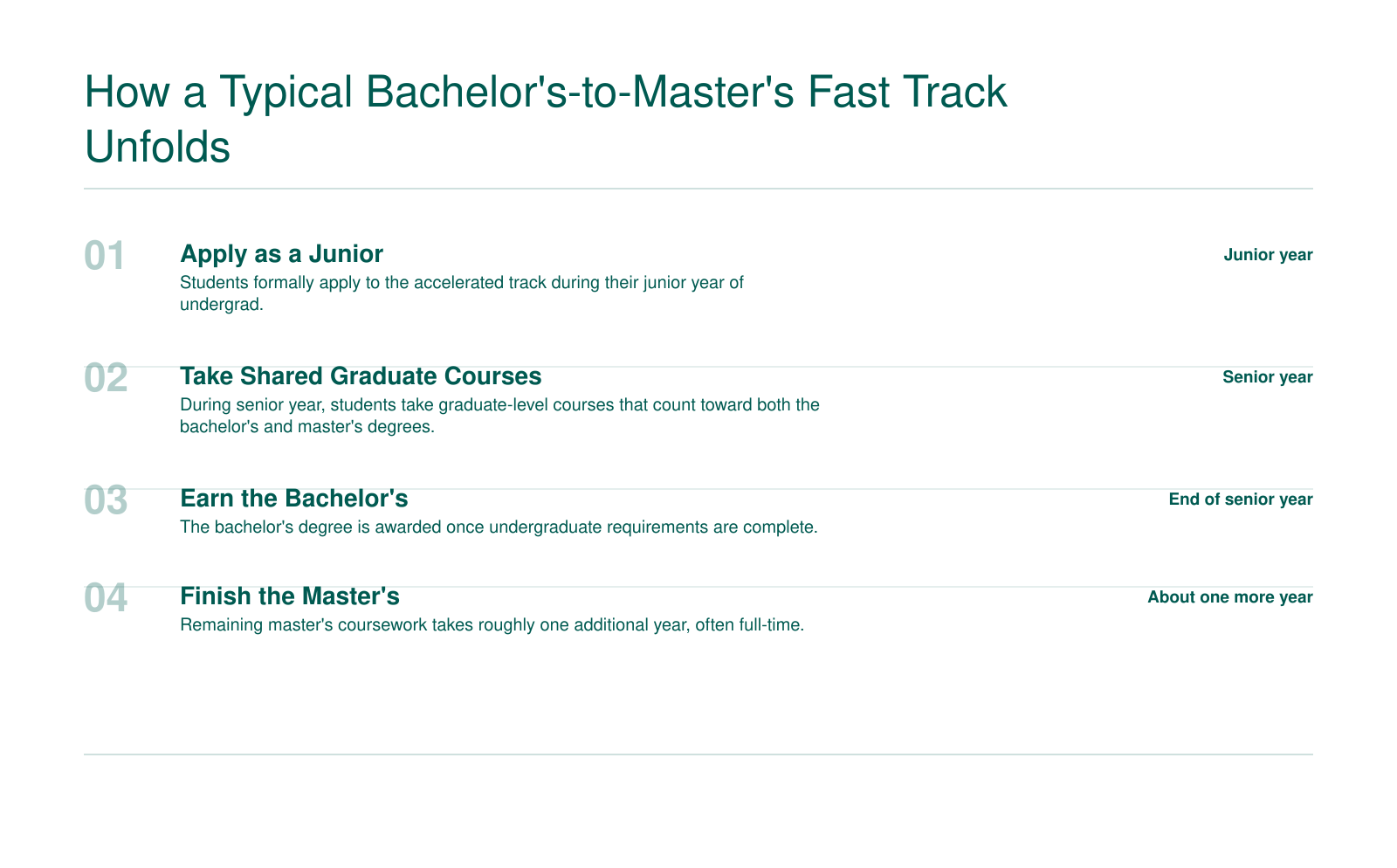
How a Typical Bachelor's-to-Master's Fast Track Unfolds
The sequence below shows a common fast-track pattern, not one school's policy. Application timing and the number of shared graduate credits differ by program, so verify these details on each admissions page.
How to Check an Admissions Page for Legitimate Fast-Track Claims
- Verify the .edu sourceCheck that accelerated or combined-degree language appears on the university's own admissions page, not just in third-party listings.
- Confirm eligibility numbersLook for GPA floor, completed credits, required major or prerequisites, and application timing. Clemson lists a 3.4 GPA and 90 credits; Cleveland State's 4+1 asks for a 3.0 and 90 credits with a spring junior-year application.
- Get shared-credit terms in writingSome pages state how many graduate credits count toward both degrees, Clemson allows up to 12, but the minimum grade to keep those credits is often not published. Ask directly.
- Ask about home-institution and pace limitsClarify whether the track is open only to current students at the home school or named partner schools, and confirm full-time and part-time timelines, practicum, capstone, or residency requirements.
- Don't confuse standalone with acceleratedA regular master's with a 3.0 GPA floor, ASU's Clinical Research Management M.S., for example, is not proof of a fast-track policy.
Tuition, Cost Savings, and Financial Aid for Accelerated Pathways
A fast track can cut a semester of graduate tuition, but it can also move you into tighter federal loan rules sooner, so the cheapest path depends on how you pay.
What published rates show
Drexel's MS in Clinical Research Organization and Management tuition page lists $1,412 per credit for 2026-2027 across 36 credits, about $50,832 in tuition, plus a $125 yearly graduate online program fee. Rutgers charges $1,009 per credit for New Jersey residents and $1,050 for others on a 36-credit program, roughly $36,324 to $37,800. That figure comes before a $50 administrative fee and program, technology, and background-check fees.
Where accelerated savings come from
The savings come from credits you never pay graduate rates for. Suppose a combined program counts 9 graduate credits toward your bachelor's and bills them at undergraduate tuition. At a $1,412 rate, that is $12,708 in graduate tuition you avoid later. Get written confirmation of which rate applies to shared credits.
Aid rules changed in 2026
While you are still an undergraduate, graduate courses are typically aided under undergraduate rules and loan limits. Once you shift to graduate status, the new federal rules apply. For new borrowers, Grad PLUS loans end for periods beginning on or after July 1, 2026, and aggregate borrowing for non-professional graduate programs is capped at $100,000.1 Students who enrolled and borrowed for their program before that date may keep the prior $20,500 annual unsubsidized limit for a limited time.2
Compare net price after every fee and any employer tuition assistance against affordable clinical research management master's programs, not the per-credit sticker.
Related Articles
Accreditation and Certification Prep You Can't Skip
Accreditation is the outside check that tells federal aid offices and employers a degree is real, and for a fast-track master's it comes in two layers. Institutional accreditation is non-negotiable because it controls federal aid eligibility and how the degree is read. Confirm it in the Department of Education's DAPIP database or the CHEA directory, and check the institution and the award level. A claim of "accredited" on a brochure is not enough.
Programmatic accreditation, such as CAAHEP review of clinical research professional programs, is a separate layer, and most master's programs do not hold it. Do not infer it from institutional status.
Certification Eligibility
A degree can shorten the experience path, not erase it. Per ACRP's handbooks, the CCRC, CCRA and ACRP-CP each ask for 3,000 hours13, and a qualifying degree can substitute 1,500 of them, provided the institution is CHEA-recognized.23 SOCRA's CCRP Category 2 pairs a clinical research degree with one year of full-time experience.4 SOCRA says management degrees may qualify only if the curriculum covers clinical research regulations, including ICH GCP.4
Ask whether the curriculum builds in exam prep or only aligns with ICH-GCP content.
Clinical Placement, Practicum Hours, and Capstones
Internship track or capstone track: that choice shapes your timeline more than any other curricular decision in this field. These degrees rarely involve clinical rotations like those in accelerated nurse practitioner programs. Instead, they ask for applied work on live trials or a research project you design, conduct, and defend.
The published requirements vary widely. Rice's standard track builds a two-semester internship practicum worth 18 credits into a 49-credit degree, while its online track swaps in a 6-credit capstone with a written report and defense, bringing the total to 37.1 Case Western's 3-credit capstone requires at least 160 hours over a single semester, roughly 20 hours a week for eight weeks.2 UAB's distance track includes a 3-credit practicum within 30 credits total.3 UNT Health allows six to 12 months for either an internship practicum or a capstone, with online students eligible to substitute the capstone.
None of these pages states who secures the site. Ask directly before you enroll. Working coordinators can often use their current employer, which protects the schedule; an unarranged placement is the usual reason a fast timeline slips.
A Salary Benchmark Worth Knowing
For clinical research management, the closest federal pay benchmark is the median wage for medical and health services managers.
Salary and Job Outcomes for Clinical Research Management Graduates
Clinical research management careers usually follow a progression from clinical research coordinator to clinical research associate or monitor, then clinical project manager, and eventually clinical operations manager. Experience and certification, more than the pace of the degree, drive movement up that ladder.
The Broad Pay Picture
The Bureau of Labor Statistics projects Medical and Health Services Managers (SOC 11-9111) to grow 24% from 2025 to 2035, adding 155,100 jobs.2 The 2025 median annual wage for that proxy occupation is $123,860, or $59.55 per hour.2 An earlier BLS projection for 2024 to 2034 also showed strong growth of 23.2% and a median annual wage of $117,960.1 That figure is a broad management benchmark, not a direct salary for coordinators or associates.
Is the Degree Worth It?
Accelerated master's programs do not replace experience, but they shorten the path to higher-paying roles such as clinical project manager or clinical operations manager. The degree tends to be strongest for clinical research coordinators who already have site-level experience and want to move into management. For someone entering with no research background, the payoff is weaker until they gain clinical operations or monitoring experience.
Clinical Research Management programs by state
Common Questions About Accelerated Clinical Research Management Master's Programs
These are the questions prospective students ask most often when comparing accelerated clinical research management options. The answers below focus on program length, value, 4+1 eligibility, and certification requirements.
How many years does an accelerated clinical research management master's take?
Is an accelerated master's in clinical research management worth it?
Can I join a 4+1 track if I'm finishing my bachelor's at a different school?
Will finishing faster hurt my eligibility for ACRP or SOCRA certification?
Compare Clinical Research Management programs on the data that matters
Explore more Healthcare specializations or browse every graduate field.
All Healthcare programs