Accelerated Master's in Nutrition Programs (1-Year and Fast-Track)
Compare 320+ accredited fastest Nutrition programs at 180+ schools, with graduate earnings, cost, debt, and completion data from IPEDS and the U.S. College Scorecard.

Since January 1, 2024, the Commission on Dietetic Registration has required a graduate degree to sit for the RDN exam, which is why so many nutrition students now want a master's quickly. The catch is that "accelerated" has no single meaning.
It can describe a 12-month standalone MS, a five-year bachelor's-to-master's pathway, or a coordinated program that folds supervised practice into the degree. Only some of these programs lead to RDN eligibility, and the fastest option is rarely the cheapest or the most flexible.
Key Points
- A standalone 12-month MS is the fastest route, but part-time versions can stretch to 18 to 24 months.
- Speed isn't eligibility: only accredited programs with supervised practice lead directly toward the RDN credential.
- Northwest Missouri State starts at $8,096 in tuition and fees, and program-level earnings data isn't yet published.
The 10 Fastest Accelerated Master's in Nutrition Programs for 2027
This ranking prioritizes the shortest realistic completion timelines, then weighs tuition and institutional outcomes such as graduation rate and net price. Graduation rates shown are institution-wide, not specific to any one program. We do not rank programs on prestige alone; we focus on measurable speed and value.
Samford University
#1Birmingham, AL · $20,000 – $25,000/yr (est.)
Best for: Online career changers meeting prerequisites
Samford's online MS in Nutrition can be completed in one year full-time and also offers a part-time option. The curriculum covers public health nutrition, advanced nutrition and metabolism, clinical nutrition, and research methods. A Dietetics Concentration requires 48 credits and includes supervised experiential learning, preparing graduates to sit for the RDN exam.
- 1-Year program
- 33-34 credit program
- Dietetics Concentration: 48 credits, includes supervised experiential learning
- Can sit for RDN exam
- Rolling admissions
- 3.0 GPA minimum
- Prerequisite courses required
- No I-20 for this program
SUNY Oneonta
#2Oneonta, NY · ~$13,000/yr (est.)
Best for: Future RDNs completing supervised practice
SUNY Oneonta's online M.S. in Nutrition and Dietetics is a one-year, full-time program designed for future registered dietitian nutritionists. It combines 36 credits of advanced coursework with 1,180 supervised experiential learning hours, and the program is ACEND accredited. Students arrange local practice with RD preceptors while completing online coursework.
- 1-Year program, 36 total credit hours
- ACEND accredited
- 1,180 clinical hours
- 96% licensure pass rate
- 100% job placement rate
- Prepares for Registration Examination for Dietitians
- 3.0 GPA minimum
- Students locate own RD preceptors
Simmons University
#3Boston, MA · $25,000 – $30,000/yr (est.)
Best for: Working professionals needing flexible nutrition tracks
Simmons offers a 30-credit MS in Nutrition and Health Promotion that can be completed in one academic year full-time online or through evening on-campus classes. Students can choose an Applied Nutrition Science track culminating in research or an Entrepreneurship track that develops a business plan. The program can be combined with a dietetic internship to pursue RDN credentialing.
- 1-Year program, 30 total credit hours
- Two tracks: Applied Nutrition Science and Entrepreneurship
- Online or evening on-campus classes
- 97% RDN exam pass rate for DI
- Prerequisite courses required
- Combine MS with dietetic internship to become RDN
- Entrepreneurship track culminates in a business plan
Meredith College
#4Raleigh, NC · ~$14,000/yr (est.)
Meredith's MS in Nutrition offers three tracks: Advanced Career, Didactic Program in Dietetics, and an Accelerated Dietitian Nutritionist Track. The accelerated track combines didactic and experiential learning and prepares students for the CDR credentialing exam, with a reported 100% dietetic internship match and 94% exam pass rate. The program uses an on-site organic garden, food lab, and patient simulator.
- 3 concentration options
- ACEND accredited
- 94% licensure pass rate
- 100% match rate to dietetic internships
- GRE optional
- Full-time and part-time options
- Accelerated 1-year option available
- 47 total credit hours
- Didactic and experiential learning combined
- Prepares for CDR
- Supervised experiential learning at top corporations and medical centers
- Open to any undergraduate degree
- Cohort-based structure
Wayne State University
#5Detroit, MI · ~$18,000/yr (est.)
Wayne State's online or in-person MS in Nutrition and Food Science uses 8-week half-semester courses and can be completed in three semesters. Online out-of-state students pay in-state tuition, and up to six credits may be waived for ACEND-accredited dietetic interns or registered dietitians. The program includes a capstone or thesis and covers biochemistry, genomics, neurobiology, food safety, and epidemiology.
- 3-Semester program, 32 total credit hours
- 8-week half-semester courses
- Online or in-person
- In-state tuition for online out-of-state students
- Up to six credits waived for dietetic interns or registered dietitians
- No GRE required
- ACEND accredited
- Capstone included
University of Southern California
#6Los Angeles, CA · ~$72,000/yr (est.)
USC's online MS in Nutritional Science emphasizes healthspan and longevity, built for students with a nutrition background or current RDNs. The 32-unit program combines 24 units of didactic coursework with 8 units of research and can be completed full-time in about 12-18 months. It is STEM-designated and uses synchronous online classes.
- 32 total credit hours
- Full-time in 12-18 months
- 24 units didactic, 8 units research
- STEM Visa eligible
- Focus on healthspan and longevity
- Synchronous online classes
- 3.0 GPA minimum
- Rolling admissions
The University of Alabama
#7Tuscaloosa, AL · ~$12,000/yr (est.)
Alabama's online MS in Human Nutrition offers Clinical, Community, and Generalist concentrations, with a 30-credit curriculum and optional capstone. UA undergraduates can use the Accelerated Master's Program pathway and may count up to 12 graduate credits toward both degrees. The program is ACEND accredited and has dietetic internship partnerships.
- 30 total credit hours, 10 total courses
- 3 concentration options: Clinical, Community, Generalist
- ACEND accredited
- Accelerated Master's Program for undergrads
- Dietetic Internship partnerships
- Prerequisite courses for non-ACEND students
- 3.0 GPA minimum, 3 letters of recommendation
- GRE not required
American University
#8Washington, DC · ~$37,000/yr (est.)
American University's online MS in Nutrition Education focuses on behavior change and health communication, with 30 credits and 10 courses completed in about 18-24 months. The asynchronous program uses 8-week accelerated courses and includes electives in school-based health, sports nutrition, and weight control. It prepares students for CNS, CHES, or DipACLM credentials.
- 30 total credit hours, 10 total courses
- Complete in 18-24 months: 4 semesters + 2 summers
- $38,950 total program tuition
- 8-week accelerated course format
- No GRE required
- Prepares for CNS, CHES, DipACLM credentials
- Electives in school-based health, sports nutrition, weight control
Arizona State University
#9Tempe, AZ · ~$14,000/yr (est.)
ASU's campus-based MS in Nutritional Science offers focus areas in sports nutrition and maternal-child health. The 30-credit STEM-designated program has an accelerated bachelor's-plus-master's pathway and applied project or thesis options. It is located at the Downtown Phoenix campus.
- 30 total credit hours
- Two focus areas: Sports Nutrition and Maternal-Child Health
- STEM-OPT extension eligible
- Accelerated bachelor's plus master's pathway
- Thesis or applied project option
- 3.0 GPA minimum, 1 letter of recommendation
- Located at Downtown Phoenix campus
University of Connecticut
#10Storrs, CT · ~$23,000/yr (est.)
UConn's MS in Nutritional Sciences with a Human Nutrition and Metabolism concentration combines coursework with research in human metabolism and disease prevention. The 30-credit program offers thesis or non-thesis options and an accelerated 4+1 BS/MS pathway. It is ACEND accredited and supports collaborations with UConn Health.
- 30 total credit hours
- 4 concentration options
- Thesis or capstone option
- Accelerated 4+1 BS/MS program available
- ACEND accredited
- Recommended prerequisites: nutrition, biochemistry, physiology
Cost & outcomes by school
Federal data for the highest-earning Nutrition programs, independent of the ranking above. Earnings are this field's master's graduates four years after completing, where the Scorecard reports them.
| School | Earnings | Tuition / yr | Debt | Grads/yr | Format |
|---|---|---|---|---|---|
| Simmons University MA | $74,038 | $28,561 | $41,000 | 31 | Online |
| Arkansas State University AR | — | $7,322 | — | — | Online |
| Northwest Missouri State University MO | — | $8,096 | — | — | Online |
| Bluffton University OH | — | $9,430 | — | — | Hybrid |
| University of the District of Columbia DC | — | $9,604 | — | — | Campus |
| Morgan State University MD | — | $9,981 | — | — | Online |
Sources: U.S. Department of Education. Tuition and graduates: IPEDS. Earnings and debt: College Scorecard, this field's master's graduates; a dash means no figure is reported.
Cost, debt & payoff
Median earnings of this field's master's graduates (4 yrs after completing) vs. their median federal loan debt · U.S. College Scorecard
Across these programs the median graduate earns about $65,918 and finishes with roughly $34,200 in debt — a ratio that clears a common rule of thumb (keep debt below first-year salary). Tuition and debt vary widely school to school, so check the per-school figures in the table above before you shortlist.
True 1-Year Programs vs. 5-Year Bachelor's-to-Master's Pathways
The fastest master's degree in nutrition is a 12-month standalone MS, open to students who already hold a bachelor's degree. Some "1-year" programs stretch when taken part-time: Penn's online MS runs 18 months part-time, and Rush lists 15 to 24 months. Pathways that include supervised practice take longer but fold in that requirement.
| Pathway | Typical length | Best fit | Supervised practice included? | Usual delivery format |
|---|---|---|---|---|
| 12-month standalone MS | 12 months full-time (Penn, Memphis, Rush); longer part-time | Career changers and working professionals who already have a bachelor's degree | Varies. Memphis lists a clinical nutrition internship in each of its three semesters, so confirm for each program | Fully online (Penn), hybrid (Memphis), or on campus |
| 4+1 combined BS/MS | Five years total, with the master's year folded into undergraduate study | Students who commit to nutrition or dietetics as first-year undergraduates | Varies by school, so check whether the practice component is part of the pathway or separate | Varies by school, most often on campus or hybrid |
| Coordinated MS with integrated supervised practice | Often 16 to 24 months (Wayne State runs four semesters) | Students aiming for RDN eligibility who want coursework and practice in one program | Yes. Pitt requires at least 1,200 hours and UAB builds in 1,000 hours | Often on campus or hybrid. UAB coursework is online, with practice hours done in person near the student's home |
Accreditation and RDN Eligibility: Which Fast-Track Programs Count
A degree that finishes fast means little if it doesn't make you eligible to practice. For nutrition, speed and licensure eligibility are separate questions, and many accelerated nutrition graduate programs deliver the former without the latter.
Two kinds of accreditation
Regional (institutional) accreditation and ACEND programmatic accreditation are not the same thing. A university can be fully accredited while its nutrition master's is not recognized by ACEND, the body that approves education leading to the Registered Dietitian Nutritionist (RDN) credential. A program being legitimate does not mean it qualifies you for the RDN exam.
The ACEND routes that count
Since January 1, 2024, the Commission on Dietetic Registration has required at least a graduate degree (master's, practice doctorate, or doctoral) from a USDE-accredited institution for RDN exam eligibility.1 The degree alone is not enough. You still need an ACEND-accredited route:2
- Graduate Program (Future Education Model): Integrates coursework with 1,000+ supervised experiential hours.3
- Coordinated Program: Combines graduate coursework and supervised practice.2
- DPD plus dietetic internship: Didactic coursework followed by separate supervised practice.2
Verify before you apply
Short duration tells you nothing about RDN eligibility. Confirm each program's current status and category in ACEND's public program directory before applying.3 That directory is the controlling record.
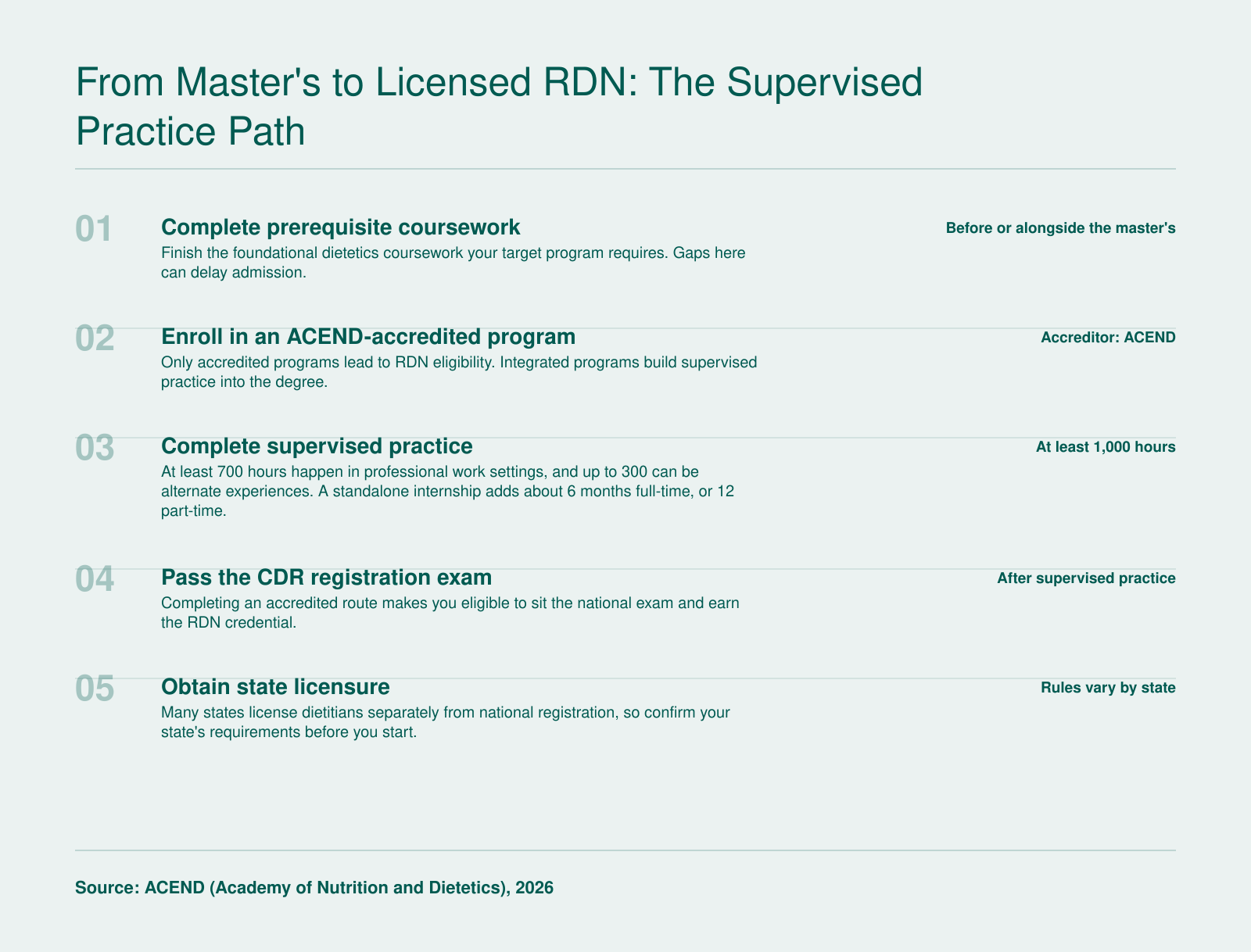
From Master's to Licensed RDN: The Supervised Practice Path
A fast degree does not always mean a fast credential. Programs that fold supervised practice into the degree finish both together, while a master's without it can leave you waiting on a separate dietetic internship that adds roughly 6 months full-time, or up to a year part-time.
Related Articles
What an Accelerated Nutrition Master's Really Costs
The cheapest route to a nutrition master's is not always the most flexible, and the sticker price rarely matches what you pay. Among the lowest-cost schools here, graduate tuition and fees run from $8,096 at Northwest Missouri State University, which charges the same rate in and out of state, to $42,740 for out-of-state students at Ohio State University. Net price after aid is an institution-wide average, not a program quote, and it lands between roughly $11,700 and $17,800 for these schools. Program-level median debt and monthly repayment figures are not yet published for these programs, so there is no reliable borrowing estimate to show.
Realistic Totals for Named Programs
- Arkansas State University: MS in Nutrition and Dietetics (Non-RD Track Online) is $350 per credit across 36 credits and comes to $12,600 with all fees included, online, in as few as 12 months.
- University of Texas at Austin: Online Master of Science in Nutritional Sciences Tuition is $750 per credit across 30 credits and comes to about $22,500 for 2026-27, plus fees of $500 to $1,200 per semester and a $1,000 enrollment deposit.
- King's College: Nutrition and Dietetics Master's Degree is $869 per credit across 39 credits, about $33,900 in tuition. Including $4,100 in non-tuition costs, a two-year path can reach $44,708.
Pricing models differ by school, and rates can change, so confirm current figures with each program before you budget.
Master's in Nutrition Requirements for Accelerated Programs
Requirements vary by school, so confirm each program's current handbook before you apply.
- Bachelor's degreeStandalone 1-year programs expect a completed bachelor's, while 4+1 pathways require you to be an undergraduate at the same school.
- Minimum GPAA 3.0 is the most common floor, but Indiana University lists 3.2, the University of Tennessee 3.3, Montclair State 3.4, and the University of North Florida 3.75.
- Science prerequisitesExpect general chemistry, often organic chemistry, plus introductory nutrition and sometimes anatomy, physiology, or microbiology, with Purdue requiring a C or better in each.
- DPD verification statementThe University of North Florida requires it, Southeast Missouri State accepts it or an equivalent, and Missouri State's accelerated track is for its own internal students.
- GRE statusMost programs waive or don't require the GRE, and Southeast Missouri State lists it as optional.
- Deadlines and start termsDeadlines range from October 1 to May 1 depending on the school, with summer, fall, or May starts.
Nutrition programs by state
Accelerated Nutrition Master's FAQ
Can you complete a master's in nutrition in one year?
Does an accelerated nutrition master's qualify you for the RDN exam?
Can I work full time while completing a one-year nutrition master's?
How much does an accelerated master's in nutrition cost?
Compare Nutrition programs on the data that matters
Explore more Healthcare specializations or browse every graduate field.
All Healthcare programs