Best Master's in Nutrition Programs in Michigan
Compare 10 accredited Nutrition programs in Michigan at 6 schools, with graduate earnings, cost, debt, and completion data from IPEDS and the U.S. College Scorecard.

Since January 1, 2024, the Commission on Dietetic Registration has required a graduate degree to sit for the RDN exam. So the first question about any Michigan nutrition master's is whether it leads to RDN eligibility or is a research-focused science degree.
This ranking puts campus and online programs side by side, and the format split matters: Eastern Michigan's online Human Nutrition degree does not lead to the RDN credential.
At least one Michigan program has announced an admissions pause, so a listing does not prove an open seat.
Key Points
- Since January 1, 2024, a graduate degree is required to sit for the RDN exam.
- Wayne State's online master's runs $866 per credit for Michigan residents in 2026-27.
- Central Michigan is the only school here reporting program-level earnings for nutrition master's completers.
Top Master's in Nutrition Programs in Michigan, Ranked
Michigan's master's in nutrition options split into two groups. Some are coordinated or internship-linked programs that lead toward RDN eligibility. Others are research-focused degrees that do not. Graduation rates below describe each university as a whole, not the nutrition program. Check the status of any program with a stated hiatus before you apply.
Wayne State University
#1Detroit, MI · ~$18,000/yr (est.)
Best for: Aspiring RDNs wanting Detroit clinical training
Wayne State offers three distinct nutrition master's paths in Detroit: an online MS, a campus MA, and a two-year coordinated dietetics MS. The coordinated program caps its cohort at 15 and partners with Detroit health centers. The online MS needs no GRE, and out-of-state online students pay in-state tuition. The university-wide graduation rate is about 58%. The 2027 coordinated cohort application opens November 1, 2026, with a February 1, 2027 deadline.
- Online format, 32 credits, finished in three semesters
- 8-week half-semester courses with a capstone
- No entrance exam required
- In-state tuition for online out-of-state students
- Up to six credits waived for dietetic interns or RDs
- Prerequisite courses required
- Campus-based program combining nutrition, food safety, and human health
- Prepares for clinical nutrition and food regulation roles
- Applied research and professional development
- Prepares for doctoral study
- Prerequisite courses required
- Campus-based, 2-year program, 34 credits, fall start only
- 1,032 clinical hours and a required capstone
- Class size limited to 15
- ACEND accredited since 1980
- Prepares for the CDR exam and RDN credential
- Minimum 3.3 GPA calculated from prerequisite courses
Madonna University
#2Livonia, MI · $15,000 – $20,000/yr (est.)
Best for: Hybrid learners balancing work and supervised practice
Madonna's MS in Nutrition and Dietetics is a hybrid coordinated program that combines small on-campus classes with online learning and about 1,000 supervised-practice hours. It prepares students for RDN credentialing. Supervised practice covers clinical, community, and athletic settings, and the program has a reported connection with the Detroit Tigers. The university-wide graduation rate is about 60%. The priority deadline is March 15 for fall entry.
- Hybrid format with small on-campus classes
- 1,000 clinical hours with a required capstone
- 3.0 GPA minimum and two recommendation letters
- Prepares for the CDR Registration Examination for Dietitians
- Prerequisite courses required
- Admissions also request a resume, statement of purpose, and interview
Central Michigan University
#3Mount Pleasant, MI · ~$17,000/yr (est.)
Best for: Military and state employees studying online
CMU's MS in Nutrition and Dietetics is a fully online, synchronous program with four plan options: Thesis, Internship, Coursework, or the ACEND-accredited Experiential Track toward RDN eligibility. Military, veteran, and Michigan state employee discounts apply. Status flag: CMU's official pages, updated October 8, 2026, say the program will be on hiatus indefinitely beginning June 2028. The pages still list application deadlines, but they do not explicitly confirm that 2026-2027 applications are open. Confirm with CMU before applying. The university-wide graduation rate is about 59%.
- Fully online, synchronous classes
- Four options: Thesis, Internship, Coursework, Experiential Track
- Completion within about 2.5 years
- Taught by PhD faculty who are Registered Dietitians
- Dietetic internship credits can be integrated
- Hiatus indefinitely beginning June 2028 per CMU pages updated October 8, 2026
- Listed deadlines: Aug. 15 (spring), Jan. 15 (summer), Feb. 15 (fall)
Eastern Michigan University
#4Ypsilanti, MI · $15,000 – $20,000/yr (est.)
Eastern Michigan's online MS in Human Nutrition is aimed at registered dietitians seeking continuing education and professionals who want deeper nutrition expertise. It does not lead to the RDN credential. Out-of-state students pay Michigan resident tuition. Rolling admissions and three start terms add flexibility. The university-wide graduation rate is about 46%.
Michigan State University
#5East Lansing, MI · $22,000 – $42,000/yr (est.)
Michigan State offers a hybrid MS in Nutrition and Dietetics built around the Dietetic Internship, plus an on-campus MS in Human Nutrition for research-minded students. The dietetics track combines online coursework with supervised practice at sites across Michigan and prepares graduates to sit for the RD exam. Participants pay the in-state rate even when completing the online coursework from outside Michigan. MSU has the highest university-wide graduation rate in this group, at about 81%.
- Hybrid: online coursework plus supervised practice sites
- 30 credits with a master's project and final presentation
- 3.0 GPA minimum and three recommendation letters
- Designed for concurrent Dietetic Internship
- Prepares for the Registration Examination for Dietitian Nutritionists
- Campus-based, 30 credits
- Thesis or non-thesis project option
- Advanced biochemical nutrition courses
- Interdisciplinary focus areas available
- 3.0 GPA minimum; collateral coursework for deficiencies
Western Michigan University
#6Kalamazoo, MI · $20,000 – $25,000/yr (est.)
Western Michigan's campus-based MS in Nutrition and Dietetics in Kalamazoo is aimed at current dietetic interns and practicing RDNs, not general applicants. Admission requires prior or current acceptance into WMU's Dietetic Internship, which admits once a year with a deadline around February 15. The program meets the master's requirement for RDN eligibility. Scholarships and assistantships are available, and the university-wide graduation rate is about 58%.
- Campus-based in Kalamazoo
- Requires acceptance into the Dietetic Internship
- 3.0 GPA minimum and three recommendation letters
- Annual deadline around February 15
- Meets the new CDR master's requirement for RDN eligibility
- Scholarships and assistantships available
Cost & outcomes by school
Federal data for the highest-earning Nutrition programs, independent of the ranking above. Earnings are this field's master's graduates four years after completing, where the Scorecard reports them.
| School | Earnings | Tuition / yr | Debt | Grads/yr | Format |
|---|---|---|---|---|---|
| Central Michigan University MI | $69,324 | $17,187 | $16,080 | 12 | Online |
| Western Michigan University MI | — | $20,103 | — | — | Campus |
| Eastern Michigan University MI | — | $17,968 | — | 6 | Online |
| Madonna University MI | — | $18,000 | — | 4 | Campus |
| Wayne State University MI | — | $17,960 | — | 2 | Online |
| Michigan State University MI | — | $21,772 | — | — | Hybrid |
Sources: U.S. Department of Education. Tuition and graduates: IPEDS. Earnings and debt: College Scorecard, this field's master's graduates; a dash means no figure is reported.
RDN Eligibility and ACEND Accreditation for Michigan Nutrition Master's Programs
The safest way to read a master's in nutrition and dietetics is to separate credentials that lead to the RDN exam from credentials that only study nutrition. Since January 1, 2024, the Commission on Dietetic Registration has required a graduate degree to sit for the RDN exam, so ACEND accreditation carries more weight than it used to.
ACEND pathways in Michigan
- Coordinated program: Wayne State University and Western Michigan University both run ACEND-accredited coordinated programs, combining graduate coursework with supervised practice. Eastern Michigan University is also listed as an ACEND-accredited coordinated program.
- Didactic program plus internship: Michigan State University's Didactic Program in Dietetics is ACEND-accredited, but the DPD alone does not qualify you for the exam; you still complete a separate dietetic internship.
- Future Education Model: Central Michigan University's MS in Nutrition and Dietetics Plan B Experiential Track holds full ACEND accreditation as a Future Education Model graduate program and is a direct RDN pathway, though CMU lists the program on hiatus until June 2028.
A general master's in nutrition science, community nutrition, or nutritional research is not automatically a direct RDN pathway. Check the ACEND program directory before applying, because accreditation status and pathway type can change, and some accredited graduate programs in Michigan include supervised practice while others do not.
What Michigan Nutrition Master's Graduates Earn After Finishing
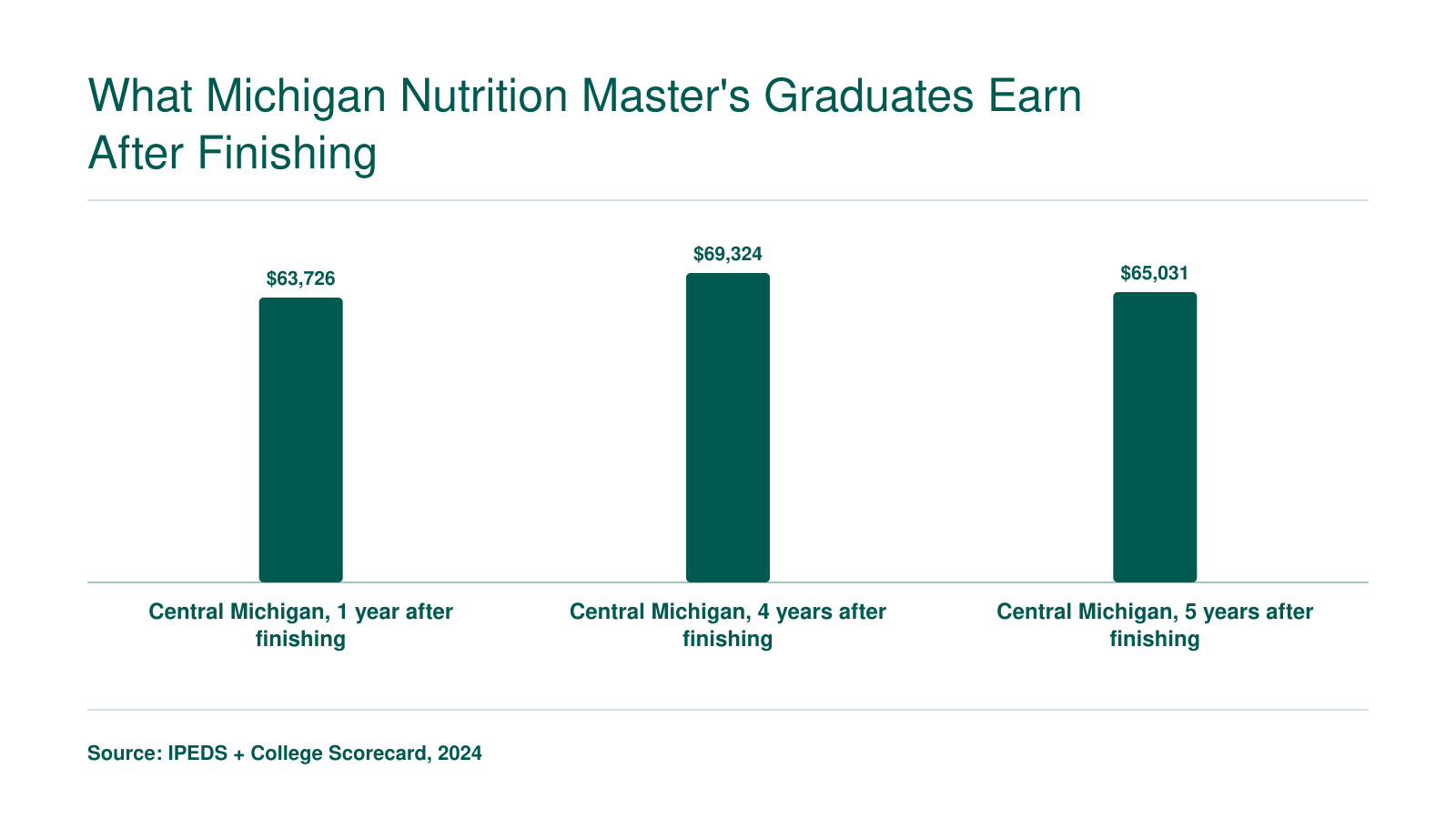
Among the schools ranked here, only Central Michigan University has a published program-level earnings figure for its nutrition master's completers, so it is the only school charted. Other schools do not report one, and institution-wide earnings are not substituted. These are College Scorecard program completer medians, not wages for the dietitian occupation.
Online and Hybrid Master's in Nutrition Programs in Michigan
Michigan nutrition master's programs first split by delivery: fully online or campus-based, with the online options covered in our Best Online Master's in Nutrition Programs guide. Central Michigan, Eastern Michigan and Wayne State run online degrees. Michigan State pairs online coursework with on-site internships. Madonna and Western Michigan are campus programs, and Madonna uses a hybrid format with small classes.
Wayne State offers its Nutrition and Food Science (M.S.) in person, hybrid or fully online, but the tracks end differently. The on-campus version is thesis-based, with 8 thesis credits and 8 lab credits within 32 total. The online version also requires 32 credits but closes with a 3-credit capstone seminar. It runs in 8-week courses over three semesters, starting in fall and finishing with the capstone in spring/summer. Wayne State's materials don't specify whether online courses are asynchronous, so don't assume there are no live sessions. Central Michigan states that its online classes are synchronous.
If you are pursuing the RDN, online coursework won't replace supervised practice. Expect in-person placements wherever you enroll. Also note that Eastern Michigan's online degree does not lead to the RDN credential.
Related Articles
Which Michigan Nutrition Master's Programs Waive the GRE?
Do you still need a GRE score for a Michigan master's in nutrition? It depends on the program, and several schools below have dropped or relaxed the requirement; for a broader comparison, applicants can review No-GRE master's programs and Master's in Nutrition Programs With No GRE Required. Minimum GPAs often sit near 3.0, and common prerequisites include biochemistry, physiology, and nutrition coursework.
- Wayne State University recommends the GRE but does not strictly require it. The prerequisite GPA minimum is 3.3, with coursework in organic chemistry, anatomy and physiology, microbiology, human nutrition, food science, and statistics. Fall 2027 deadline: February 1, 2027.
- Michigan State University does not require the GRE. A 3.0 GPA and DPD verification are needed; published Fall deadline is April 15, with December 1 priority.
- Central Michigan University does not require the GRE. The 3.0 GPA applies to the last 60 semester hours, and prerequisites must be completed before applying; February 15 is the Fall start.
- Western Michigan University does not state a GRE requirement. A 3.0 GPA is stated for RDN-status applicants, and master's admission is rolling, though internship acceptance is required first.
- Eastern Michigan University and Madonna University do not publish a current GRE policy in available admissions pages. Contact each program directly before relying on any test waiver.
Master's in Nutrition Tuition in Michigan and Licensure After Graduation
Wayne State University charges $866 per credit for Michigan residents and $1,876 for nonresidents in 2026-27 on its online Nutrition and Food Science master's. At 30 credits that works out to about $25,980 in-state and $56,280 out-of-state. The program lists 32 credit hours, so expect somewhat more. Treat these as estimates, and note that no separate online rate is established.
Comparing Costs
Annual program-level tuition is lowest at Central Michigan University ($17,187, the same for residents and nonresidents) and Madonna University ($18,000, flat). Wayne State runs $17,960 in-state and $36,542 out-of-state. Eastern Michigan University's resident and nonresident rates are lower than most, though its dietetics route totals $52,995 to $54,552 for residents once foundational credits are included. Net price figures are institution-wide approximations, not program costs, a distinction also covered in the Most Affordable Master's in Nutrition Programs.
Debt and Return
Central Michigan reports program-level median debt of $16,080, or about $183 a month over ten years. That is modest next to a median first-year salary of $63,726 for its graduates. Comparable figures are not published for the other programs here.
Michigan Licensure
Michigan's 2024 law created a Licensed Dietitian Nutritionist (L.D.N.) credential. Board rules took effect April 17, 2026, but the license requirement is not scheduled to begin until October 27, 2027, so confirm current status with the state. Employers still look first for the CDR Registered Dietitian Nutritionist credential, which RDN-eligible MS in Nutrition and Dietetics programs prepare you to earn.
Michigan Nutrition Master's FAQs
Can I become an RDN with a master's in nutrition from Michigan?
Can I enter a Michigan nutrition master's program without a nutrition bachelor's degree?
How long does a master's in nutrition take in Michigan?
Compare Nutrition programs on the data that matters
Explore more Healthcare specializations or browse every graduate field.
All Healthcare programs