Most Affordable Master's in Nutrition Programs
Compare 320+ accredited most affordable Nutrition programs at 180+ schools, with graduate earnings, cost, debt, and completion data from IPEDS and the U.S. College Scorecard.

Since January 1, 2024, anyone sitting for the registered dietitian exam must hold a graduate degree, which turns the nutrition master's from an optional upgrade into the price of entry for aspiring RDs. That makes cost a career decision.
Among the programs ranked here, listed graduate tuition runs from $7,446 to $12,751 for in-state students and from $12,985 to $31,408 for nonresidents. The residency gap can outweigh the difference between schools.
Fees, supervised practice, and ACEND accreditation status decide whether a low price actually leads to the RD exam. A cheap degree loses its edge if graduates still need a separate dietetic internship before testing.
Key Points
- Federal IPEDS and College Scorecard data anchor this affordability ranking.
- Several programs add supervised-practice travel and liability coverage costs.
- Top earnings figure is $81,872 while BLS projects 8% job growth.
The 10 Most Affordable Master's in Nutrition Programs
This ranking weighs net price and financial aid more heavily than prestige, so affordable public campuses rise to the top. The programs below pair low published graduate tuition with ACEND-accredited dietetics pathways, flexible online or hybrid delivery, and focused concentrations in clinical, community, and research nutrition. Use each card to compare the format, residency pricing, and school-level graduation rate that matter most for your budget.
CUNY Hunter College
#1New York, NY · ~$11,000/yr (est.)
Best for: New York residents pursuing research electives
Hunter College centers its MS in Nutrition on a focused 36-credit track for credentialed dietitians and students with strong science backgrounds. Its real affordability advantage comes from New York resident tuition plus a modest academic excellence fee, keeping published cost below many competitors. The program requires a fall start and pairs small in-person courses with an elective-based focus in cancer research, food policy, or nutritional epidemiology.
- 36 total credit hours
- Complete in 1.5 years or 3 semesters
- Fall start, March 1 application deadline
- 3.0 GPA preferred, prerequisites required
- GRE not required, TOEFL for non-English degrees
- Thesis or capstone option
- Classes meet once a week, weekday mornings or afternoons
- Elective focus in cancer research, food policy, or nutritional epidemiology
CUNY Brooklyn College
#2Brooklyn, NY · $10,000 – $15,000/yr (est.)
Best for: Career switchers needing rolling admissions
Brooklyn College offers a clinically oriented MS in Nutrition with rolling fall and spring admissions and 33 credits of advanced science and nutrition coursework. Students choose between a thesis and a comprehensive exam, and gain access to ACEND-accredited dietetic internships through placements at major New York health systems, though the degree does not directly confer the RDN credential. It is a strong affordable option for career changers who want New York City internship connections and a CUNY price point.
- ACEND accredited
- 33 total credit hours
- Rolling admissions for fall and spring
- Prerequisites in biology, chemistry, and nutrition
- Thesis or comprehensive exam option
- ACEND-accredited Dietetic Internship available
- Internship placements at Mount Sinai and Northwell Health
- Does not lead to RDN credential directly
CUNY Queens College
#3Queens, NY · ~$12,000/yr (est.)
Best for: Future dietitians focused on evidence-based practice
Queens College houses its nutrition track within an MS in Nutrition and Exercise Sciences, giving students a research-heavy curriculum with dedicated faculty advisors for each specialization. The program emphasizes professional writing, oral presentation, and critical assessment of evidence, with prerequisite coursework available for applicants who need to strengthen chemistry or biology foundations. It suits future dietitians who want rigorous, campus-based training with an evidence-based practice lens.
- ACEND accredited
- 3 concentration options
- Rigorous research and evidence-based practice
- Dedicated faculty advisor for each specialization
- Prerequisite coursework available
- Emphasizes professional writing and oral presentation
CUNY Lehman College
#4Bronx, NY · ~$12,000/yr (est.)
Lehman College's MS in Nutrition combines advanced nutrition science with a Dietetic Internship pathway that qualifies graduates to sit for the national registration exam for the RD or RDN credential. The curriculum spans clinical and community nutrition, prepares students for doctoral study, and emphasizes evidence-based practice across diverse populations. It is a practical choice for Bronx-area students who want a direct route to dietitian eligibility at a CUNY tuition level.
- ACEND accredited
- Dietetic Internship pathway included
- Prepares for RD or RDN registration exam
- Clinical and community nutrition careers
- Pathway to doctoral study
- Evidence-based practice across diverse populations
University of Houston
#5Houston, TX · $10,000 – $19,000/yr (est.)
The University of Houston offers a fully online, 30-credit MS in Nutrition built for working professionals, dietetic interns, and credentialed registered dietitians. The non-thesis curriculum focuses on advanced medical nutrition therapies, physical assessment, and clinical management leadership rather than research coursework. This makes it a practical online option for practitioners who need to advance while working.
- ACEND accredited
- 30 total credit hours
- Fully online non-thesis program
- Evidence-based medical nutrition therapies
- Advanced physical assessment skills
- Clinical management leadership focus
- Built for dietetic interns and working RDs
- No thesis requirement
University of North Carolina at Chapel Hill
#6Chapel Hill, NC · ~$13,000/yr (est.)
UNC Chapel Hill is the research powerhouse on this list, with a nutrition department housed inside both a public health and a medical school. The school offers an MS in Nutrition built around laboratory and population-based research and a thesis, as well as an MPH in Nutrition and an MPH in Nutrition and Dietetics for students targeting the registered dietitian exam. Its net price is higher than the CUNY campuses, but students get a top-ranked public health environment and a dual-degree option with the BSPH in Nutrition.
- 39 total credit hours
- Prerequisites in anatomy, physiology, biochemistry, and nutrition
- Thesis required
- Lab and population-based research skills
- Only nutrition department in public health and medical schools
- Accelerated dual degree with BSPH in Nutrition
- No entrance exam required
- 42 total credit hours
- 2-year program, fall start
- 3.0 GPA minimum, 3 recommendation letters
- $95 application fee
- Hybrid residential and online formats
- Assistantships provide tuition assistance
- ACEND accredited
- Cohort-based, 40 students per cohort
- Prepares for the CDR registration exam
- First ACEND Future Education Model program
- 2-year program with internship
- Residential at UNC Gillings
North Carolina A & T State University
#7Greensboro, NC · ~$8,000/yr (est.)
North Carolina A&T State University combines an HBCU mission with a food and nutritional sciences master's that prepares graduates for nutrition research, food safety, community health, and regulatory affairs. The concentration in nutrition covers food chemistry, microbiology, nutritional biochemistry, and public health nutrition, and is a strong fit for students who want an applied science career rather than a clinical dietetics-only path. Its in-state tuition is one of the lowest on this list, though net price varies by aid.
- Concentration in Nutrition
- Coursework in food chemistry and microbiology
- Nutritional biochemistry and metabolism
- Public health nutrition and community health
- Careers in food development, research, and regulatory affairs
- Roles in academia, industry, and government
University of New Mexico
#8Albuquerque, NM · ~$10,000/yr (est.)
The University of New Mexico offers an ACEND-accredited MS in Nutrition with interest areas in clinical nutrition, community and public health, management, health education, and research. Students can apply for teaching, graduate, and grader assistantships, and the Albuquerque campus provides real-world partnerships with local healthcare and community organizations. It is best suited to students who want a broad, customizable nutrition science degree in the Southwest.
- ACEND accredited
- Interest areas in clinical nutrition, public health, management, health education, and research
- Teaching and graduate assistantships available
- Requires letter of intent, 3 recommendation letters, and CV
- Hands-on partnerships with local healthcare organizations
Texas Woman's University
#9Denton, TX · ~$9,000/yr (est.)
Texas Woman's University provides two flexible nutrition master's options: a general MS in Nutrition and an MS in Nutrition with a dietetics concentration that combines coursework with supervised practice. The general track is designed to be completed in as little as 12 months with 30 credits and is offered online, hybrid, and in person on the Denton and Houston campuses, while the dietetics track places emphasis on medical nutrition therapy and RDN preparation. TWU's long-standing ACEND-accredited dietetic internships and Texas-focused school nutrition practicum make it a strong value for Texas residents and working professionals.
- ACEND accredited
- 30 total credit hours
- Complete in as little as 12 months
- Starts fall, spring, and summer
- 3.3 GPA minimum
- Thesis or capstone option
- Pathway to Registered Dietitian Nutritionist
- Only School Nutrition Specialist practicum in Texas
- ACEND accredited
- ACEND-accredited dietetic internship
- Medical Nutrition Therapy emphasis
- Two locations in Denton and Houston
- Combines MS with supervised practice
- Prepares for RDN credential
- International students welcome
- 7% job growth projected
University of Central Arkansas
#10Conway, AR · $5,000 – $10,000/yr (est.)
The University of Central Arkansas offers a fully online MS in Nutrition with thesis and non-thesis tracks requiring 30 or 36 credits respectively. Established in 2018, the program pairs research and statistics coursework with specialized classes in sports, geriatric, and diabetes nutrition, and the university is regionally accredited by the Higher Learning Commission. It is a sensible pick for online learners who want Arkansas affordability without relocating.
- 2 concentration options
- Fully online option available
- 30-36 credits depending on thesis track
- Established in 2018
- Core coursework in research and statistics
- Classes in sports, geriatric, and diabetes nutrition
- Higher Learning Commission accredited
- Service-learning and current research
Cost & outcomes by school
Federal data for the highest-earning Nutrition programs, independent of the ranking above. Earnings are this field's master's graduates four years after completing, where the Scorecard reports them.
| School | Earnings | Tuition / yr | Debt | Grads/yr | Format |
|---|---|---|---|---|---|
| Framingham State University MA | $83,433 | $10,965 | — | 12 | Campus |
| CUNY Lehman College NY | $81,872 | $11,570 | — | 6 | Campus |
| CUNY Hunter College NY | $75,480 | $11,398 | $33,795 | 5 | Campus |
| Saint Elizabeth University NJ | $75,352 | $19,178 | — | 20 | Hybrid |
| Simmons University MA | $74,038 | $28,561 | $41,000 | 31 | Online |
| Benedictine University IL | $72,603 | $19,584 | $40,312 | 17 | Online |
| Central Michigan University MI | $69,324 | $17,187 | $16,080 | 12 | Online |
| Indiana University of Pennsylvania PA | $68,605 | $12,672 | $31,856 | 8 | Online |
| Ohio University OH | $66,093 | $9,720 | — | — | Campus |
| Arizona State University AZ | $65,743 | $10,843 | $29,120 | 48 | Online |
| Arizona State University AZ | $65,743 | $13,587 | $29,120 | — | Campus |
| The University of Alabama AL | $64,913 | $11,980 | — | 123 | Online |
Sources: U.S. Department of Education. Tuition and graduates: IPEDS. Earnings and debt: College Scorecard, this field's master's graduates; a dash means no figure is reported.
Cost, debt & payoff
Median earnings of this field's master's graduates (4 yrs after completing) vs. their median federal loan debt · U.S. College Scorecard
Across these programs the median graduate earns about $65,918 and finishes with roughly $34,200 in debt — a ratio that clears a common rule of thumb (keep debt below first-year salary). Tuition and debt vary widely school to school, so check the per-school figures in the table above before you shortlist.
How We Ranked the Most Affordable Nutrition Master's Programs
An affordability ranking is only as good as the numbers behind it, so this list of affordable master's in nutrition programs relies on federal data rather than advertised discounts or marketing claims. Graduate tuition comes from IPEDS, while net price and outcomes come from the College Scorecard.
What the Numbers Can and Can't Tell You
At each school, net price averages what students pay after grants and scholarships across the whole institution. It is a useful comparison point, but it is approximate and not a personal quote. Your actual cost will shift with residency, aid, and how many credits you take each term, especially in online master's in nutrition programs.
Graduation rates and 10-year earnings figures describe the whole school, not the nutrition program alone. Program-level earnings come from Scorecard completer data, and we use them only where they are published.
What the Ranking Leaves Out
Two issues matter a great deal to nutrition students and are not captured here:
- ACEND status: Accreditation determines whether a degree can lead toward the Registered Dietitian credential. The ACEND section below shows which affordable programs qualify.
- Internship costs: Supervised practice can add real expense beyond tuition. The RD pathway graphic below walks through that step.
Check both before you treat the cheapest sticker price as the best value.
What These Programs Really Cost: Tuition Plus Mandatory Fees
The sticker price can hide several practical charges. Several programs below publish a per-credit or total figure, but background checks, liability coverage, and travel to supervised practice sites often add hundreds or thousands more. Ask the admissions office for a total-program cost sheet rather than comparing per-credit rates alone.
| Program | Background check | Liability insurance | Rotation travel | Other published fees or tuition | Published total cost |
|---|---|---|---|---|---|
| University of North Florida, Integrated Graduate Nutrition Program (2026) | $139 | $35 | $3,200 | N/A | N/A |
| East Texas A&M University, M.S. in Nutrition (2026) | $50 | N/A | N/A | $50 per online credit hour | N/A |
| University of Southern Mississippi, Master's Required Dietetic Internship (2026) | $100 | Included in course fees | N/A | $600 total course fees | N/A |
| Northern Illinois University, M.S. in Nutrition with Dietetic Internship (2026) | $92.25 | Included in fees | Varies by practicum assignment | N/A | N/A |
| Texas Tech University, Dietetic Internship Graduate Coursework (2025-2026) | $40 to $70 | $30 | N/A | Resident tuition and fees $9,550; nonresident $20,460 | N/A |
| Cornell University, M.S./Dietetic Internship (2026) | N/A | $26 | Varies by placement | $5,893 program and other fees | $14,007 to $14,418 |
| University of South Florida, Online M.P.H. in Nutrition and Dietetics (2026) | $139 | $35 | $3,000 | $1,500 technology fee | $22,055 |
In-State vs Out-of-State: Do Online Nutrition Master's Programs Charge Residency Rates?
Will I pay more for an online nutrition master's if I live outside the state? At some public universities, yes. At others, no.
Where the Gap Is Large
Campus-based public programs still bill by residency. Listed program tuition at North Carolina A&T runs $8,368 in-state against $21,168 out-of-state. UNC Chapel Hill lists $12,751 against $31,408. Texas Woman's University shows $8,520 against $15,900, and Lamar University $8,642 against $16,022. Wayne State's listed out-of-state figure is $36,542, but the university says online students from outside Michigan qualify for in-state rates.2 Confirm that with admissions before treating the lower number as yours.
Programs With One Rate for Everyone
- Arkansas State: The non-RD online M.S. charges $350 per credit to all U.S. residents, fees included, which works out to $12,600 for 36 credits. Tuition may change yearly.
- Oregon State: No nonresident premium at $609 per credit, but materials and associated fees are extra.1
- University of Rhode Island and Bowling Green: Both charge the same for in-state and out-of-state students.34 URI adds a $30 registration fee and a $16-per-credit technology fee each term for 2026-2027.3
Regional Exchange Options
WICHE's Western Regional Graduate Program lets eligible residents of participating western states pay no more than 150% of resident tuition, and most institutions charge resident tuition. It is not automatic, and each university chooses its eligible programs. Among the schools here, only Arizona State's online nutritional science M.S. appears as a possible fit. Check WICHE's Graduate Savings Finder before counting on it.
What a Flat Rate Can Leave Out
A flat online rate rarely covers everything. Oregon State's hybrid dietetics option requires a site-based internship year in Oregon.1 URI bills internship tuition of $12,000 separately.3 Arkansas State's RD track, at 53 credits and $18,550, is limited to current A-State students. Ask what falls outside the quoted rate before comparing totals.
Related Articles
ACEND Accreditation and the RD Path: Which Affordable Programs Qualify
Two Routes to the RD Exam
A coordinated graduate program and a standalone nutrition master's can both lead toward the registered dietitian exam, but only one gets you there without a second admissions process. The Accreditation Council for Education in Nutrition and Dietetics (ACEND) accredits the programs that count toward the credential. Since January 1, 2024, the Commission on Dietetic Registration has required a master's degree to sit for the exam, in addition to ACEND-accredited coursework and supervised practice.
Future Education Model graduate programs and coordinated programs bundle the degree with the required supervised practice. Standalone master's programs deliver the degree only, so you still have to apply to a separate ACEND-accredited dietetic internship before you can test.
Where the Programs Here Stand
Program pages for the ranked schools point in different directions:
- Lehman College: Describes its M.S. in Nutrition as leading to RD/RDN eligibility.
- Texas Woman's University: Frames its MS as preparation for the registration exam and runs dietetic internships in Denton and Houston.
- Brooklyn College: Offers an ACEND-accredited dietetic internship but states its master's does not lead directly to the RDN credential.
- University of Houston: Its online degree targets dietetic interns and practicing RDs rather than replacing supervised practice.
Beyond this list, New Mexico State's online dietetic internship combines the master's with 1,000+ supervised hours, though it requires an ACEND-accredited bachelor's in dietetics. Oregon State's 47-credit professional dietetics option integrates an ACEND-accredited internship (40 hours a week in Oregon), while its online 45-credit option does not. Colorado State, Old Dominion, Alabama, and Kansas (through Great Plains IDEA) offer online degrees with no supervised practice built in.
Low Tuition Isn't the Whole Bill
For affordable master's programs, a cheap per-credit rate loses its edge if you finish and still need a separate internship: another application, another tuition bill, and more time before you can sit for the exam. A program that bundles supervised practice can cost less overall than a bargain master's followed by a separately paid internship.
Verify Before You Apply
Words like "pathway" and "prepares for" are not the same as accreditation. Before applying, confirm each program's current status and type on ACEND's official accredited program directory, review the master's in nutrition prerequisites, and ask admissions exactly which credential verification you will receive at graduation.
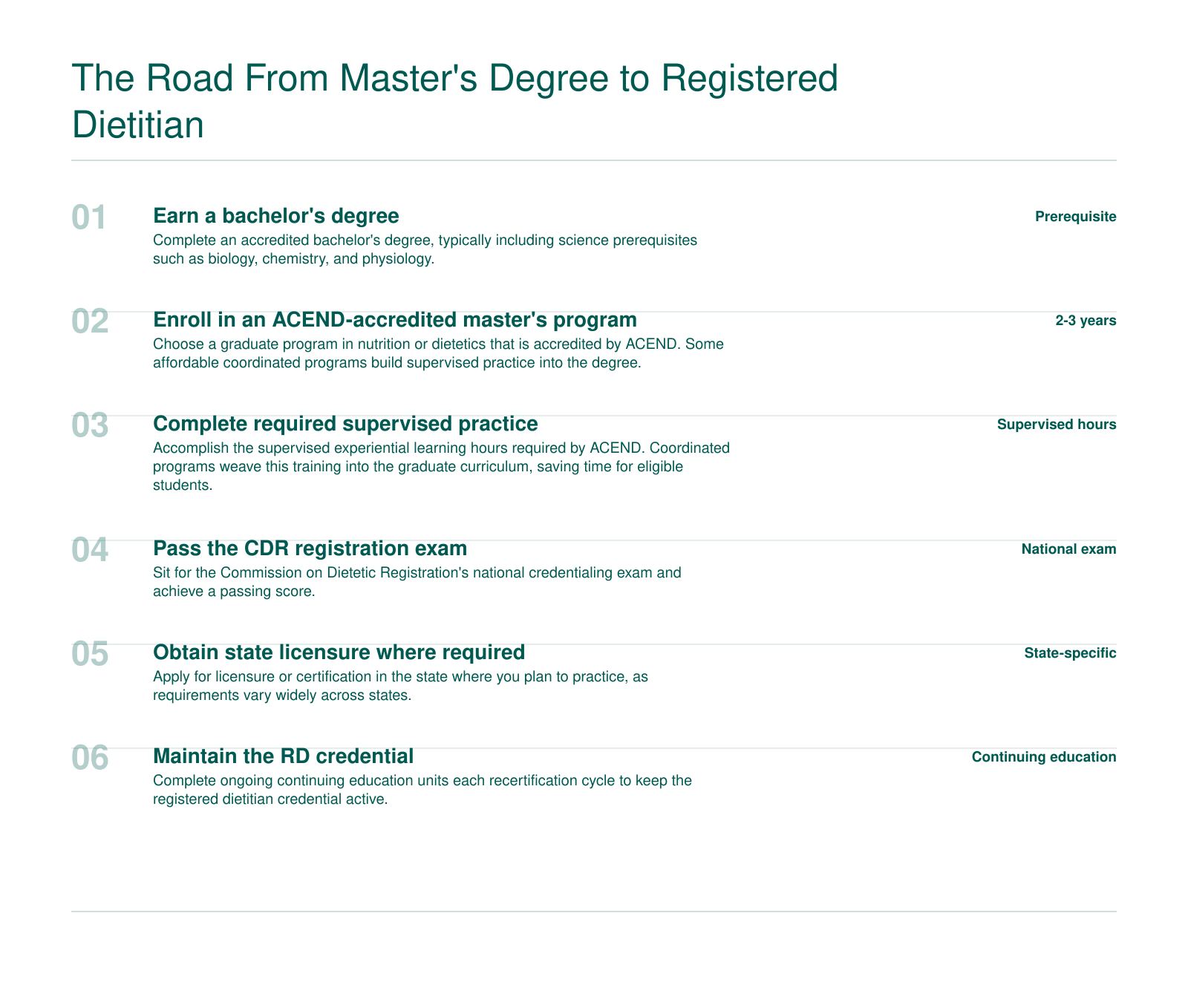
The Road From Master's Degree to Registered Dietitian
Becoming a registered dietitian follows a clear credentialing ladder. Several affordable programs below combine the graduate degree with required supervised practice, which can compress the timeline and lower out-of-pocket costs.
The Bureau of Labor Statistics projects employment of dietitians and nutritionists will grow 8 percent from 2025 to 2035, compared with 3 percent for all occupations. That is more than double the average, and BLS expects employment to rise from 86,300 to 93,000 jobs over the decade.
The highest published program-level earnings figure among these affordable nutrition master's programs is $81,872.
Nutrition programs by state
Frequently Asked Questions About Affordable Nutrition Master's Programs
These are the questions prospective students most often ask when weighing an affordable nutrition master's. Answers draw on the cost, accreditation, and earnings data detailed above.
What is the cheapest master's in nutrition program?
Can you become a registered dietitian with an online master's in nutrition?
Is an online master's in nutrition worth it if you don't plan to become an RD?
What is the total cost of a nutrition master's including fees?
Compare Nutrition programs on the data that matters
Explore more Healthcare specializations or browse every graduate field.
All Healthcare programs